Tyranny in American Political Discourse

By |2021-04-14T06:52:31-05:00April 2nd, 2017|Categories: Alexis de Tocqueville, American Republic, Aristotle, Democracy in America, Featured, Plato, Russell Kirk, Timeless Essays|

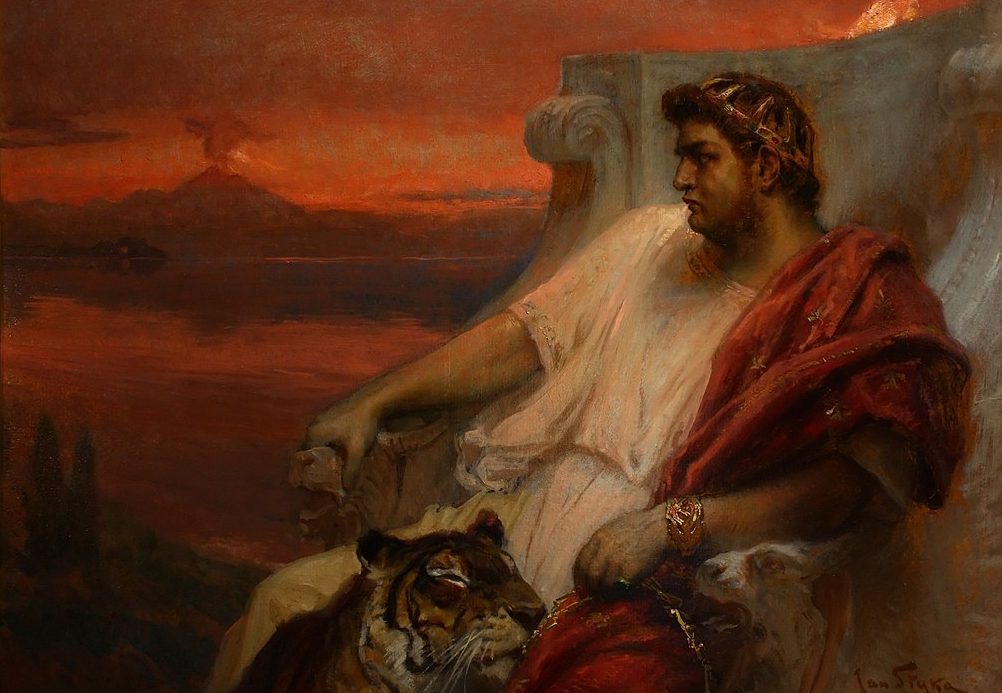
There is a strong case to be made that the United States is creeping ever closer to tyranny. For if the rule of law is undermined, political rule will then be, by definition, tyrannical. The word “tyranny” has a long history in American political discourse. Since at least the American Revolution, Americans have used the [...]

Music and the Idea of a World

By |2021-05-18T15:46:45-05:00February 9th, 2017|Categories: Aristotle, Civil Society, Featured, Music, Peter Kalkavage, Plato, St. John's College|

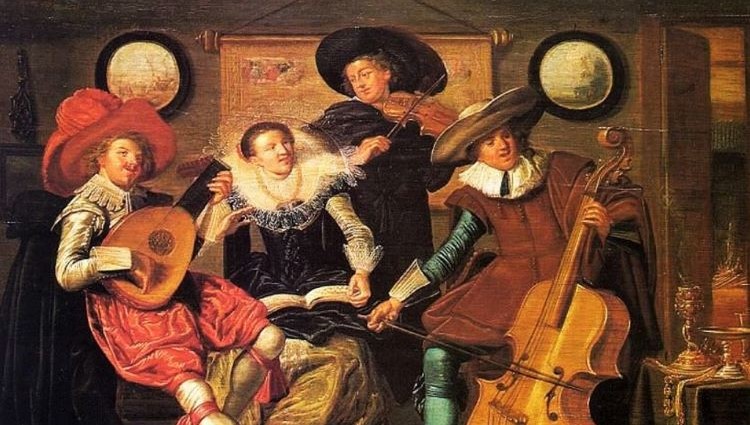
Music assures us that we are not alone: that there is something out there in the world that knows our hearts and may even teach us to know them better. Thanks to music, we experience what it means to be connected to the whole of all things. “Music, too, is nature.” —Victor Zuckerkandl, Sound and [...]

Will the Wicked Be Punished?

By |2021-05-18T15:58:36-05:00January 15th, 2017|Categories: Aristotle, Capitalism, Christianity, Civil Society, George Stanciu, Justice, Morality, St. John's College|

To shun wickedness, to care for our souls, and to love one another without looking for rewards, if followed by all, would turn injustice, now a constant companion of human life, into a stranger. In his 2005 masterpiece, Match Point, Woody Allen explores moral failing in a universe governed by chance, or what the protagonist [...]

Determinism: Science Commits Suicide

By |2019-07-23T14:05:22-05:00June 10th, 2016|Categories: Aristotle, George Stanciu, John Locke, Plato, Science, St. John's College|

Despite the advent of relativity, quantum physics, and chaos theory, most scientists, including most physicists, intellectually inhabit the Newtonian Cosmos. In stark contrast to the Aristotelian Cosmos, where plants and animals possess an inner agency that causes them to emulate the Prime Mover, the Newtonian Cosmos is mechanical, where lifeless matter as well as animate [...]

M.E. Bradford & the Intoxicated Air of the Modernist Moment

By |2021-08-12T10:44:26-05:00June 2nd, 2016|Categories: Agrarianism, Aristotle, Books, Dante, Featured, Homer, Literature, M. E. Bradford, Marion Montgomery, Plato, South, Southern Agrarians, St. Augustine|

IV M.E. Bradford The principle underlying the Agrarian­-New Critic’s position as literary critic, shared generally in the New Critical move­ment at large, may be simply put: Some poems are better than other poems. He judges them as things existing in them­selves, made by that intellectual crea­ture—man. The problem term, of course, is better, since it commits intellect, willy­ [...]

Love & Friendship: Whit Stillman & Jane Austen Contemplate Virtue

By |2023-11-25T12:56:17-06:00May 25th, 2016|Categories: Aristotle, Christopher Morrissey, Featured, Film, Jane Austen, Virtue, Whit Stillman|

Whit Stillman’s new movie, Love & Friendship, is an adaptation of Jane Austen’s Lady Susan. Mr. Stillman takes this piece of Austen juvenilia, an epistolary novella, and fleshes it out into a screenplay faithful to the spirit of Austen. Not only that, but also he has reworked Austen’s story into a novel of his own, [...]

Socrates on Age and the Progress of Study

By |2023-05-21T11:30:52-05:00May 23rd, 2016|Categories: Aristotle, E.B., Education, Eva Brann, Philosophy, Plato, Senior Contributors, Socrates, St. John's College, The Music of the Republic series by Eva Brann|

1c-d. The activity of this higher logos, dialectic itself, is beyond Glaucon’s present reach and no part of the preliminary survey. To set out on the dialectical road would be to see “no longer an image… but the true itself” (533a3); the “most serious matters” are withheld from Glaucon, and so from any mere reader [...]

Finding Happiness in Our Cell Phones?

By |2019-09-25T15:57:51-05:00May 21st, 2016|Categories: Aristotle, Christianity, Culture, Featured, Happiness, St. Thomas Aquinas|

It’s called FOMO: that sneaking Fear Of Missing Out on the experience that will make us feel happy and fulfilled—what Aristotle calls “human flourishing.” It comes from a belief that happiness comes from something we do, and social media exacerbate our fears, because when we see other people accomplish, experience, or achieve something we haven’t, [...]

The Conservative Thought of Eric Voegelin

By |2022-02-23T11:13:42-06:00April 21st, 2016|Categories: Aristotle, Christianity, Conservatism, Eric Voegelin, Featured, Plato, St. Augustine|

Eric Voegelin was born in Cologne, Germany in 1901. Receiving his doctorate from the University of Vienna in 1922, he served on the law faculty of that institution. To escape the Nazi regime, he came to the United States in 1938. Subsequently, he taught at Harvard University, Bennington College, the University of Alabama, and Louisiana State [...]

Jane Austen’s Love & Friendship

By |2024-08-08T11:06:07-05:00February 25th, 2016|Categories: Aristotle, Culture, Featured, Friendship, Jane Austen, Literature, Marriage, St. Dominic|

For all whom we love and value, for every friend and connection, we equally pray; however divided and far asunder, we know that we are alike before Thee and under Thine eye. May we be equally united in Thy faith and fear, in fervent devotion towards Thee, and in Thy merciful protection this night. —from Jane [...]

Aristotle on the Contemplation of Being

By |2019-12-13T14:22:07-06:00January 28th, 2016|Categories: Aristotle, Christopher Morrissey, Intelligence, Philosophy|

What can a philosopher’s metaphysical “intuition of being”[1] offer to society? I think the root philosophical difficulty, whenever we speak of politically contentious things, is that we have few resources with which to resist “modern philosophy’s ideological approach to politics.”[2] How can one cultivate the right personal disposition such that one might avoid the pitfalls [...]

An Unexpected Bestseller: Plutarch’s “Lives”

By |2021-05-19T09:27:01-05:00December 3rd, 2015|Categories: Aristotle, Christopher B. Nelson, Featured, Liberal Learning, Plutarch, Rome, St. John's College|

Now that school is back in session, I will shortly be resuming a study group that began last year on Plutarch’s Lives of the Noble Grecians and Romans. I thought I might say just two things here about the particular excellence of this great book—that it fuses history and philosophy, and that it promotes the [...]

Did the Constitution Kill the Common Good?

By |2017-06-28T21:15:48-05:00November 30th, 2015|Categories: Aristotle, Featured, Philosophy, Political Philosophy, Politics, Wyoming Catholic College|

Michael Hannon and Robert George are both orthodox Catholic thinkers who subscribe to a personalist anthropology and Aristotelian/Thomistic social philosophy, one that interprets the character of the modern, autonomous individual as an evil fiction, one that recognizes the existence and priority of intrinsic, common goods, and one that posits the indispensability of social communities ordered [...]

Go to Top