
The late historian M.E. Bradford’s examination of early American history provides us with a framework for understanding the American experience and so gives a standard to clarify our present darkness. His Old Whiggism is a rhetoric of the heart, an appeal to stand in the old ways, to keep alive the spirit of the original republic.

“This is an extraordinary book, deep in itself and giving rise to deep thoughts in all sorts of matters.” – Jeffrey Hart from the introduction to A Better Guide Than Reason
Introduction
“[P]hilosophy has no fatherland.” So said Arnold Ruge, one of the nineteenth century German reformers of the Young Hegelians. Therefore, he concluded, fatherlands must go. Professor M. E. Bradford would agree with the first statement, but for him, it is philosophy that must go. These two alternatives still define our present dilemma. Dr. Bradford uncovers the dilemma fully in the course of looking at the beginnings of the American Republic in his classic little book, A Better Guide than Reason. “Reason,” of course, refers to those abstract philosophies, such as Ruge subscribed to, which would re-order a nation based on ahistorical, geometrical thinking about society. Though the essays in the book were written around the time of the American bicentennial, that occasion for introspection suggests that nearly half a century later introspection based on his analysis may again be appropriate. Or perhaps even more so, for as the nation is torn by various factions and populist movements, disrupted by a virulent ideology, not to mention a literal virus policy, his views on American history and politics which deal deeply with earlier disruptions seem especially pertinent. He identifies in those early American struggles the core values which made the new country possible and in so doing also identifies for us how far we have deviated from those beginnings and how hard the road back will be – if there is a way back at all. To say so is to understate, almost to the point of mockery, our moribund condition.
To accomplish his task, Dr. Bradford relies on concrete, historical cases, and a careful scrutiny of the American “founding,” the Declaration of Independence, the Constitution, the War Between the States, and Abraham Lincoln’s revolution. In doing so, he shows that the men most influential in launching our independent endeavor rejected the state of nature and natural rights arguments. Instead, the dominant American thinking was rhetorical, legal, poetic – not metaphysical/dialectical/Euclidean. They saw the new republic as a modified Whig Rome where their countrymen were “prepared to honor law, the unwritten prescription, and the patria (their lesser homelands, the chartered colonies qua states). Virtus was demonstrated in every assembly, on every battlefield. Personal honor and the unselfish keeping of oaths were both assumed. But responsible liberty was the precondition for all of these elements of character…”1 They were attuned to the particular contributions and practices of their forefathers which were a heritage to be received with reverence and passed onto their children. They took pride in a shared body of law and a shared history which gave them their corporate identity, and whose struggles, successes and failures helped to shape not merely a way of life, but to nourish the early American spirit. The rights they had were rights they had earned. Liberty and rights for Bradford and his American Old Whigs, though reasonable, did not exist except in the matrix of received social institutions; indeed, they had no meaning without them.
Throughout the book he confronts with consummate rhetorical skills the perennial issues of change and continuity, necessity and choice, experience and reason, and the American “genius.” The method which he uses to look at historical issues itself embodies an argument, that of rhetoric over dialectics, experience with reflection over abstract, a priori ratiocinations. Though the head and the heart must be engaged together, he rightly says, it’s equally clear he prefers to emphasize the latter, sharing Robert Penn Warren’s low view of “the bald and metaphysic skull.”
David Hume could, with justification, observe that determining the nature of the Whig and Tory parties is “one of the most difficult problems, that can be met with, and is a proof that history may contain many questions, as uncertain as any to be found in the most abstract sciences.” There were, after all, old Whigs, new Whigs, country Whigs, commercial Whigs and eighteenth versus nineteenth century Whigs; and sometimes their views even overlapped with those of the Tories. But Bradford reduces the problem to manageable proportions by examining historical cases form the point of view of the American country Whig perspective to support his theme – like a good Old Whig. In the end his Old Whiggism is a rhetoric of the heart, an appeal to stand in the old ways, to keep alive the spirit of the original republic. That spirit was best exemplified in his three main characters: John Dickinson of Pennsylvania, Patrick Henry of Virginia, and William Henry Drayton of South Carolina. In what follows the chief features of their views will be looked at followed by a critique and evaluation which includes suggestions to strengthen his case.
John Dickinson: Choice, Necessity, and Change
Dr. Bradford begins his analysis of American Whiggism with the writings of John Dickinson. “For John Dickinson was one of the best educated, most respected and most eloquent of the public men who brought us, with character and argument, to and beyond the choice for independence.” (BG, pp. 79-80) He was a “legalist or Erastian for whom the English Whig and Roman regimens coalesced into one (still predominantly English) instruction of American colonials.” (p. 15) His view of the English political identity (its Constitution, chartered rights, institutions, procedures, and habits of thought) can be summarized as “a product of a given history, lived by a specific people lived in a particular place.” (pp. 80-81) He believed it was the best known to man and that any declension from this “experienced perfection” must be vigorously opposed. Such a correction was more than a patriotic affirmation; it amounted to an assertion of universal truth. When Bradford explains that in Dickinson’s view the authority of government “belongs to the total system, not to the persons who operate it at a given time”, however legitimately they hold office, he includes respect for ancestors as well as obligations for posterity and especially legal precedents. Such officers have no authority to innovate. It was in his view treason to submit to “dreadful novelty” or “dangerous innovation” even if it came from a prince or sovereign. This historic and legal identity was “formed over the course of centuries by so much trial and error and with such cost and turmoil…” (p. 81)
But one of those legal precedents was the 1689 Bill of Rights, a bill which involved an important change, an alteration in the relation of King, Parliament and people. How was such a change to be understood? In Dickinson’s view the change was understood as an elaboration and intensification of the extant tradition, of its inherent character, not a novelty contrived from outside the tradition as a result of the fanciful, agitated cogitations of rationalists. It was the same point made by Edmund Burke, in discussing the passing of the crown to King William, who described the change as a “peccant” alteration only, needed for the altered circumstances and intended to preserve the whole of that remaining tradition, a change to conserve, not to innovate. In Bradford’s view, Dickinson gives a critical sense of choice and change from a conservative perspective, namely, that “he framed these substitutions from necessity alone, because familiar arrangements and channels for negotiation had been forever destroyed. In other words, framed them to protect, not ‘found’, as changes made in discovery but not in creation.” (BG, p. 82) “If forced into existence on the basis of strict legal arguments,” Braford continues, “the new nation could hope to keep intact the established order of American life…What was, however, most important to Dickinson was that difficulties and differences be settled on certain grounds, according to a certain logic or theory of government…” (pp. 83, 84) That logic was that, “We came free…under no other auspices, no larger structure of abstraction, with authority above and beyond the social bond…Only revolution that is not revolutionary, that is a ‘child of necessity’, can be called American.” (p. 84)
In addition to his political values, Bradford is interested in Dickinson’s mode of argumentation, his rhetoric, of choice and avoidance. The old school Whigs believed “in the prescription of British history and the importance of circumstance in interpreting what a precedent means when a prudent choice must be made.” Such flexibility has its limit in history: “For the deepest teaching of that history was that persuasion, even if incomplete, leaves the social bond intact.” In contrast: “Calumny, claims of divine sanction, and rigid arguments from definition (asking, for instance, ‘What is man?’ or ‘What is a republic?’) have a contrary effect.” Instead, the Whig traditionalist looks still further into Roman history where “the notion of ‘public virtue’ received its original definition and the idea of corporate liberty, liberty under law, was given meaning.” (BG, p. 86) Not a priori, but only a posteriori, definition based on the experience and the example of Republican Rome is acceptable. To be perfectly clear about Dickinson’s views, especially about “natural rights,” Bradford adds: “[To] destroy the continuum where historic rights can survive by reaching for an a priori definition is to risk a sad declension from what real ancestors under real difficulties have achieved…” (p. 91)
Dickinson had a definite view about the end of government though he distinguished between government and society. Bradford writes of Dickinson’s view: “To encourage men to perform the virtue of which they are capable, and thus pursue their happiness, as persons and as a community, is the final end of government.” (BG, p. 90) Beyond this he would not go; there was no goal of an abstractly conceived state, no dream of nationalistic grandeur, no turbulent social policies to achieve social change. Instead, Bradford says: “The need for fellow feeling and interdependence, for a corporate sense achieved through free choice, counts for just as much,” as enlightened self-interest. And “In the opinion of Dickinson, government is law– law which allows society to grow and flourish. Its terms and specific properties derive from an anterior social reality, not the other way around. It is a set of ‘ground rules’ or agreed-upon procedures, found in the course of their history to be reasonable and conducive to the general happiness of those whom it binds into nationality. And even the meaning of liberty…is restricted by these rules.” (90-91). Not social engineering but the encouragement of virtue is government’s role which is accomplished by upholding the law of the anterior social reality. In that context any changes will be based on the free choices of individuals operating from the bottom up, not the top down.
Since the “agreed upon” rules and procedures themselves shape the meaning of “liberty” they include a socially embedded goal: the rules allow society to flourish/grow while still shaped to encourage virtue. This preserves and promotes the corporate sense achieved through free choice, where choosing is a socially responsible act to the tie that binds, not an exercise in eccentric individualism or vain social reconstruction. How these rules are achieved is a matter of historical, experiential discovery, not mathematical reasoning. They become a part of and add to the social identity. And one of those procedures, perhaps the chief one, is for Dickinson the wide diffusion of land, a view which distinguishes him from the commercial Whigs: “‘A landed interest widely diffused among the mass of the people, by the personal values of honest industry, fair dealing, and laudable frugality is the firmest foundation that can be had for the secure establishment of civil liberty and national independence.’” (BG, p. 95) Bradford’s picture of the oak tree similarly reflects process, growth and development, and end state; it is and remains an oak tree, true to itself, throughout all the changes.
Patrick Henry: Design, Accident and Genius
Patrick Henry is also described as a country Whig with a “commitment to historic rights, inherited rights available at law” which are “passed on in a historic continuum (organic compact), as property is passed from father to child…” (BG, p. 101) Like Dickinson, these rights were achieved by “a given people located in a given place over a number of generations…” His guiding light was “lamp of experience” followed by meditation. (pp. 101, 105) Each people, said Henry, has its “genius” identified in its history and for the English people and their American cousins that was liberty, and liberty was the direct and only end of government. (p. 102) He feared encroachments on that liberty by any grand design of the federal government which explains his objections to “Madison’s crafty composition,” objections which were “all finally productive of what we now know as the Bill of Rights. His America did not exist to pursue certain military, economic, moral, or philosophical objectives.” (p. 106) His cry for liberty meant that he wanted his countrymen “free to be themselves and to generate their own culture, out of the dialectic of their experience according to what he called their ‘genius’.” (p. 102) “Genius,” Bradford explains, is key to understanding Henry’s view of what the revolution was all about. While it can mean several things, “in a political context [it] will usually signify a quality rooted in nature and place.” Like the ancient resident spirit of a wood or stream, “it could not be known save through its activities” (p. 105) and, “Virginia had a ‘government suited to the genius of her people’ – a government ‘formed by that humble genius,’ a spirit which included the genius of their ancestors.” (p. 106)
Of special interest is Bradford’s characterization of another one of Henry’s key themes, namely, that the success of the English and their American cousins proved that those who formed their society “‘perhaps by accident, did what design could not do in other parts of the world.’ It is only thus that liberty, a condition, is the end of official government, for by its operation is genius released, and a culture permitted to develop from its roots, upward…” And this pitting of “design” against “accident” is, Bradford argues, central to Henry’s political teaching. (BG, p. 106) By “design” Henry means any federal plan intended to dragoon citizens to achieve some “externally determined end,” a condition where men live for the government. His preference was for liberty away from any “extrinsic telos.” Such a society is “nomocratic,” says Bradford, (using Michael Oakeshott’s term) or forms a “compact” (Eric Voegelin). (pp. 106-107)
What is meant by “accident” is not answered as explicitly but certainly implies the opposite of federal projects. It could, of course, be something providential, or merely fortuitous, or possibly incidental. But more likely he means the historical production of a people’s identity, or political manners, divorced from any external, i.e., federal governmental, purpose. Dealing with the problems of society was not primarily political in the sense of passing laws and regulations, but rather, “Political manners divorced from any purpose outside of sustaining their devotees in relation to each other, would produce identity for a posteriori description by the wise: grown identity, as good husbandry of soil makes a tree bear fruit, but does not plum the mystery of that tree.” Not the power and glory of a king, nor the atomistic individualism of the herd would suffice. “What was needed must come from within, from persons in relation to persons, all knowing who they are.” (BG, p. 107) Again, the picture of a tree as a symbol of the organic figures on the front of Bradford’s book. In his limited usage of this metaphor, the social tree grows according to its own “genius.” It’s something the arises from within. There is, also, a sense which suggests that the English oak had reached maturity so that further change could only be detrimental.
To understand Henry’s view of “accidental” change, Bradford finds it useful again to refer to his earlier chapter on Roman history. “Out of the pull and push,” he explains, “the dialectic of a few tribes in central Italy, emerged a cohesive unity, bound by blood, place, and history, slowly absorbing neighboring cities and peoples once these had earned their right to absorption, periodically redistributing sources of power within itself whenever the amiable interaction of its constituent parts required such readjustment.” The city continued to “grow and prosper under new and unexpected conditions…” He goes on: “Imperial expansion, in conjunction with rearrangements within the Roman order – changes brought on by the exigencies of protracted conflict and unexpected, inadvertent conquests – disrupted the moral and economic balance of the Republic.” (BG, p. 6) These unexpected conditions are the “accidents,” the external factors, not the people’s genius alone, that figure in Rome’s expansion. The Roman constitution was “organic,” in the sense that it was not made by lawyers, savants, or through analytical methods, but “‘through the experiences of many struggles and problems; with the actual knowledge gained in the ups and downs of success and failure.’” (p. 10) Obviously, this heuristic process took time, but one which resulted in a balanced union sufficient to meet all changes and circumstances, building on what went before. So it was of Henry’s America. It had backed its way through historical struggles into its present condition.
As to the reliance on history and experience, Henry is not to be understood as never having any kind of theory. But it is a different kind of theory than modern political scientists normally prefer and is found in different sources. Bradford insists that “there is theory in the private history of free Americans living privately in communities, within the ambit of family and friends: living under the eye of God out of the memory of their kind. Theory is evident for such students as are prepared to begin in the proper places and to seek out the proper contemporary guides in framing language for the translation of actions into thought – theory usually better than the disembodied kind.” And this approach, a delving into the private, particular and local actions and reminiscences, is the best way “to know from the inside the kind of America Patrick Henry wanted to leave us and so “to practice a more complete piety and to make the precedent here considered into a living force…” (BG, p. 108)
William Henry Drayton: Common Blood and Law
William Henry Drayton of South Carolina has themes which overlap those of Dickinson and Henry but go beyond both. As an “Old Whig” Drayton also held the Roman Republic in high regard as well as the inherited rights of Englishmen and the genius of the people. But he added a pointed quality of timelessness to those inherited rights combined with what in the language of the day he called the “authority of blood.”
For Drayton, as Bradford explains him, it was the English Constitution that had always acted in South Carolina as authority and as “sovereign.” Judge Drayton told the gentlemen jurors, in an early case over which he presided, that “‘he knew no master but the law’” and that he “was a servant not to the King, but to the Constitution.” (BG, p. 115) For the American colonists, law and constitution originated in the English tradition which their forefathers had brought over to these shores, a view rooted in his own formulation of English constitutional theory. The English subjects who came over to these shores carried with them “inherently in their persons” the heritage of the common law in America and the “‘invaluable rights of Englishmen – rights which no time, no contract, no climate [could] diminish.’” This legacy was “the seat and source of group identity binding together the generations of a common blood.” (p. 119) It was their “genius” to have articulated a body of laws so well suited to their peculiar character as a people. “For the self-defining inheritance of law/identity,” explains Professor Bradford, “the incarnate spirit or ‘presiding genius of the English race’, is nourished only through its application to present circumstances…” Drayton himself writes that it is “‘from a reverence to our ancestors from whom we received it, and from a love of our children, to whom we are bound by every consideration to deliver down this legacy, the most valuable that ever was or can be delivered to posterity.’” (p. 120)
It is this reverence for ancestors and the binding together of the generations which gives a sense of timelessness to Drayton’s thought, not from the quality of any abstract philosophical propositions. English constitutional “rights” were “natural” insofar as they were passed on through kinship and descent. The English king had no authority to engage in acts which were “destructive of those rights” which were “peculiar to the blood.” For Americans, too, their modified English tradition carried over to the new shores where “the continuity and application of the English common law [was] the foundation of the American identity…” (BG, p. 122) The sense of timelessness is emphasized when Bradford, summarizing Drayton’s view, says the American colonists belong “to an undying composite whole, an immortal family made up of mortal men which, like a corporation under the statutes of mortmain, cannot lose its property though its particular members must be replaced. The anterior identity broods over every question…” (p. 123) With such emphasis on history, nature, and the authority of blood, we are far removed from the modern understanding of natural rights. (pp. 122, 123)
This sense of timelessness is also enhanced in his consideration of apparent historical discontinuities. The precedent of 1688, for example, cannot be perfectly imitated. There is no simple replacing of the king (in America at that time as there wasn’t in England earlier), and so justification for a separation from England must reach deeper than mere replication. Part of this justification lay in the concepts of “choice” and “change,” and in this Drayton anticipates Edmund Burke (in the latter’s Reflections on the Revolution in France). The slight alteration involved in monarchical succession was a necessity, not a choice, and a change, but one of conservation, that is, to preserve the monarchy.
And necessity gives choice a different character. Choices of necessity do not count as discontinuity, at least, not while the system as a whole is still left largely intact (a wholeness is intergenerational as well as geographical). Changes made out of choice (preference) are different. Like John Dickinson, Drayton thought innovations were baneful and tended to work for the alienation of inherited rights. (BG, p. 123) But change under the compulsion of circumstances and done for the purpose of preserving the social order as a whole is as acceptable as it is necessary. And changes in laws are acceptable in this light, although Bradford explains: “With sanction from the antecedent colonial arrangement, from generally recognized and rarely questioned concept of Carolina’s political identity (but not from generalization about the nature of man), a new law might be made. Though not really new – only restored.” (p. 115) Bradford later comments that “Old Whigs almost always reform by restoration, by bringing back ‘the old, normal order’ which has been lost.” (p. 133) 2
Timelessness again appears in Bradford’ treatment of the original compact or covenant that constituted the bond between king and people. “This bond.” he says, “is not to be thought of as dating from a precise moment. It has been negotiated over the course of centuries. And it may alter in some details. But its essential assumption is a reciprocity of ‘protection and subjection.’” (BG, p. 125) Despite the centuries of historical struggle amidst changing circumstances, it is this principle of reciprocity which defines the continuity of the American experience. The new American nation was to be “the perfection of what they [the colonists] had only begun there in the long history of her most constitutional development.” (p. 128) Again, the hint of timelessness is unmistakable.
The dominant concern of all three men was the conservation of the anterior social reality, as Bradford calls it. And the role of government was the preservation of the social relations this reality entailed. Private life and the passing on of the ancient patrimony with all its customs, traditions, and common law precedents, were paramount. It was natural for such men, beginning as they did with an affection for being, that their mode of thought would be rhetorical, not dialectical, historical rather than rationalistic, a type of reasoning done in and through the social order. And so far as government was concerned that history involved the lessons of Rome combined with their own English and colonial experience. That whole, balanced system between the private and the public negotiated over the centuries came down to the one simple principle of correlative duties: the people obey the king while the king preserves their heritage. Only thus could the talents of the people flourish.
Evaluation and Critique
This is clearly a sharp alternative to the usual interpretation of American history and the beginning of the nation. And there are a number of operative points, distinct but scarcely separable, Dr. Bradford makes which bear repeating and scrutiny. These can be loosely placed into four groups: (1) the rejection of the argument from definition and its substitution with the concept of “visibility”; (2) understanding that historical visibility to include dialectical struggle; (3) the rejection of federal, teleological projects which are external (i.e., alien) to the pre-existing social reality in favor of a kind of proceduralism which impacts his view of “being,” and “becoming”; and (4) the adequacy of his understanding of “continuity” without an ultimate beginning and change within the anterior social order, and the timing and nature of historical events and processes it involves. Taken together these overlapping and interdependent attributes are key elements in a “theory” of Whig politics. As mentioned above, Bradford’s handling of them is both compact and complex so that any analysis of them is in danger of coarsening with treatment. The four points listed above are matters of emphasis, not mutually exclusive categories; though the concepts most often run together, they can be separated only tentatively, not finally.
The first point, then, deals mainly with Dr. Bradford’s view of definition. What he, like Edmund Burke and others, means when he criticizes the argument from definition is definition of a certain type. As seen above Dickinson, Henry, and Drayton not only preferred legal precedent and concrete historical examples for their arguments rather than abstract theories, but also shunned the latter mode as dangerous and out of keeping with their character as statesmen. Bradford makes his point even more forceful elsewhere when he writes: “Politics…is not an exercise in dialectics. The statesman is not the same thing as the philosopher. And when the roles are confused, there is likely to be trouble. The statesman’s world is closer to that of the rhetorician, who rarely argues from definition…”3 Rather, it is the anterior social order that is his starting point in reasoning. In fact, he insists that, “Principles derived from a definition of men…as vessels of reason lead only to some kind of levering on the cornerstones of our corporate liberty, our habits of order and virtue that are the usual targets of the rhetoric of the Left….In my own case,” he explains further, “I resist with all my resources the argument from definition in prescribing for a polity to which I was at birth committed by ontological and historical realities, a polity in operation almost 200 years, with antecedents reaching far back into British and European history.”4 Edmund Burke’s familiar distrust of metaphysics is recognizable here and Burke, says Bradford, “is our best guide to the main-line of Whig thought.” (BG, p. 35) And following his guidance, conservatives, Bradford’s position implies, prefer relatively low-profile definitions that are usually implicit in history and precedent.
Dr. Bradford himself relies on such implicit historical-based definitions when he examines populist rebellions in North Carolina, Virginia, Maryland, and Georgia. In all these cases “what was demanded was the restoration and observation of a certain implicit idea of confederation or interdependence, not that roles and stations, duties and authorities in their traditionally understood character be abolished or reversed” (emphasis added). Even when new circumstances required change that change depended upon precedent for its authority. (BG, p. 62) Bacon’s Rebellion in particular he believes is useful “as a paradigm for subsequent Southern resistance to violation of the norms of confraternity.” (p. 64) Those norms defined the English sense of the “structured community of interdependent men.” This, and not any plan for elevating the condition of slaves and servants or any scheme for the remodeling of society, was in their minds. (p. 66) The conflicts are historically defined to be those of interests, not of classes. The “rebels” merely demanded that the “old conditions be restored, the rights of Englishmen [be] observed, and imperial politics [be] conducted by the rule of interdependence…” (p. 73) These populist uprisings as with Americans in general traditionally looked to “the communal bond and the ancient vision of the good society as an extrapolation from family…Interdependence, which secures dignity and makes of equality a mere irrelevance, [was] the principal victim [of arrant individualism].” (p. 30).5
Such views lead him to distinguish true from false populism. The former requires an “homogenous base” (BG, p. 74), which includes the “prior amity” upon which law and policy operate, rooted in the people’s common blood and history. (p. 159) And it is the South which is more truly American than the North since Northern populism has most often tended toward the political Left. But after 1865, Bradford regrets, “that kind of ground was difficult to find outside of a South whose political influence had been diminished by Secession and defeat…But homogeneities are of many kinds” and so, he is hopeful that enough of them remain to form a true populist strategy, one which can be built upon a Southern base, and that “what is here identified as an unbroken stream may flow once again into the current of our national life.” (p. 74) A true populism is one whose identity incorporates the “‘funded wisdom of the ages’ as that deposition comes down through a particular national experience. Despite modifications within the prescription of a continuum of political life, only a relativist or historicist could argue that American conservatism should be an utterly unique phenomenon, without antecedents which predate 1776 and unconnected with the mainstream of English and European thought and practice known to our forefathers in colonial times.” (p. 31) Those attributes – confraternal, structured community, historical, familial and the funded wisdom of the ages – define the American character. They were embodied in the precedent of the American War of Independence, the authority in the rhetoric of genuine populist movements, and was again relied on in the Confederate South for its Second War of Independence.
And yet, in his more explicit defining, Bradford, appealing to Burke’s “moral essences” which shape a commonwealth, similarly comments these attributes are rooted in “the natural law, made partially visible only in the prescription, but made visible nonetheless.” (BG, p. 34, emphasis added). Making the higher law visible in the prescription replaces the need for formal, philosophical definition, just as “[t]he old Roman of good family had about him a continuous visual reminder of the history by which he had been personally defined.” (p. 7)6 John Adams also pleaded higher law, says Bradford, but “only in the spirit of Burke, as something sometimes visible and partially preserved in the ‘cake of custom…’” (p. 18) In fact, in Adams’ view, as for Dickinson, there is no pre-social state but only a social contract that is worked out by a given people over a period of time; their existence as a people was their a priori. Such a view, says Bradford, reflects Polybius and Livy. (p. 19) In his introduction to John Taylor’s Arator he explains Taylor “had no doubt of what a republic should be. He had seen the answer – in Virginia.”7 Visibility for Bradford, understood as lived, historical, social experience, like the concept of “necessity” for Whigs, serves as the foundation of his political thinking, that is, as the self-evident starting point for all definition – as it did for the Romans and the early Americans he names.
Secondly, we note that Bradford’s concept of “visibility” includes that of a “dialectic.” It is not, of course, the philosophical/abstract concept of logical analysis, but the historical or experiential sense which he employs. We can repeat Patrick Henry’s statement, namely, that he desired “to see his countrymen free to be themselves and to generate their own culture, out of the dialectic of their own experience according to what he called their ‘genius.’” (BG, p. 102) Or, again, speaking of Rome, he says, “Out of the push and pull, the dialectic of a few tribes in central Italy, emerged a cohesive unity, bound by blood, place, and history…” (p. 6) Altogether, then, gleaning similar remarks from his Better Guide, we have: internal vs external pressure, accident vs design, and war vs peace, along with the dialectics of necessity and choice, and of change and continuity. One could also add libertarian vs conservative derived from his other writings, and perhaps vice vs virtue, though he does not explicitly say so (as John Taylor does in Arator). But Bradford’s broader problem is that he uses rhetoric in place of dialectic, thus sometimes leading to confusion so that one could go so far as to include a meta-dialectic where dialectic, including the argument from definition, contends with rhetoric. Bradford’s approach itself can be seen as a dialectical struggle between the impulse for practicing abstract metaphysics (dialectic in its worst sense) and the practice of rhetoric. And that struggle, too, helped make the moral law partially visible.
However partially visible that natural moral law may be, though, Dr. Bradford sometimes gives the impression that he does not believe it arises from a given human nature. He speaks elsewhere disparagingly of “abstract theories concerning the essential nature of man”8 In fact, he reflects Professor Michael Oakeshott when he says that “moral conduct is an art, insofar as it concerns the relations of men – an art learned by apprenticeship.”9 This is troublesome, for Professor Oakeshott insists the moral life is “determined, not by nature, but by art”10 and that while a “generalized form of the possibilities of [moral] behavior” may exist, they are “determined by art not by nature.”11 And his view on human nature is hardly traditional. “There is, indeed,” Oakeshott writes, “not much profit to be had from general speculation about ‘human nature’, which is no steadier than anything else in our acquaintance. What is more to the point is to consider current human nature, to consider ourselves” (emphasis added).12 (He spends some effort explaining his thoughts further in which the word “current” is prominent.) When speaking of education, Professor Oakeshott goes so far as to claim infants are not even human until they are educated since that, too, is a matter of art, not nature. He says the “‘educational engagement is necessary because nobody is born a human being, and because the quality of being human is not a latency which becomes an actuality in a process of ‘growth.’’”13 Without a discernible nature, or only a fleeting, “current” one, for whoever the being is who is not yet human, we are left with an educational project as arbitrary as it is abstract, imposed by the older generation upon the younger. It is an approach not well suited to Bradford’s otherwise obvious belief in an enduring human nature, though he does deny its usefulness for the purposes of political discussions.
Which leads us to the third point in which Bradford relies on Oakeshott’s distinction between “nomocratic” and “teleocratic” regimes. The nomocratic society, and the national government especially, relies on accepted procedures (laws, customs, precedents) to guide activity, while the teleocratic society is driven to pursue substantive ends or projects in educational, social, and political matters initiated and managed by the national government. The former activity arises from within a society, is intrinsic to it, while the latter is imposed upon it by the national government and so is extrinsic to it. The distinction is certainly a worthy one. However, it is not always clear since a procedure (e.g., the law) also has an end in view (equity) and while the ends or purposes are often selected by individuals in their private capacity, not by the national government, an end usually requires a procedure. (Equity, again, requires law as its instrumentality.) Expected differential outcomes are naturally a part of the choice of procedures (e.g., negotiate or go to war). Choosing and changing procedures effect the condition of a project (voluntary choice vs compulsion, paying for a service or receiving it free); and procedures can at times themselves become projects (the war on poverty as a federal project was itself part of a process or procedure for a project of still greater social change); and pure procedure, without an end, can be certainly abstract.14 (One thinks of change for the sake of change, or the pursuit of a technique for its own sake, with no other sense of purpose.) It is the age-old recognition of the leap-frogging quality of ends and means: ends become means to still other ends as we work our way up the hierarchy of values, although here that quality need not be hierarchical nor need there be an ultimate value in any traditional sense.
Those who prefer the so-called nomocratic approach or society simply believe that the telos has already been achieved as Dickinson and Drayton believed. That is why they took a dim view of any change since it was likely to be less good than what they already had. They wanted neither changes from the state nor destructive social impulses. At best the only change to be admitted was that already intimated in society which allowed it to become more of what it already was. The “teleocrat”, however, is one who is still looking to achieve his end through a state-run project. But it is true that they are never satisfied. There is always another project in view. At this point the increasing projects become themselves procedures for further projects and so procedures without end until the teleocratic looks like a form of the nomocratic.
In any event, Bradford rejects teleocratic projects which eat away at an inherited polity by pursing an ideal expressed in an a priori definition of a political principle such as justice, equality, efficiency, or liberty, the pursuit of which is more likely to lead to a worse result.15 Equality of opportunity is especially singled out for criticism. Though he distinguishes between ideal as end and ideal as condition (BG p. 23), he also insists that the ideal condition of equal opportunity necessarily leads to efforts to impose the ideal of equal outcome (p. 30). His distinction, however, may be as obscure as Oakeshott’s, rendering their difference scarcely discernible in practice. Yet, a form of teleocratic project is endorsed so long as its purpose is to undo the effects of previous governmental projects. Thus, he would have Congress restrict the Supreme Court’s jurisdiction by statute, have the 14th Amendment repealed, or amend the Constitution to see to it that federal courts are restrained.16 It is, ultimately, their end which distinguishes their worth.
One example of an historical effect is the external pressure put on ancient Rome by its enemies. Contrary to received opinion, Bradford claims that the existence of enemies was necessary and healthy for Rome’s “development of a balanced constitution and a cohesive interdependence of the classes…this dependence was in itself nothing ominous or unusual. Some of it is visible in the history of every healthy nation – an oblique proof that enemies can motivate a people to perform their best.” (BG, p. 11) Other examples include the Dutch fight against Spain in which “the seven provinces backed their way through a successful war of independence” (p. 127) and the Venetian Republic which also “backed its way into existence.”17 But such “accidental projects,” as one might call them, were not altogether good, for he later adds: “For Rome, although it had no imperial theory, had acquired an empire with a rapidity and ease which its social structure could not digest. Moreover, the conquest had given the imperialist temper of the city a momentum which its earlier struggles in Italy did not foreshadow.” (p. 12) The unintended, or accidental, result, then, was unhealthy, and the continuity of the earlier, healthier Rome was lost.
Another example of a teleocratic project is the English settlement of the New World involving cooperation between private groups and the crown. The “messy” quality of this cooperative effort often was nothing more than good old fashion gulosity and corruption, rather than an ideology of social justice, equality, etc., no project like Oakeshott’s term means. By the 1770’s, it was a simple matter of the ruling elite in England wanting to exploit the colonials. And English settlers in America were burdened by “a sense of general decline in the moral fiber of their world – a decline with its source in England.” (BG, p. 13) Like Rome, England had acquired an empire, had spent the eighteenth century in frequent wars and, like Rome, had found the enterprise was not good.18
The difficulty of staying away from at least a slight reliance on an external telos is indicated in Drayton’s own address to the Grand Jury of October 15, 1776. During that address Bradford notes that Drayton “moved toward a teleological rhetoric and spoke with confidence of God’s involvement with American successes. A bit of political religion was good propaganda. But it is out of keeping with the rest of his rhetoric.” (BG, p. 132) But Drayton, sounding like Dickinson, conceived the new American nation as being in its near final form, for no more valuable legacy “can be delivered to posterity.” (p. 120) It was still a rhetoric of the status quo.
Just what that rhetoric entails Bradford makes clear earlier in his treatment the mode of speech used in the Declaration of Independence. He explains: “Tropes and figures, terms weighted more or less by usage, norms of value configured, and dramatic sequences of associated actions discovered through an unbroken stream of place and blood and history operate in this mode of communication as something logically prior to the matter under examination. And likewise, the law, especially where the rule is stare decisis. Where myth or precedent or some other part of the ‘wise prejudice’ of a people is presupposed and identity therefore converted into a facet of ontology,a providential thing (‘inalienable’ in that word’s oldest sense, not to be voted, given, or reasoned away), there is nothing for mere philosophy to say.” (BG, p. 33) Identity consisting of the wise prejudice of a people – law, custom, precedent, etc. – runs parallel with the race and through it becomes a part of its being.
A combination of these attributes is illustrated in the 2002 motion picture, Gods and Generals. While overlooking the river and the town just before the battle of Fredericksburg, General Lee, in a very personal and humane mode, explains to his aide what all this means: “You see these rivers and valleys and streams, fields…even towns? They’re just markings on a map to those people in the war office in Washington. But to us…oh my goodness…they’re birth places, and burial grounds; they’re battlefields where our ancestors fought, and places where you and I learned to walk, to talk, and to pray; places where we made friendships, and…oh, yes, fell in love, and of the incarnation of all our memories, Mr. Taylor, and all that we are…all that we are.” It was as though Lee could see the values he held dear, where memory and geography affectionately came together as one.
Such is Bradford’s meaning of identity as a facet of ontology through historical endeavor. Throughout his Better Guide, he defends a society content to be what it is, and contrasts this with the restless, dynamic, ever-changing societies driven by their hungry dissatisfaction with being. Yet, he later confuses matters when he stresses in the frontier life the South’s becoming rather than its being. In fact, these aspects of early Southern history give us “the definition of terms for the dialectic of our cultural and political history to this day.” (BG, p. 180) Briefly put, the free planter was “something more than an Englishman, though only incidentally and unselfconsciously so – out of his whole Englishness…he became organically…” On the other hand, there was the pull of received institutions such as the “English church, law, political habits and international concerns, and a freedom from all prospect of felt discontinuity” making him more identifiably a traditional Englishman. (p. 179)
To interpret Bradford here we can apply his own standard of rhetorical rules of inference, namely, to evaluate a work as it unfolds, out of the wholeness of his rhetoric. Otherwise, his statements are not always satisfying. In the early “becomingness” the pioneer Southerner departed from his Englishness only in an incidental and unselfconscious manner, but the “essential prescription” remained intact. (BG, p. 180) On the other hand, Bradford maintains these incidental differences were characteristic of and a further expression of that same Englishness. The “whole Englishness,” then, must be understood to include the essential as well as the incidental. The new settlers developed their Englishness as a mixture of a sense of independence and self-reliance with traditionally received English institutions. Like the rhetoric of which Bradford speaks, so the character of the English temper unfolds with the history of the early Southerner who then understood himself better through these differences but without losing his Englishness. The “becomingness” implicitly was limited by whatever were the limits of the English mind and heart. The transported social structure held but was flexible within these limits.
In the course of this becoming, even his concept of “gentleman” returned to a sense of usefulness, and not mere decoration. Structure and hierarchy remained but with an added quality of vitality, mission, and purpose. Resisting the temptations of a demi-paradise, the Southern gentleman balanced New World circumstances with Old World customs. Overall, the changes he underwent helped him to be more completely what he already was, in the sense Oakeshott rejects (as mentioned above) but is precisely what Bradford means here: a latency which becomes an actuality in a process of growth. The organic analogy of the oak tree may help here: in its ontology it understandably unfolds as it grows, changes occur within limits, and then still is the tree though now mature. And so also with the South, once it had grown to maturity, maintenance and conservation were its key goals with small changes allowed in the name of that same conservation, but not innovation or change for the sake of change. The oak tree becomes an image then which implicitly helps define his meaning of the nature of colonial and antebellum South.
In contrast we see his meaning more clearly when he criticizes Lincoln’s Gettysburg address. He writes that it involved “an advance from discourse of what is believed to be into an assertion of what must be, and yet forever remain in the process of becoming” (original emphasis). Based on this performance the dominant American interpretation of our history has combined this with the “Battle of Hymn of the Republic” and its distorted view of the Declaration into a cauldron of anachronistic myth to remake history with a gnostic injunction “which can never rest easy with the given social and moral nature of the poor souls whom it enjoins.” (BG, p. 188) Under a millennialist impulse many Americans have labored to abolish time and repeal contingency in a “gnostic aggression against Being.” (p. 199) It is a recipe for continuing revolution and the difference between purpose and practice is scarcely distinguishable.
Nevertheless, Bradford muddies these waters by relying on a sense of the slowness of temporal processes, a sense which is more consistent with “becoming” than “being.” Again, in discussing Lincoln’s Gettysburg speech, he refers to the “liberty” of the Whig commonwealth with its “slowly earned and evolved rights and law.” (BG, p. 191) Rome’s many struggles helped form an “organic” constitution. “Organic” because it was not formed by mere analytical methods. He concludes: “Of course, this is a slow process and certain to involve fierce conflict. Livy’s first ten books give us a narrative of that evolution.” (p. 10)
Implicitly, in Bradford’s view, time and history become an important intrinsic, if not strictly nomocratic, procedure or process. This is underscored when Bradford explains Drayton’s view, as mentioned above, that the “original contract between king and people” was not to be understood as having occurred at some precise, historical moment, but, rather, was something “negotiated over the course of centuries.” (BG, p. 125) We can also recall his exposition of Patrick Henry’s views, who, though he used the “conventional language of contract theory,” would not seriously consider the possibility that rights could be acquired outside of a complex negotiation of a given people located in a given place, a negotiation which would take place over a number of generations. (p. 101) Like Burke’s veiling of the origin of government, the original contract between king and people or the acquisition of rights in this view is obscure, and obscurity is its own form of abstraction, as abstract as any form of a priorism. It lacks the essential Whig feature of the concrete and particular. A very similar perspective is shared by Samuel T. Coleridge as described by Russell Kirk: “Rousseau, confusing ideas with theories and events, fell into the error of believing the social contract to have been an historical occurrence. No such event ever took place; but the social contract is genuine in the sense which Burke understood – the idea of an ‘ever-originating’ contract between God and man and among the several elements of society, a spiritual reality that can be discerned only by spiritual perception.”19 In both cases the ordinary sense of an (original) historical event is lost either by attenuation or spiritualization; the denial of a specific historicity through diffusion in time ends up making the concept analytical after all. And multiple “originals,” or re-negotiations (or ever-originations), are akin to endless re-becoming, and lend themselves to abuse through increasing possibilities of “baneful innovation,” which undermines the Whiggish desire for “visibility” and continuity. Instead, the existing arrangement ought to incarnate and keep clear the meaning of that first and foremost event. An original can only be remembered, not repeated.
Bradford, of course, does not subscribe to a Hobbesian or Lockean pre-social situation with individuals endowed with “natural rights.” He always refers, as seen above, to the anterior social reality. But what was the anterior social reality before the negotiations over the centuries and generations started? Whether understood as an historical event/process, or merely as an analytical device, or merely the polite use of the language of contract theory, still leaves the reader either with the idea of an individualistic, anarchic state which individuals surrendered in order to enter the security provided by government, or leaves him to infer some vague, social organization. He is, though, less vague in his Modern Age article on “Remembering Who We Are.” After sixty years of strife, he points out, the Icelandic Vikings copied the legal order of the Norwegians from whom they had earlier fled, while in Venice the wealthy Romans fled the conquering Germanic tribes and brought their Roman heritage with them. The Aeneas-like beginnings are obvious in both cases but so is the fact that no lengthy period of complex negotiation was required. For many purposes this approach may be enough; for others, something more is needed. It may also be that Bradford has in mind a state where government and society are coeval and “anterior” is not to be understood as society preceding the origin of government. Rather, it may refer to a social condition preceding any particular governmental initiative, as something logically, not temporally, anterior. He may mean either one at different times.
In any case the process is neither slow nor mindless and the use of the analogy of “growth” is misleading. In the heuristic method of stare decisis, the solution is discovered through the dialectical play of the judicial process; there is no “organic” development properly speaking. The process of discovery is as rapid as the solution of the problem at hand requires. These solutions are accumulated over time, to be sure, to form the body of legal results, which is only “final” for the problems addressed. The various principles in play are embedded in the concrete cases involved and the elucidations of their differentia are matters of further discovery. Time enters the matter as a way of testing the adequacy of the solutions, but not as the controlling factor pointing to an inevitable upward direction. No necessary improvement over time occurs, certainly not automatically, unless one holds to the degenerate Whig tradition which Richard Weaver identifies as the belief in inevitable progress, that tomorrow will necessarily be better than today. The fault of this (later) Whig theory of history was “its belief that the most advanced point in time represents the point of highest development, aided no doubt by theories of evolution which suggest to the uncritical a kind of necessary passage from simple to complex.”20 Instead, proper discovery depends on the proper orientation of the will, the will to moral goodness, to justice, without which court decisions go wrong. Standing by the decisions of the past is a guide to that end. But to recognize this requires recognition of Bradford’s “homogeneity.”
Over time, incidents and problems accumulated until it was no longer possible to ignore them. Each change was more complete for its purposes when applied with Burke’s prudence, which involves a deliberate choice to relate current issues with earlier decisions, and an intimate knowledge of the circumstances and their potentialities in the service of justice. The solution Magna Charta provided was used immediately to address specific, current, political problems. Of course, it had beneficial consequences which extended more widely than the original authors anticipated. (In that sense “accidental.”) The Petition of Right of 1628 was clearly related to Magna Charta and the Bill of Rights of 1689 related to both. “Down almost to the end of medieval times,” writes Russell Kirk, “all the kings of England were required to confirm afresh the Great Charter – some of them to confirm it several times over.”21 But repeated confirmations were evidence, not of growth, but of mere repetitions of the homogeneity of the transgressions.
Legal scholar A.V. Dicey comments on the “perplexity” a student of law may feel in considering “earlier history of English law” because of “the rapidity with which the mere existence and working of law Courts may create or extend a system of law.” Specifically, he speaks of the “rapidity with which the law of the King’s Court became the general or common law of the land.”22 This he explains in part is due the man’s natural tendency to imitate that which is successful or prestigious, as the previously mentioned Icelandic Vikings did. But, he continues, it may “be urged that the creation under judicial influence of a system of law is an achievement which requires for its performance a considerable length of time, and that the influence of the King’s Court in England in moulding the whole law of the country worked with incredible rapidity.” He identifies the period of the Norman Conquest to the accession of Edward I (1066-1272) as the time during which, in not much more than two centuries, the foundations of English law were laid. On the other hand, if the organization of the judicial system be marked from the accession of Henry II (1154), then “we might say that a great legal revolution was carried through in not much more than a century.” Given the moral influences or impressiveness of powerful tribunals, he says, one should not be greatly astonished at this rapidity of development.23 (And if we refer to Roman history, Plutarch gives specific examples of the rapid establishment of customs. One need only consult his treatment of Romulus and Numa Pompilius.)
It is noteworthy in this consideration of legal precedents and the nature of the state that there is confusion and doubt about the correctness of the “organic” metaphor. Earlier, Bradford had described the expression “genius” as used in the eighteenth century, as an “imprecise term,” but for his purposes he gives it an organic flavor by describing it as something “rooted in nature and place” or like the “resident spirit of a stream or wood.” (BG, p. 105) But later, in referring again to the “genius of the people,” he describes it as an “inorganic relationship between government and people governed.” (p. 74) While he refers to Burke’s “moral essences” (p. 34), Burke himself, after using that phrase, critiques the use of organic analogies: “The objects which are attempted to be forced into an analogy,” he says, “are not found in the same classes of existence.”24 Peter Stanlis likewise is ambiguous in its use. On the one hand, in explaining Edmund Burke’s views, he writes that “all changes in the organic and temporal nature of the state were to be made in conformity with the Natural Law” and that “the state was a complex living organism which waxes to maturity through centuries…” Yet he had just previously said the state “was not an organic natural growth, like an unattended seed springing to maturity, but the product of man’s conscious reason and will.”25 It is not that these statements are necessarily contradictory, but they do admit of an important measure of ambiguity and uncertainty about the character and nature of the state. Dicey is similarly at pains to explain when and how such a metaphor can be used.26
According to Bradford, the old school Whigs believed in the “importance of circumstance in interpreting what a precedent means when a prudent choice must be made.” Using circumstance to interpret the meaning of a precedent when precedents are themselves supposed to be a guide amidst fluctuating circumstances is obviously problematic. Or else, some circumstances, those that govern the interpretation, must be valued greater than the other circumstances to determine the limits of application and to identify a prudent choice, and hence meaning – which is a definition. Certainly, it leaves plenty of room for flexibility in making a choice. But Bradford himself identifies one important limit: “For the deepest teaching of that history,” he explains, “was that persuasion, even if incomplete, leaves the social bond intact.” (BG, p. 86)
But even that may not always be enough. As Jeffrey Hart points out in his introduction to the book, the circumstances within which the rhetoric of abstract rights functions varies. Our Western rhetoric “grew up in an eighteenth-century context of benevolent and not so benevolent despotism. In 1770, in France, what ‘political’ recourse was there? In that context, rights were simply posited. I myself would be ready to posit a few rights ‘outside the context of politics’ were I residing in, say, the Soviet Union or China today.” (BG, xvi) And to this Bradford responds favorably, saying he would allow for one general proposition: “that men may posit their ‘right’ to an inherited politics generated by an inherited social and political order, and to civil condition within that politics.”27 That has to be understood, of course, in the robust sense of a vibrant patrimony with a “prior amity” and all the values which go into tradition and custom. How that comports with a Whig view may be problematic since the necessity of choice requires selection by a transcendent standard. Even without a state of nature and with the Whig view of restoration, selection of what is to be restored would seem to be inescapable. But in the Whig view that may not be a difficulty after all, since they may hold that there is only one highest and best outcome which is self-evident and so is not a matter of preference. That outcome may be intimated in a society’s past, or based on imitation of the elements of another society’s conformable, portable, successful social and political order, or both.
In the fourth and final point, there is Bradford’s emphasis on continuance, the “unbroken stream” of place and blood, and history. “Continuity is my constant theme – English continuity!” he writes and notes further that “[i]t is the characteristic of Old Whig teaching to emphasize not the future but the past.” That he certainly documents in the thinking of Dickinson, Henry, and Drayton. These men did not think highly of innovation in the social order but favored continuing faithfulness to the patrimony of their forefathers. He explains further that his reason for doing this study is the piety he feels toward those critical years from 1767 to 1787. “That reverence,” he says, “is reason enough for this book.” But there are other justifications. “A political tradition,” he continues, “which argues its view of human rights as properties to be understood only in the continuum of a particular history, as having no meaning in vacuo, has many advantages not to be found in what Professor Oakeshott has rightly labeled ‘the teleocratic regime’…The only freedom which can last is a freedom embodied somewhere, rooted in a history, located in space, sanctioned by a genealogy, and blessed by a religious establishment.” (BG, pp. xi-xii) Certainly, these are worthy reasons for concern about continuity.
But continuance implies some definition even if couched in Bradford’s term of “homogeneity.” Since “homogeneity” means “of the same kind or nature”, it is obvious that we are still dealing with a universal despite his rhetorical mode. And, as Bradford rightly says above, they are of many kinds (e.g., spatial or geographical, as well as temporal (precedent), and social (custom, tradition, common law), or more succinctly, they are of “race, place and history.” (Indeed, he points to Thomas Jefferson’s view, echoing that of the ancients, that “a republic should be racially homogenous.” (BG, p. 144)) One could add the need for the continuance of “moral homogeneity” in opposition to some soi-disant conservatives and to help distinguish true versus false populism. But how something continues as the same kind or nature requires an understanding of what “sameness” is. We can only identify the homogeneity or establish the connection with a precedent, for example, by identifying that “sameness,” hence continuity, with other cases which in older language, as Richard Weaver reminds us, is achieved by extracting its essence, and that is a “speculative idea,” not an empirical one. A Whig practicing “meditation” or “common reasonableness” must be practicing at least a low-profile philosophizing, including, perhaps, a little “a priori-ism.” (Precedents are, after all, a legal a priori, and for the Whigs, Rome was the grandest one.)
However, when it comes to continuance of traditions (customs as well as legal precedents) from their ultimate source, the Burkean sacred veil is in play here as much as it is with the origin of government or the social contract, though politely affirming their divine beginnings. Or perhaps it is fairer to say it is a part of his piety in such matters which keeps him silent or at best restricted to indirect references. Thus, he refers to Confederate General Richard Taylor of Louisiana who reaffirms the “unbroken stream of English liberty” this way: “‘Traditions are mighty influences in restraining peoples. The light that reaches us from above takes countless ages to traverse the awful chasm separating us from its parent star; yet it comes straight and true to our eyes, because each tender wavelet is linked to the other, receiving and transmitting the luminous ray. Once break the continuity of the stream, and men will deny its heavenly origin, and seek its source in the feeble glimmer of earthly corruption.’” (BG, p. 165) Continuance of the social order depends not only on the serial fidelity of the precedents which make it up but on a recognition of their ultimate source. The critical factor for Taylor is continuity over “countless ages.”
This bears comparison with Edmund Burke’s high value for both antiquity and continuance. “‘The reason first why we do admire those things which are greatest,’” writes Russell Kirk, quoting Hooker, “‘and second those things which are ancientest, is because the one are the least distant from the infinite substance, the other from the infinite continuance, of God.’ Burke could repeat from memory this sentence of Hooker’s; and it expresses the soul of their prescriptive philosophy.”28 Greater antiquity, then, gives greater proximity to God’s infinite continuance. So, the more ancient the world is the more admirable it is in this regard. Extrapolating further, an infinitely ancient world is the most admirable since it would perfectly possess infinite continuance. Such a pagan conclusion, of course, neither Hooker nor Burke came to. But it does exemplify “the soul of their prescriptive philosophy,” that is, the soul of the Whig tendency to avoid treatment of the question of ultimate origins, which means this view was used to infinitely deflect from discussions of man’s nature and origin, except in polite terms, and allowed especially nineteenth century Whigs to comfortably situate themselves in the undefined “middle” on this issue as they did on so many others. Taylor’s reference of light wavelets taking “vast ages” to traverse an imposing distance of space, that “awful chasm,” has the effect, whether intended or not, of politely affirming a divine origin on the one hand, while on the other, burying that beginning so far beyond serious consideration of its social and political impact as to be effectively veiled.
Behind this problematic view is the deeper one which confuses present operations as explanatory for an understanding of beginnings. How something ultimately originated cannot be explained by its current mode of functioning, by its “continuance,” producing itself, as it were, from out of itself, as if it were self-existent. First, in the Christian view, light was created ex nihilo and originally did not take countless ages to reach us but was instantaneous in effect. Second, the flow was, again originally, from the light to the stars, that is, light was created first, then the stars. Taylor’s “heavenly origin” is, thus, the other way around from its present manner of functioning. The different direction of the continuity should give us a different understanding of the possibilities of continuance, for the unique character of creation involves maturity without age and subsumes continuance, constitutes a completeness of being without temporal sequence. C.S. Lewis suggests this latter aspect also: “The modern acquiescence in universal evolutionism,” he says, “is a kind of optical illusion…We are taught from childhood to notice how the perfect oak grows from the acorn and to forget that the acorn itself was dropped by a perfect oak.”29 From this ultimate beginning, the “perfect oak” had the appearance of age, or maturity without time. Even more, all the power involved of an alleged (pagan), i.e., infinitely old world – is subsumed, is concentrated – in a singular moment, in that timeless beginning, in the instantaneous creation of the cosmos, the exordium ex nihilo. Its ongoing being and functioning memorialize that beginning and so testify that it did not make itself (cf. Ro 1:20). The world, in this sense, began with timeless continuance.30
Without a concept of the ultimate exordium of the world, and intermediate beginnings such as for governments, the Whigs were left to rely overly much on the concepts of an “unbroken stream” of precedents, along with appeals to custom, tradition, and time-out-of-mind arguments. The rhetorical cogency which would come from a more explicit reliance on transcending authority was lost. This weakness could have been overcome by appealing to such a transcending image, as explained above, one which would have included a clearer dependence on the guidance which comes from understanding an enduring, providentially endowed, human nature. Without it, they were unable to defend themselves as well as they could have. In fact, Bradford admits that “traditional societies cannot recognize their own composition as something frail, in need of self-conscious husbandry, of protection from internal schism and the temptations of novelty and change.” (BG, pp. 5-6)
Bradford disagrees with those scholars who emphasize America’s discontinuity from its English past, succumbing to novelty and change, “[e]xcept insofar as the original creation of the particular colonies marked an innovation…” (BG, p. xi) However, these changes were not “innovations” in the required sense of estranged “newness,” alien immaturity, or even nascent novelty, for they do not touch the core of the “anterior social reality.” But there are also changes which are actually quite congruent with the Whigs’ emphasis on precedent, the past, and their insistence on avoiding discontinuity, which would be more evident if they incorporated a greater sense of transcendent beginnings in their thinking. Beginnings which include maturity without time offer a parallel continuity, which can be drawn on in time of need, and are like the miraculous wine of Cana: already aged and restoring the needed supply of drink. And because the nature of that “new” wine was the same as the wine already consumed, or to use Bradford’s term, had the same “homogeneity,” it provided continuity. Or, it would be like William of Orange becoming king of England: the subsequent history of that decision justified it as it was absorbed and harmonized into the English monarchy and way of life.31 This was not merely an instrumental change in lineage, or as Burke called it, a “peccant” alteration, but a continuity of monarchy. In the Whig view it was restorative, not innovative.
The same can be said for America’s “founding,” a beginning already mature which provided continuity of the American tradition in its Aeneas-like character. But also, the new beginning and what had gone before had continuity in that they both had their common origin in Divine Providence. Any “unbrokenness” in the historical stream was compensated for by this common origin. There is no “baneful innovation” in the Whigs’ required sense: unhistorical preferences expressed in social experimentation to reorder society entirely, nothing to do, again as Burke said, with dissolving society “into an unsocial, uncivil, unconnected chaos of elementary principles.”32 Moral and other historical homogeneities bridged the gap, and the anterior social reality was conserved even if there were posterior adjustments in the external form of government. It was the same truly, though not exhaustively.
Transcendent maturity is a substitute for precedent, or rather, the necessity of a new beginning constitutes its own precedent, is self-precedential – by authority of its divine source (cf. Ro 2:14-15). Edmund Burke asymptotically approaches this but does not quite get there because of his well-known veiling of the beginning of government. He writes: “It is the first and supreme necessity only, a necessity that is not chosen, but chooses, a necessity paramount to deliberation, that admits no discussion and demands no evidence…this necessity is a part…of that moral and physical disposition of things to which man must be obedient by consent or force…” 33 And the “moral disposition” includes faith in divine direction, which is Taylor’s insistence on precedents’ heavenly origin, and intervening beginnings which involve transcendent maturity.
And yet there is one important exception where Bradford wrestles with beginnings. His chapter entitled “First Fathers: The Colonial Origins of the Southern Tradition” does speak of “roots of Southern identity” and to do so he must “begin before the beginning, with the idea of the South as it existed in the minds of Southerners-to-be.” (BG, 169) In this beginning, Bradford relies on Michael Drayton’s poem, “The Virginia Voyage” (1606) to mark the Southern character. He takes away two lessons from the poem: that the South was “an arena for enacting and transplanting a slowly developed but well-established English character and a demi-paradise, another (or almost) Eden…” These two things mark the “beginning before the beginning”: the English cultural and spiritual heritage and the physical world of great beauty with its potential for both material acquisition and further development of character and virtue. So began that history which later is properly called “Southern.” Theirs was to be a balanced development, with no vision of improving upon its received cultural heritage. “The plantation of Virginia,” says Bradford, “will be new in the sense of extension or re-creation – as Rome was a fresh but minimally different Troy…” It is Virgil who defined the problem of “how to have old things and have them more abundantly, but in a new place.” (p. 172) It certainly was “not a new creation of the kind envisioned by some philosophers.” (p. 176) Aeneas and the Graeco-Trojan story place the nascent Southerner in a kind of middle in that it is both backward and forward looking: the reference to Eden, an analogy of man’s beginning in the past is imposed on Virginia’s bounty as a hope for the future. But it is a better-defined middle.
However, the Southern dream, “despite its allegiance to the memory of Eden, remained inside history” – looking back to what is called the ‘cultivated garden’, “the best of the gifts of this life available after the Fall, if pursued with prudence, energy, honor, and regard for a wise prescription.” (BG, p. 174) Bradford’s expression, “despite” with reference to Eden is curious for it implies that Eden is somehow outside history and Southern allegiance to its memory contradicts its commitment to remain inside history. But the South’s “metaphysical dream” took the account of creation not only seriously but literally. “To most Southerners,” says Weaver, “the term ‘creation’ comes with its literal meaning.”34 That would mean that Eden for them was inside history, too, a view of origins which would only strengthen Bradford’s point.
This is all the clearer when Bradford contrasts the South retaining a sense of the exordium in the form of Eden, the beginning of history, even though re-enacted on a new continent and with an inherited culture, with New England which emphasized the eschaton, the end of history and a millennialist vision of the future. The former naturally coheres with a Whiggish sense of settlement and maintenance of the status quo, whereas the latter view is restless and strenuous in the application of change; exordium and eschaton are politically incompatible. The two visions were bound to come into conflict. (BG, pp. 173-174) And when they did, the Southern sense of beginnings, the disposition of 1776, was yet remembered in 1861. As Robert Toombs of Georgia, sounding like William Henry Drayton, said at the time: “I was not educated in the school of passive obedience. I will not maintain the Union when the Constitution is overthrown. Obedience to such a Union is treason to the Constitution.” And Jefferson Davis insisted that the separation of the two sections was a necessity, not a choice, again sounding like Drayton, and Burke, and others. They wished to perpetuate the institutions of their “fathers,” as from the beginning, as much as it was in their power to do. (pp. 160-161) Ultimately, the South, however imperfect the performance, had found a receipt for resolving the Christian tension of being in the world but not of it, for reconciling contentment with being in a fallen world with transcendent values of personal honor and virtue. In contrast, the later, new founding of America began with Father Abraham, a new nation brought forth to be sure, but something quite unlike 1776. Bradford refers to it as “Mr. Lincoln’s exordium.” (p. 191) And to do this Mr. Lincoln had indeed to act like the beginner and maker he claimed to be, like a god himself, scrambling the normal order of events and meanings to reconstitute the nation, not “according to the order of time” (p. 188) but with a “mixture of modes” and confusion of sources (p. 187) necessary to mold America into his own political image, which was, and is, at once both ahistorical and worldly. One can only speculate to what extent, in the debates leading up to this conflict, a clearer understanding of their position, both in terms of their ultimate exordium as well as their national one, would have helped Southerners in their defense against Northern presumption.
One thing more is still to be noted. Even though the analogy of the South as another Troy was still extant in the second half of the nineteenth century, when Worsley sent General Lee a dedicatory poem to that effect referring to the South as the fallen Troy, there was a hint of that which transcends history and society from the beginning. For Bradford omits an important verse of the poem (BG, p. 173), which was appropriate for his purpose but not for ours; the verse omitted reads:
The widow’s moan, the orphan’s wail,
Come round thee; yet in truth be strong!
Eternal right, though all else fail,
Can never be made wrong. 35
Here is “eternal right,” discovered to be sure through experience, earned in heroic struggle and articulated in a given society and its history, but whose rightness, taken to refer to a collectivity, not an individual, is still independent of historical circumstance, i.e., can never be made wrong – though all else fails. The reliance on moral homogeneity over time is clear. Add to this Worsley’s reference to the “grand old bard that never dies” in describing Homer and yet insisting it would take not Homer but an “angel’s heart” and an “angel’s mouth” to do justice to the cause of Virginia and Lee. Lee accepted what he called the undeserved compliment as a tribute rather to the merit of his “countrymen who struggled for constitutional liberty.”36 A concrete history and eternal right were seen as one. Something universal had been incarnated in a particular social form and held with affection; though the form was lost, its truth endures.
Conclusion
Professor Bradford’s examination of early American history provides us with a framework for understanding the American experience and so gives a standard to clarify our present darkness. The Roman identity, the English rule of law, the heritage of constitutional liberty and reliance on the wisdom of our ancestors constitute that framework. Whatever else we think should be added to characterize early American thought – Enlightenment ideas, Lockean notions, even Thomas Paine’s writings, or what some have called a “mongrel heritage” – Bradford makes a persuasive case for his thesis. Experience followed by meditation, a sense of providential care, a rejection of the various forms of ratiocinations which tend to undermine social order are other features of that theme. And yet that theme, as argued above, can be strengthened by attending somewhat more to definition, to the homogeneities, and to a vision of origins which are essential to his own favorite themes of precedent and historical continuity. Most importantly Bradford’s heroes (Dickinson, Henry, Drayton) share a passion for piety: for the past, for truth, for social stability and order, for honor and for freedom. It is here the Virgilian image of renewal through restoration and the Christian doctrine of redemption come together… and are most needed.
The Imaginative Conservative applies the principle of appreciation to the discussion of culture and politics—we approach dialogue with magnanimity rather than with mere civility. Will you help us remain a refreshing oasis in the increasingly contentious arena of modern discourse? Please consider donating now.
Endnotes
1Bradford, Melvin E. 1979. A Better Guide than Reason. Sherwood Sugden and Co. LaSalle, Illinois, p. 13. Hereafter, references to this work will be abbreviated as “BG,” followed by the page number in the text. The interested reader should also see Bradford’s A Worthy Company and Clyde Wilson’s, A Defender of Southern Conservatism listed in the bibliography. Also, I am indebted to Dr. Benjamin Alexander, a former student of Professor Bradford, for his helpful comments on an earlier draft of this paper.
2Gottfried Dietze, in writing about Hayek, quotes the following from Fritz Kern: “When a case arises for which no valid law can be adduced, then the lawful men or doomsmen will make new law in the belief that what they are making is good old law, not indeed expressly handed-down, but tacitly existent. They do not, therefore, create the law: they ‘discover’ it. Any particular judgment in court, which we regard as a particular inference from a general established legal rule, was to the medieval mind in no way distinguishable from the legislative activity of the community; in both cases a law hidden but already existing is discovered, not created. There is, in the Middle Ages, no such thing as the ‘first application of a legal rule’. Law is old; new law is a contradiction in terms; for either new law is derived explicitly or implicitly from the old, or conflicts with the old, in which case it is not lawful. The fundamental idea remains the same; the old law is the true law, and the true law is the old law. According to medieval ideas, therefore, the enactment of new law is not possible at all; and all legislation and legal reform is conceived of as the restoration of the good old law which has been violated.” (See Machlup, Fritz. 1976. Essays on Hayek. Hillsdale College Press. Hillsdale, Michigan, p. 125. Cf. Ecclesiastes 3:15.) So, slowness of time is not an attribute of this process.
3Bradford, M.E. 1982. “On Remembering Who Are: A Political Credo,” in Modern Age, vol. 26, no. 2, p. 144.
4Ibid. p. 151.
5It further means that the Old Whig tradition in its highest and best version as argued by Bradford was principled because it was historically minded. Richard Weaver, of course, holds that the nineteenth century Whigs were not the best examples of Whig thought; they had become compromisers without ideals, desiring merely to hold power. (See Weaver, Richard. 1953. The Ethics of Rhetoric. Henry Regnery Company. Chicago, pp. 78-80.)
6“Romans honored…the manes of their ancestors, the lares and penates of hearth and rooftree, the genii loci of groves and plains and waters…Respect for all the mores majorum, the tested ways, permeated everything in the habitus of this society.” (BG, p. 7) In the days of its glory Roman identity was supported with the ties of “blood and place” from every level of society, i.e., “every level of class and occupation.” And furthermore, “[a] general distribution of property… was the strength-giving backbone of the Roman Republic.” (BG, p. 8)
7See Bradford’s introduction, “A Virginia Cato: John Taylor of Caroline and the Agrarian Republic” in John Taylor’s Arator, 1977 [1818]. Liberty Classics. Indianapolis, p. 21.
8Bradford, M.E., Modern Age, op. cit., p. 148.
9Ibid., p. 149.
10Oakeshott, Michael. 1991 [1962]. Rationalism in Politics and Other Essays. Liberty Press. Indianapolis, p. 466.
11Ibid., p. 480.
12Ibid., p. 413.
13Wolterstorff, Nicholas. 2004. Educating for Shalom: Essays on Christian Higher Education. William B. Eerdmans Publishing Company. Grand Rapids, Michigan, p. 13.
14After Bradford defends Dickinson’s view that virtue is the final end of government, he adds the following comment: “Yet its means to such an end are not social policies or teleological commitments to the achievement of some abstractly conceived state or condition or national dream of grandeur.” (BG, p. 90) Obviously, based on the earlier statement, it does have a teleological commitment, namely, the virtue of the citizen. But Bradford must be understood as using the term “teleological” here in the sense of Michael Oakeshott, as a commitment by government to politically inspired projects that are external to what is explicitly or implicitly committed to socially or in the mosmaiorum. Still, some might see the result as mixed. On the one hand, we have the implicit distinction between an end which is embedded socially but complemented by government policy and yet we have a view that law should only be a procedure, without pursuing a particular end state or even elements of an end state.
15Bradford, Modern Age, op. cit., pp. 144-145.
16Ibid., pp. 149, 151.
17Ibid., p. 146.
18How this explains “accidental” is unclear. Circumstances may affect some qualities (“accidental” attributes in the older philosophical discourse) which were not foreseen originally by the first English immigrants to the New World, but which were part of the natural course of events when society was allowed to “grow” without external governmental compulsion. Alternatively, one could invoke something akin to Adam Smith’s “invisible hand” or doctrine of unintended consequences, i.e., the view that later decision-makers make use of the accomplishments or choices of earlier decision-makers and so build upon them in ways the first deciders did not envision. The result is the accumulation of all these decisions, not the decision of one individual or group. Of course, in such a case, it is also possible that the results are undesirable, and efforts will be made to correct or eliminate or modify them. Though in Smith’s sense, the beneficent outworking of this process is due to Divine Providence, not man’s reasoning, nor some mechanical or natural method. Historical circumstance and natural principles are the efficient causes of the final ends of Providence. This, then, may be understood as the intended meaning of “accidents.”
A less generous view is that in order to uphold the antipathy toward rational policy projects, pursuing ends extrinsic to society, a people’s history is shaped by its various intrinsic practices in the context of changing circumstances, and so is the product of a mindless activity, i.e., unintended results. In Bradford’s term the healthy society “backs” its way into these results. Or else, they are the results of a collective mind, the genius of the people.
19Kirk, Russell. 1986. The Conservative Mind: From Burke to Eliot. Regnery Books. Chicago and Washington, DC, p.141. Also, Thomas Molnar makes the point that unlike pagan thought, Christian theology is intensely reliant on history, on real events. “Historical reality demands of the worshippers that they deal with natural events, but also that they deal with the theological subtleties expressed therein as reality and not as myth…. Christ’s story cannot be changed after the fact because in distinction to those of the pagan heroes his acts are historically ascertained: his story is true.” (See Molnar, Thomas. 1987. The Pagan Temptation. William B. Eerdmans Publishing Company. Grand Rapids, Michigan, p.86.) Neither are these events to be spiritualized or metaphorized away which would be another form of mythologizing which is what ever origination is, not unlike the teaching of eternal recurrence.
20Weaver, Richard. 1948. Ideas Have Consequences. University of Chicago Press. Chicago, p. 1.
21Kirk, Russell. 1974. The Roots of American Order. Pepperdine University Press. Malibu, California, p.195.
22Dicey, A.V. 1982 [1915]. Introduction to the Study of the Law of the Constitution. Liberty Classics. Indianapolis, p. 251.
23Ibid., p. 252.
24See Bredvold, Louis I. and Ralph G. Ross (eds). 1960. The Philosophy of Edmund Burke. The University of Michigan Press. Ann Arbor, p. 50.
25Stanlis, Peter J. 1986. Edmund Burke and the Natural Law. Huntington House Inc. Shreveport, Louisiana, pp. 206, 208, and 210.
26Dicey, op. cit., p. 116. Henry Veatch makes the point that since there is no “substance” there cannot be even analogically a sense of organic growth. He argues further that societies exist for the individual but organic, holistic models imply that the individual exists to serve society See his article, “What Price an Open Society?” in Order, Freedom, and the Polity: Critical Essays on the Open Society, 1986, George Carey, ed., Intercollegiate studies Institute, p. 51.
27Bradford, Modern Age, op. cit., p. 152.
28Kirk, Conservative Mind, op. cit.,
- 37. Along with this love of antiquity, the slowness of social development adds to the mystery and obscurity of the past which Burke liked. It should also be clear that Michael Oakeshott’s view of continuity is thoroughly nominalist. In his unctuous explanation, the concept of continuity becomes kaleidoscopic, even scrambled, and leaves very little to the normal understanding of tradition. “Everything is temporary,” he says. See Oakeshott, op. cit., pp. 61-62.
29Lewis, C. S. 1980. The Weight of Glory and Other Addresses. Macmillan Publishing Co., Inc. New York, p. 90.
30We have a similar line of reasoning in St. Augustine’s treatment of the greatness of the soul. Using a mathematical analogy, he explains to his interlocutor that there must be a starting point from which a line is drawn such that this “initial point,” where length begins, does not itself have length. “For if you invest it with length,” he says, “you simply fail to grasp that from which length itself takes its origin.” (See Wippel, John F. and Allan B. Wolter (eds.). 1969. Medieval Philosophy: From St. Augustine to Nicholas of Cusa. The Free Press. New York, p. 58, emphasis added). The comparison with the beginning of government or of man himself is straight forward. Adam is the beginning of mankind from whom all descendants come, i.e., he initiates human descent, though he himself is without human ancestry. His existence can’t be explained by genealogy.
31One can only hint at the character and implications of the concept of transcendent beginnings with their endowed original maturity here; but for a parallel line of reasoning, the interested reader should consult C. S. Lewis in his Miracles: A Preliminary Study, 1947, Macmillan Publishing Co., New York, pp. 60-62. Also, while “first” and “foremost” are not necessarily the same in ordinary usage, they are in the sense used here, as “firstborn” in biblical language means the son who inherits all things preceding him and adumbrates what follows. That, of course, is the fulness of the first-born Son of Man who is the new beginning. On a lesser scale, the Old Whigs use Magna Charta in this way.
Also, the sense of concentrating power which would otherwise be diffused over time into one moment is not unfamiliar in biblical thought. For example, the light of seven days is spoken of as being contained in one day to describe its intensity, more power in less time, in Isaiah 30:26. May we not say the same thing in some usages of “ancient,” as in “Ancient of Days,” which can mean not only great antiquity, but also intensity of power?
Lastly, the concept of maturity without age as it relates to “continuance” is consistent with the Medieval concept of law explained in endnote 2.
32Bredvold, Louis I. and Ralph G. Ross (eds). 1960. The Philosophy of Edmund Burke. The University of Michigan Press. Ann Arbor, p. 44.
33Ibid.
34Curtis, III, George M. and James J. Thompson, Jr. (editors). 1987. The Southern Essays of Richard M. Weaver. Liberty Press. Indianapolis, p. 236. Any account of the ultimate beginning of the world, no matter how factual, will tend to sound mythical simply due to the nature of the subject matter; there is simply no way to talk about it that doesn’t invoke a sense of the fabulous.
Plutarch senses this when he writes about the early days of Romulus and Remus and notes that his narrative “is suspected by some, because of its dramatic and fictitious appearance; but it would not wholly be disbelieved, if men would remember what a poet fortune sometimes shows herself and consider that the Roman power would hardly have reached so high a pitch without a divinely ordered origin, attended with great and extraordinary circumstances.” C. S. Lewis deals with the issue in his writings and from another perspective so does Thomas Molnar. The Southern sense used here is slightly different: taking the account of creation as literally true, one confronts the world with awe and affection for God’s fabulous, creative acts. “Basically, nature is right in being as it is. Change for its own sake is not good, and many of nature’s dispositions are best left as they are.” (Weaver, p. 236)
35Freeman, Douglas Southall. 1935. R. E. Lee, A Biography. Charles Scribner’s Sons. New York, vol. iv, p. 260.
36Ibid.
Bibliography
Bradford, Melvin E. 1979. A Better Guide than Reason. Sherwood Sugden and Co. LaSalle, Illinois.
-. 1982. “On Remembering Who Are: A Political Credo,” in Modern Age, vol. 26, no. 2, pp. 144-152.
-. 1977. “A Virginia Cato: John Taylor of Caroline and the Agrarian Republic” in John Taylor’s Arator, 1818 [1977], Liberty Classics, Indianapolis.
-. 1982. A Worthy Company: Brief Lives of the Framers of the United States Constitution. Plymouth Rock Foundation. Marlborough, NH.
Bredvold, Louis I. and Ralph G. Ross (eds). 1960. The Philosophy of Edmund Burke. The University of Michigan Press. Ann Arbor.
Carey, George M. (editor). 1986. Order, Freedom, and the Polity: Critical essays on the Open Society. University Press of America and the Intercollegiate Studies Institute, Inc. Lanham, MD.
Curtis, III, George M. and James J. Thompson, Jr. (editors). 1987. The Southern Essays of Richard M. Weaver. Liberty Press. Indianapolis.
Dicey, A.V. 1982 [1915]. Introduction to the Study of the Law of the Constitution. Liberty Classics. Indianapolis.
Freeman, Douglas, Southall. 1934. R. E. Lee, A Biography. Charles Scribner’s Sons. New York.
Hexter, J. H. (general editor). 1967. The Traditions of the Western World. Rand McNally & Co. Chicago.
Hume, David. [Based on the 1777 version]. Essays: Moral, Political, and Literary. Liberty Classics. Indianapolis.
Kirk, Russell. 1974. The Roots of American Order. Pepperdine University Press. Malibu, California.
-. 1986. The Conservative Mind: From Burke to Eliot. Regnery Books. Chicago and Washington, DC.
Lewis, C. S. 1980. The Weight of Glory and Other Addresses. Macmillan Publishing Co., Inc. New York.
-. 1947. Miracles: A Preliminary Study. Macmillan Publishing Co. New York.
Machlup, Fritz. 1976. Essays on Hayek. Hillsdale College Press. Hillsdale, Michigan.
Molnar, Thomas. 1987. The Pagan Temptation. William B. Eerdmans Publishing Company. Grand Rapids, Michigan.
Oakeshott, Michael. 1991 [1962]. Rationalism in Politics and Other Essays. Liberty Press. Indianapolis.
Stanlis, Peter J. 1986. Edmund Burke and the Natural Law. Huntington House Inc. Shreveport, Louisiana.
Weaver, Richard. 1953. The Ethics of Rhetoric. Henry Regnery Company. Chicago.
Wilson, Clyde N. (editor). 1999. A Defender of Southern Conservatism: M. E. Bradford and His Achievements. University of Missouri. Columbia.
Wippel, John F. and Allan B. Wolter (eds.). 1969. Medieval Philosophy: From St. Augustine to Nicholas of Cusa. The Free Press. New York.
Wolterstorff, Nicholas. 2004. Educating for Shalom: Essays on Christian Higher Education. William B. Eerdmans Publishing Company. Grand Rapids, Michigan.
The featured image is courtesy of Pixabay.



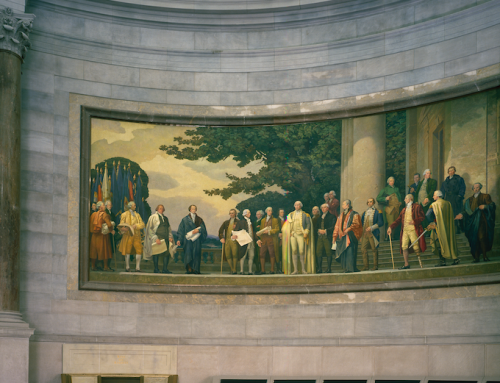

Leave A Comment