
Nikole Hannah-Jones is right and wrong. Although the first slaves arrived in Jamestown in 1619, the year and the event carry less significance than she imagines. Although neither deceptive nor careless, she is uninterested in facts in a conventional sense. Her principal objective is not to understand the past but to rebuke the present and, if possible, to change the future.
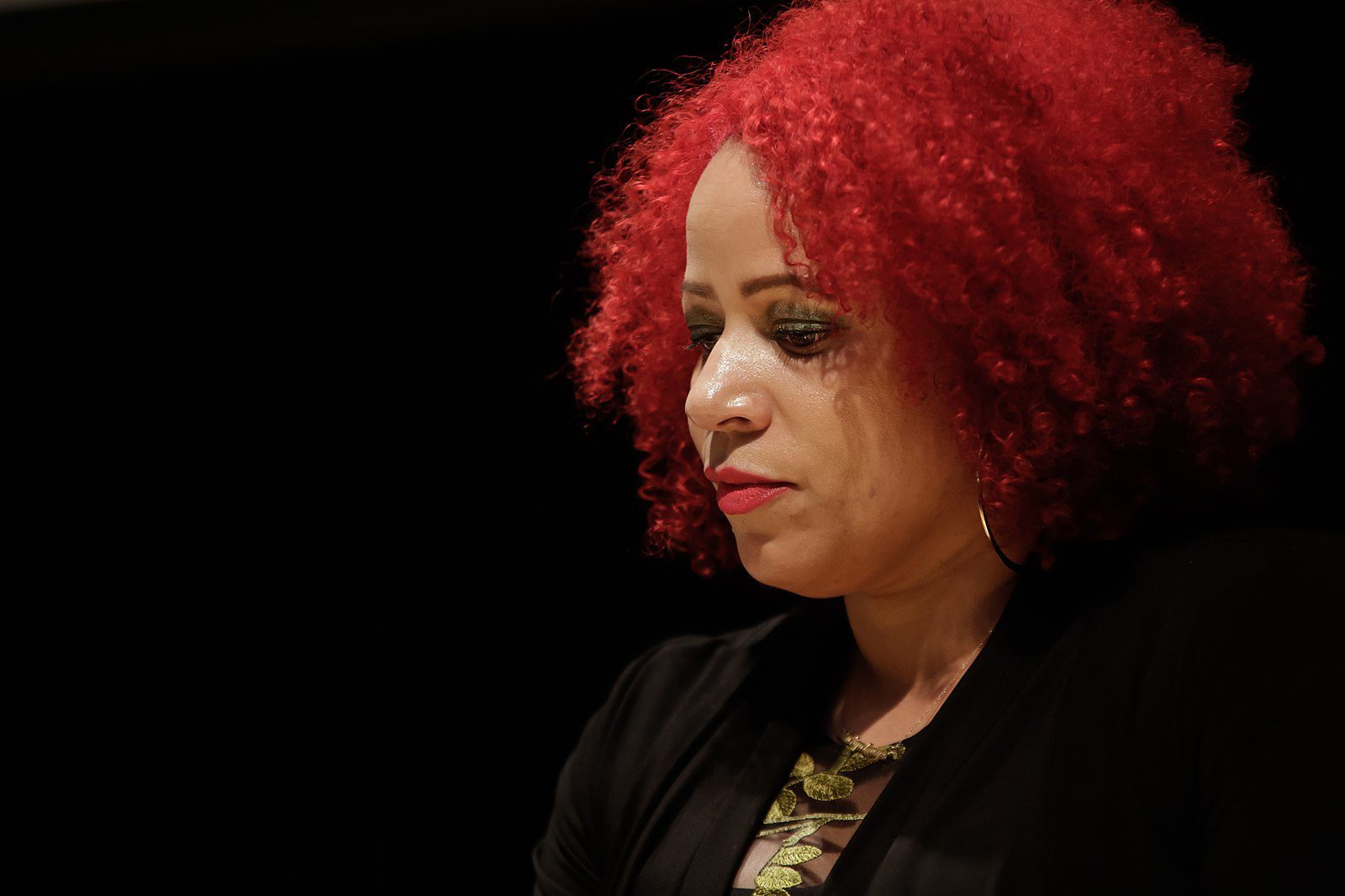
Nikole Hannah-Jones
Americans are not innocent of their history. Of all the moral ambiguities to emerge from the American past, none have revealed themselves to be more stubborn, divisive, and bedeviling than slavery and race. The concept of race especially is among the most inscrutable aspects of human nature. Perhaps we shall never understand why people attached significance to skin color and other so-called racial characteristics. In truth, Americans have yet to determine the meaning of race. For many the confrontation with supposed racial differences remains primitive and fearful. But a more detached, circumspect, and thoughtful approach also often leaves us with little more than the residue of anger, shame, and bewilderment. As revolutionary as it was in charting a new direction for human relations, even Christianity did not surmount racial antagonisms. The opposite was true. Hated of Muslims and Jews in Spain, for example, involved more than an effort to eliminate Islam and Judaism. An obsessive preoccupation with the evils of alien blood as much as with the quest for a purity of faith underlay the Inquisition.
When Europeans found their way to other continents inhabited by non-whites, their discoveries transformed worldwide racial geography. During the four hundred years between the end of the fifteenth and the end of the nineteenth century, Europeans migrated across the oceans of the world and conquered lands previously unknown to them. They subdued hundreds of millions of persons in the Americas, Asia, and Africa, bringing them to a greater or lesser degree under European governance. Doubts about the moral validity of imperialism and the economic benefits of colonialism notwithstanding, the prestige of Empire endured. Peoples who pretended to the contrary secretly envied Europeans, and emulated them when they could.
But after the Second World War fewer Europeans extolled the natural and cultural superiority of whites or believed that whites ought to rule the world. Despite earlier expressions of concern, Europeans recognized somewhat belatedly that administering, policing, and defending their overseas possessions had often cost them more than the colonies were worth. With a few exceptions, such as South Africa, European governments thus began to dissolve their empires; the worldwide political supremacy of whites came to an end. At the same time, the international decline of white power brought to the forefront the dilemma of racial coexistence. Nowhere has this condition been more acute and painful than in the United States.
After Americans freed the slaves as the result of a vicious civil war, it quickly became apparent that legal emancipation was insufficient. The former slaves continued to face discrimination and violence. In the more than 150 years since the abolition of slavery, racial tension has alternately receded and intensified, but it has never disappeared. Although Congress and the courts removed legal barriers to racial justice, white hostility to blacks persisted. When blacks migrated to the North during the early years of the twentieth century, they exchanged prejudice tempered by familiarity and a degree of forbearance for legal equality poisoned by intolerance and spite. For blacks, egalitarianism was no more than a legal fiction that left attitudes unchanged. Whites continued to regard blacks as their inferiors even as law and policy declared such judgments illegitimate.
Meanwhile, the liberal consensus following the Second World War suggested that greater access to the marketplace, which was sure to accompany economic development, would in time curtail and finally eliminate both white bigotry and black discontent. The democratization of wealth, in other words, became the solvent of racial animosity. To forestall social disintegration required appeasing blacks, who had to be convinced that they, too, could realize the American Dream. This aspiration, at once naïve and cynical, rested on sustained economic growth and the willingness and ability of government restrain corporate power. In the thirty years between 1945 and 1975 economic growth thus substituted for thoroughgoing reforms undertaken to address entrenched and systemic racial inequality. Continuous expansion of the economy had made it possible for Americans to avoid confronting the failure to achieve more than a modest and rather pointless redistribution of wealth and power and to alleviate the endemic racism that continues to disgrace the United States. The intention of The 1619 Project: A New Origin Story is to address these deficiencies and the grievances that have followed from them by exposing the history and consequences of enduring racial injustice.
II.
The 1619 Project begins with an epiphany. When she was a teenager, Nikole Hannah-Jones discovered that Africans had arrived in British North America in 1619, before the Mayflower made landfall in Massachusetts a year later. She describes this moment of insight, which for her was anguished and exhilarating:
African people had lived here, on the land that in 1776 would form the United States, since the White Lion dropped anchor in the year 1619. They’d arrived one year before the iconic ship carrying the English people who got the credit for building it all. Why hadn’t any teacher or textbook, in telling the story of Jamestown, taught us the story of 1619? No history can ever be complete. . . . But I knew immediately, viscerally, that this was not an innocuous omission. The year white Virginians first purchased enslaved Africans, the start of American slavery, an institution so influential and corrosive that it both helped create the nation and nearly led to its demise, is indisputably a foundational historical date. And yet I’d never heard of it. (xix)
Ms. Hannah-Jones is right and wrong. The importance of slavery is beyond dispute. Slavery was an essential component in shaping the history of the United States, and the legacy of racism continues to disfigure American politics, law, public policy, and social relations. Her mistake is not factual, but reveals the epistemological and political limits of the book. Although the first slaves arrived in Jamestown in 1619, the year and the event carry less significance than Ms. Hannah-Jones imagines. Although neither deceptive nor careless, she is uninterested in facts in a conventional sense. Her principal objective is not to understand the past but to rebuke the present and, if possible, to change the future, although, as I will argue, the latter purpose is questionable given the ideological foundations from which she proceeds.
Discontented with the world as it is, Ms. Hannah-Jones and her collaborators have turned to the study of history to learn how and why the world went wrong and how the wrong persisted for centuries. The utility of history lies not in elucidating the past itself in all its complexity, but in exposing and perhaps destroying the racism that has betrayed and oppressed peoples of color. Ms. Hannah-Jones has little regard for facts in themselves. They are illustrative. Truth does not reside in them, but in their associations and implications. In her mind, 1619 “conjures an image of glowing three-dimensional numbers rising from the page.” The date is talismanic. It adumbrates the suffering and sorrow of generations, and projects a new version of the American story.
In the tradition of Howard Zinn, Nikole Hannah-Jones has challenged the strict division among journalist, historian, and activist. She did not intend to produce a conventional or an objective history (even if the latter were possible), but to tell the story of the oppressed and downtrodden, to illuminate the plight of the marginalized and the powerless, to show, as Zinn declared, “how bad things are for the victims of the world.” Her intention has been to fashion a critical perspective on the history of the United States, first to rectify Americans’ ignorance and, more important, to motivate them to create a more just and equitable future. She echoes Zinn’s concern that “the really critical way in which people are deceived by history is not that lies are told, but that things are omitted.” But for Ms. Hannah-Jones, the study of history ought to do more than educate. It must also to appeal to the conscience to incite social and political reform, or at least to induce feelings of guilt and remorse. She explains that:
We cannot change the hypocrisy upon which were founded. We cannot change all the times in the past when this nation had the opportunity to do the right things and chose to return to its basest inclinations. We cannot make up for all the loves lost and dreams snatched, for all the suffering endured. But we can atone for it. We can acknowledge the crime. And we can do something to try to set things right, to ease the hardship and hurt of so many of our fellow Americans. . . . Nationalized amnesia can no longer provide the excuse. None of us can be held responsible for the wrongs of our ancestors. But if today we choose not to do the right and necessary thing, that burden we own. (475; emphasis in the original)
Her focus on the present and the future as much as on the past, Ms. Hannah-Jones sees blacks, along with Indigenous Peoples, as the principal victims of America. Yet, although blacks have been systematically denied the benefits of American life, “they have also played an unparalleled and uncompensated role in building our democracy.” (475; italics in the original) They fight still to preserve and extend democracy, she avows, and the “unacknowledged debt” owed to them continues to accrue.
Critics may question Ms. Hannah-Jones’s personal motives and political agenda. In the fog of the culture wars, which does not lend itself to meticulous deliberation, she is too prone to regard blacks only as heroic victims—to produce a sort of American hagiography in reverse. Former heroes, such as George Washington, Thomas Jefferson, and Abraham Lincoln, become villains. The new heroes are heroic precisely because they are victims. In her efforts to assail complacency about, and to defeat complicity with, racism, she sometimes does more to provoke than to enlighten. Such a critique notwithstanding, it is hard to ignore or dismiss Ms. Hannah-Jones’s anxieties about ongoing discrimination against blacks and relentless ignorance of the American past.
There is a vast divide between the academic and the popular understanding of slavery and race. Teaching these subjects in elementary and secondary schools is often cursory, inadequate, and now, in part as a response to the 1619 Project, increasingly proscribed. Ms. Hannah-Jones makes clear that she thinks these blunders and omissions intentional, even conspiratorial. She may be right, but it is more prudent not to attribute to malice what may be accounted for by stupidity, especially when stupidity explains so much. Malice there has surely been. But for all the mistreatment that blacks have endured—discrimination in education, health care, and housing, in economic opportunities, in political influence, in civil rights—a worse grievance may be the unending insult to their pride. The myriad humiliations that blacks suffer everyday remind them that they are “inferior.” This thoughtless assumption has permitted white Americans to disregard black people and black history with impunity because, unless blacks compelled them to pay attention, they had no reason to do so. Whites did not have to notice black people, to hear black voices, or to respond to black complaints. Such thoughtless indifference must be maddening even when it does not arise from vicious intent.
Ms. Hannah-Jones hoped that The 1619 Project would at least remedy such ignorance and apathy, even if it did nothing to end racism. But that recognition brings us back to the problem of 1619 and Ms. Hannah-Jones’s approach to the history of American slavery and race. Although true, her interpretation is not true enough. Her outlook is too parochial. She advances her own version of American exceptionalism. For racism was not exclusively an American attitude or slavery a uniquely American practice.
It is, in fact, not surprising that the English who settled in North America turned to slavery; more surprising is how long they waited to do so. By the time a Dutch man-of-war, The White Lion, brought the first slaves to Jamestown in 1619, slavery was ubiquitous throughout the Western Hemisphere. Slaves had arrived in Hispaniola (modern Haiti and the Dominican Republic), the first permanent European colony in the New World, in 1502. Within twenty years, by 1522, the Spanish were exporting sugar cultivated by slave labor. Far from a “peculiar institution,” slavery, as David Brion Davis showed in The Problem of Slavery in the Age of Revolution, 1770-1823 (1975), extended from the St. Lawrence River basin in Canada to the Rio de la Plata in Brazil. It was the chief system of labor in the most prosperous European colonies.
The English colonists who established Jamestown in 1607 did not have it in mind to create a slave society. They initially favored white indentured servitude and did not formulate a legal definition of slavery until the early eighteenth century. In its origins, America was not the slavocracy that Ms. Hannah-Jones imagines. The enormous transfer of people that took place as a result of the Atlantic slave trade brought a comparatively small number of Africans to the mainland colonies of British North America. Of all those who crossed the sea, less than five percent came to the mainland colonies. This figure represents fewer slaves than entered Cuba. The most extensive importation of slaves to North America occurred between 1680 and 1808. It accounted for seven percent of the slave traffic crossing the Atlantic during those years and twenty percent of the total English commerce in slaves.
Yet, North America became an integral part of an Atlantic colonial system that relied on slave labor to produce staple crops for European markets. In the Atlantic world of the seventeenth century, chattel slavery was a legally recognized and increasingly preferred form of labor. Slavery was spreading throughout Latin America and the Caribbean. The English colonists in the Chesapeake were thus not experimenting with some radical innovation when, after 1680, they began to purchase Africans in large numbers. They were instead following what by then had become a conventional pattern in the Atlantic world.
Within a decade of settlement, English colonists in Virginia were exporting tobacco. To make the cultivation of tobacco profitable, planters extracted from both indentured servants and slaves as much labor as they could. If the slaves in the Chesapeake were better off than their counterparts on the sugar plantations of the Caribbean, they were not appreciably so. At the same time, the unsettled frontier conditions that prevailed throughout much of the Chesapeake enabled many blacks to set the terms of their own labor, to establish a relatively stable family life, and on occasion to barter for their freedom. During the seventeenth century, black freedmen owned land and slaves, voted, and even occupied minor political offices. They could sue and be sued and testify in court. If they did acquire property they could sell it or pass it on to their descendants. Until outlawed by statute in 1691, interracial marriages between blacks and whites—even marriages between black men and white women—were accepted, if rare.
Blacks in the Chesapeake initially enjoyed many of the same rights as other subjects of the English Crown, or at least were not systematically denied them. But as in the Caribbean, Latin America, New England, and the Middle Colonies, there was a direct and unambiguous correlation between growing numbers of blacks in the Chesapeake and the enactment laws to restrict their freedom. By the middle of the seventeenth century the trend was clear: as the black population rose, the rights of black men and women, slave and free, diminished. As Donald R. Wright indicated in African Americans in the Colonial Era (1990), the dike holding back the deluge of legislation that condemned blacks to slavery broke when the importation of Africans increased after 1680. Blacks in the Chesapeake quickly lost the rights and freedoms that remained to them and found themselves legally, socially, and culturally isolated from whites. By the 1720s the English colonies in the Chesapeake were well on their way to becoming slave societies. During the next century the evolution of slavery altered every facet of black life. Gone were the days when the status of blacks approximated that of whites. Of the considerable population of blacks living in the Chesapeake by the1820s, nearly all were slaves.
For blacks, life in Virginia was undone by success. In “To the Virginian Voyage,” composed in 1606 to promote colonization and settlement, Michael Drayton had envisioned Virginia as “Earth’s only paradise;”
Where nature hath in store
Fowl, venison, and fish,
And the fruitful’st soil
Without your toil
Three harvests more,
All greater than your wish.
As the high mortality rate in Virginia began to decline in the 1630s, many indentured servants stood on the threshold of fulfilling their dream to become independent proprietors. They settled along the great rivers of Virginia, planted corn, raised livestock, and cultivated tobacco. But from prosperity new difficulties arose. After 1640, as longevity improved and population increased, former indentured servants found it harder, if not impossible, to acquire land. According to Edmund Morgan in American Slavery, American Freedom: The Ordeal of Colonial Virginia (1975), as life expectancy in Virginia advanced, there emerged a growing number of freed servants who could not afford to purchase land except on the frontier, which was unprotected from Indian attack, or in the unfertile interior. By 1676, Morgan estimates that twenty-five percent of Virginians were without land and worse without the prospect of obtaining any.
The presence of a class of impoverished former servants terrified the planter elite. Young, single, and propertyless, these men had nothing invested in the community and nothing to lose by attacking it. More ominously, they were armed. Sir William Berkeley, the royal governor of Virginia, feared that these dispossessed former servants would rise in revolt. His fears were justified for in 1676 Bacon’s Rebellion, the largest civil disturbance in the colonies before the War for Independence, swept Virginia. Although the rebellion subsided quickly, the causes did not disappear. An excess of indentured servants continued to arrive in Virginia every year to man the tobacco plantations. When they at last attained their freedom, most could not afford to buy even marginal land. It was under these circumstances that Virginia planters turned to slavery.
Costing approximately £20 in 1700, about twice as much as it cost to engage an indentured servant, slaves were the more profitable investment since they were bound to the master for life. The unexpected social and political benefits of slavery matched the economic advantages. Slaves were far less dangerous than the former servants had become. No slave uprising in the history of the North American colonies or the United States approached the magnitude of Bacon’s Rebellion. In addition, slaves fell permanently under the control of their masters and could be denied rights that Englishmen, bound or free, traditionally demanded. There was a limit beyond which the abridgement of English liberties could not go. Masters, by comparison, subjected slaves to harsh punishments without the slaves having recourse to the law. They kept the slaves unarmed, unorganized, and ignorant. Increasingly, the color of the slaves’ skin indicated their probable status, making escape more difficult. In addition, by enslaving Africans, Virginians stopped adding to the band of indigent white freed servants who threatened to disrupt the fragile order of the colony.
If Africans had not been available in sufficient numbers to meet the demand for labor Morgan surmises that colonial planters would likely have found it impossible to keep the former servants in their place. The continued abuse of English subjects might have resulted in the outbreak of another mass insurrection. Even more probable was a parliamentary ban on the importation of servants to Virginia, which would have devalued the land and impeded, if not destroyed, the tobacco economy. The attempted enslavement of free-born Englishmen would have caused more problems than it solved. English colonists thus thought the enslavement of Africans an expedient way to organize a disciplined labor force and to maintain social and political order. Englishmen in Virginia enslaved Africans because they could not enslave other Englishmen. This solution, Morgan concluded:
allowed Virginia’s magnates to keep their lands, yet arrested the discontent and repression of other Englishmen, a solution which strengthened the rights of Englishmen and nourished their attachment to liberty which came to fruition in the Revolutionary generation of Virginia statesmen. But the solution put an end to the process of turning Africans into Englishmen. The rights of Englishmen were preserved by destroying the rights of Africans.
In the search for a date on which to inscribe a “new origin story,” one that places slavery and race at the center of American history and life, 1676 is of a far greater import than 1619. But origins do not matter as much as events and conditions. The events and conditions that led to the expansion of slavery reveal that its significance was historical. The racism that contributed to and resulted from slavery was not, as Ms. Hannah-Jones would have it, encoded into the DNA of whites from the beginning of American history. Racism is no more the product of biological determinism than is the concept of race itself. Like race, racism is an ideological construct, the consequence of historical decisions, accidents, contingencies, expedience, and struggle. It is not the product of genetics. Our origin is not our destiny.
III.
In Virginia and eventually in the other southern colonies, slavery resolved the problem of what to do with and about the poor. The growth of slavery limited the demand for indentured servants. Those who remained and fulfilled their contracts had better prospects for acquiring land, thereby eliminating most of the “idle poor” whose presence was the scourge of order and peace. Transformed from destitute rabble into sturdy yeoman, the once landless poor became trustworthy citizens. No demagogue could manipulate them; no tyrant could starve them into submission. Secure, virtuous, and armed, they were at liberty to enjoy the fruits of their labor and were prepared to defend their property and their independence against any who imperiled them.
When, during the seventeenth century, the impoverished masses had endangered the stability of the colony and the welfare of the elite, they met with prompt and savage vengeance. Although Nathaniel Bacon had died of fever, placing himself beyond mortal reach, the Royal Governor, William Berkeley, hanged the other leaders of the rebellion despite Charles II having issued a general pardon. Charles lamented “that old fool has hanged more men in that naked country than I have done for the murder of my father.” No longer harassed by a class of unruly poor whites, Virginians of the eighteenth century, by contrast, could afford to entertain radical ideas about taxation, political representation, equality before the law, and the rights of freemen. Slavery had inadvertently relived the social and economic pressure on landless whites that, in the seventeenth century, had reduced them to servitude and poverty and had subjected them to violent reprisals. As slavery became more prominent after 1680, Virginians, like other southerners, moved toward a form of government in which small farmers had a more prominent role. As slaves replaced poor whites at the bottom of the colonial social order, the fears and prejudices long directed toward the poor could be restricted to blacks, whose rights and freedoms were forever suppressed. It is no exaggeration to say that the freedom of Englishmen came to rest on the enslavement of Africans.
Given the complex and intricate relation of slavery and freedom in early American history, Ms. Hannah-Jones may perhaps be forgiven her most audacious but mistaken judgment that the colonists struck for independence in a determined and conscious effort to preserve slavery. “Our founding mythology,” she insists:
conveniently omits the fact that one of the primary reasons some of the colonists decided to declare independence from Britain was because they wanted to protect the institution of slavery. They feared that liberation would enable an abused people to seek vengeance on their oppressors. . . . The wealth and prominence that allowed Jefferson . . . and the other founding fathers to believe that they could successfully break off from one of the mightiest empires in the world came in part from the dizzying profits generated by chattel slavery. So they understood that abolition would have upended the economies of both the North and the South. (16)
More nuanced in the book than in the original version of the 1619 Project that appeared in the New York Times Magazine, Ms. Hannah-Jones’s statement nevertheless remains one-dimensional and inaccurate. She underestimates the acrimony that disagreements over slavery injected into American politics.
Those who contemplated independence from Great Britain found that the contradiction between the quest for liberty and the defense of slavery was becoming an embarrassment. Slavery had always been something of a problem for Englishmen. The enslavement of Africans violated English judicial traditions, for English Common Law did not recognize the legitimacy of slavery. The introduction of slavery into the English colonies was a radical departure from the norm, an innovation of the sort that prudent Englishmen usually avoided. For generations, the English colonists had made their peace with or ignored the inconsistency, even as they benefitted from the labor of their slaves. When the call went up in the 1760s to throw off the yoke of British oppression and to reassert their traditional rights as Englishmen, American colonists could disregard it no longer. To do so would have marked them as hypocrites alike to their enemies and their allies.
The welcome that arguments against slavery began to receive emerged in part because new ideas about humanity and society had gained popularity and influence among the educated classes of Western Europe and North America. Writers and thinkers of the eighteenth-century believed in nothing more than the happiness, dignity, and freedom of the individual. From their perspective, slavery represented the antithesis of these principles and was an unmitigated evil that debased the human spirit and threatened human progress. The philosophes on both sides of the Atlantic agreed that they had emancipated the mind from authority, tradition, and superstition, had unveiled the truths of nature, had vindicated the rights of man, and had pointed the way not only toward human improvement but also human perfectibility. To these apostles of liberty, slavery was a criminal violation of the rights of man and citizen. Its continued existence rendered impossible peace, social order, and morality, and confounded the very essence of enlightened civilization.
Many of the men who advocated a war of independence against Great Britain thought themselves products of the Enlightenment. Faith in human intelligence, reason, and benevolence encouraged them to believe that they could establish a more perfect union, a new order for the ages in which justice reigned and men embraced their natural right to freedom. During the struggle that ensued, many American leaders, even in the South, admitted that slavery was contrary to the principles for which they fought. A number of reformers warned that American independence could be justified only by a decision to rid the land of slavery. They asserted that Americans could not secure their own freedom until they had first emancipated the slaves.
Independence, of course, did not end slavery. No body of slaveholding planters anywhere ever acquiesced in emancipation save when coerced, whether by a national government or by the slaves themselves. Their celebration of liberty notwithstanding, American slaveholders proved just as resistant. Slavery was integral to the national economy. Americans could not have sustained their economic viability or their political independence without it. Liberty required independence and independence rested on property. Eighteenth-century Americans were not so morally callous to value property rights over human rights. In their view, human rights were intimately connected to, and sustained by, property rights. One could not survive without the other. Any scheme of emancipation would destroy a legal form of property and would in the process endanger the foundations of republican liberty. Slavery, it seemed, was interwoven into the fabric of the Republic, and could not be eradicated without unraveling it. Slaveholders may have been willing to concede that slavery was an evil—but if that was so it an evil about which nothing could be done.
Even the concession that slavery was a necessary evil rendered its proponents vulnerable. The argument was politically inadequate and morally treacherous. Slaveholders had to insulate themselves from the conviction that slavery, however necessary, was an evil that honest men must try to remove from the body politic whatever the costs. Herein resides the deeper significance of independence to which neither Ms. Hannah-Jones nor her critics have devoted enough attention. In response to fears that the rhetoric of independence might excite a general opposition to slavery, southerners fashioned the first truly racist vision of American society. The rudiments of the argument are familiar. Slavery was justified because blacks and whites could not live together in peace as free and equal citizens. By nature blacks were inferior and uncivilized. They were cunning but stupid, idle, promiscuous, dishonest, and savage.
Slavery may have come to America without much deliberation. Racism certainly did not. Its genesis was calculated and purposeful. To deflect the assault on slavery, southern whites invented a thoroughgoing racist image of blacks. Even the enlightened philosophe Thomas Jefferson was not immune. Writing in the 1780s, Jefferson noted that in any comparison of whites and blacks, skin color immediately obtrudes to render whites the more attractive. Whiteness is far “preferable to that eternal monotony . . . that immoveable veil of darkness” which envelops black faces and black bodies. In addition to lacking physical beauty, blacks were deficient in the capacity to reason. Their emotions were ardent but frivolous and superficial. In imagination, Jefferson expounded, they were “dull, tasteless, and anomalous.” Approaching the subject with diffidence and caution, Jefferson advanced it “as a suspicion only that the blacks, whether originally a distinct race, or made distinct by time and circumstances, are inferior to the whites in the endowments both of body and mind. . . . This unfortunate difference of colour, and perhaps of faculty, is a powerful obstacle to the emancipation of these people.” Merely to profess self-interest in maintaining slavery would have seemed grotesque in the face of a principled vindication of the freedom that Nature and Nature’s God had promised to all men. Instead proslavery thinkers elaborated the grave risks that premature emancipation would bring in its wake, accentuating both the inferiority and the wickedness of blacks.
The creation of a new government reinforced the slaveholders’ apprehensions. Under imperial rule, southerners had never exercised absolute control over their colonial institutions. Although independence had freed them from British interference, it also gave rise to a potentially more harmful situation. The new southern states found themselves in a political union with other states that had eliminated slavery within their own borders and whose citizens viewed with deepening skepticism all attempts to justify the continued existence of slavery elsewhere. As a consequence, slavery disturbed relations between the North and the South from the beginning of American national history. The presence of slavery nearly ruined the prospects for establishing a union at all, first in the debates over the Articles of Confederation and then more acutely at the Constitutional Convention. As early as 1790, during the second session of the first Congress of the United States, Thomas Tudor Tucker of South Carolina already recognized the extent of the problem. Tucker asked: “Do these men [of the North] expect a general emancipation of the slaves by law? He answered his own question: “This would never be submitted to by the Southern states without a civil war.”
For more than seventy years the American political system averted such a conflict. Between 1789 and 1861, Congress, the president, and the courts as well as the major political parties and their leaders prevented the issue from being joined. But whenever the subject of slavery intruded into politics, from the Missouri Compromise of 1820 to the Nullification Crisis of 1832-1833 to the Compromise of 1850 and the turbulent decade that followed, the rancorous disagreements invariably spawned threats to the Union. Each compromise proved more fragile than the last, as two societies, one slave and one free, expanded within a single nation that could not ultimately reconcile their political aims and economic interests, their social philosophies, their religion and morality, or their world views. The dispute over slavery was at the heart of the most grievous tragedy ever yet to befall the United States.
IV.
All people carry with them the burden of their past. Although they may cry out in protest, Americans are no exception. Every people longs to find comfort and reassurance in their history. They wish to see in the past an image of themselves as generous and benevolent, guilty perhaps of no more than misjudgments and errors but of no terrible crimes or unforgiveable sins. Ms. Hannah-Jones and her colleagues have done their utmost to disturb the easy conscience of white Americans about the past. They have been determined to show that those historical figures whom many Americans venerate were responsible for the most heinous offenses, which, because they remain unacknowledged, continue to disrupt and pervert American national life.
At least after a fashion, Ms. Hannah-Jones and her colleagues take history seriously, which is more than may be said for those Republicans who are contemptuously indifferent to facts, logic, truth, or even ideological consistency. Alternating between incoherence and nihilism, they have nothing of substance to contribute to American politics or thought. Those conservative who have retained their devotion to a traditional patriotic narrative of the American past are in retreat. Even when their efforts to defend the pieties of yesterday merit sympathy, they neither persuade nor inspire. In the face of overwhelming evidence to the contrary, the liberal commitment to progress, although equally touching, is just as quaint, superficial, and irrelevant. The relentless optimism that liberals espouse has led them to see in history the fiction of inevitable progress. Every question has an answer, every problem a solution. From adversity comes only triumph. Despotism, imperialism, racism, sexism, the entire panoply of historic crimes, will fall as “the arc of the moral universe” bends incrementally but invariably toward justice.
Ms. Hannah-Jones is less sanguine and more disillusioned. She acknowledges but then quickly abandons any discussion of the “astounding progress” that blacks have made in their quest for freedom and equality. To her credit, she has not merely celebrated the accomplishments of blacks Americans, replacing one weary and threadbare story of progress and triumph with another. But according to her world view grievance and oppression have been more important in the lives of black Americans than a cursory optimism or an ephemeral progress. Anti-black racism is fixed and ineradicable. Ms. Hannah-Jones finds little consolation in promises broken or in self-satisfied fantasies about liberty and justice for all.
Her outlook fits the political moment, emphasizing continuity rather than change, as Americans across the political spectrum become more ideologically resolute and more politically entrenched. Contemporary American politics and society are nothing if not tribal. Blacks and whites in the United States are what they have long been: one people who live separate lives and who now increasingly embrace different versions of the past and different visions of the future. Events and developments always have the capacity to surprise us, but the prospects of a rapprochement seem distant. As a people, as Americans, blacks and whites are divided and paralyzed. They can neither separate nor unite. They do not as much communicate with as they confront one another across a widening chasm, uttering ominous accusations and threats.
The battleground has shifted from the streets to the past—there and to the recesses of the individual conscience. The killing of Travyon Martin, Michael Brown, Eric Garner, Tamir Rice, Freddie Gray, Philandro Castile, Alton Sterling, Stephon Clark, Botham Jean, Breonna Taylor, George Floyd, and others too numerous to mention; the Unite the Right rally in Charlottesville, Virginia; the massacre of black men and women in Charleston, South Carolina and Buffalo, New York have provoked a militant, uncompromising, and impassioned reevaluation of American history. Rather than seeking a “usable past,” to borrow a venerable phrase from Van Wyck Brooks, thinkers such as Ms. Hannah-Jones have sought the origins of present injustice in past iniquity. The United States, Ms. Hannah-Jones contends, must undergo a profound historical “reckoning” to expose centuries of the racial subjugation that constitute the essence of national identity and the source of all that is exceptional about America.
With her historical world revolving always around slavery and racism the arc of Ms. Hannah-Jones’s moral universe does not bend in any direction. It is motionless. This static vision of the past offers no mechanism to explain, let alone to promote, change. Her interpretation of American history cannot account for the rise of the abolition movement, the end of slavery, or the advance of civil rights. It is one thing to look upon the world with a cold eye and to reject platitudes about the inevitability of progress. It is quite another matter to lose faith in the future, as Ms. Hannah-Jones seems to have done. She is left with nothing but the past, which she deems responsible for all the transgressions and misery of the present. She must ignore significant change and deny genuine progress in race relations. She must emphasize, and even in a sense commemorate, a history of victimization and a politics of grievance that knows no end. There is no alternative. There is no way out. White Americans are slaves to an unalterable genetic racism and black Americans are their perpetual victims.
Ms. Hannah-Jones’s outlook has more in common with resignation to despair than it does with a healthy sense of tragedy, which it superficially resembles. Americans like to think our history impervious to moments of tragedy. But slavery was just such a moment, and it lasted for centuries with incalculable consequences. “Generally speaking,” wrote Alexis de Tocqueville:
it requires great and constant efforts for men to create lasting ills; but there is one evil which has percolated furtively into the world; at first it was hardly noticed among the usual abuses of power; it began with an individual whose name history does not record; it was cast like an accursed seed somewhere on the ground; it then nurtured itself, grew without effort, and spread with the society that accepted it; that evil was slavery.
As in Greek tragedy, the sins of the father have been visited on the sons. These unfortunate progeny are cursed by their inheritance. Their destiny becomes a tragic choice among evils. Psychic wounds deepen, fester, and do not heal. Guilt is irresistible and devastating. They are driven to madness. Behind their suffering lies the past.
As Tocqueville understood, slavery imposed a curse on American life not easily lifted. Our pathetic disavowal of this reality, our continued withdrawal into an unsullied past, our anxious proclamations of innocence have shielded us from the truth. To break the deadlock, to absolve the crime, to end the curse, to redeem our world, we must learn the ruin that inhabits every act of treachery, every appeal to hubris. We must embrace humility and compassion. As Stephen Dedalus remarked in Portrait of the Artist as a Young Man, “where there is reconciliation there must first have been a sundering.” Making amends must become a rite of passage during which innocence dies and experience is born. Dreadful and terrifying, this national ordeal will bring illumination and renewal, or at least we are entitled to hope.
“We have come to this,” proclaimed the Greek playwright Aeschylus, “the crisis of our lives.” And so in America we have. If it is to take place, the transformation of our society must begin not as Ms. Hannah-Jones implies with recrimination and guilt, but with honest answers to painful questions. It will plunge us into agony just the same. But Ms. Hannah-Jones is right about one thing. If we wish to survive as a nation and a people, white Americans sooner or later must abandon our fatal self-righteousness and confront the vicious aspects of the past, of which slavery is only one. Will we remain defiant and resentful? Will we, alternately, resign ourselves to apathy and despair? Will we nurture our fear, our anger, and our hate? Will we succumb to our own variety of madness? Will we turn America into a charnel house? If, in the end, we do undertake this painful journey will our suffering only add to our trauma and out sickness or will we at last suffer into truth? Even were we straightaway to disavow identity history and tribal politics, we should not delude ourselves. The racial, political, and moral tension between blacks and whites would not soon vanish. Only under these altered conditions that tension would have a chance to hold society together rather than to tear it apart.
The Imaginative Conservative applies the principle of appreciation to the discussion of culture and politics—we approach dialogue with magnanimity rather than with mere civility. Will you help us remain a refreshing oasis in the increasingly contentious arena of modern discourse? Please consider donating now.
The featured image, uploaded by Nikole Hannah-Jones, is licensed under the Creative Commons Attribution 2.0 Generic license, courtesy of Wikimedia Commons.




great article!
So many wrong assumptions and falsified facts. Where to begin? The first slaves from Jamestown were not blacks, but two white male teenagers given to two Indian tribes to keep the peace. One of the first black “slaves” was rescued from slavery by the Jamestown colony and sent to a black family to live. Available online for all to read are the early minutes of the Jamestown council and the letters and memoirs of many of the original settlers.
“With her historical world revolving always around slavery and racism the arc of Ms. Hannah-Jones’s moral universe does not bend in any direction. It is motionless. This static vision of the past offers no mechanism to explain, let alone to promote, change. Her interpretation of American history cannot account for the rise of the abolition movement, the end of slavery, or the advance of civil rights. It is one thing to look upon the world with a cold eye and to reject platitudes about the inevitability of progress. It is quite another matter to lose faith in the future, as Ms. Hannah-Jones seems to have done.”
Dr. Malvasi,
Interesting piece. Thank you. As a white American the above quote sums up my frustration with the whole race debate. Those such as Ms. Hannah-Jones propose to know the problem but in the end have no real answers. They seem to have eyes wide open to the sins of the past while being substantively blind to the progress we have made as a nation. One thing is for sure, whatever answers there are to our intractable race problems will require significant cooperation and agreement on the part of both white and black Americans. Those who go through life in a permanent state of ignorance and apathy regarding our race challenges are no help, but I would argue the same for those who are in a perpetual state of grievance and anger. I have little hope that our institutions will foster progress in this area. That leaves me with the many Americans “on the ground” so to speak who work and live in our neighborhoods striving to get along and live in peace.
I find Dr. Malvasi’s comments to be clarifying. Yet he overstates the current state of affairs in the US.
He makes the classical error of painting with a brush so wide that it obscures bright spots. There are many.
Born and raised in the US and living primarily in the South for some 75 years, I find his portrait of doom and gloom about race to be overstated. His “Ain’t it Awful” message is an imprecise and out-of-date conclusion.
The evidence for racial harmony and is ever present where I live in the lower part of South Carolina. I have more in common with Black people who grew up in our little town than I do with the flood of folks moving here from New York, New Jersey, Massachusetts and Ohio.
Looking through a different window, Dr. Malvasi,how do we compare to other countries who were slave societies?
Finally, his caricature of dreaded awful Republican monsters seems downright goofy. Maybe he watches too much MSNBC and lives in an academic Ivory Tower with no windows to the changing world outside.
Come see us!
Good point. I believe that most of our racial struggle is centered in blighted areas of both our urban and rural areas, and the reason for that struggle goes far beyond racism to broader socio-economic causes. I live in a middle to upper middle class suburb of a major US city and it is a beautiful thing to see the racial/ethnic mix of our neighborhoods and schools, and how well folks get along. Not the promised land for sure but we are making it work one day at a time.
Dear Mr. Sweatt:
We can debate the goofiness of my assessment of certain Republicans another time.
You raise an important point and ask an important question in your comment, which I would like to address.
First, I have no doubt that race relations in your portion of South Carolina a better than those in many places throughout the United States. But I would turn your argument on its head and say there are plenty of places in the U. S where they are worse. For me, it’s not an either/or condition. It may simultaneously be true that racial harmony co-exists with racial discord and deepening racial tension if not animosity. It seems to me equally unwarranted and unwise to ignore or to exaggerate the problem. Because blacks and whites have found a way to live together in “the lower part of South Carolina” does not mean that they have managed to do so elsewhere. Nor does it mean that racism is ephemeral or illusory.
Second, your question: “how do we compare to other countries who were slave societies?” is complicated. I’m not sure on what basis you would like me to offer a comparison.
I would begin by saying that although there were other societies with slaves none became a slave society like the one that developed in the antebellum South. In that sense at least the South was unique and the history of southern slavery more complex.
After the international slave trade to the U. S. closed in 1808, slaveholders had to find a way to maintain their slave property. Unlike their counterparts in Latin America and the Caribbean, who could continue to import slaves and work them to death, the slaveholders of the South could not afford to do so. Motivated both by economic self-interest and a sense of Christian obligation to be their brothers’ keepers, southern slaveholders had to find a way to keep their slaves healthy enough to work and to reproduce. As a result, the slaves in British North America and the United States were the only slaves in the Western Hemisphere to reproduce themselves by natural means. On the eve of the Civil War, their population had grown to approximately 4.5 million (There is a slight exception to this development among the small number of slaves in the mining district of Brazil after the mining boom ended. ) For good and ill, slaveholders in the South had to find a way to live together with their slaves, and vice versa.
I hope that is the sort of comparison you sought If not, please don’t hesitate to ask additional questions.
What is lacking in this assessment of slavery, as well as the “fair minded criticism” of the 1619 advocates. And that is the acceptance that slavery is somehow a unique original sin of America (the culture, not the continent). At the time of the founding of this country, slavery had not been outlawed in any society anywhere in the world, and that was more than 150 years after the 1619 “institutionalization” of slavery that the 1619 proponents want to display.
Treating the propagandists as equally fair minded participants in the es nothing to assuage their satisfaction in pushing the outcomes they desire. Those outcomes, without exception either lower or raise the bar as it serves them. Facts, in these kinds of confrontations, carry little weight and so well-documented events as Kelly S Collins provided are new to most. (Thank you, Kelly, for posting that information!). I’d be curious if the author of this essay were even aware of that information, or has academia become such an echo chamber that even the most fundamental facts have been expunged from the record?
Dear CT,
One of the key points of my argument was that slavery was not unique to the British North American colonies or the United States, but was ubiquitous throughout the Western Hemisphere. I wrote that “by the time a Dutch man-of-war, The White Lion, brought the first slaves to Jamestown in 1619, slavery was ubiquitous throughout the Western Hemisphere. Slaves had arrived in Hispaniola (modern Haiti and the Dominican Republic), the first permanent European colony in the New World, in 1502. . . . Far from a “peculiar institution,” slavery . . . extended from the St. Lawrence River basin in Canada to the Rio de la Plata in Brazil. It was the chief system of labor in the most prosperous European colonies.
I also made it clear the the English settlers in the Chesapeake initially favored white indentured servants to slaves.brought from Africa or the Caribbean. But please also note that Englishmen enslaved Africans because they could not enslave other Englishmen. There were limits beyond which the abridgement of the rights of Englishmen could not go. In time, no such restrictions.applied to blacks.
If you reread the essay you will see that I have already addressed your objections, and that I do not regard slavery as “a unique original sin of America.”.
The comments of Kelly Collins show only how fluid the definition of slavery was in the early history of the Chesapeake and how long it took English settlers to define slavery at law according to race.
Dr. Malvasi,
Forgive me for posting a second comment, but just how do white Americans “abandon our fatal self-righteousness and confront the vicious aspects of the past.”? What does this “painful journey” for white America look like? Is it a matter of re-education? Is it reparations? Is it acceptance of policies and laws that actually advantage black Americans in hiring, admissions, access to loans and grants, etc.? And if so, for how long? Is it embracing CRT? And why is it that the solution to our race problems lie solely with white America?
It seems to me that as long as this debate, along with the proposed solutions, remains one-sided then we will remain forever in this endless cycle. Good problem solving must be collaborative and each side must hear the other. Otherwise, all we end up with at best is more of the same, and at worst a type of soft oppression toward white America. I feel that we are already seeing signs of the latter.
Maybe I’m all wrong on this issue. My apologies if so. But one thing I am for sure is frustrated. Peace.
I am curious as to whether anyone can cite a historical example of a country that was expected to assume a generally — permanently? — penitential attitude because of something that occurred centuries before. It seems to me that that is what many people — not necessarily professor Malvasi — are asking of Americans. It seems possible to me that there is no real precedent for what many are asking. (Or more than asking.).
Dear Mr. Alioto,
I agree with what I take to be the underlying premise of your comment. No people can be asked to repent forever for the sins of the past—sins for which no one in the present is responsible.
Although I am no theologian, I think my position is theologically sound when I say that the purpose of repentance is forgiveness. Sins may be repented and forgiven.
Our problem is that slavery was a mistake, and mistakes can mock repentance. I think Tocqueville was making that point in the passage I quoted in which he identified slavery as a permanent evil.
Our forebears made a mistake in reintroducing slavery. We have inherited the consequences of that mistake.
I would prefer if we no longer thought of slavery as the original sin of American for which white Americans must repent again and again. I prefer us instead to think of slavery as a mistake for which repentance may be impossible and the consequences of which, perhaps, cannot be fully rectified. At the same time, we are not helpless. We can acknowledge the mistake. We can accept the consequences it has created. We can try to correct them. We can vow not to continue or repeat them.
There is an instructive passage in Forrest Carter’s novel Gone to Texas (a politically incorrect source, I know, but one takes instruction wherever one can find it) in which Josey Wales rides out to meet the Comanche chief Ten Bears. Ten Bears responds to Josey’s proposal that the Indians and whites live in peace by pointing out “These things you say we will have, we have already.” “That’s right, Josey said, I ain’t promisin’ nothin’ extry. . . ‘ceptin’ givin’ ye life and ye givin’ me life. I’m sayin’ men can live without butcherin’ one ‘nother and takin’ more’n what’s needin’ fer livin’. . . share and share alike. ”
Such may not only be the stuff of fiction. Josey doesn’t apologize or try to make up for the injustices done to the Indians and Ten Bears doesn’t require it of him. There is no “big talk . . . ner big promises.” Perhaps without fully trusting or loving one another, blacks and whites in America can learn to live together simply by choosing to do so, by agreeing to give each other life.
Dear Professor Malvasi,
I wish I could find a way to thank you for giving a detailed, thoughtful and thought-provoking answer to my question. If I remain skeptical that it is possible to rectify or make up for things that happened centuries ago — this morning I listened to an interview with an Oakland, California city councilwoman discussing plans for her city’s now-existing Department of Race and Equity — I will accept that that’s me and my issues. I fear the whole question has become something of a racket, less about what I believe to be the impossible task of rectifying what is long gone and more about the distribution of benefits today. Again, that’s just me.
But I remain very grateful for the time you devoted to the answer you gave me.
Dear Charlie,
First things first. There is no reason for you to apologize for anything. The Imaginative Conservative generously provides an open forum for readers to ask questions. You are well within your rights to do so. You are also entitled to state your views, whether you think that I or others will agree with them. I tell my students (usually to no avail) that it is the right of a free people to ask questions and it is the responsibility of educated persons to know the right questions to ask. You have merely exercised those rights and have committed no offense for which an apology is necessary. You have, on the contrary, helped to preserve freedom.
I feel your frustration, and share some of it. We are all, blacks and whites alike, frustrated. There is no easy way out.
You have posed a series of thoughtful and probing questions that merit a series response. Permit me to work backward by answer the last one first.
I would rephrase the question slightly by substituting “primarily” for “solely.” Then my answer is that “the solution to our race problems lies primarily with white America” because:
1. Whites have historically controlled most of the wealth and power in this country and are thus better positioned than blacks to make substantive and enduring changes
2. Whites enslaved blacks
3. When slavery ended, whites fashioned a system of legal discrimination that deprived blacks of their freedom, their rights, and their dignity
4. White also resorted to extra-legal and often violent means, such as lynching and murder, to prevent blacks from regaining or exercising those rights
5. Despite the enactment of laws outlawing legal discrimination, discrimination against blacks continues
Given these historical circumstances, the burden of easing racial tensions falls disproportionately on whites. That is one of the painful consequences of our history. No one alive today is responsible for what happened in the past. But as I wrote we are not innocent of our history. And the history of race relations has been one of the less savory aspects of our inheritance.
I think that “our painful journey . . . to abandon our fatal self-righteousness and confront the vicious aspects of the past” begins simply by acknowledging the past and the terrible consequences that it has had for American society. We have done much, although not enough, to bring about change. We must now address the problems that continue to bedevil us.
Legislation may help to eliminate ongoing instances of discrimination. Beyond that, it will be counterproductive. We do not need to correct one injustice by creating another. We do not need white people to undergo re-education. Not all aspects of American history are bad or vicious. It is not only dangerous but wrong to think them so. This, I think, is one of the principal mistakes that Hannah-Jones makes. She believes that slavery and racism have poisoned everything about America. They are debilitating ills that we need to confront and eradicate, but they are by no means the whole story.
What, then, is to be done? You have provided a partial answer to that question. We must learn to cooperate with one another. But I would argue that cooperation requires from whites an acknowledgement of the past. We can’t ignore or deny it any longer. We must face the reality of slavery and racism if we want at last to be rid of it.
Even Hannah-Jones acknowledges that people are not responsible for what happened in the past. But I do agree with her that we are responsible for what we do. Acknowledge the past but break the chain. Abandon those ideas, beliefs, and practices that may yet do injury in the present and the future. Easier said than done, I know. But then as I pointed out the journey will be painful.
Does this mean that blacks are always right and whites are always wrong–that whites must forever feel guilty and apologize? No. I will go further and say that every criticism of blacks is not an expression of racism. If it were then with my critique of Hannah-Jones’s perspective I would be more guilty than most.
If I had but one wish for our country it would be, as I suggested at the end of the essay, that we abandon our identity cultures and our tribal politics.
The retreat from our commitment to justice for blacks has once more left blacks vulnerable to racial enmity and violence.
White Americans do need to think hard about offending the dignity and self-respect of blacks, and about unintentionally encouraging those who wish to do even greater harm.
But blacks ought also to tread lightly. Insisting that a people forget their past or remember it only with shame (think about the unceremonious removal of Confederate monuments), insulting the dignity and self-respect of white people, are equally dangerous occupations. They are almost certain to prompt resentments that in time will explode and bring out their worst.
Is a society permanently divided by racial animosity really the society that we want?
Dr. Malvasi,
Thank you so much for your thoughtful and gracious response. I think I can agree with much if not all of your sentiment. I’ll end with this one quote from your response, “If I had but one wish for our country it would be, as I suggested at the end of the essay, that we abandon our identity cultures and our tribal politics.”
Sign me up with that wish! Identity culture and tribal politics is tearing this country apart piece by piece. Self-serving politicians and other opportunists are feeding this disease. The seeming movement in our society from the concept of individual rights to group rights (BIPOC vs Whites) is just one example. Such a divisive strategy cannot end well in my opinion. God help us all.
It is a shame that there is a segment of the progressives movement in America which has joined thier hyper politicization tactic to the 1619 debacle. There is evidence that some people want the racism dilemma in America to be kept alive. Thus more reason to belabor the blame game so that the issue can maintain its place in the driving- divisiveness- in America.-deeper game.
Dr. Malvasi,
Two points that are perhaps lacking in your essay.
Your very first line: “Americans are not innocent of their history” is not broad enough. Yes, your essay is about the USA, but a wider context is both needed, especially from historians such as yourself, and that context is sorely missing. The entire world is not innocent of our history. Many of us are still familiar with the Exodus story. Slavery was foundational to … almost every civilization not limited to a single island. In my limited studies, only the ancient Israeli / Jews rose above their former slave status to create a singular civilization – one of the first based on equality before the law. The Greeks, Carthaginians, Nubians, Romans, Chinese, Aztecs? All people of color, all civilizations where slave owners were “not innocent of their history”. So, perhaps a more accurate first statement might have been “Slavery has been foundational to almost every civilization. The world is not innocent of this history.”
Second point, which is perhaps too controversial to even mention. Where is a black man in 1618 to go? Wasn’t his free life in Africa nastier, shorter and more brutal than most European lives? Weren’t Pelosi’s Kente clothed, colonial Ashanti slave-owners even nastier and more brutal to their defeated enemies and slaves? Aren’t the Ashanti people, distinguished solely by their tribe; a tribe that conquers another tribe, a tribe that settled the defeated lands, a tribe that sold their vanquished enemies – don’t we call these people “colonists”?
The enslaved Black had first been enslaved during the continuous, internecine wars between the warring tribes of Africa – those wars continue today in Rwanda. Would not the Dutch slavers purchase the slaves from both sides of a conflict merely by stopping at two neighboring ports? I assume these captured slaves only had four potential outcomes: stay in Africa – where they would be worked to death; be sold to the Caribbean or South America – where they would be worked to death; be sold to the northern Muslim trade – where they would be worked to death, or be sold to the British colonies – where they had the very limited opportunity to form a families. Did not both Washington’s, Jefferson’s and other colonial plantations have limited families long before your 1808 date? You briefly touched on the differences between Cuba and the American colonies. But shouldn’t you have at least noticed that the slightly greater number of slaves sent to Cuba had become fewer than 4 million (1 million Black, and about 3 million Mestizo), while the number of slaves sent to America have become 43 million? Isn’t that discrepancy worth at least a mention?
Of course, these slaves had absolutely no choice in the matter – but your essay and the 1619 project completely ignore this point. Is it simply to controversial to state that perhaps, the imported slaves to the American Colonies might have had the least objectionable outcome of their five choices? That their descendants today have the least objectionable outcome in terms of local freedoms, leadership and personal wealth? Doesn’t the “per capita” income of the 2020 African family deserve at least a little insight? Again, from my limited research, that African family is wealthiest in the Western OECD nations.
Ps. I smile reading your gratuitous, condescending, and unrelated comment about Republicans. Why a smile? Because we all know that a conservative site will publish your essay with this sort of comment, and that your liberal “friends” might excoriate you for even daring to write for this site. Your comment in that light was not an insult to Republicans as much as it is an underhanded insult to your fellow liberal Academics. You included it merely to insulate yourself from the vitriolic reaction you might have otherwise received from your “friends” in Academia. Doesn’t that make you wonder about such friends?
Dear Mr. Braswell,
Your long and detailed commentary raises thoughtful questions, imparts much useful information, and contains much that is historical inaccurate.
Let me try to address your objections.
It took me a book, Slavery in the Western Hemisphere, c. 1500-1888 (2003), to address in full the historical context of slavery. If you re-read the essay, you will see that I tried to do in a brief way what I did at length in the book. Here I was not writing about slavery in the Western Hemisphere. I was writing a review essay about The 1619 Project. I tried to show, again as briefly as possible, that Hannah-Jones herself ignored the historical context in which slavery developed.
Yet, that slavery was ubiquitous throughout the Western Hemisphere does not relieve Americans of facing the consequence so their past. I do not suggest how they should feel about that past. I do argue that they can neither deny nor ignore it. Nor do I apologize to any who may find that reality uncomfortable.
You are also right that slavery existed throughout the ancient world and in other non-western societies. Nowhere have I asserted the contrary. But, again, ancient slavery was not my subject. It was slavery and racism in American history. Yet, if you want to implicate everyone throughout history for perpetuating slavery, I will not oppose your or try to stop you. You will be in good company. That argument still does nothing to relieve Americans of their responsibility.
Your comments on African history are more troubling, for they are both informed and uninformed.
If you are serious in arguing that slavery in British North America was preferable to life in Africa, I steadfastly disagree.
First, life in Africa was not uniformly worse than life in Europe or anywhere else. The life expectancy of slaves in the Caribbean was on average seven years. Africans lives considerably longer. Your right that slaves in British North America survived longer and were healthy enough to establish more or less stable families. But they also lost their families and their way of life when they were taken from their homeland. It is perhaps not for us to comment on the quality of life in Africa and the Americans. We might better leave such observations to the slaves themselves.
That is not to say that Africans were not complicit in slavery or the slave trade. The nature and extent of African collaboration in the slave trade remains controversial. Why did some Africans enslave and sell others, whether to other Africans or to Europeans? Were they eager or reluctant participants in the slave trade? Did they control the commerce in slaves or were they merely the pawns of Europeans?
Here is a brief history of slavery in Africa that confirms some of your comments and refutes others.
The evidence indicates no clear or certain answers to these questions. The willingness of Africans to take part in the domestic and later in the Atlantic slave trade admitted wide variations. The rulers of Benin, for instance, resisted and eventually dissociated themselves and their kingdom from the slave trade. In Kongo and Senegambia, by contrast, those who dominated the slave trade not only garnered huge profits but in time also rose to political power. The societies most active in the slave trade developed both the potent military apparatus and the complex economic mechanisms required to capture and transport large numbers of slaves for sale in distant markets. If nothing else, the emergence of such instruments demonstrates that African societies were neither backward nor isolated, long discredited stereotypes that nonetheless continue to find their way into the scholarly and popular literature.
Moreover, the African market for slaves did not disappear with the expansion of the Atlantic slave trade. Yet, unlike Europeans who preferred male slaves, Africans wanted mainly females. In Africa, women worked as field hands and domestics or served as concubines. African slaveholders also thought female slaves less likely to runaway or rebel, and regarded them as generally easier to govern. By the seventeenth century, the growth of the Atlantic slave trade in conjunction with the survival of the African slave trade had made the number of persons in bondage in Africa equivalent to the number of persons in bondage in the Americas. Throughout the eighteenth century, wars among states along the west coast of Africa, specifically in the Bight of Benin, yielded on average 15,000 slaves per year for export.
As the population declined, the price of slaves rose considerably between 1690 and 1730. The quest for an alternate source of slaves forced other regions into the slave trade, including the Bight of Biafra (southern Nigeria), Sierra Leone, the Gold Coast (Ghana), Angola, and the Congo. To satisfy the demands of the market, Africans dispossessed these societies of their men. In West and Central Africa the ratio of women to men reached 10 females for every 7 males. Meanwhile, the ratio of women to men in Angola and the Bight of Biafra stood at 2 to1.
The gradual abolition of the Atlantic slave trade beginning in the late eighteenth century, ironically y brought the expansion of slavery and the slave trade in Africa. As slave exports from West Africa to the Americas declined, slave exports from Angola, the Congo, the Sahara, the Horn, and East Africa increased or held steady. By the 1850s, the British Royal Navy had nearly eliminated the Atlantic slave trade. For the next eighty years, slavery and the slave trade flourished in Africa. As a consequence, by the late nineteenth century, after the emancipation of the slaves in the United States (1865), Cuba (1866), and Brazil (1888), there were more slaves in Africa than at any other time in its history.
Among the agrarian societies of western and central Africa, slavery was thus long established as a social and economic institution. Although the practice of slavery in Africa varied considerably, there is no doubt of its continuing importance. In some regions of West Africa during the nineteenth century, slaves composed 75 percent of the population.
Slavery in Africa differed from slavery in the New World. Almost everywhere that slavery existed in Africa, it was tied to kinship networks and household production. The addition of slaves to a household enhanced the status and power of its head as well as increased its productive capacity. Kinship often distinguished a slave from a free person. Put simply, slaves and their descendants were almost always outsiders, thus making possible their economic, political, and social exploitation by insiders, the original members of the family and household. Over several generations, slaves could become recognized and even valued members of a household, but they never quite lost their status as Aother than kin.@
As in most places where slavery existed, Africans obtained slaves by more or less violent means. War, banditry, and kidnapping were among the most common, but men and women were also enslaved for debt or such criminal offenses as stealing, adultery, and murder. Others found themselves sold into slavery by their relatives or their rulers. Prisoners of war were usually enslaved as an alternative to being put to death. Captives were not especially valuable near their homes. They knew the terrain too well and were more likely to try to escape. Hence, their masters usually sold them away as quickly as possible if there were no pressing need for their labor. Merchants eager to buy prisoners of war at bargain prices and to sell them in distant markets commonly followed African armies into battle and negotiated for captives on the field. In addition, as the Atlantic slave trade grew, slavery probably became a more common punishment for a variety of crimes.
African societies that regularly acquired slaves were also accustomed to selling them. The African slave trade that brought slaves across the Sahara to North Africa, in fact, extending from before 700 A. D. into the twentieth century, lasted far longer than the Atlantic slave trade. Central Africans sold slaves in India for almost as long. The onset of the Atlantic slave trade did not signal something new for Africans. By the time Europeans appeared, Africans already had social and economic institutions in place to provide slaves in exchange for the commodities that they preferred, including textiles, iron, copper, knives, swords, jewelry, and alcohol. Guns were also among the items in greatest demand.
The most arresting and novel aspect of the Atlantic slave trade was its scale. No other movement of slaves, before or since, approached the massive, involuntary transportation of people out of western and central Africa to the New World during the four centuries between 1450 and 1850. Equally remarkable, this process went forward without a major war between Africans and Europeans. The decisive European conquests of Africa occurred years after the slave trade had come to an end. Furthermore, Europeans largely purchased rather than captured the slaves who flooded the Atlantic sea lanes and sustained the colonization of the New World. The Portuguese put this system into place between 1456 and 1462, and it continued to characterize relations between African and Europeans for centuries to come.
Africans thus played an active and important role in developing the Atlantic slave trade with Europeans, and did so on their own initiative. There was, after all, little difference between trading slaves with other Africans and trading them with Europeans. Africans= complicity in the slave trade was motivated not by economic need, for African industry produced adequate qualities of virtually every item (or its equivalent) imported from Europe to be exchanged for slaves. Moreover, Africans transported goods to regions where they were not manufactured in abundance through established commercial networks. The impetus that induced African participation in the slave trade was not the effort to obtain essentials but was rather the desire to satisfy caprice, to augment wealth, and to enhance prestige.
The slave trade, therefore, did not retard African economic growth and development. It did not disrupt industrial production or upset commercial activity. As a consequence, Africans found no compelling reasons to eradicate it. Instead, they sought to control and even to monopolize it, although ultimately they were no more successful in doing so than were the Europeans. Nevertheless, the authorities in numerous African kingdoms insisted that they benefit from the slave trade, either directly or through the payment of tribute, and were content to allow business to continue without interference once they had received their share.
Slavery was indigenous to African societies and was deeply rooted in African legal, social, political, and institutional structures. Europeans simply entered an existing slave market and Africans responded to the increased demand, and the economic opportunity it represented, by providing more slaves for sale and purchase. The Atlantic slave trade was thus an outgrowth of the internal African slave trade. Africans participated in the slave trade from the beginning, and not only as individuals but as organized societies and states. They also exercised significant, if incomplete, control over the traffic in slaves until those slaves boarded European ships bound for the New World. The Atlantic slave trade thus originated in Africa, where slavery was already firmly entrenched in African social, political, and legal systems where the capture, ownership, purchase, transfer, and sale of slaves was ubiquitous and accepted.
That Africans participated in slavery and the slave trade is undeniable. That historical reality neither supports nor justifies your suggestion that slavery in America was preferable to freedom in Africa. Certainly the slaves did not think so and I will defer to their judgment.
I smile reading your gratuitous, condescending, and unrelated comment about Republicans. Why a smile? Because we all know that a conservative site will publish your essay with this sort of comment, and that your liberal “friends” might excoriate you for even daring to write for this site. Your comment in that light was not an insult to Republicans as much as it is an underhanded insult to your fellow liberal Academics. You included it merely to insulate yourself from the vitriolic reaction you might have otherwise received from your “friends” in Academia. Doesn’t that make you wonder about such friends?
Finally, you may smile if you wish at my comment about Republicans. But it was not gratuitous, condescending, nor unrelated to the subject at hand. If you do not think that questions of race dominate our political discussion then you have not been paying attention. If you do not think that certain elements in the Republican Party use race both to frighten and to animate their constituents, then, again, you have not been paying attention. I could have quoted a number of Republicans who denigrated The 1619 Project without, I suspect, having read a word of it and then cynically used it to agitate their base. Their number includes everyone from Newt Gingrich to Ted Cruz. These men and women use the past, but I stand by what I wrote: they are “contemptuously indifferent to facts, logic, truth, or even ideological consistency.” I applaud Hannah-Jones and her colleagues for at trying to take history seriously.
If you read this essay and others you will see that I am none too kind to liberals.
I will concede one important point. The conservatives who publish and edit The Imaginative Conservative have been uncommonly generous to my work. I have expressed my gratitude to them on more than one occasion, especially since many of my essays are sure to have left then shaking their heads in disbelief and perhaps brought them close to despair. They have never asked me to change a word that I have written. Their continued forbearance is a marvel that I can neither understand nor explain.
I do not write to please anyone or to protect myself from anyone, whether liberal or conservative. I write only to please myself by saying honestly what I think and responding to criticism to the best of my ability. I do not include calculated statements in my essays to “insulate [myself] from the vitriolic reaction [I] might have otherwise received from [my] “friends” in Academia. If any liberals are displeased with what I write, they know where to find me, the same as do conservatives. “Segui il tuo corso et lascia dir les genti.”
Thank you for your time and your reply. I found it enlightening. I would purchase your book, but the current price on Amazon makes me save my shekels from the allowance my wife allows me. She has the rule about “read the last book you purchased first”, and alas with a 10 and 11 year old, my reading time is — somewhat reduced. Thank you again,
Thanks to Professor Malvasi for his penetrating analysis and very useful history — and to The Imaginative Conservative for publishing his thoughtful article. The current outgrowth of the 1619 Project seems to b a huge uptick in hatred of whites, promotion of Critical Race Theroy and division. Professor Kendi seems to be leading the charge for more division and the conclusion that the white American past is an irredeemable, unforgivable and unique sin. That is hardly a way forward. The slow progress that American blacks were making was blown up by President Johnson’s construction of a road to government dependency and destruction of the black famiily. Was that good intentions gone awry or deliberate? The result is the same – votes for Democrats and the scourge of crime by fatherless blacks debilitating black neighborhoolds. Jason Riley has as good a grip on today’s situation as anyone. In his youth he was despised by studying like whitie. Self-improvemet is clearly possible, e.g. Thomas Sowell, but the desire must be fostered and encouraged and the blame for past sin not made the burning fact of today and tomorrow.
“Americans are not innocent of their history.”
What a line, and what a portent to the intellectual errors in this article. The ideological racists depend on the falsehood of collective guilt (even as Ms. Hannah-Jones speaks out of both side of her mouth on the subject). Read C.S. Lewis on the topic of collective guilt and take it up with him if you are an unwitting communist. This might have been better claimed to have said, the sins of our forefathers have consequences that reverberate in and beyond our age, but when it comes to innocence and guilt, we ought not to abuse speech.
“the international decline of white power brought to the forefront the dilemma of racial coexistence.”
When did you stop beating your wife?
The assumption in this sweeping statement is that an accidental feature like “whiteness” or as they say “blackness” is other than an accidental feature that inheres in a body. It absurdly implies the accidental identity is an essence, and this is patently false. Further it implies a kind of efficient causality to a material consideration like “whiteness.” This notion is false. One is not racist because one is white, one is racist because one chooses to be. “White power” and the decline of “white power” what is that really? It seems to me intellectually and morally irresponsible to state this as such.
Beneath the surface of this apparent historical commentary is thinly veiled platitudinous virtue signaling, not confused by historical facts, but by the absence of the philosophical underpinnings that lead one to truth, such as the fullness of truth discovered in nature by formal and final causes, true intellect, and free will which implies moral agency. It may even suffer that defect of a rejection of man’s fallen nature.
Broad brush here seems the order of the day, sweeping indictments with no basis in fact beyond the tumultuous emotionalism that has engulfed this benighted age.
“Whites continued to regard blacks as their inferiors even as law and policy declared such judgments illegitimate.” Really? Who is “whites”? All whites? Are there exceptions? Can a white person not regard blacks as inferior? Can you prove this? Can you see how absurd this is if you live in the real world?
Lewis said in 1943, in the mouth of the demon Screwtape- “Only the learned read great books, and we have so dealt with them, that they of all people are the least likely to get anything out of them.” Something worse can be said of modern academic historians “Only the learned read history books, and the demons have so dealt with them that they of all people are the least likely to interpret history correctly.”
As my mentor Fr. James V. Schall wrote in his book on modernism “if someone says something happened in history that didn’t happen, that is not history, that is ideology.” This article is a good example of his maxim. The author concedes far too much ideological ground for his criticisms of Ms. Hannah-Jones to carry the kind of weight to properly evaluate such a “work” as 1619. To debunk her work by the massive historical exclusions and countless other errors but to keep her ideological complaints is to throw out the baby but keep the bath water.
There is no doubt that honest and compassionate conversations need to be had surrounding the current race debates, and even the history of slavery, but it simply cannot be done on the ideological grounds of materialism and identity politics, this is not a conversation that holds out any hope for fruitfulness- It may be that we are past the point of no return for any kind of reasonable public civil discourse.
Dear Mr. Jonathan,
My first impulse is to ask whether you read the essay that I wrote. Where do I speak of or advocate “collective guilt” for white people? That is your view of my work. It is not mine. How do you know so well my sentiments and attitudes? On what basis can you accuse me of intellectual dishonesty other than I seem to disagree with you?
My argument was that white Americans cannot afford to hide from or ignore the past. We do not have to live in sack cloth and ashes to atone for it. But we cannot run from it, either. Standing fast and facing ourselves is not always a pleasant or painless undertaking.
You believe that I was making ideological rather than historical statements–ideology disguised as history.. I was not. I was not advocating any position. I was interpreting the past. If you disagree with my interpretation, then put forth an alternative. You can challenge my arguments and my conclusions, ,but you cannot get away with merely dismissing them as ideological nonsense perpetuated by some sinister slight-of-hand..
In a more civilized age, your gratuitous accusation of wife-beating would have brought a demand that you satisfy my honor. Remember, there was once a time when gentlemen did not settle such slanders in court.
My second impulse is to suggest that you write your own essay to correct the myriad intellectual errors in mine. I’m sure the publisher of The Imaginative Conservative would welcome such a riposte.
But if we can stop berating one another for a moment, I found a promising, if wrong-headed, comment in your diatribe.
Your describe race as a “accidental feature,” as a genetic attribute that has no significance. Such an outlook, if we can ever get there, may be an important step forward in race relations. But such a view as the one you put forth does not and cannot explain why race has then been used for centuries to justify relations of authority and subordinate, or worse.. When dealing with the history of race and relations, it seems to me that we cannot avoid dealing with the politics and ideology of race. Race may be an “accidental feature” of genetics. But the meaning that people have attributed to race is not.
Where I thought Hannah-Jones had a point, I was willing to concede it. Where I thought she was wrong, I said so and explained my thinking. To my mind, that approach is honest, decent, and fair–the very sort of honesty, decency, and fairness of which you believe the ideological fanatics in the academy are incapable. But why should you worry? You have already made it clear that one who does not agree with you knows nothing and has learned nothing.
Mr. Jonathan,
The first error I see is that you accuse Mr. Malvasi of assuming something…yet, literally right before you made that accusation, you assumed that Malvasi beats his wife. Please be consistent.
The second error I see is that you speak of race as an accidental feature. It is not. I don’t know what your religious views are, but even if you are an evolutionist or so-called atheist, you are still religious; atheists still worship something, and that is themselves. This being said, if you are a man that believes that at least some sort of deity created the earth (of course, the truth is that there is only one God, but even if you believe in multiple false gods), you will see how race isn’t accidental. Gen 1:27 (NASB 1995): “God created man in His own image, in the image of God He created him; male and female He created them.” Unless you believe that God has a random number generator in heaven which pops out humans, you will see that race isn’t a thing of accidental nature. It is something chosen by God. Each person is made in the image of God, all races included.
I appreciate very much this essay. It is the first one I’ve seen by a conservative which clearly enunciates the evils of slavery. But I find it uneven and even incoherent. Each time I find myself agreeing with gratitude to what is said, there is a reverse for a moment. At one time he says we have changed things: abolished slavery, or enforced equality of voting rights. The next thing I hear is how “progress” of liberal vision is illusory. Or that the future never brings purely better times. Huh?
I would read this without the critique of Ms Hannah-Jones. Let her be the catalyst. Catalysts like her are crucial to saving America. Now read everything else that this essay tells us, and go from there.
This is why I always say we’re better united by religion than by race. Race is a meaningless category for people of faith.
The danger of such a treatise as the 1619 project that professes inherent and indelible racism is that the only solution becomes revolution and the eradication of the oppressors. Is that the goal of Ms. Hannah-Jones?
I find that this essay yields too much to the thesis of the 1619 Project:
1) “Former heroes, such as George Washington, Thomas Jefferson, and Abraham Lincoln, become villains. “…and how can any child be encouraged to honor a villain? The 1619 Project seeks to destroy the US through its historic failures. Who will refute the charge?
2) “Slavery was integral to the national economy. Americans could not have sustained their economic viability or their political independence without it. “….the Crown offered two emancipation proclamations during the War for American Independence. Even Samuel Johnson was contemptuous of the “yelps for freedom from slave drivers”. Who will refute the charge?
3) “In response to fears that the rhetoric of independence might excite a general opposition to slavery, southerners fashioned the first truly racist vision of American society. “….so now Southerners are thrown under the bus. If it weren’t for Lord Dunsmore’s emancipation proclamation in 1775, the US would have been spared the problem of slave-owning allies. Who refutes the charge?
4) “Those conservative who have retained their devotion to a traditional patriotic narrative of the American past are in retreat.”….a conservative defined by “maintaining the status quo (truly lacking imagination) has been in retreat for the last half century. Traditionalists may be more suited to the task. Who will refute the charge?
5) “At least after a fashion, Ms. Hannah-Jones and her colleagues take history seriously, which is more than may be said for those Republicans who are contemptuously indifferent to facts, logic, truth, or even ideological consistency. Alternating between incoherence and nihilism, they have nothing of substance to contribute to American politics or thought. “…it is unclear who are accused of “incoherence and nihilism”, Ms Hannah-Jones and her colleagues or Republicans. Perhaps the accusation applies equally to both. Neither address the fact that slavery was not ended by the 1861-65 War, but criminalized. The 13th Amendment allows slavery by exception. What the war ended was the interruption of the flow of tariffs and duties collected in Southern ports and transferred to the US Treasury. Today slavery is called “human trafficking “. Nor does either side address the continued legalization of abortion-on-demand in legacy Union states, nor does either side adddress a federal Leviathan that imposes vaccinations on certain of its civilians and military without answering the question: “What is the source of the cells used for batch quality control testing of vaccine doses?” Who will refute the charge?
The essay is a fair essay that is worthy of discussion in a world of academia, but as an average black American. From my view, whites seem to think the black view is based in slavery. That is only party true. Most black Americans I speak with talk about the Jim Crow Era to present times. During a time in America when the economy was exploding whites legally locked blacks out. Whites only job, white only land grants, developers excluding blacks, pushing European immigration….. the list is endless and recent not about slavery. Slavery is a good starting point but for me it is difficult to defend the things that happened the following 100 years. It speaks to the diligence of whites to maintain something they see as specifically for white Americans not a freedom and justice for all.