
Meindert De Jong’s “The Wheel on the House” is not merely about what we like. It is about what we need. Too often, announcements in our world that “We’re all in this together” are merely announcements from powerful people that they are in charge. De Jong’s beautiful tale is something different.
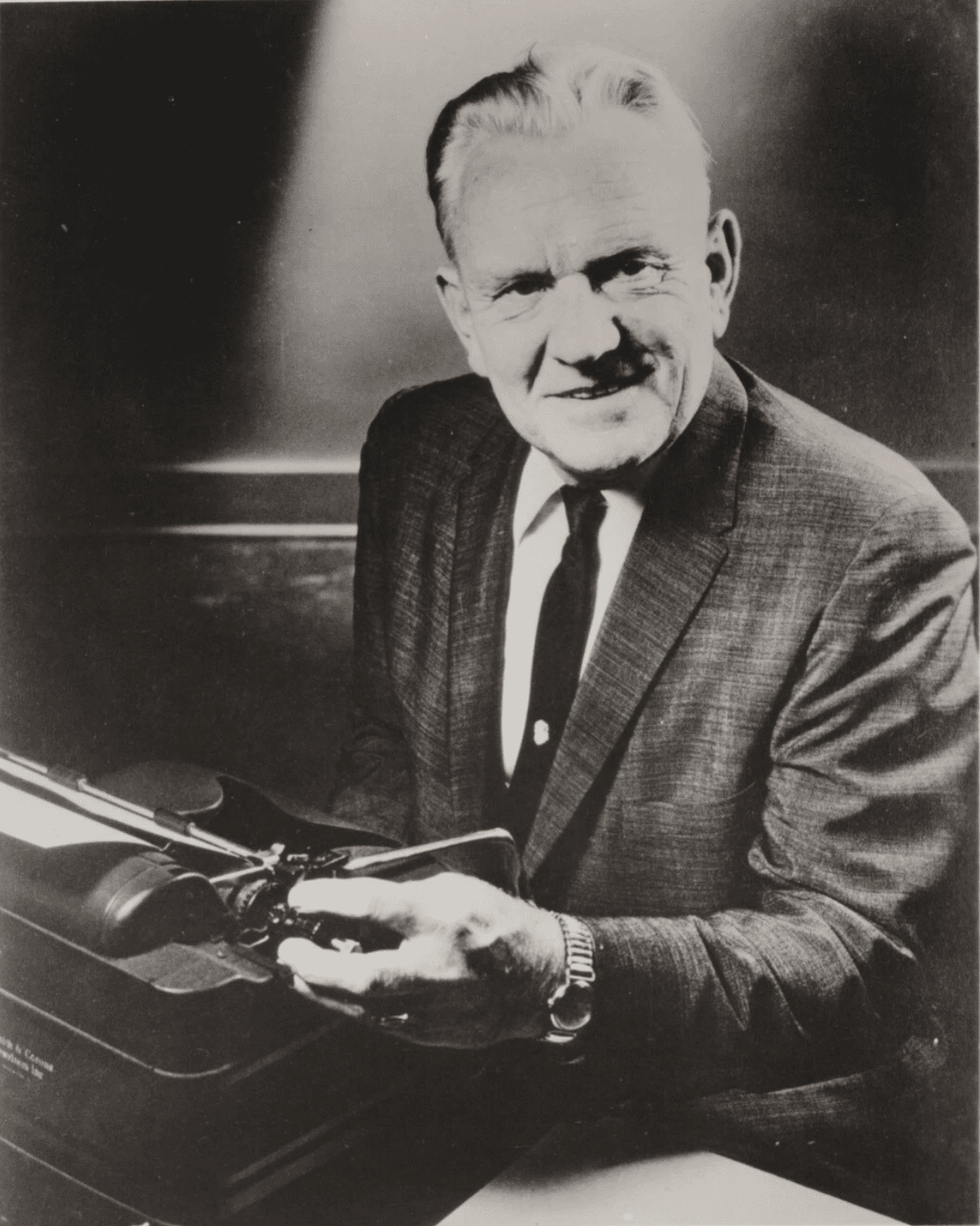
Meindert De Jong
My alma mater, Calvin University (“College” when I was there), celebrates its 150th anniversary this year. For most of its history, this little school founded by Dutch Calvinists punched far above its weight class intellectually. Many people know it for the scholars it has produced: distinguished historians such as Harry Stout and John Van Engen; theologians such as Lewis Smedes, Cornelius Plantinga, James Vanderkam, and Cornelius Van Til; and, above all, philosophers including Willam Frankena, Peter Kreeft, Alvin Plantinga, Calvin Seerveld, and Nicholas Wolterstorff.
Despite the Calvinist reputation for dourness and strict systematic thinking, the school has also produced a great many artists of literature and film over the years. Legendary comic novelist and New Yorker writer Peter DeVries was an alum, as was National Book Award finalist Frederick Manfred (né Frederick Feikes Feikema IV). Paul Schrader, the Academy Award-winning screenwriter of Taxi Driver, Raging Bull, and The Last Temptation of Christ is an alum. Ranking highest in this list, however, is probably the writer of children’s books Meindert De Jong, class of 1928.
Though he started out teaching at Grundy College in Iowa, De Jong soon realized he had little teaching talent (he described himself in an interview as “a total flop”) or desire for the job. Because of the Depression, the college started paying in “scrip,” temporary money that served as credit. He decided to try his hand at farming on his father’s farm in Michigan. Having desired to be a writer since high school, De Jong began to send out stories. While magazines accepted them, they weren’t paying. Eventually, a librarian who was impressed by his stories about his animals, particularly a goose that had a habit of sitting on his head, encouraged him. The Big Goose and the Little White Duck, which he said he wrote in three weeks, was published in 1938. Though he never read children’s books himself, he demonstrated a great talent for writing them.
The first American recipient of the International Hans Christian Andersen for contributions to children’s literature, De Jong has the record for most books—five!—recognized by the Newbery Award Selection Committee. Shadrach and Hurry Home, Candy were both Newbery Honor books in 1954 (he is one of two authors to have two books named in one year), while The House of Sixty Fathers and Along Came a Dog were recognized in 1957 and 1959, respectively. In 1969, he won the National Book Award for children’s literature for his Journey from Peppermint Street.
It is not surprising that such a prolific writer would have been sought out for the still-relatively new medium of television writing. IMDB lists De Jong as the writer for one episode of The Magical World of Disney and eight episodes of the BBC show Jackanory, which featured famous actors reading folk and fairy tales.
The most famous of De Jong’s books won the 1955 Newbery Medal: The Wheel on the House. Like several other of his 27 books, it had two qualities that worked well for him: it was set in his childhood home of Friesland and illustrated by the marvelous Maurice Sendak. Also, like his first book, it involved birds.
“To start with there was Shora,” De Jong begins his tale. A fishing village in Holland, “[i]t lay on the shore of the North Sea in Friesland, tight against the dike.” It is a small village, with five houses where dwell six school-aged children, a school, a church with a tower, and a few more houses with old people. The action starts in the school, where the only girl, named Lina, has written a story of her own accord about storks that concludes wondering why the storks come to villages all around to build their nests upon the roofs—but never to Shora.
After Lina reads her story to the class, the teacher encourages the students to think about storks until they return the next day. To Eelka’s complaint that he cannot think very long about storks, the teacher agrees that one can’t think long about things about which one doesn’t know much. But, he says, one can think much if one exercises the power to wonder. “For sometimes when we wonder,” the teacher says, “we can make things begin to happen.”
The students do attempt to use that power of wonder. Lina does so and goes to share her conclusions with Grandmother Sibble, who is not really anyone’s grandmother except for the whole village. What makes Grandmother Sibble so nice is how she acts with the children. “She didn’t talk to you as if you were a tiny tot, almost a baby, and miles of years away, the way grownups usually did.”
As it turns out, Grandmother Sibble, sitting on her stoop, has been dreaming of storks for years, too. She remembers the days when the storks did come to Shora. When Lina offers her theory that the roofs are too steep in Shora, Grandmother Sibble advises her to “try to think the way a stork would think!” She talks about the trees that used to be there and wheels on tops of houses to make the nests less precarious. She then sends Lina in to get some wineballs from her candy tin. The tin has a picture of a village on its lid. The village trees have tall storks in them. The houses all have nests on their roofs.
Lina brings the wineballs back to the porch, filled with the possibility of bringing those lucky birds back. As Lina leaves, she looks back with wonder, not only at the fact that things have begun to happen, but at the warmth she feels “about a little old lady who had become a friend.”
At school the next day, Lina is infuriated at and rats out the boys who went ditch jumping rather than think about the storks. She is more interested in the storks, however, and relays her conversations with Grandmother Sibble and the solution to the problem. Though they cannot get enough wheels for all the houses, can they get a wheel to put on the school?
The rest of the book is about the pursuit of a wheel to bring the storks. Lina has catalyzed those boys and, it will be revealed, the rest of the grownups in the village, too. The reader follows all of the children in their attempts to get the wheel: “Jella and the Farmer”; “Pier and Dirk and the Cherry Tree”; “Auka and the Tin Man”; and “Lina and the Upturned Boat.”
By the last-named chapter, the children are now altogether again and working as a team. As it happens, Lina herself discovers a wheel under a boat stuck in the dike. The trick will be to retrieve the wagon wheel and place it on the school as a storm hits. Then, they must rescue two storks stuck on a sandbar.
All of this is perfectly gripping storytelling. But, as with Grandmother Sibble, the heart of the action is not purely external. It is the discovery of the potential friends one has who are geographically close but not intimates in any way. Old Douwa, 93-years-old but seldom seen in the village because his days are spent taking long walks to distant villages, is the one whose boat has been stuck for close to eighty years.
And “legless Janus,” reputed to be the meanest man in Shora, is now at the heart of the children’s attempts to retrieve the wheel and mount it. As the children have discovered he is not so mean, this wheelchair-bound man has discovered that he still can contribute, offering his know-how to those down in the dike trying to retrieve the wheel. “Here he was on the dike with the sea below thundering in full tide. Here he was in the midst of things again.”
Not everything works out as the children or adults would like, but De Jong’s tale is not merely about what we like. It is about what we need. Too often, announcements in our world that “We’re all in this together” are merely announcements from powerful people that they are in charge. De Jong’s beautiful tale is something different. “A little child will lead them,” the Prophet Isaiah tells us. And so we see Lina and eventually the other children leading the way in restoring the communion of Shora with the storks and each other, including the old and the lame.
The last of Sendak’s 44 black-and-white illustrations depicts the whole village around the school, looking up in wonder at what just a short while ago had seemed impossible. “Storks in Shora,” Lina says to her new friend in the wheelchair, who is not so mean after all. “But I can believe it, Janus! It’s so impossibly impossible, I can believe it now.”
What began in wonder led to faith and was crowned in a vision of the birds in their nests and the goodness and pleasantness when brothers live in harmony together.
__________
The Imaginative Conservative applies the principle of appreciation to the discussion of culture and politics—we approach dialogue with magnanimity rather than with mere civility. Will you help us remain a refreshing oasis in the increasingly contentious arena of modern discourse? Please consider donating now.
The featured image is a photograph of Meindert De Jong by Marvin Lanninga.



Lovely article! I fondly remember reading De Jong’s book as a kid, and now both of my siblings attend (or have attended) Calvin University.
Yes! I also recall reading it as (probably) a young teen, and being enraptured.