
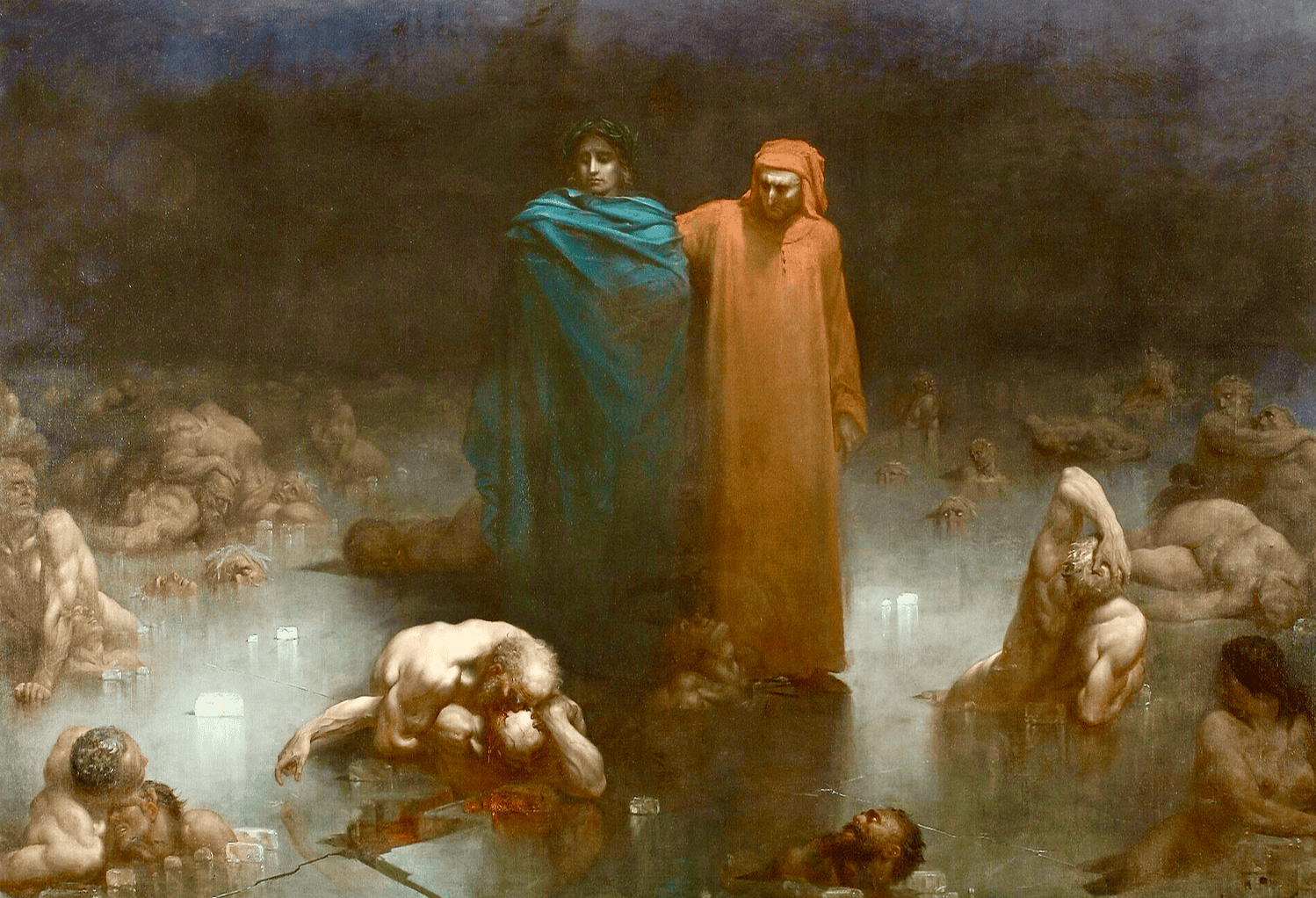
Perhaps prison was the very best place to read the “Inferno.” Gustave Doré’s engravings on the overhead embellished my lectures, and I immediately noticed my jump-suited students raptly attentive to his vivid representations of Hell’s punishments. “What happens if you’re guilty of more than one of these?” one sheepishly asked. No one laughed.
 The department chair popped out of his alcove like a cuckoo clock striking one. He’d clearly been expecting me along my usual route to class. “Can I speak with you for a minute?” he asked, pulling me into his office. When a first-year assistant professor gets grabbed like this, you expect bad things. A grade complaint? (“You see, when you only answer one of four required essay questions, your odds of passing drop rather quickly.”) A student didn’t care for my lecture on the Stamp Act? (“Look, it was an ordinary law, lots of precedents, nothing remotely obnoxious about it.”) My tie was seasonally incorrect? (“Who wears orange in February?”) He closed the door behind me looking pensive. “Professor Blue has to drop his classes for the remainder of the semester due to a personal problem and I’m wondering if you’d be willing to cover two of them.” In your second semester of a job it took five years to get, there is only one answer. “Great,” he replied in his thick Brooklyn accent. “One is here on on-campus, and the other is Fridays at the state prison. They’re both the usual Great Books classes. I’ll hook you up with Mr. Green, the prison education director, and he’ll ….” I zoned out after “prison.”
A prison teaching assignment (we called it “the pokey,” the state called it “the correctional facility”) was always possible, and the job listing when I applied stated it clearly. I accepted that one day I might get the call, but never mid-semester. These classes were unpopular with professors, and one colleague even acquired a doctor’s note to avoid them and incurred the chair’s wrath. Part-timers usually covered them. But they were important to the college since inmates could earn a degree and cut their sentences, and state government funded the entire program. Even decades ago, long before enrollment cliffs and “birth dearths,” colleges searched for any revenue stream.
First up, I had to face the on-campus class, and I insisted the chair join me to explain the switch. The class was full to seating capacity, thirty-five college seniors loudly expressing their unhappiness so near to graduation. Their concerns were perfectly reasonable—like how would their grade be impacted and how assignments and classwork would change. Professor Blue and I came from different disciplines, and we understood the world in radically divergent ways, so the syllabus had to be rewritten. Let’s just say Blue reveled in Foucault’s Panopticon, and I’m a Burke and Hayek kind of guy. There would be changes. Questions on Blue’s exit we could not answer, privacy rules and all, and after a few minutes the chair left. The best I could offer them was, “You’re unhappy and I didn’t expect to be here, but we need to finish this semester and get you graduated.” That settled them down.
Prison teaching took longer to arrange, and paperwork, background checks, and acquiring an ID delayed my entry for weeks. When the day came, I arrived at the prison parking lot and awaited the van taking instructors inside (a few others teaching math, writing, and GED accompanied me). Your stomach tightened the moment you exited your car. With Mr. Green in the driver’s seat, we headed toward the “Welcome Center” and joined locals visiting inmates and welcoming those being released. Guards examined IDs, frisked us down, and ran our bags through a luggage scanner like we were boarding a flight. My leather satchel contained a few books and notepad and nothing else, since they looked closely for anything qualifying as contraband or dangerous. You always emptied jacket pockets and bags Friday mornings before you left the house, just to make sure. One instructor actually arrived one day (I was not there) with a hollowed-out book in his briefcase containing a small pistol, like a Cold War spy sneaking into East Berlin. “It’s just for protection,” he told incredulous guards. Alas, he never taught at prison again. Once complete, we moved through remotely controlled, heavy, metal doors (clank!) and back to the van, which Mr. Green had driven through the gates after it too was searched.
The prison was a series of rings and sectors varying in security. This outer perimeter was less intense, and we passed large barracks for offenders transitioning toward release, the brick hospital and administration building—which looked better suited for an Ivy League campus—dozens of trucks and small equipment maintaining a facility the size of a golf course, and the back wall of the super-max facility (its entry was on the high security side) whose tiny, tinted, slit windows looked like they shielded bowmen poised to puncture our van with arrows. At a second gate, a towered guard waved us through to the education building, and Mr. Green drove into the garage, closing the door behind us. This job was no place for claustrophobes. Once inside, you too were prisoner with no quick and easy way out.
The tired, ugly, low-slung, disco-era education building smelled of dust and decades of marginal maintenance. People of a certain age remember buildings like this. Everything is mid-century modern and square. Square windows on the outside and on the inside decorative squares of red, yellow, orange, and blue like a Mondrian rip-off. Florescent lights hummed overhead, and threadbare wall-to-wall carpets lined the classroom corridor. My room was midway down on the left, just opposite the doorless bathroom. It looked like most classrooms in America, just bleaker. The blackboard was caked with chalk dust, and your scribbled words hid amidst the fog if you tried writing on it. I gave up after a few classes. Beside the board, a cart with an old overhead projector guarded a television and VCR which rarely worked. This was the only technology allowed, since rules forbid prisoner access to computers or the internet. Students hand-wrote all assignments on lined white paper.
Windows lined the wall opposite the door, looking out onto a neglected garden courtyard of dead, tall grasses surrounded on three sides. The courtyard end opened to the muddy driveway, the inside fence, more barbed wire-topped fences beyond, and then thousands of acres of corn fields speckled with tree groves. On the far horizon, freight trains moved east and west with frequency, and through the thin dirty windows could you hear their horns.
I hear the train a-comin’, it’s rolling ‘round the bend
And I ain’t seen the sunshine since I don’t know when.
By the door on a shelf sat a solitary roll of toilet paper. Only one student at a time could leave for a bathroom break, and each would rise, grab the roll, and return a few minutes later. This was a process I never policed. They knew the penalties and never violated the rules for fear of losing their treasured classroom seats. A drinking fountain stood near the bathroom too, which students only used before or after class. One day just before class I popped into the corridor to see workers disassembling it. They took off the outer shell to reveal its piped intestines jet black with mold. A student passing by caught my eye, and appealed to me loudly: “You see how they treat us here? You see what we have to drink?”
All your senses flipped to high alert the moment you entered prison. You became extremely aware of your surroundings, how people moved, where they sat, who was walking around. You heard everything in the classroom and every creak or shuffle in the corridor. After 15-20 minutes of waiting, you noticed footsteps and voices and students in brown jumpsuits entered the room, always with salutations of “Good Morning” and “Hello.” The moment they arrived you smelled unwashed bodies and unclean clothes. Back on campus without heightened senses or anxiety I may not have noticed, but here it stuck in your nostrils. These prison students never complained or asked questions about Professor Blue, and the transition was seamless and entirely transactional. They wanted that degree, and I held the key. When they realized the new syllabus included Augustine, Aquinas, and Dante, they quickly adapted. They listened to lectures with eye contact and took notes and asked a flood of questions, more than on-campus classes would pose in two semesters combined. Prison students read everything completely and carefully because in a setting of boring monotony they had nothing else to do. These texts occupied their minds.
This was stripped-down education without gadgets or power points, and we read the great works of Western Civilization together in grim, squalid surroundings. I lectured, we read out loud, and we discussed the material back-and-forth in true Socratic fashion. I made one semi-comic mistake, however, although it seemed less funny at the time. Rather than write an entirely new syllabus, I simply used my on-campus version and obliviously included several weeks of reading Dante’s Inferno. Gustave Doré’s engravings on the overhead embellished my lectures, and I immediately noticed my jump-suited students raptly attentive to his vivid representations of Hell’s punishments. “What happens if you’re guilty of more than one of these?” one sheepishly asked. No one laughed. The Inferno was not some theoretical discussion of punishment and justice to them. They were all thinking the same thing.
I never asked Mr. Green what crimes my students committed to be in prison, although he offered to tell me. Afraid it would affect how I interacted with them, I refused. But I knew these were very serious offenses, including manslaughter and molestation. When you accidentally discover a student was a seventh-grade music teacher, you prefer not to know. Perhaps prison was the very best place to read the Inferno.
When the semester ended, every student shook my hand and thanked me as he left the classroom. I won’t say I found prison teaching an enjoyable experience, but I returned the following academic year. Digging through twenty-year-old emails recently, I just discovered that in my second stint I taught Homer’s Iliad, Plato’s Dialogues and the Republic, and (surprise) the Inferno. I must have seen the good in taking my students to Hell and back.
By now, I suppose you’re thinking I’ll conclude with some C.S. Lewis line about learning in prison-time and the humanity of my students:
Human life has always been lived on the edge of a precipice. Human culture has always had to exist under the shadow of something infinitely more important than itself. If men had postponed the search for knowledge and beauty until they were secure, the search would never have begun.… Men are different. They propound mathematical theorems in beleaguered cities, conduct metaphysical arguments in condemned cells, make jokes on scaffolds, discuss the last new poem while advancing to the walls of Quebec, and comb their hair at Thermopylae. This is not panache, it is our nature.
But the truth is more complex. I left prison teaching without redemptive moral lessons on my time in the pokey. It didn’t alter my opinion on human nature or fill me with hope. Mr. Green’s hard words of warning before I stepped into the classroom always stuck with me. “Just remember,” he counseled, “all these guys are con-men. They might not always be good at it—they’re in prison, after all —but they’ll do and say anything to get what they want in here.” Were their handshakes sincere? Did they enjoy and learn from the class as they told me? I have no firm answers, just memories of months inside teaching Great Books. I came, I taught, I left.
A few years later, I bumped into a former prison student in the grocery store. The encounter was awkward, to say the least. What do you say over a bin of lemons and limes? “How’s life now that you’ve been released from jail?” After some basic small talk, I wished him the best while keeping it vague, but we exchanged knowing looks. We parted, and I never saw him again.
__________
The Imaginative Conservative applies the principle of appreciation to the discussion of culture and politics—we approach dialogue with magnanimity rather than with mere civility. Will you help us remain a refreshing oasis in the increasingly contentious arena of modern discourse? Please consider donating now.
The featured image is “Dante and Virgil in the Ninth Circle of Hell” (1861), by Gustave Doré, and is in the public domain, courtesy of Wikimedia Commons.




Leave A Comment