
The American community that I, a Chinese national, discovered on Perrin Avenue in Lafayette, Indiana, offers its members a supportive and loving world in which religious and cultural traditions are preserved and shared beliefs venerated. It embodies many meaningful elements indicative of the original form of the community, which are absent in the ersatz ones of university departments or Facebook groups.

When Linda Schafer, a loyal reader of The Imaginative Conservative, sent me the first email in mid-March 2021 introducing herself and expressing a hope to bring me into her little community, where conservative principles are cherished and practiced, I had no idea that, in the next three months, I would be touring Tocqueville’s America.
As a Chinese national, Tocqueville’s Democracy in America, which I read for the first time in 2015, opened my eyes to a concept of civil society, which is not only absent in the Chinese society but alien to the Chinese mind. In China, government is the only source and authority to which people turn for remedying social problems, notwithstanding its blatant and unapologetic unfairness and injustice. There are no intermediaries such as churches, neighborhoods, or PTAs as go-betweens between the state and the individual. Contrary to many Westerners’ impression that Chinese society is cohesive and humane because Chinese are family-oriented, in fact Chinese society is run on what Edward Banfield would call “amoral familism.” In The Moral Basis of a Backward Society—a classic in political science published in 1958—Banfield defines amoral familism’s operative principle: “Maximize the material, short-run advantage of the nuclear family; assume that all others will do likewise.” The civil society that grew up organically and historically on American soil that was, almost providentially, fertilized with a rare spirit of freedom, thus offers me a stark contrast to the totalitarian and atomized society where I have lived for 30-plus years.
Since in today’s political climate people attach whatever meanings to whatever terms they use, I should properly define civil society before I proceed. Civil society refers to the plural and particular relationships (i.e., not uniform) and local institutions that are created at liberty and that operate outside the turf of the state. The essential components of civil society are families, neighborhoods, and rich webs of religious and civic associations. In Edmund Burke’s words, those communities are the “little platoons” that are fundamental to human flourishing. Only in small, particular, and thus tangible social orders can humans develop a clear sense of justice and goodness, build interpersonal trust, as well as foster competence and good character. Only in little platoons do we have the best chance of raising good children and virtuous citizens.
The Perrin Platoon
I remember I was quite surprised to read an email of literary quality. My surprise would be more understandable when putting it in the context that I have resided for the past 3 years in a public university where graduate and undergraduate students nowadays speak and write in broken English that is littered with excessive “likes.” To Linda’s surprise, I responded with enthusiasm that I was eager to meet her community. My eagerness to meet “other” Americans would make sense considering that, as absurd as it may sound, I have lived in a collegiate and purportedly collegial environment where the inhabitants strike me as not quite real humans but as simulacrums. They have the same look, wear the same demeanor, and speak the same language that is coated with a thick layer of affected, excessive politeness. I was anxious to step out of that supposedly liberal precinct where certain pseudo-concepts (i.e., untethered to reality) are imposed on everybody, such as androgyny or gender fluidity or Stop-Asian-Hate.
Only a few sketches of Linda and her husband, whom people call “Spider” in affection, would suffice to vividly portray what rooted, experienced, and tradition-oriented Americans they are. Linda, who recently retired, served for 35-plus years as a music director at St. Boniface Church, Lafayette. Spider owns a local roofing company that has been in business since 1970. They have six children and 27 grandchildren. Almost half of them live in the same neighborhood: On Perrin Avenue in Lafayette, Indiana.
Today, too many English words have had the original meaning sucked right out of them, leaving behind a protean sack that can be and oftentimes is stuffed with vague, sweeping, and arbitrary substance at whim. The word community is a conspicuous example of such semantic abuse. The Perrin community, however, astoundingly embodies many meaningful elements indicative of the original form of the community that are completely absent in the ersatz ones of university departments or Facebook groups. The Perrin community takes shape, through a long period of time, out of face-to-face, person-to-person engagement, and close participation among group members. It is bounded, both metaphorically and literally – their properties are properly fenced. It is earthy and real.
Neighborliness
Many observers have written in agreement that American community life is unlike community life elsewhere. Among the observers, Alexis de Tocqueville was undoubtedly the most influential and authoritative voice. He identified two aspects that make American community life exceptional: One was its neighborliness and the other the existence of voluntary associations to solve local problems.
The neighborliness I witness on Perrin Avenue breathes in the sense that the neighbors are real social creatures who form and flourish in their community and who enrich each other’s lives in sociableness. The spirit of association, the spirit of locality, the spirit of work (not labor), and the spirit of play that permeate the neighborhood are vibrant, palpable, and, most amazingly, contagious.[*], As Tocqueville and many others have articulated, those spirits constitute the very conservative soul that has made Americans exceptional people and accounted for the endurance of America as the longest-lasting constitutional republic in history.
The Perrin neighborhood offers community members a comprehensible, supportive, and therefore loving world in which religious and cultural traditions are preserved and shared beliefs venerated. As a result, when for the past several years many patriotic Americans were fraught with a vague but genuine and pressing thought of “wanting their country back,” the Perrin folk never felt that they had lost their country because they saw in each other every day what America is and what Americans are. And I see in them the Americans I adore and the America I admire—a land of freedom, the home to a group of patriots and friends who are authentic, confident, spirited, joyful, self-respecting and respectful, devout, faithful, kind, generous, and whole-heartedly welcoming to an alien whose nationality and skin color and exotic accent bear no significance because she has one thing in common with them: She deeply appreciates the traditional American way of life. The Perrin folk have thus shown me in a tangible and personal way why America has for centuries attracted immigrants around the world. It never really is about the so-called American dream, at least not primarily; the charm is the fulfilling and delightful communal life that the diverse and vital American communities have offered humans, all of whom have an enduring and profound need for belonging and attachment.
The Perrin neighborhood also provides members a public space where social life, rather than the act of consumption, takes place. Consumption is a lonely and dreary activity, propelled by and prevalent in industrialized mass society. It has shaped much of the daily routine of our modern life. There is a feedback loop between consumerism and loneliness that is incessantly haunting the atomized individuals who keep themselves busy by surfing YouTube or shopping Amazon. For the past ten years, I was horrified to see many of my fellow Chinese transform from peons to dedicated consumers with impressive purchasing power who spend their off-work time in shopping malls, wheeling their toddlers around or strolling through stores with their elders. The shopping mall for Chinese is the only public sphere permitted by the state, except “the common good” is merely the goods that the people consume in common.
Rather than the antsy Chinese consumers who often find themselves lost in a fog of commodity choices or the hip Americans who wake up with a stranger in bed after a glittered Friday night, I see in the Perrin public sphere lively, and again earthy, gatherings where a group of neighbors and friends are comfortable and delighted in their settled forms of social life. Here no one is distracted by the “modern life” that is supposed to be inundated with emails, texts, or phone calls; they are effortlessly fully present and engaging each other with full attention. Hence, the precious moments I experienced in the Schaffer family gathering after the Easter Sunday Mass, George’s First Communion celebration, David’s birthday, or Farther Elliot’s ordination were reassuring because they vindicated my philosophical conviction that our deepest emotional needs can be satisfied only in genuine human companionship.
The Family
The most noticeable characteristic of the Perrin Platoon is its idiosyncratic families. Family, according to the conservative understanding that is rooted in human nature instead of abstract philosophizing, is an institution that emerges naturally. Matrimony, seen in this way, is not a cold, calculated social contract between two consenting adults, one or both of whom can dissolve it at will. It is a union with a telos that transcends the husband and the wife and that transcends the present. Children (not exclusively biological) are precisely the thing that delivers the transcendental leap. A family, run on this understanding, is not merely a source of support or benefits; it lays down a thorough grounding in the lives of the offspring who have a better chance of developing a particular personhood than their counterparts who grow up in the liberal or progressive ethos that champions diversity but in effect mass-produces conformity in terms of a way of thinking and way of behaving.
Claire, a mother of five, has a poetic heart; Katie, a mother of seven, has a logical mind; and Audrey is Ms. Sunshine. She just had her second baby. Their children each exude idiosyncrasies that fascinates my analytical mind and warms my heart at a time when I oftentimes find myself disheartened to see their peers in either China or America growing up as mass men who are undifferentiated from one another, and worse still, now becoming an extension of the digital devices without which they cannot live.
“You must mention the woods,” Linda said to me. Linda was referring to the woods in her backyard where her grandchildren spend lots of their outdoor time. The woods, alive with openness, potentiality, and wonderment, represent a crude world that is antithetical to the closed, safety-proofed, polished, and hyperpalatable-engineered playgrounds that are characteristic of the consumer society where humans seem to be collectively evolving into the bars of barcodes, reduced to machine-readable form. Linda pointed to the “forts” built by the kids with branches. In her proud gaze, I read a few elements that are essential to making us fully human—play, problem-solving skills, exploration, imagination, and true human autonomy. The cultivation of such virtues is possible only in nature and in the delightful and scented solitude where inexpressible magic floats in the air.
The Communitarian
The two mechanisms that have up till now safeguarded American democracy—namely, private associations and local self-government, according to Tocqueville—served as an effective check on both the tyranny of the majority and individualism in its extremity. Just like his European contemporaries, who all noted that Jacksonian Americans were restless with enterprising energy and obsessed with the “almighty dollar,” Tocqueville commented in length in his book about Americans’ “spirit of gain” or “passion for wealth.” He was deeply troubled by an individualism with acquisition and material pleasure at its core. For Tocqueville, individualism painted in this light was not only offensive to his anti-commercial sensitivities but worrisome because it would eventually create a bourgeois-type liberal society where self-centered private individuals, who are preoccupied with self-interests instead of public and communal concerns, would easily cede their autonomy to a despotic, tutelary state that takes over child-rearing, education, commerce, and, finally, the ability for one to think for oneself. Tocqueville attributed this degraded individualism largely to Protestantism and the unquestioned acceptance of Cartesian thinking that regarded individual reason as the sole source of truth.
Perhaps because of their Catholic faith that is not individualistic but fully communitarian, most of the Perrin folk do not seem to possess the “unbounded desire for riches” that Tocqueville criticized with avidity. It seems to me that they prefer the pleasure of imagination and the labor of intellect to the pursuit of money. Rather than perpetually moving whenever opportunity calls, the Perrin folk seem to be content in taking root in their shared and beloved communal life.
The Return to Human Nature
Conservative principles are sometimes criticized, by opponents in good faith, of representing grim sentiments of yesteryear, trying to conserve things that should be left in the past. It seems hard not to buy into that kind of argument, for, as a Chinese proverb says, it is prudent to swim with the tide. But is conservatism really an inopportune nostalgia? No, the Perrin Platoon has offered us an unambiguous answer to that question: Conservative principles are not only the good but also the right way of living because they adhere to our human nature and attend to the deepest human needs. Conservatism, therefore, does not conserve “the past;” rather, it tries to preserve the eternal.
The Perrin Platoon represents the conservative soul that we can rightly call American conservatism. It is not the ahistorical, dogmatically political, and ideological neo-conservatism that emerged in the Cold War era. Nor is it the Lockean liberalism that conceives humans as individuals born into a mythical “state of nature” and champions a version of social contract too narrowly understood. For all its emphasis on liberty, the Lockean contract leaves a door wide open for deforming human nature into an unencumbered self that is detached from any pre-existing relationships and constraints. This leads to a slippery slope of a delusional and overbearing understanding of ourselves and the universe, as evidenced in the 1992 Planned Parenthood of Southeastern Pennsylvania v. Casey Supreme Court decision: “At the heart of liberty is the right to define one’s own concept of existence, of meaning, of the universe, and of the mystery of human life.” The ignorance and hubris vividly revealed in that proclamation rendered me speechless, as it is an undeniable truth that each life is created in a particular context—a peculiar story, in Alasdair MacIntyre’s word, which defines one’s starting point for crafting one’s self-identity and seeking the good in the world. Whether one likes it or not, or recognizes it or not, a specific past is always present to some degree in one’s present, as MacIntyre eloquently put it.
Individual happiness and human flourishing are possible only when we have an adequate understanding of human limits.
The Ending
I want to end this essay by saying a few words to Helen, a young lady whom I promised I would mention by name in my essay. Helen, if you ever doubt the way in which you were raised in the Perrin Platoon or question the adequacy of your home, please then listen closely to a weary voice.
After many years of rebellion, the initial thrill I got in defying tradition for apparent emancipation and in rejecting customs for shallow novelty has become banal; the delusion that one could seek freedom in revolt has faded away. What is now left in me is a gloomily meditative mind and an aching soul who does not know where she belongs or of what and whose story she finds herself a part.
Only in moments spent on Perrin Avenue, have I ever felt light-hearted, rested, and peaceful.
__________
[*]Here I am citing Hannah Arendt’s definition of and differentiation between labor and work. According to Arendt, labor exclusively corresponds to biological processes and attends only to necessities that human existence dictates. Labor creates nothing that is long-lasting, and once its efforts are consumed, the activity must be renewed. It is never-ending. In this aspect of existence, humans and animals share the same territory. Hence, Arendt refers to humanity in labor as animal laborans. Work refers to making or building things. The artifactual construction endures after the activity of work comes to an end. Arendt argues that work is distinctly human, a privilege not shared with animals, because it is not governed by biological needs but adheres to ends and intentions.
The Imaginative Conservative applies the principle of appreciation to the discussion of culture and politics—we approach dialogue with magnanimity rather than with mere civility. Will you help us remain a refreshing oasis in the increasingly contentious arena of modern discourse? Please consider donating now.
The featured image is “Luncheon of the Boating Party” by Pierre-Auguste Renoir, and is in the public domain, courtesy of Wikimedia Commons.



An outstanding essay.
Habi, I love this so much. I appreciate how you mention that the Perrin Platoon has come about over time- fifty years in this case. It happened with people planting their roots and “sticking it out”. I have heard people say that they want what Perrin has- but think that they can create it out of nothing and instantly. We have tended to the Perrin garden for a long time and that is the only way it can be authentic- with hard work and toil. We are so pleased that you have found refuge in our small piece of the world. Yours, Mary (the Southside Outlier)
Mary, I love your response. I was talking today with Piroska who mentioned the difficulty of extracting a formula from the Perrin Platoon and replicating it elsewhere. I think it is almost impossible or surely undesirable to do so. Should there be a formula that allows for mass production of the Perrine Platoon, what we would produce is only the ersatz community, something akin to dummies in the shop window. What I wish to see is millions of little platoons of their own particularities which constitute true beauty.
Good afternoon, My name is Eve. I wanted to let you know that the Perrin Platoon is not alone! You see, my husband and I have lived our lives as military service members for a long time and have finally found a resting place in the cold wild valleys of Colorado. Here, in a town sweetly tucked in folds of the mighty Rocky Mountain range is a small town called Larkspur. At first glance driving through you would completely miss the world that exists out here. The valley is spread out, dotted with small ranches and farms, but there is life hidden here. Our children run through the woods with puppies in tow, calling to one another to come play. “Forts” are dotted all along the way between houses across the landscape. Families plan their properties out to support one another, not just themselves. The deep reverence of patriotism and pride in work and craftsmanship is thick as the sweet honey we harvest and share out here. Gardens are grown to feed us all and we work in kind to raise our young. When they say it takes a village… yeah, we got that!
Habi Zhang, the American spirit is not gone, or (from where I sit) in danger. For tucked away, outside the bustle of major cities, and crowded mindless suburbs there are many small, what would appear to be, sleepy towns, and we are very much alive. I will tell you this Habi as well to grant you a little hope of finding your place. My grandmother came here from Hokkaido, Japan. She fell in love and came here with with my grandfather, an Army soldier, who’s ancestor (William Bradford) also made the frightful journey when America was just an idea. We all found our home here. The sleepy towns are waking up, and we will fight to keep our homes and our freedoms I promise you that. Kindly, Eve
I want to move to Larkspur!
Keep the essays coming, Habi! I have been deeply moved by your contributions and appreciate learning from your profound musings on American life.
Thank you, Aaron, for your very encouraging words.
A wonderful validation of a life we have chosen. Thank you for your inspired and uplifting words.
What a wonderful evocation of life in one particular community.
Love this so much! Thank you for writing about the Perrin Platoon! I put this quote from your writing in my Quotes file: “Conservatism, therefore, does not conserve ‘the past;’ rather, it tries to preserve the eternal.” Yes, yes, yes. I feel like this is what CS Lewis was trying to showing us in his novel “That Hideous Strength.”
Very perceptive social anthropology. And by an outstanding writer.
A wonderful essay. Thank you. Hopefully the America about which you write is not disappearing.
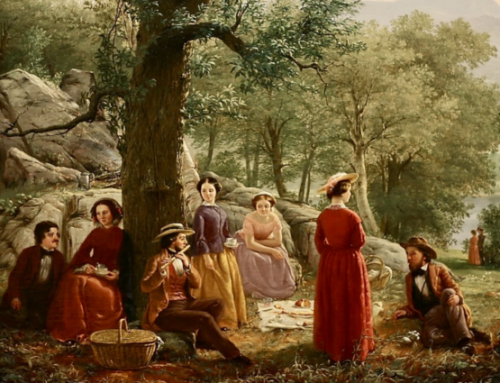
Interesting to see the ideas illustrated with “Luncheon of the Boating Party,” as a copy of that painting decorated my wall for some years. Like the Perrin Platoon, my childhood friends played in the woods and built forts. Maybe the absence or rivers, lakes or outdoor places of conviviality in our very”dry” part of Texas made Renoir’s slice of life including some friends more attractive, but we lived it together.
Habi, just finished your essay. Your writing is a voice for some of us that are silent, only because we have not found a way to say what you have said. I have always believed what you taught so well.
Thinking and pondering upon the lovely, and enduring principles of happy living,you have suggested, is well received here. I do hope we will discovercover (again, and again) and preserve them in our daily living.
Thank you