
“The ‘contact’ between seen and unseen is not a secret formula but a person,” says artist Martin Earle. “The ultimate justification for Christian art is that the infinite God has taken the initiative, revealing Himself in a finite form. This is the form we encounter sacramentally in the Mass, and it is the form sacred art touches and seeks to manifest.”
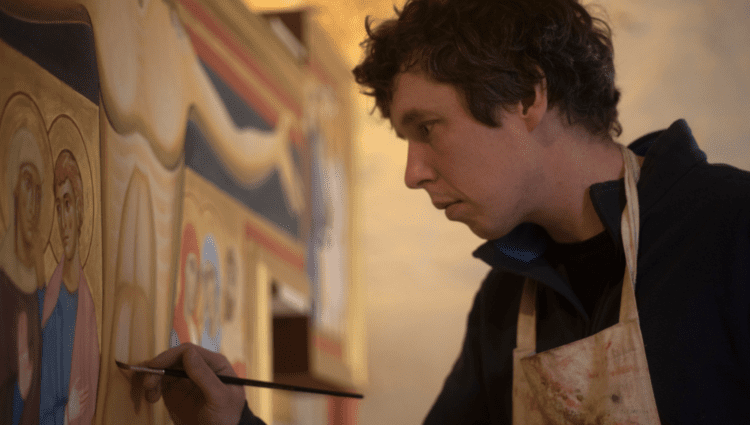 Martin Earle is a traditionally trained Catholic artist creating work for the liturgy in egg tempera, carving, and mosaic. Alongside commissions, he develops design schemes and projects, often in collaboration with other craftspeople. His work draws on the Church’s living visual tradition—especially Early Christian and medieval art—seeking a language that is iconic, contemplative, and attentive to Revelation. His inspirations include the mosaics of Ravenna, the sculpture of Chartres, the Winchester Bible, and the altarpieces of Fra Angelico.
Born in London in 1984, he entered the Catholic Church during art school, after reading the Gospels and The Belief of Catholics by his great-great-uncle Monsignor Ronald Knox. After graduating from the Royal College of Art in 2008 and spending time as an assistant in a L’Arche community, his formation included a five-year apprenticeship with the iconographer Aidan Hart.
He sees sacred art as a way of helping people enter more deeply into the mysteries of the liturgy.
Based in the UK and working internationally, recent projects include an award-winning crucifix for Aberdeen Cathedral, a chapel for a retreat centre in Wisconsin, a reliquary for St Eanswyth, and a limestone altar in a converted pigsty in North Wales.
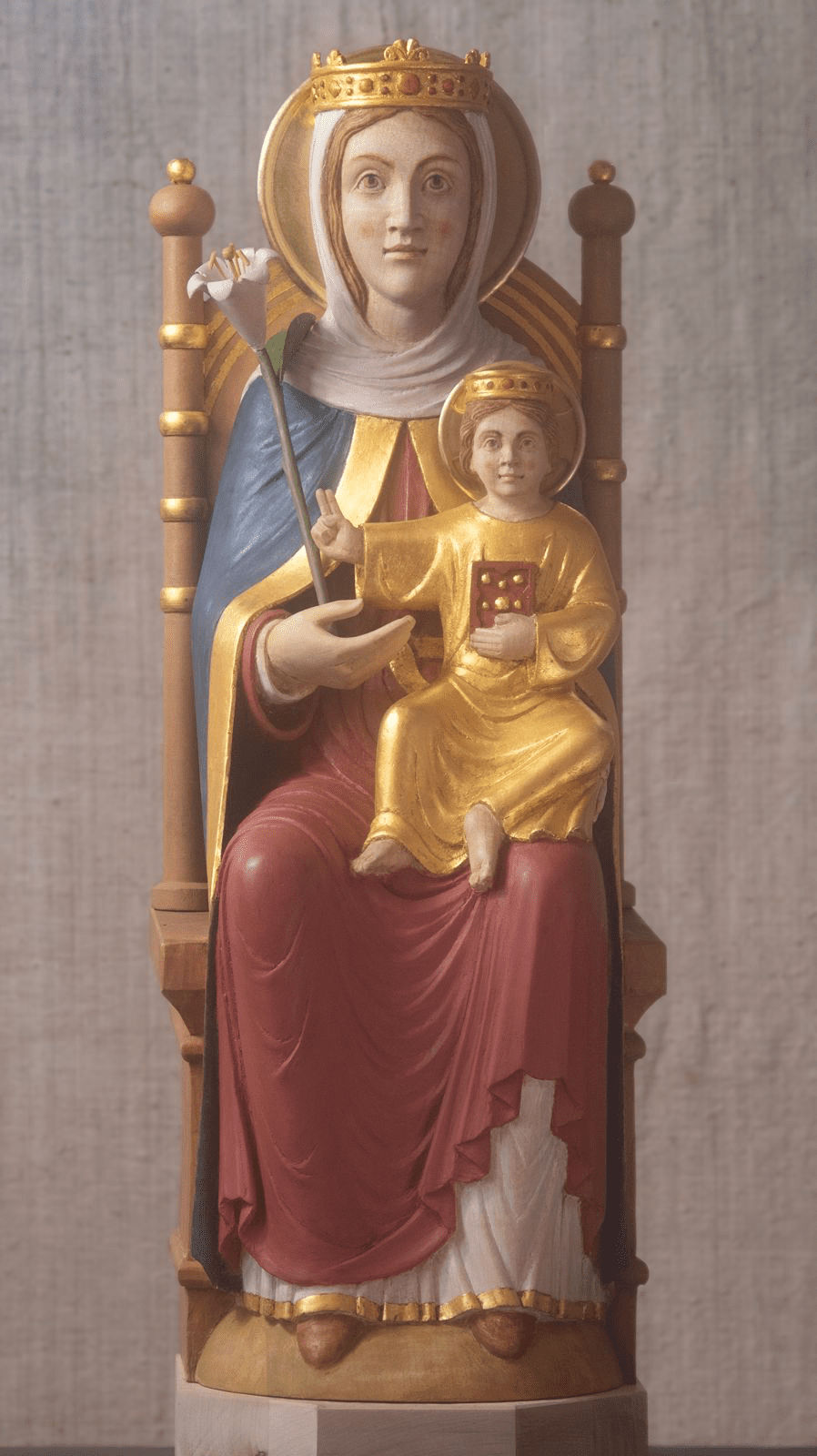
Our Lady of Waslingham, Arundel Castle
Robert Lazu Kmita: Dear Martin, let’s talk from the beginning of our discussion to what is—without a doubt—the heart of the matter: What is Christian sacred art? I emphasize that to such questions, the most detailed answers—even if long—are the best. So please, if you wish, feel free to quote the definitions of the masters you follow in addition to your own.
Martin Earle: Nonetheless, I’ll try to be concise! Sacred art is best defined not by its subject matter but by its use. A helpful working definition is this: Sacred artworks are things we make to use in the liturgy. The term is democratic. It is no guarantee of artistic quality or even of any particular style or content. An altar cloth your grandmother stitched is as much a work of sacred art as Chartres Cathedral. Chalices, altars, churches, chairs, incense—these are sacred artworks only insofar as they have something to do with the sacred rites. In some ways, the altar cloth is more fully a work of sacred art than the cathedral, because it is so close to the heart of the action.
Josef Pieper writes brightly about this in In Search of the Sacred, drawing on Aquinas’s formula: “A thing is called sacred (sacrum) by virtue of its relationship to divine worship (ad cultum divinum).”
Because sacred art serves the rite, we can also see—within Catholic tradition—another important, though not strictly essential, role. Sacred artworks manifest the rite through images. They speak in pictures. They bear witness to the invisible realities into which they are drawn. They facilitate, and they reveal.
One more thought. Whether the Mass is celebrated in a basilica or in a gulag, it is not possible without bread and wine—without things made for the Mass, without sacred art. So, mysteriously, what we make has some central role in the New Covenant.
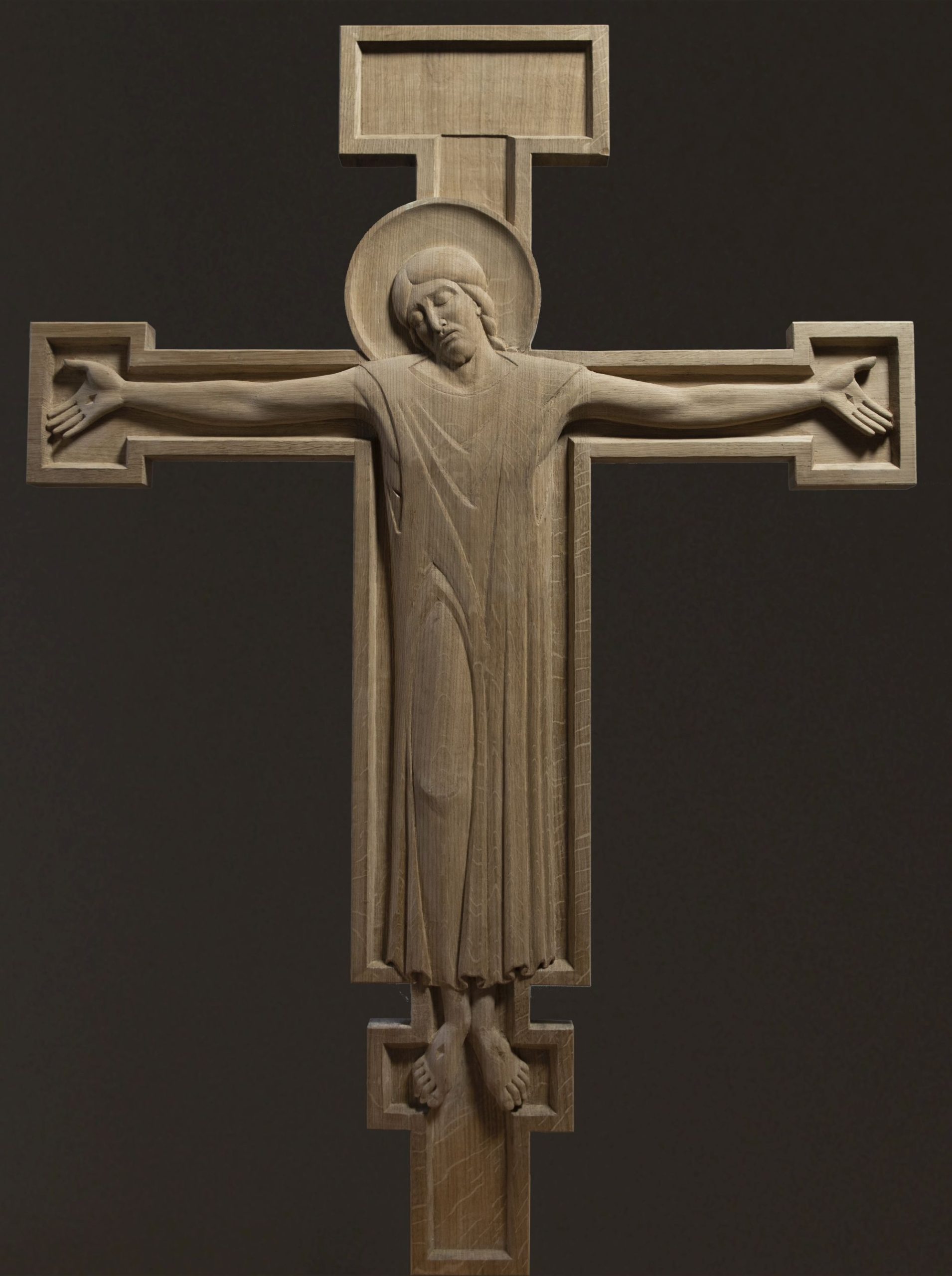
St John the Forerunner crucifix
Robert Lazu Kmita: There are some aspects in your answer that must be developed. At least three questions instantly blossomed in my mind when I was reading your insights. I will ask the first: Besides the sacred artworks used in the context of the Holy Liturgy, are there sacred works that are not liturgical? Can such sacred creations be “domestic”—like an icon or a statue that is used at home by a faithful Catholic?
Martin Earle: Part of me wants to be disciplined with the terms: The artworks you describe, an icon in a bedroom or a statue in a garden, are devotional rather than, strictly speaking, sacred. The terms sacred, profane, devotional etc carry no qualitative weight; they aren’t intended as grades of excellence. Instead, they simply describe the sphere an object is useful in.
But your question highlights that these boundaries can be porous. I am thinking again of Josef Pieper and his identification of the liturgy (cultus) as the soil from which all human culture grows. If we take this seriously, the distinction between the sanctuary and the world begins to soften. The “river of life” flows from the temple and into our cities, homes and gardens and alleyways. Like the Corpus Christi processions that take place in Catholic countries, where what belongs to the altar is carried into the streets and cultivates beauty wherever it goes.
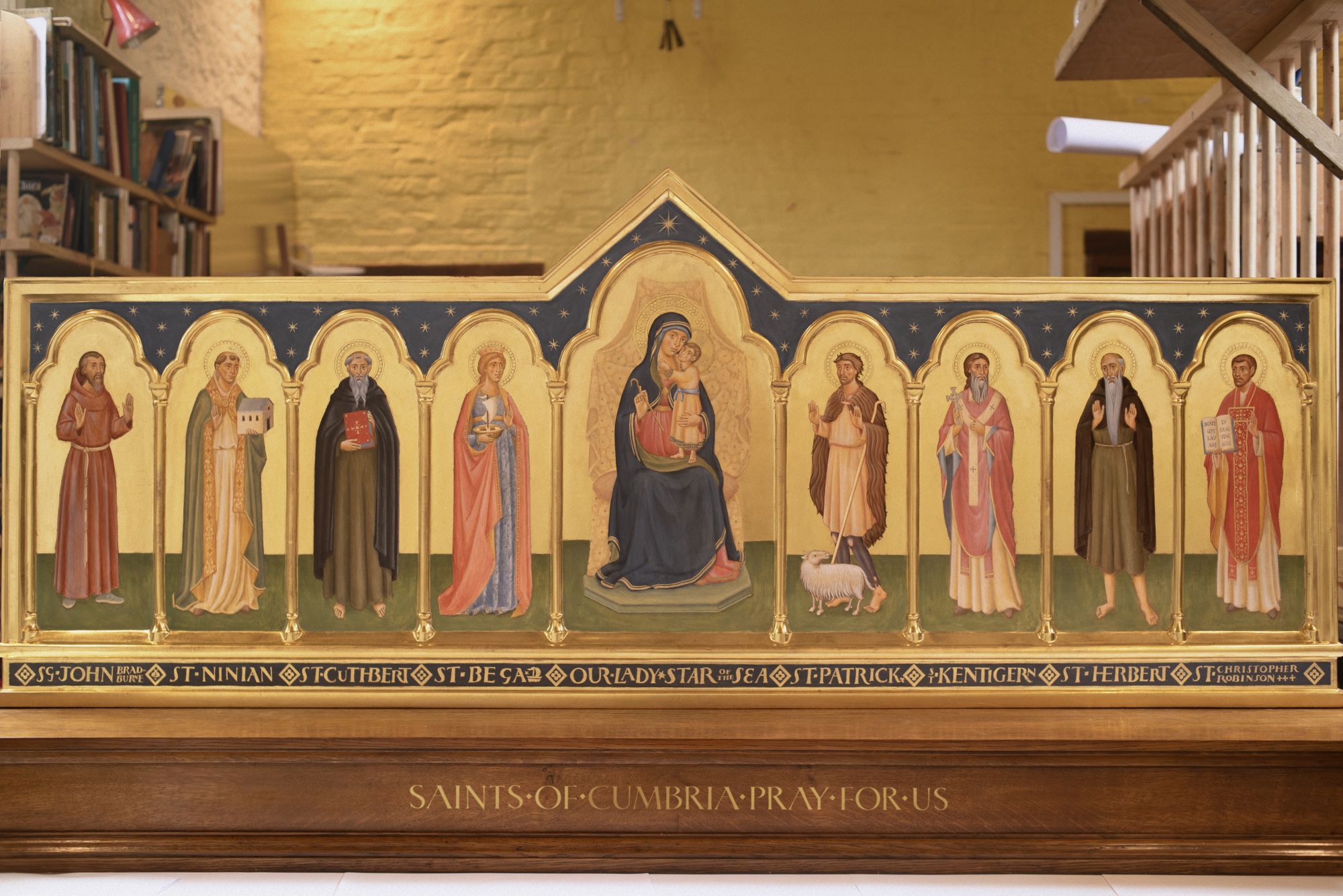
Saints of Cumbria altarpiece
Robert Lazu Kmita: I propose to our readers to keep in their memory and ponder in their hearts this extraordinary image: The “river of life”—that is, supernatural life given to us through the Holy Eucharist—that flows from the temple into our cities, homes, gardens, and alleyways. Wonderful!
Now, related to the “liturgical” definition of sacred art, as the sum of the artworks used in the context of the Holy Mass, I think that it covers only the extrinsic dimension of it. I am sure that you will not accept that any type of artwork introduced into the liturgical context can be considered sacred. That implies that there are some intrinsic qualities of a piece of art for it to be considered sacred. What are those qualities that make an icon an icon? Or a real chalice a liturgical chalice? Can a plastic cup be made sacred only because a priest used it to keep the Holy Sacrament of the Altar in it? Or can a whale made of plaster and displayed in front of the altar be considered sacred?
Martin Earle: I understand your hesitation, but perhaps what we recoil from in the idea of the sacred-plastic-cup is actually something close to the scandal of the Incarnation. In the first ‘liturgy’—she wrapped him in swaddling cloths…. Christ was laid in a manger, a trough. The plastic cup chalice is obviously not ‘fitting’ in the surprising and providential way that the manger was, but both are made sacred by becoming vessels for the Word made Flesh.
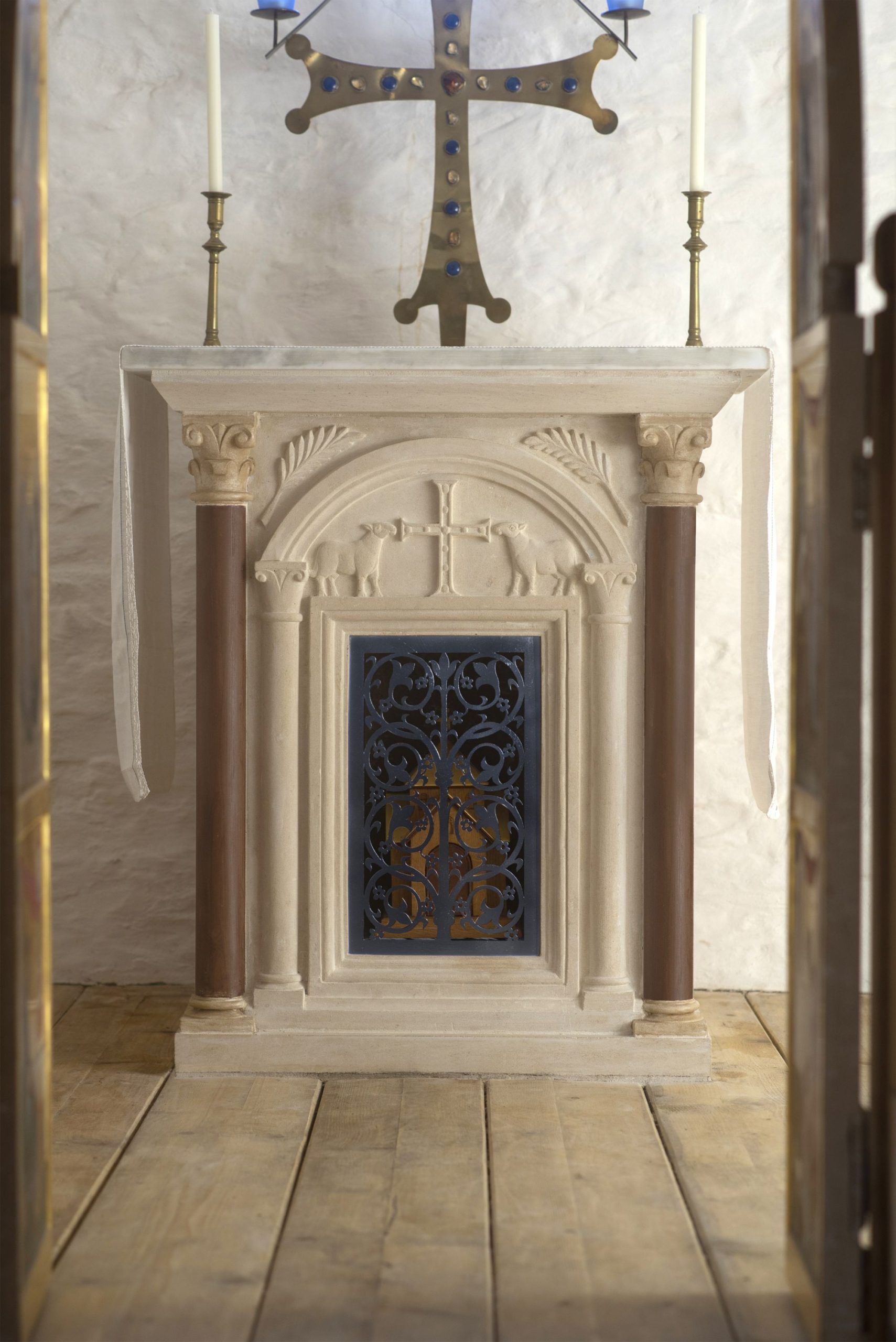
Welsh hermitage chapel altar
The eastern church has its own definitions of what constitutes an icon. Unlike in the Roman Rite where the liturgical veneration of an image is only required on Good Friday with the veneration of the cross, the use and venerations of icons is widespread in the liturgy itself. While the parameters of what constitutes an icon seem debated, they are generally ontological rather than aesthetic. In the Byzantine tradition, the ‘intrinsic’ quality that makes an icon an icon is the inscription of the subject’s name. And icons venerated as miracle working are rarely the best artistically!
For our purposes, as Roman-rite Catholics, perhaps a more useful question to ask is this: How should liturgical objects manifest the invisible realities in which they participate—drawing us analogically, as Abbot Suger would say, from the seen to the unseen?
Robert Lazu Kmita: Indeed: How? I am glad that you mentioned Abbot Suger: His artists rigorously respected rules similar to those followed by the Byzantine masters of iconography. But the main question still remains intact: What provides the “contact” between visible, seen sacred artworks and their invisible prototypes? More specifically, what is that element—considered by the greatest theoretician of sacred Christian art, Cardinal Federico Borromeo, as having been indicated or discovered by Pythagoras (!)—that allows the establishment of the analogy between seen and unseen?
Martin Earle: Not an element—or anything to do with classical ideas of harmony or mathematics—but an event: the Incarnation of the Logos. The “contact” between seen and unseen is not a secret formula but a person. The ultimate justification for Christian art is that the infinite God has taken the initiative, revealing himself in a finite form. This is the form we encounter sacramentally in the Mass, and it is the form sacred art touches and seeks to manifest.
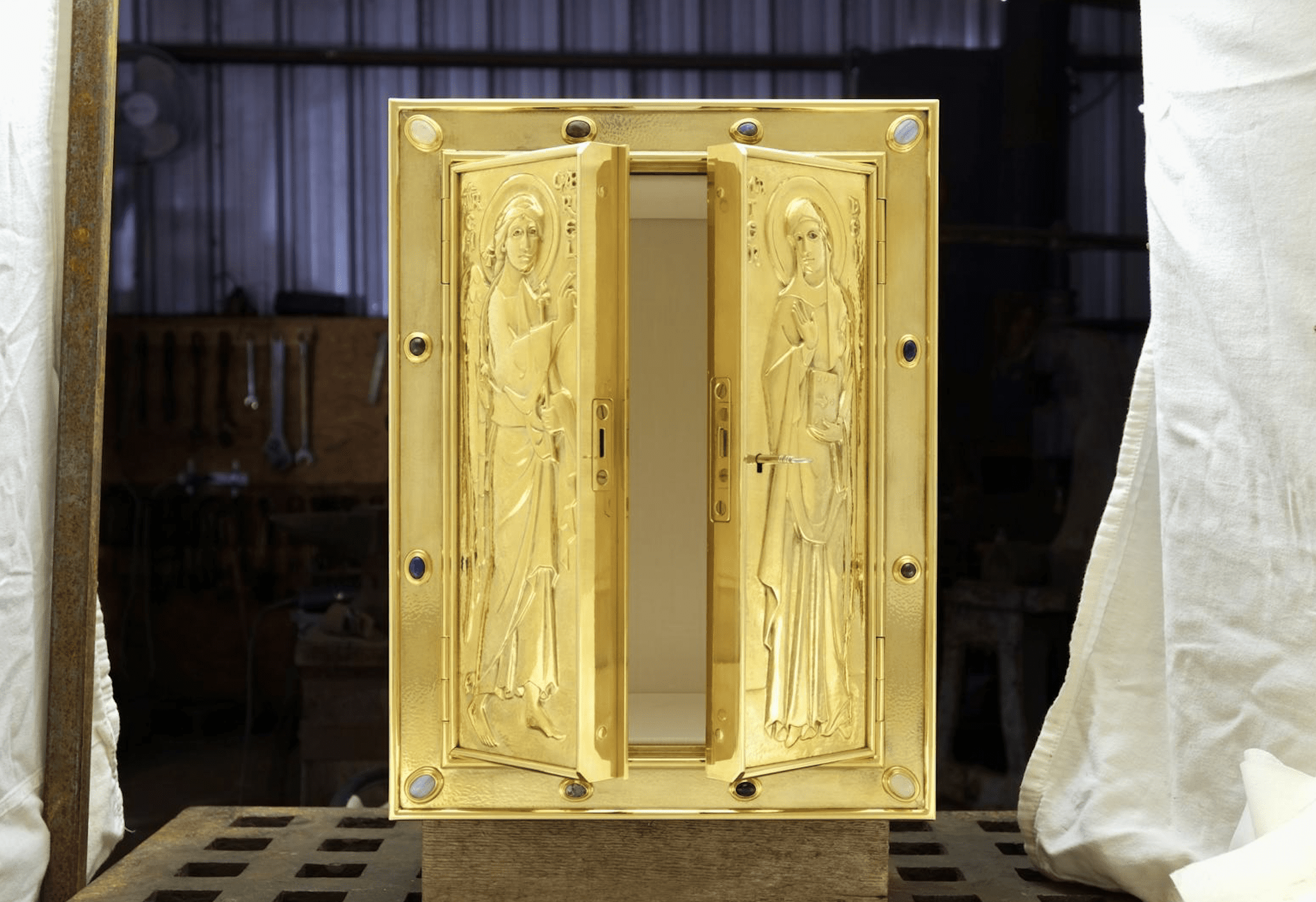
Annunciation tabernacle for Priests’ Chapel project, made by Evan Wilson
Robert Lazu Kmita: Of course, the Incarnation of our Lord Jesus Christ is the foundation of Christian sacred art. Saint Theodore the Studite, among others, developed the subject extensively in his treatises. But, to approach now the “applied” part of sacred art, which classical creations, for you, best illustrate this foundation?
Martin Earle: I love the frescoes discovered about a century ago in a 3rd-century house-church in Dura-Europos, Syria. The building contained several rooms repurposed for distinct liturgical functions, and the frescoes were found in the small baptistery—an antechamber catechumens passed through, physically and spiritually, on their way to full membership in the Church. The room has a close, womb-like quality. To move towards font through a narrow passageway in semi-darkness must have felt like being born.
On the west wall – so on your right as you would process toward the font – is a depiction of the Myrrhbearers approaching Christ’s tomb on the morning of the Resurrection. It is interesting that the tomb in the fresco is exactly the same size as the font’s stone frontal. The message is visceral: to be baptized is to enter the tomb, to be plunged into the mystery of Christ’s death and resurrection.
These images of the Myrrhbearers are clearly more than storytelling. In the liturgy, salvation history is not just recalled; it is actualized and made our “today.” A high point of the liturgical year for me is the Exsultet hymn at the beginning of the Easter Vigil. A deacon chants: “Haec nox est”—“This is the night.” This isn’t a poetic metaphor; it is the ontology of the Church’s worship. The events of salvation are the “here-and-now” in which the Church stands. Images used in the liturgy simply manifest this: hidden from our eyes but nonetheless real.
So, the “how” is first answered by the nature of the liturgical event itself. Only after this comes the question of appropriate style and technique.
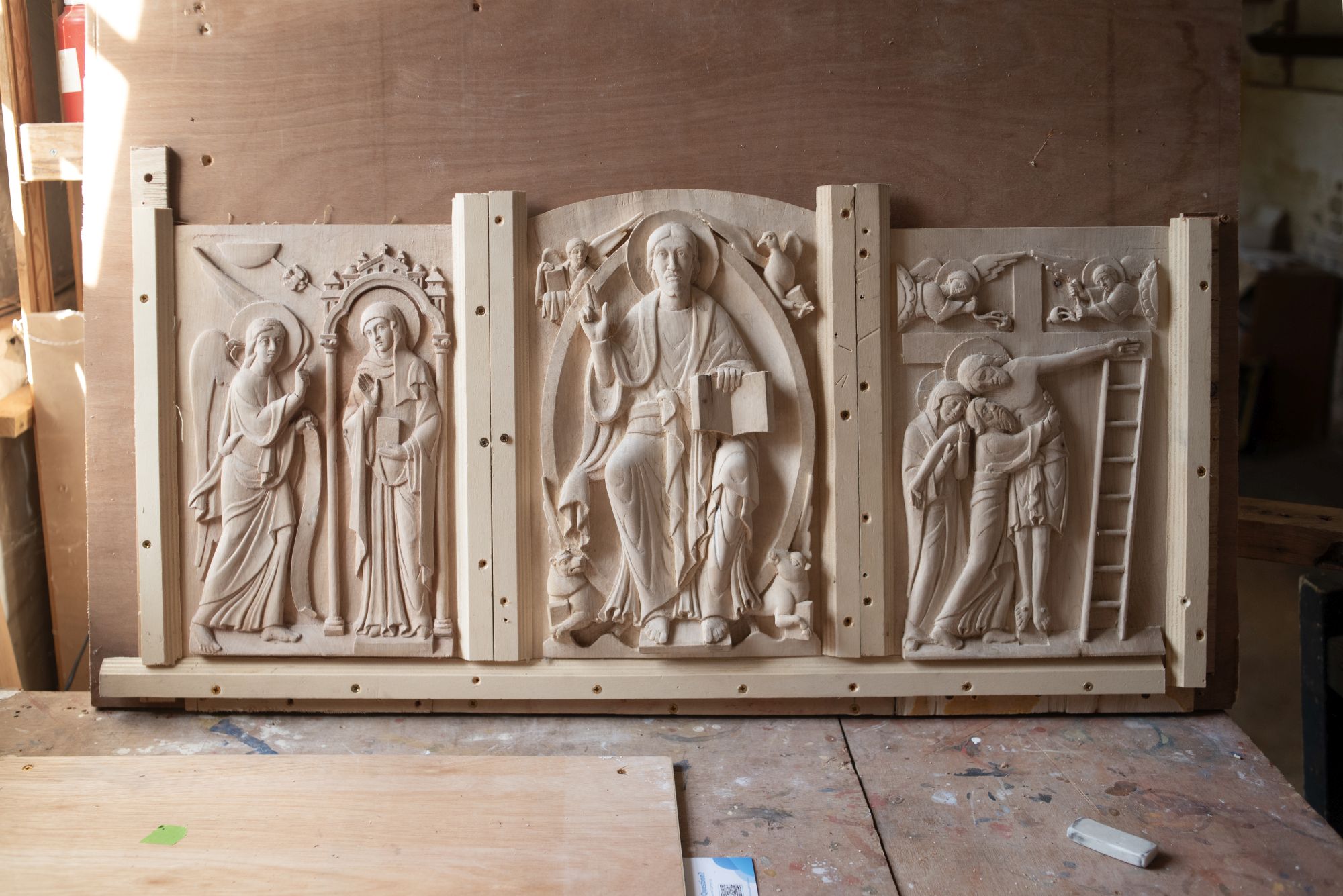
Carving in sycamore, in progress
Robert Lazu Kmita: In the case of sacred music, the Church has explicitly stated—in official documents—that the only authentic form that can be considered sacred music is Gregorian Chant. This does not exclude polyphonic music; however, the only form of music truly defined as sacred is thus defined. Clearly, this music has a specific style: monodic and well-defined. Is there such a defined style in the ecclesiastical context as the style of sacred art par excellence? And what is your opinion on the pedagogical-didactic and narrative Christian paintings/sculptures?
Martin Earle: Thank you for introducing Gregorian chant. Yes, I believe there is a specific visual “language” of art, just as there is a particular style of music, that is uniquely fitting for the liturgy. Sometimes it seems the Orthodox East has been a little too rigid on this point, while we Catholics have become too relaxed.
There is a thread that links the visual art of the first millennium—taking the apse of Sant’Apollinare in Classe in Ravenna as a high point—to the early Gothic sculpture at Chartres, the Winchester Bible, and the altarpieces of Fra Angelico. That thread, uniting different cultures and media, is a tradition that is recognizable yet tricky to define; it possesses that “sober inebriation” which Ratzinger associated with Gregorian chant. It is disciplined and liturgical, yet overflowing with otherworldly joy. There is something iconic and hierarchic about it, but it draws back from purely Platonic forms. It is ordered toward a personal encounter with the subject depicted. The events of salvation history are not depicted as taking place in the world; no, the world is depicted as taking place in them.
As opposed to classical harmony and proportion, this visual tradition is deeply rooted in the surprising, paradoxical qualities of the Incarnation and in the knottiness of salvation history—not Apollo, to paraphrase Ratzinger again, but the Logos crowned with thorns. Because it is alive and rooted in the freshness of revelation, it takes on new forms and responds to the different spiritual needs of each age without losing its identity.
Regarding narrative Christian art: Within the Catholic tradition, I see these forms functioning as a kind of sacramental mystagogy rather than a simple, “Sunday-school” style of pedagogy. These are images arranged to spark off one another—like a Church Father riffing on hidden connections within the Scriptures—pointing everything toward Christ as experienced in the “today” of the liturgy.
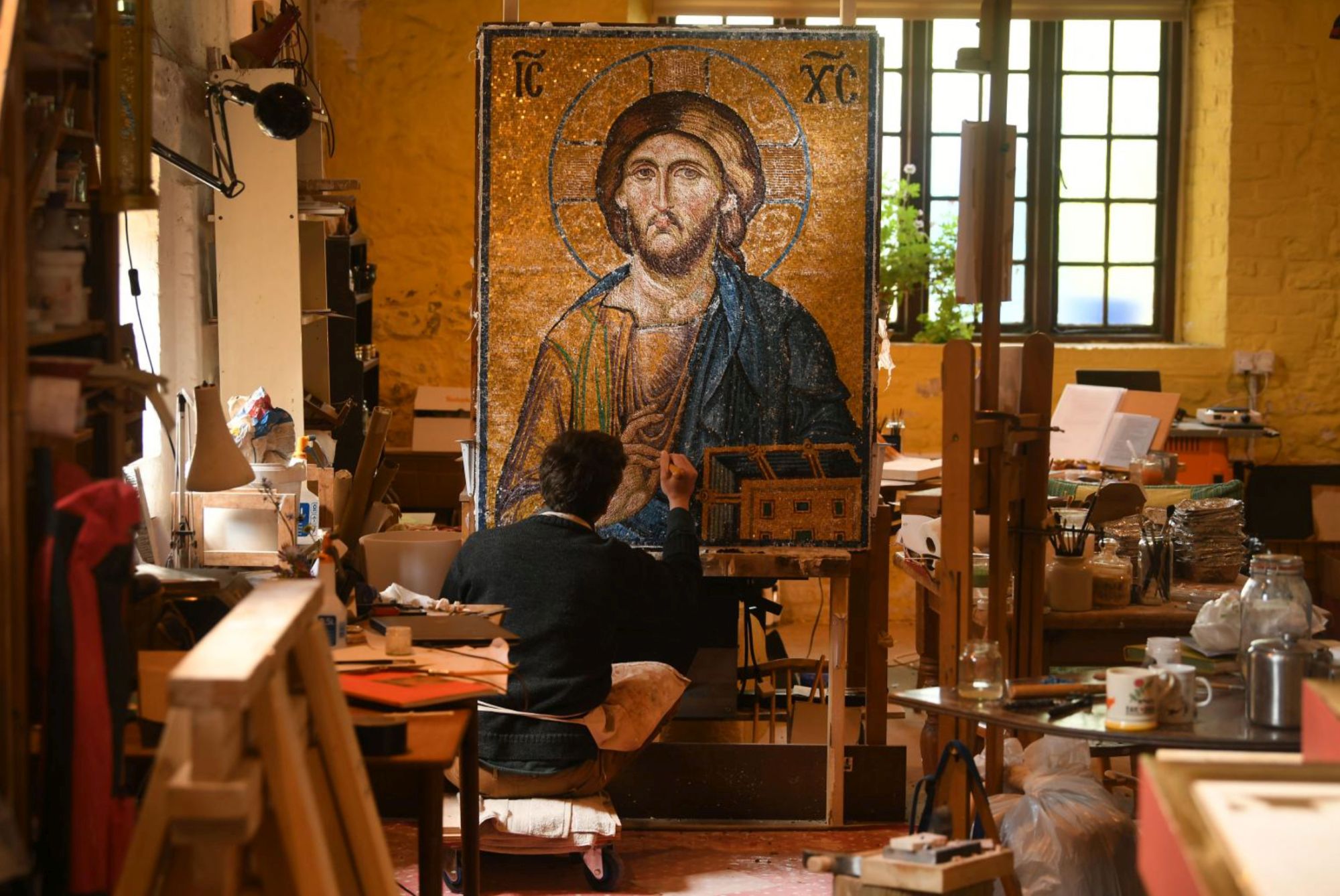
Photo credit: Russell Sach (copyrighted)
Robert Lazu Kmita: You have provided important landmarks from the field of sacred art history through your responses. All of them deserve to be explored in depth with great care. However, there is also a practical, concrete dimension to these. After all, art is a craft. Therefore, I would like the last part of our dialogue to discuss the concrete situation of sacred art. Especially since, visibly, the last decades have seen an accelerated secularization and de-sacralization of churches worldwide. So, what is the situation of authentic Catholic sacred art? Could you tell us if there are schools—such as the one created by Cardinal Federico Borromeo—completely dedicated to the creation of authentic sacred art.
Martin Earle Yes, it is a craft—and it is blood, sweat, and tears, too. It isn’t controversial to complain about ugly modern churches; that’s a mainstream sentiment. New churches, especially in America, are being built along “traditional” lines, but you can’t pick up so many broken threads that easily. It takes a slow process of failure and discovery to rebuild what’s been lost.
In church architecture, “tradition” is sometimes handled too shallowly; you end up with a “pan-opticon” auditorium-style church dressed up in conservative decor, but with little that is fresh enough to speak to the heart. Authentic sacred art, liturgy, and architecture go together. I have an inkling that to build a truly traditional church, you’d have to conceive it as a rich, interwoven image-world—with space to wander through, worlds within worlds, light and gloom, pillars to cry behind. More like a village or a city than a hall. Actually building a few churches like that would give enough room to fail, discover, and eventually teach others.
I’d love to learn more about Cardinal Federico Borromeo’s school. I don’t know of any such schools today—though it has been tried—but there is a network of artists and makers who drink from the same well. Historically, the marketplace—supply, demand, reputation, guild apprenticeship—has often a good place to cultivate the liturgical arts and that appeals to me.
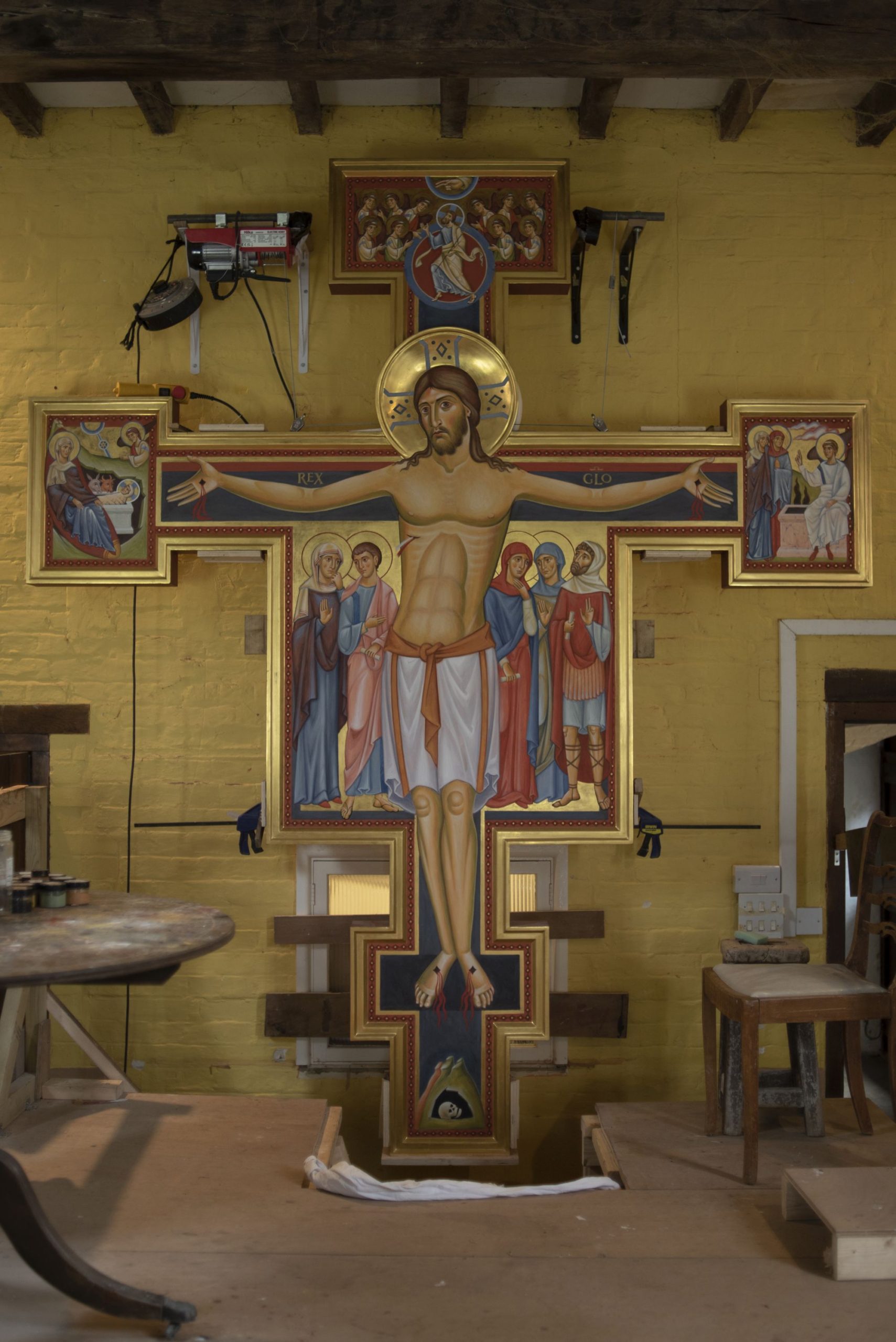
Aberdeen Cathedral crucifix, Martin Earle and Jim Blackstone
Robert Lazu Kmita: Thanking you for this substantial interview, I will conclude here before addressing a double question to you: What are those projects carried out in the past that brought you the greatest spiritual joy? And what are the projects you are currently working on?
Martin Earle There is always a joy in collaborating with other artists and craftspeople. My colleague, Jim Blackstone, and I painted a nine-foot San Damiano-style crucifix for Aberdeen Cathedral, and we invited others into the process—including people who came to our studio to learn the craft “on the job.” In every project, you are sustained by the commissioner or, quite often, an entire parish community. Ultimately, the work becomes a living conversation; after all, it is “not good for man to be alone”!
At the moment, I am working with colleagues on a chapel I designed alongside a local architect, Chris Renier, for a community of sisters in Wisconsin. They have established a retreat center for priests and have been wonderful collaborators. We are creating an “image-world” centered on the theme of Christ’s eternal priesthood, which will include statues, a gilt tabernacle, a mosaic, and a painted apse. Everyone involved is taking risks and giving it their all, and there is a great deal of joy in that.
__________
The Imaginative Conservative applies the principle of appreciation to the discussion of culture and politics—we approach dialogue with magnanimity rather than with mere civility. Will you help us remain a refreshing oasis in the increasingly contentious arena of modern discourse? Please consider donating now.
Images courtesy of Martin Earle’s website.




Leave A Comment