
The development of mechanical reproduction and transmission at the dawn of the 20th century changed how we experience music. It remains true that technology has allowed us to extend, amplify, and disseminate the experience of art. This is, in itself, a good thing. The question is how we use this gift.
 In the past, when one wanted to experience works of art, there was no alternative to experiencing them “live,” in the flesh. If one wanted to hear music, one made it oneself or one went to a concert, church service or other occasion in which music was played or sung. If one wanted to look at painting or sculpture, one had to go to a museum or, failing that, obtain a print or copy (which, needless to say, never could hold a candle to the original). To see a drama involved going to the theater. And so forth.
The development of mechanical reproduction and transmission at the dawn of the 20th century changed all this. In a sort of technical miracle, art forms could now be copied in a simulacrum and conveyed to far-away audiences. You could hear from your living room a symphony orchestra a thousand miles away performing Beethoven on radio or a record. By means of more sophisticated photography, visual art could be reproduced in an extremely true-to-life form on paper. You could now adorn your home with art of the Old Masters, or of the new masters. The movies brought drama in canned form—using a new art of storytelling through carefully edited images—to mass audiences in special theaters. We all live with these forms of reproduced art to such an extent that we have come to take them for granted.
In using the term “canned” I am following Virgil Thomson, the great composer and critic, who used it (as well as the term “processed”) to describe music enjoyed through mechanical means. Thomson in 1943 took stock of the remarkable phenomenon of canned art, commenting on both its positive and negative aspects. He declared: “It is harder today in the United States to avoid music than to hear it. Commercial music, folk music, art music, all day long they bathe us…. Never before has civilized humanity lived in an auditory décor, surrounded from morn til night, from cradle to coffin, by planned sound.”
Thomson concluded: “As cultural opportunity for all, this is a fine thing. As forced consumption of everything by everybody, it is a horrid thing. One used to have to work hard to keep in touch with the cultural tradition. Today educated people are obliged to immure themselves in order to avoid suffocation from the constant contact with it.”
Doubtless most of us now experience music, drama, and visual art predominantly in canned form. Ask yourself: How many concerts or plays have you been to in the past year, versus how many recordings or films? If you are like me, your enjoyment of music, for example, comes largely through recordings, video, and the like. And there are many reasons for this. One is that the very fact that canned matter is so widely available has in some measure killed off “live” art, performances, etc. We have become spoiled by convenience, and “living” art has suffered as a result. Moreover, the facility of producing canned art has led to an overproduction and surfeit. At last, the “natural” situation has been upended: There is now more art in canned form than in “real” form.
There is a double-edged sword here. In one sense canned art reveals a world which has become increasingly artificial and dominated by technology, a world increasingly dissociated from “real” experience and oriented toward the virtual. But there’s more to it than that. The manmade, the technological, is not entirely bad. Electric light, an imitation of natural light, can have a certain mysticism of its own. Similarly, art in canned form offers many advantages and has its own legitimacy beyond being simply a convenient copy or record of an artistic original.
To speak only of music, you can through collecting build a repertoire you enjoy or are interested in. You can enjoy the works at pleasure, whenever you want to. Whereas a live performance is evanescent, you can return to a favorite piece or performance in canned form many times, refreshing your acquaintance and perhaps hearing new things in it. Canned art allows you to be in contact with the whole of artistic history, not just whatever happens to be currently fashionable or held in regard.
A canned performance attains a certain permanence as an artistic statement, just as a good reproduction of a great painting allows it to “travel” and reach more people. More recently, downloads of movies have allowed them to be seen by more people than would have been possible in theaters. Let’s leave alone the question of the quality of the films; suffice it to say the technology allows for wide enjoyment of the art or entertainment form.
There is nothing inherently wrong with the canned arts. The question is how we use them. We would do well, as we enjoy them, to try to achieve something more like the more intentional, attentive state of mind I imagine people had when enjoying canned art in Virgil Thomson’s mid-20th-century milieu, when I presume multitasking was unheard of and everyday life had a greater degree of structure. Mind you, I don’t think here’s anything wrong with using music as an accompaniment to other activities; such an atmospheric use of music is old and legitimate. But neither do I think that mindless or absentminded listening should be the norm.
It will be well if we resist the mechanistic, totalizing, mass-producing tendencies of contemporary society, in which everything is to be consumed—and once consumed, thrown away. Instead of consuming, we should appreciate with awareness and intelligence.
It’s for this reason that I’m not in favor of downloads as a replacement for physical recordings. A work of art was never meant to be merely an evanescent digital blip. Like books, records and compact discs have a concrete physical presence; they are accompanied by artwork and documentary notes that enhance and give background to the music. Listening to music through headphones and earbuds should never be the default way, since music has to resound and at least have the potential to be heard by others.
Yet it remains true that technology has allowed us to extend, amplify, and disseminate the experience of art. This is, in itself, a good thing. The question is how we use this gift. Overfilling our lives with art and consuming it in a chaotic way leads to distraction. We don’t need distraction but greater deliberateness and structure. Treat art as a meal to be enjoyed, not junk food to be consumed. Don’t let the mere availability of art tempt you to gorge yourself on it in an undifferentiated manner.
In appropriating the canned arts, we should as far as possible reject the disjointed, random, chaotic manner in which modern life tends to proceed. To my mind there are few things more comical—and disturbing—than the fact that one can turn on a Brahms symphony in the car, cut it short when one gets to the supermarket, then resume it after one has finished shopping. This is not how Brahms or anyone else expected their work to be experienced. (Similar things may be said of movies or any other art form that unfolds in time.) Such a slicing and dicing of a serious work is, to my mind, an apotheosis of the disjointed lifestyle.
Canned art involves certain inevitable distortions: The way our ear receives music on a recording is not the same as how the music would sound in person (although I suppose technology is always attaining to a more faithful and realistic reproduction of sound). Nor does any art reproduction look exactly like the original. Perhaps an even more serious problem with canned art is that the artworks are always to a certain degree wrenched from their original contexts. Here is where some weeding and discernment are in order. I would argue that some artworks work canned and some don’t. We are now able to access the entire history of art at our fingertips—but does everything sound or look well in our living room? Do all artworks make equal sense when removed from the time and place and occasion for which they were created? This is something we must judge case by case. Not everything merits revival and preservation, nor does everything work or hold up well in canned form.
Culture should not be a mad and indiscriminate hoarding of every scrap of history; rather it should be a thoughtful and discerning appropriation of the best that mankind has produced. Reason, intelligence, and taste should always be in play.
Canned art has its pitfalls but also its rewards. One of its greatest disadvantages is that it tends to make art appreciation a private affair rather than one shared with others. Technology indeed has the unfortunate tendency to isolate human beings. This is a problem for which I see no obvious solution forthcoming and which is, perhaps, a topic for another day and another essay. In any case, we should do what we can to avoid the pitfalls and maximize the good points of canned art. This way, technology will become a helpmate instead of a distraction and an albatross; it will aid true culture instead of becoming part of the endless stream of “stuff” that inundates our lives.
The Imaginative Conservative applies the principle of appreciation to the discussion of culture and politics—we approach dialogue with magnanimity rather than with mere civility. Will you help us remain a refreshing oasis in the increasingly contentious arena of modern discourse? Please consider donating now.
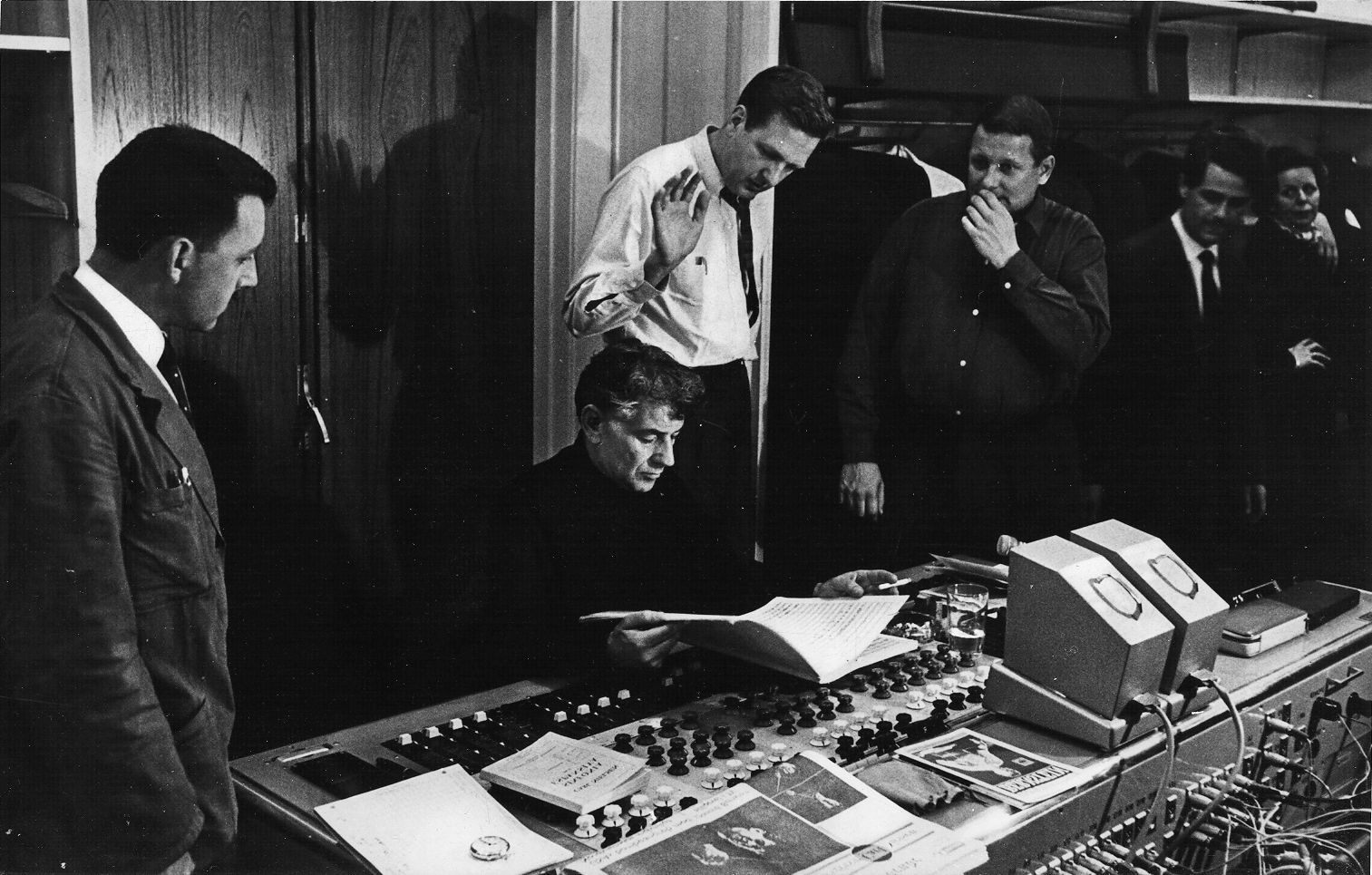
The featured image is a photograph of Audio recording for CBS of the 3. Symphony (“Sinfonia Espansiva”) by Danish composer Carl Nielsen (1865-1931), commemorating his 100. birthday, in Copenhagen, in 1965. The persons from left to right are: Hans Leonhard, Leonard Bernstein, John McClure (Director of Columbia Masterworks and CBS chief recording engineer) and Hellmuth Kolbe. This file is in the public domain, courtesy of Wikimedia Commons.




“A work of art was never meant to be merely an evanescent digital blip. Like books, records and compact discs have a concrete physical presence; they are accompanied by artwork and documentary notes that enhance and give background to the music.”
I agree 100%, Michael. Sadly, in our digital age, record stores with a sizeable classical music section are now practically extinct. It used to be such a great joy to browse such places. It’s not the same doing it online.
Many thanks, Mr. De Sapio, for a most informative and thought provoking narrative. Leonard Bernstein likewise decried the oft inescapable over-presence of canned music; larger shops, lifts and many workplaces come to mind. For me, however, the use of advanced technologies to mass produce music in some ways creates an aural artifice. For the creation of recordings for sale is directed toward as close a perfect performance as possible. Errors can be removed and replaced by measures from a subsequent or earlier recording session, dynamics can be manipulated, timing expanded or compressed whilst retaining original pitches and acoustics artificially enhanced. What the listener then perceives may or may not truly reflect an original performance, but rather a ‘perfect’ performance…one bringing musical and aesthetic satisfaction to the performers whilst meeting the quality-based expectations of those purchasing said recordings. That being said, I take great joy from my rather sizeable CD collection; the recordings make available to me works which I would otherwise never know.