
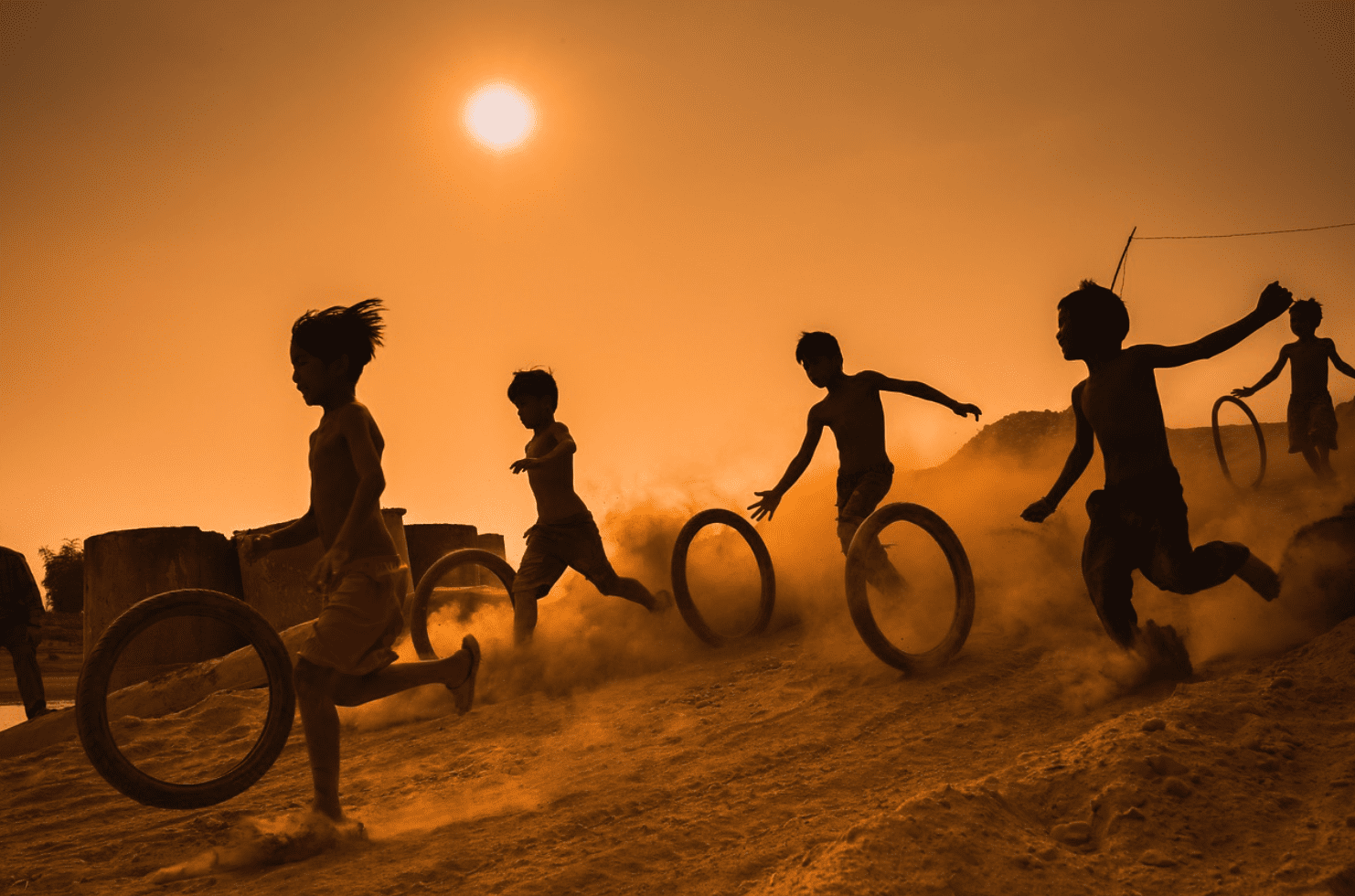
We have handicapped children by letting our concern for their safety overrule the enormous benefits that come with the way they naturally play.
 Last semester, some of our faculty recently participated in on-site CPR training on a Saturday morning. And again, this semester, on a Friday evening. Aside from the comfort you should derive knowing that teachers are willing to give up their precious weekend to make sure they can save children’s lives, I wanted to share something that happened during the training.
Our CPR instructor conducts similar training for teachers in both public and private schools all over Houston. Throughout her presentation, she mentioned the various dangerous injuries that children incur while playing at school. Each time she mentioned one of these injuries, she would turn to our school nurse and ask how frequently it had occurred on our campus. She was shocked over and over as our nurse confirmed that common playground injuries like broken bones, or serious sprains or cuts that require doctor’s visits are virtually unheard of at The Saint Constantine School.
This was incredibly exciting and validating to me personally, because I have been a strong advocate on our campus for a play philosophy that makes many parents and school administrators sweat. At our school, we have risky play equipment that was designed with fun, rather than safety, as the ultimate priority. We have almost no rules for play.
And we decided to let our students climb in the trees.
Skeptics insist that we are opening our students up to serious harm by allowing such dangerous play on our campus: it sounds like a recipe for disaster! But the research points in the opposite direction. We have our share of bloodied knees and scraped palms, to be sure—our students play hard. But why, when compared to other Houston schools, are our kids largely spared from more serious injuries?
The answer lies partially in studying the statistics on injuries and the types of play environments in which those injuries occur. Researches have been amazed to discover that the “safer” a play environment is by design, the higher the rate of serious injury in that environment.
Why is our “dangerous” playground causing fewer injuries than the plastic and padded equipment at most parks and schools? Because children need to take risks. It’s how they learn what they can and can’t handle, it’s how they get physically stronger and mentally strategic, and it’s how they have fun. When you let risk thrive on the playground, the students thrive, too.
Nothing on our playground is too easy, which means students can’t enjoy the equipment without focusing and working hard. They fall a lot, but they fall less and less the more they play. They are clumsy at first, but they scale the climbing wall faster and more efficiently with every attempt. And by suffering the slings and arrows of outrageous fortune on a small scale when they first try something new, they have the benefit of experience once they attempt more challenging feats of strength and ability.
We aren’t laboring under the delusion that no child will ever experience a serious injury on our campus. Indeed, from the CPR instructor’s presentation, it’s clear that schools and parents should anticipate a number of such injuries each year. But rather than letting the inevitability of harm dictate the way we educate students, we are embracing the possibility of injury because of all the things students stand to gain from such rigorous, risky play.
We collectively bemoan the general unhealthiness of our nation’s children, but I think adults should point the finger at ourselves: we have handicapped children by letting our concern for their safety overrule the enormous benefits that come with the way they naturally play.
If schools want to combat childhood obesity, they should install challenging, open-ended playground equipment that makes the adults shake in their boots. If parents want their children to grow in strength and kindness and creativity, they should discard the laundry list of rules for playing outside and see how the kids fare managing things on their own.
And if we want our students to be healthy, strong enough to withstand whatever comes their way, we have to let them climb in the trees.
Republished with gracious permission from The Saint Constantine School (Jan 2019).
This essay was first published here in January 2019.
The Imaginative Conservative applies the principle of appreciation to the discussion of culture and politics—we approach dialogue with magnanimity rather than with mere civility. Will you help us remain a refreshing oasis in the increasingly contentious arena of modern discourse? Please consider donating now.
The featured image is courtesy of Pixabay.






For parents it can be a little difficult to let them play dangerously but it’s our job to cultivate a rich environment for learning in ALL areas. Had we never let them go to take risks and learn what they’re capable of my oldest son may never have earned a 1st Team All-State O-Line title in high school not to mention that incredible work ethic and dedication that had him graduate with a 4.0 and go on to gain entrance to one of the country’s top business schools where he’s working toward his MBA. And my other son, a born climber and risk-taker? What if I’d kept him “safe” instead of cheering him on (while, sure, holding my breath) as he pushed himself, raising the bar year after year, till earning the title of State Champion in Pole Vault as a high school junior? He has recently been accepted to West Point where not only will he be part of their track team, he’ll be beginning what he plans to be a life-time career of protecting those he loves along with this entire country. More validation for risky play? I sure think so!
As a mother, I always wish the best for my kid, and I agree that it is important to let them play and go off the edge sometimes. However, the fear of something happening always bothers me a lot. But as you mentioned, children do need to take risks. This will really be helpful for them in the long run. Anyway, great blog! You have explained everything so well.
I will always be concerned about my children. Risk is a fact of life, and it only becomes worse as kids get older. I was pleased to let my kid walk to school, but giving him access to a phone raises additional concerns about his level of freedom and the risks that come with it. Parenting seems to be a constant stream of anxiety-inducing situations and escalating dangers for the kids’ developing negotiation skills. This ia a part of their life lesson.
“You probably shouldn’t worry so much about the children either. We can’t hold their hand all the time. We must give them space and not protect them so zealously that they never have any experience. Once they were allowed to play in peace and quiet, free from the interference of adults and with free rein for their imagination. Sometimes they fell down and hurt themselves, and sometimes it would be difficult to explain how the trousers had been torn or where the hair bow had gone. It gave you experiences that you might have preferred to have done without, but it is part of life itself.” (Margrethe Queen of Denmark (2015) : New Years Speech)
Is it any coincidence that our increasing anxiety over our children seems to correlate precisely with our diminishing trust in God?
Which also relates to the rise of anti-biblical feminism and the destruction of the biblical patriarchy
What is the most underlying study referred to that captured the injury statistics?
I will never forget watching my 3 year old climbing rocks as high as my head between rounds of chemo at our local playground. Every bone in my body wanted to run over and stop her.
But as I watched I could hear her whispering under her breath, “I can do this.”
Yes, you can,Theresa! There is no way I would have stopped her then.
Your child needs to learn to believe in herself. Let them all take risks. Someday they will all have to learn to do hard things.
How do you avoid lawsuits from parents? I agree with your philosophy, but many, many young parents today would literally characterize your philosophy as “abuse,” sadly, so I’m interested in how you avoid a lawsuit.
Does anyone else wanna know what kind of equipment they are using? They mentioned a wall for rock climbing but how high, and do they have harnesses? This is too vague. Today, merry-go-rounds are considered unsafe, so they have one of those?
I grew up with a mother who would shoo us outside with an admonition to be home for lunch. We lived in the country with a creek running through the property. I lived there in the summer, but always home for meals. Occasionally my dog would have to pull me out of trouble. My mother was terrified of horses but I loved them and she did not let me know how scared she was until long after I was grown. The evening a neighbor boy brought me home across the saddle of my horse, I thought she was going to lose it, I’d fallen into a sticker patch and she was not gentle removing dozens of stickers from my derrière, it was her revenge. My brothers hunted and trapped from 10 years old, taking ridiculous risks. We all survived Our kids survived much the same childhood. Most of my grandkids have been raised in town. Such a pity, they are not as interesting as they should be.
The comment regarding our increased anxiety correlating with our lack of trust in God is dead on, Mom had a strong belief and trust in God. She had a lot of conversations with Him throughout the day.
It reminds me of the summers I spent in Oregon on my aunt’s pear and apple orchard. The orchard was on about 40 acres, surrounded by acres and acres of forest, running streams, etc. My cousins and I spent much time as you described. I will never forget it!
Counterintuitive! Who would have thought? I wonder if there is any weakness in this proposition. For instance, is there one child in a hundred (or in a thousand) who is too afraid to play with the risky equipment?
Aha! I see one over there. Now the question is: Would this child be too afraid (or solitary) to play on safe equipment? Unless you looked for that child everywhere, you could not be certain to find it, but it could be used as an excuse to keep the playgrounds safe – lest in case the risk-averse child be discriminated against.
Oh, the rule of the super-minority!
But – let the play begin!
My husband and I were amazed and delighted, when visiting the fabulous Playmobil Park in Germany, that the attractions there were fun and RISKY, employing human energy instead of electricity, etc. A German person there confirmed that they did not baby the children, but offered challenging play. Our children ( and we) enjoyed many happy hours there.
This is an excellent commentary on playing on a playground..
I grew up in this kind of playground environment.
I also taught school for 34 years.
Sounds a lot like what we had back in the 1970’s! Now, if there would be some times set aside for behindered kids to play there with no bullying, it would be perfect!
My sons played dangerously usually under my watchful eyes. They were more manly men, good fathers and husbands with sons and daughters who are well rounded. Fishing, hunting, rock climbing, martial arts and religious training.
Great article! I really enjoyed the perspective that children benefit from a certain amount of risky play. Allowing kids to climb, explore, and challenge themselves helps them build confidence, physical strength, and problem-solving skills. Overprotective environments can sometimes limit these valuable learning experiences. When children face small risks during play, they gradually learn their limits and become more resilient and capable individuals. It’s a thoughtful reminder of the importance of balanced freedom in childhood.