
The symbol of Christianity is the Cross, and the Cross lies over the world and marks human history. The rejection by man of God makes a cleavage between the natural and the supernatural, the secular state and the Church.
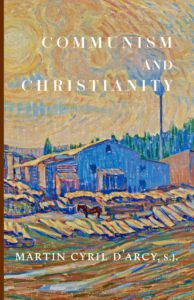
Communism and Christianity, by Martin Cyril D’Arcy (Cluny Media, 216 pages)
 The felt and reasoned distinction between spirit and matter, which these latter religions taught, is transformed in the Christian faith. God, who is spirit, becomes man, the Word is made flesh, and through his humanity he redeems man and sets the world on a new axis. The God-man is a new Adam who begets a new human race. The body shares the glories which, in pagan thought, had been confined to the spirit, and nature, which on account of its flux and evanescence, was regarded as “half-unreal,” is given a new unity and purpose. As God has entered history and has accomplished a divine intention, history cannot possibly be unaffected by such an event. The act of God, which is in our human calendars begun and finished within a small, definite number of years, has a transcendent power and quality which, so to speak, makes it at home in any period of history. It invades history and the transforming power is operative until the end of time and everywhere, as well as in the specially chosen ways instituted by Christ. All that happens, A.D., is signed with his name, whether it be for him or against him. God’s timeless act of redemptive love makes every human choice a crisis, for when the Paraclete is come, “he will convince the world of sin and of justice and of judgement.” Time becomes a string of “nows” in which the individual and the peoples meet their new fate, which is the acceptance or denial of absolute love. The divine order, which is epitomized in a person, keeps step with the temporal order, and makes the advent of the Word made flesh ever present and up to date. The word in the New Testament which conveys this mysterious truth is the Greek word, kairos, the propitious moment and opportunity in the new, historical relationship set up between God and man. It is also a “crisis” and an agony or agôn, and in the apocalyptic language of the Gospels, as of the prophets, it reflects one everlasting act or event in the dénouements of time, especially Christ’s trysting place with the soul in the chief crises of life, mostly unexpected, such as the crisis of conversion, the cross of affliction and death. So dazzled were the early Christians with the overpowering truth and mystery of this “coming,” that, as might be expected, they were tempted to simplify it and translate it into an expectation of a rapid end of the world. Whereas we now see time going on and on with no ascertainable end, many early Christians saw it within their own lifetime as the end of the world. The paradox of Christianity, however, is that time and history are indeed included within the Christian dispensation, though the end is in the beginning and any age or time is the “year of the Lord” and the kairos of God.
There can be no doubt, therefore, that in the Christian view the kingdom of God and history are not dissociated, even if we have to admit a contrast between what St. Augustine, in a well-known passage, called the City of Man and the City of God. Within recent years, as explained above, certain Christian apologists have felt the need of bringing Christianity down to earth, and this rediscovered eschatological, as it is called, element in the New Testament has provided them with the means to do so. They now claim that the teaching of Christ in the Gospels, in parables and sermons, has always a reference to life as it is lived here and now on earth, that the religious ideal and human affairs are not kept apart as later they were in a “crude supernaturalism.” In this crude later teaching the emphasis turned from this world and the bettering of it to a hope for immortality and the future happiness beyond the grave. This world became a valley of tears, a place given over to evil from which it was the duty of the Christian to retire. The idea of heaven came to be substituted for that of earth; it was the “dear country for which the eyes kept vigil.” But in the New Testament there is little trace of such a heaven as this. It is not the haven of the reward, for Christ is he “whom the heavens must receive until the times of the restoration of all things”; just as in other passages we read that Christ is to come back from heaven, that his people are to be resurrected body and spirit, that all things are to be restored, that there is to be a new heaven and a new earth, when “the holy city comes down from heaven like a bride adorned for her husband.”
There are, it must be granted, versions of Christianity which deserve to be called crudely supernatural or escapist. No natural virtues are allowed; original sin has so corrupted man that all his works are evil. But such, as we have seen, is not the main tradition of Christian teaching. In their efforts to put right what they think has been neglected, these defenders of an earthly Christian society have both exaggerated the purely human and social side of the Gospel message and fought shy of the “folly of the Cross.” Without this latter Christianity ceases to be itself, and its message is amputated. Human welfare and human goodness have been adopted by God who became man, but at the same time they must be seen in their proper proportions within the purposes of the Redemption. Religion is first and foremost the worship of God or what serves for God in man’s thought. God has to be worshiped “in spirit and in truth,” and the first truth in Christ’s teaching was that God is our Father; that is to say, God is personal and his attitude towards human beings is a loving providence, as that of a Father to his children. The second and completely new truth is that God so loves man that Christ himself, the Word of God and Son, has become man and “dwelt amongst us,” in order that he might end the estrangement and bring an atonement of man with God. Christ is to be “the way and the truth and the life,” and the new union or Atonement is to be in a form beyond man’s dream or conceiving. As Christ is one in divine love with the Father, so those who receive him are to be so united with him that they will form one society or organism and so share in the divine life itself. This elevation of man into a new life, where there is a divine current of love, and a closeness of union symbolized on another level by human marriage, is beyond the natural powers of man, and for that reason has been called supernatural. That is the technical meaning of “supernatural,” and all the other meanings which have been attached to it, the extraordinary, the magical, the mystical or unexplainable have little or nothing to do with the precise theological significance of the term. This supernatural life, then, is the keynote of the Christian religion; it is the pearl beyond price of the gospel, the treasure for which everything else must be sold; it is the invitation to the banquet for which all else must be left; and it is that supreme offer of love which is incompatible with compromises, delays, or the allegiance to any other rival love.
So stated, and without further elaborations, this doctrine changes altogether the perspective in which the welfare of human society must be regarded. But there is another historical truth which also affects the whole issue of the relations of the Christian religion to human society, and that is the Cross. The offer of God-made-man was rejected: “He came unto his own and his own received him not”; or as the Creed puts it: “He was crucified, died and was buried; the third day he rose again from the dead.” The symbol of Christianity is the Cross, and the Cross lies over the world and marks human history. The rejection by man of God makes a cleavage between the natural and the supernatural, the secular state and the Church. It is quite conceivable that, if Christ had been accepted instead of rejected, the history of the world might have been so different that a perfect society on earth would have flowered into being. This is mere speculation, but the Bible prophecies suggest some such future, and the long and severe training of Israel to prepare it for the advent of the Messiah increases in significance if this be so. Something immense hung upon the choice, and Christ himself regarded his mission to the chosen people as all important, and lamented their blindness: “Jerusalem, which I would have gathered as the hen gathers its chicks under its wing, but thou hast not known the time of thy visitation.” Those who see in Christ’s words and parables the proof that the kingdom of God would be made manifest in history are relying on a condition, which was within the free choice of man and really possible, but was never fulfilled. The other side of the picture, the prophecy in Isaiah of the Suffering Servant of Jahoe, was turned upmost, and it is in the light of the rejection that we have to understand the sad words of Christ in the discourse on the evening before his death. He speaks to those disciples who have accepted him and been faithful to him, and he separates them from the world which has not known him. “I have manifested thy (the Father’s) name to the men whom thou hast given to me out of the world… I have given them the word, and the world hath hated them; because they are not of the world, as I also am not of the world… And for them do I sanctify myself, that they also may be sanctified in truth. And not for them only do I pray, but for them also who through their word shall believe in me.” They are to suffer and to be persecuted, but from this passage, as from others, they are called to be the witnesses of his truth, to form that divine society on earth which is to spread his word, and be the new form which Christ in his risen life will take to continue as God and man upon the earth and in heaven.
Republished with gracious permission from Cluny Media.
Imaginative Conservative readers may use the code IMCON15 to receive 15% off any order of not-already discounted books from Cluny Media.
The Imaginative Conservative applies the principle of appreciation to the discussion of culture and politics—we approach dialogue with magnanimity rather than with mere civility. Will you help us remain a refreshing oasis in the increasingly contentious arena of modern discourse? Please consider donating now.
The featured image is “The Sawmill, December Sun” (1914) by Ester Almqvist, and is in the public domain, courtesy of Wikimedia Commons.



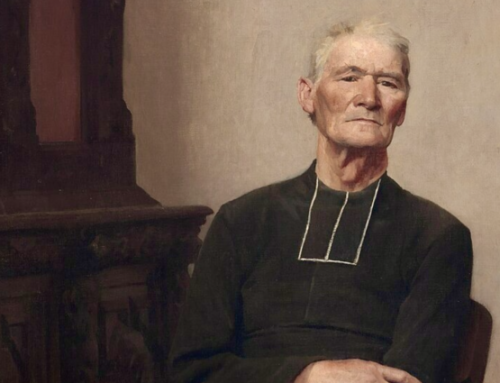
“Religion is first and foremost the worship of God or what serves for God in man’s thought.” That’s what I tell my relatives all the time when I endeavor (unsuccessfully) to convince them to assist at the traditional Mass, that being the form par excellence approved by Heaven itself.