
Devin Schadt’s “The Meaning and Mystery of Man” is an essential and enjoyable read for any husband or any man considering marriage, who wants to understand how wives are “essential in helping us become heroic, valiant, sacrificial men of God, and how a husband’s headship is at the service of completing his bride.”
The Meaning and Mystery of Man by Devin Schadt (272 pages, TAN Books, 2020)
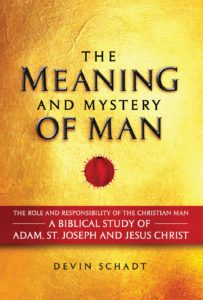 Like the idea of the “feminine genius” that often frustrates women because it is hard to find anyone who defines it, the “masculine genius” or authentic manliness is all too often spoken of without being defined. “The answer to upholding women is not to spiritually neuter or obliterate male headship, but rather to understand it for what it actually is, to proclaim its glorious, biblical, theological vision, and to live it fully,” writes Devin Schadt in his introduction to The Meaning and Mystery of Man. Schadt has contributed in an important and moving way to the modern re-discovery of the meaning of Christian manhood and the “masculine genius.” Rather than a “practical, how-to, step-by-step, self-help book about being an involved dad or an attentive, nice husband,” The Meaning and Mystery of Man is an “attempt to mine the riches of Sacred Scripture” and Catholic tradition to define the “man who is husband, father, and head of his home.”
Man’s desires and sufferings are crucial to understanding where he comes from and where he is going. Even more importantly, man’s longings and fears can teach him what he needs to give and what he needs to receive. “By delving deeply into the mines and chasms of self,” writes Schadt, “man discovers his deficiencies and his incessant longing for the coefficient, his emptiness and his desire to be full, and his hope to love another and be loved by another.” Being ordered to fatherhood—both spiritual and physical—is an inseparable element of man’s nature and destiny. This fatherhood is obviously meaningless without woman, and so Schadt quickly begins to consider man as “Guardian of the Garden.”
Schadt conducts the reader through a profound and moving meditation on Adam and his place in the Garden. Because Adam was created outside Eden—symbolic of woman and domestic fruitfulness—and only after his creation is placed in it, “man is never completely at home in the garden.” Like Adam, all men have “one foot in the external, uncharted, and perhaps hostile world, while the other foot is planted in the mystery, richness, and fruitfulness of domestic love.” Even though this creates a tension, it is a tension “willed by God” which gives “the man a certain edge”, a clear-sightedness and capacity for violence necessary for defending the sacred garden. Imbalance is created both if man neglects the domestic and interior, neglecting “his God-given subjects”, and if he becomes too “soft” and inward looking. “If the man continually looks ‘inside’ to his wife for a disordered type of validation, she will eventually peer beyond his effeminacy to the ‘outside’ for affirmation.” The popular trope of gangsters as highly attractive to women has its roots in the fact that “when the secular invades the sacred, the man’s unwillness to defend his wife will inadvertently drive her to desire a man of the wild, who appears to be a protector.”
Man is divinely called to enter the garden that is woman, and in so doing cherish and nurture rather than overpower and desecrate. Writing of a protagonist in That Hideous Strength, C.S. Lewis acknowledges how even man’s sensual desires are legitimate indicators of his needs as a whole person:
It would be quite unjust to think that his love for her had been basely sensual. Love, Plato says, is the son of Want. Mark’s body knew better than his mind had known till recently, and even his sensual desires were the true index of something which he lacked and Jane had to give.
Schadt offers a similar insight to Lewis’ in theological language: “Far more than a biological, instinctual, automated response to woman’s beauty, the summons to enter the garden of woman is a divine calling and must be respected as such.” Respect for this calling is “demonstrated by respecting the woman and awaiting her consent. This waiting is at the service of purifying the man of his lustful or inordinate desires.”
Schadt poignantly names the father as the “strong man” of Christ’s parable, whom the devil tries to bind: “The devil is bent on driving you from your vocational post as guardian of your garden that he may have his way with your wife and children.” Indeed, “if your wife and children are to be preserved from evil and remain secure in their journey towards Heaven, it is imperative that you, as the strong man of your house, stand your ground and resist the devil.” It is the father’s vocation to “stand on the horizon between the hostile world and the interior garden of the domestic life.” Like Christ, this being “outside” gives man an ability to combat the world, the flesh, and the devil “while also standing your ground, and cherishing and defending the mystery of the Trinity in [his] family.”
Discussing how men and women complement each other, Schadt helpfully places the “equality” discussion in the context of “unity” rather than “uniformity”: “To reduce the roles and responsibilities of man and woman as being the same is an attempt to create uniformity among, rather than unity between, man and woman.” Feminism and modernity diminish the woman by “diminishing the man.” This results in men who no longer sense the need “to protect, cherish, and elevate the woman for she has elevated herself—or has been elevated—at the cost of him.”
 By seeing woman as the pinnacle of creation, the one created last, Schadt shows that God’s entrustment of woman to man “does not deny the woman’s dignity or her personal responsibility to God, but rather elevates the dignity of the woman through the man’s self denial.” The masculine genius, then, is largely one of “hierarchal sacrificial responsibility.” Hierarchical because he is the “head” or leader of the woman (e.g. Eph 5:24); sacrificial because this leadership is one where his love “learns to embrace sacrifice”; responsible because of the woman who has been given to him for protection. “According to the holy Apostle,” Schadt writes, “love is synonymous with sacrifice, and headship is synonymous with being a savior; and a savior delivers himself up in sacrifice for his wife.” Not only must the man accept and understand this truth, but the true woman “does not deny or reject the true mission of her husband.” A man’s responsibility is to sacrifice self-importance and vain ambitions “for the purpose of protecting and perfecting [his] wife who is a life-bearer, a figure of the pinnacle of the created order.” This sacrifice of self is certainly a path to holiness: “For if you perfect her in Christ’s love, Christ’s love will most certainly perfect you.”
Schadt does not neglect the ways men and women help define each other. A woman “can help a man become a true man” but “a woman cannot make him a true man”: it is only God that “can make a man into a true man.” “God has designed woman and the institution of marriage to move a man through the stages of boyhood, manhood, and ultimately to spiritual fatherhood,” he says. “Without the woman it is gravely difficult for a man to become who he is designed to be: a father in the image of God the Father.” Yet many men mistake woman as the “source and summit” when, “as St. Thomas says, ‘God alone satisfies.’” If a man “clings to a woman as the source of his identity,” he “neglects his responsibility to God for his wife and children” by making her an “idol” and becoming “weak, pusillanimous, and domesticated.” While Schadt concentrates on marriage as the natural yet sanctified way to holiness, he does not forget that the Christian tradition of celibacy does not deny men the wholeness of fatherhood, but incorporates and supports it in a different way.
Understanding how to see and appreciate his wife is extremely important for a husband. The “woman has an innate longing for men to rejoice in her beauty in the manner that Adam rejoiced in Eve,” and when the husband ceases to rejoice in his wife’s beauty–especially as “time and age weary, erode, and diminish her glorious feminine luster”—the wife’s “interior spirit begins to languish.” This leads Schadt to perhaps one of the most beautiful passages in the book:
It is your duty, my brother, to re-engage your wife and pray for the grace to “see her” again, to see her true person in and through her body, which has been so wounded, stretched, and scarred by the stress of sacrificing for you and your children. It is a man’s responsibility to affirm his wife’s sacrificial beauty.
Examining the story of Joseph and Mary’s betrothal, Schadt also develops a rationale for the “dark night of solitude born from a need for woman” which purifies the man. When Joseph releases the “need to be needed,” he is re-gifted the Blessed Virgin by the angel. Like Joseph, the man who comes to greater detachment through loneliness and embracing the dark night of womanly absence is prepared by God to receive the woman more fully and maturely. Becoming obedient in silence, the man learns to lean on God and is reminded that the Giver and not the gifts are his ultimate destiny. “It is this night which forges a man,” writes Schadt.
When I started reading this book I expected to be disappointed—afraid that, like other books of this genre, it would be filled with nice but weak platitudes that didn’t touch the heart of masculinity. Perhaps the fact that I just bought three extra copies to give away to friends is an indicator of how far my expectations were exceeded. Far from being disappointed, I found Schadt’s book to be full of truly inspiring and original meditations on Adam, Joseph, and Jesus. Though free of platitudes, much of Schadt’s claims are not new. Part of coming to appreciate the book was realizing that Catholic men need to hear better “what they already know” and realizing that Schadt spoke well of things I already knew without realizing it. The Meaning and Mystery of Man is not an academic book: It is easily readable without lacking weighty and authoritative content.
Firmly convinced that the “key to renewing the ecclesia universalis” is by restoring the domestic church, Schadt orients man’s different desires and “need for another” in the perspective that “man’s need for woman is essential to the divine plan.” This book is an essential and enjoyable read for any husband or any man considering marriage who wants to understand how wives are “essential in helping us become heroic, valiant, sacrificial men of God, and how a husband’s headship is at the service of completing his bride.” This is a book that can help a man discover in himself the “warrior of self-giving love” that God created him to be. “All men suffer, but few men sacrifice,” writes Schadt. “The sacred summons to be a guardian of the garden demands that you embrace suffering for the sake of your marriage. By doing so, you and your wife will not only complement one another, but help to complete one another, and ultimately attain the fulfillment that God can only offer.”
__________
This essay was first published here in July 2023.
The Imaginative Conservative applies the principle of appreciation to the discussion of culture and politics—we approach dialogue with magnanimity rather than with mere civility. Will you help us remain a refreshing oasis in the increasingly contentious arena of modern discourse? Please consider donating now.
The featured image is “Saint Joseph” (1847) by William Dyce, and is in the public domain, courtesy of Wikimedia Commons.





Leave A Comment