
The horror genre is not about gore. Rather, it is about the human soul: its capacity for depraved conduct, but also its capacity to recognize the natural order of our existence and to work to re-establish that order at great sacrifice and in the face of evils born of hubris, self-divinization, and even tragic error.
 I always have enjoyed horror movies. Not your “slasher” movies, of course. Such depraved, degrading fare was inordinately popular in my semi-youth but I only ever watched it by mistake. Slasher movies seem to have become somewhat less common of late though only, I fear, because their key elements of torture and faux clinical close-ups have become standard fare in cable television and even on network “procedural” crime dramas. And it may be true that one reason for the continuing popularity of horror movies has been the opportunity they afford depraved moviemakers and their audiences to serve up, and consume, gore. One thinks, here, of the execrable Blade movies, in which the roots of the vampire myth in folklore and religion are dismissed with a passing vulgarity so that the slashing might begin.
The horror genre is not about gore. Rather, it is about the human soul; its capacity for depraved conduct, but also its capacity to recognize the natural order of our existence and to work to re-establish that order at great sacrifice and in the face of evils born of hubris, self-divinization, and even tragic error. On the lighter side, a central source of attraction for horror movies is the monster hunter, from Buffy the cheerleading vampire slayer to the bookish Doctor Van Helsing, so well recast as a dashing Vatican employee in the campy Hugh Jackman vehicle of the same name. But even or rather especially in its darker moods, the horror movie can (and should) immerse the viewer in a mythology that makes him confront the struggle within himself between the better and worse angels of his nature, letting him see his own existence as the beast with the angel in him.
From the original Dracula and Frankenstein one can see its sources in serious literature (Stoker, Shelley). But horror movies, properly understood, are rooted in folklore, and folklore in the West is deeply Christian, even where that Christianity works on more primitive, pagan materials. The primordial myths rooted in weather patterns, lunar cycles and the like were, after all, used by the Church as she strove to win over and fully acculturate pagans. The mere mention of the Christmas tree should be enough to make this well-known point. But the changes were not mere superficial window-dressing. Rather, old myths were imbued with sacred meaning and finally transformed by Christian content and purposes as part of the story of innocence, fall, and potential salvation through sacrifice.
No story is more deeply rooted in this sacralization than Dracula. The cruel heroism of Vlad the Impaler, who was a powerful opponent to Turkish invaders, preventing their penetration to the center of Europe at great cost in human misery, make him seem both more and less than human. That Stoker would connect Vlad, whose ancestral name (“Dracul”) refers to an early Order of the Dragon and easily shifts into “Dracula,” as the historical embodiment of vampirism seems almost natural. Of course, the folklore goes much deeper into history and our cultural memory, somewhat misleadingly termed, in these analytic times, our collective unconscious. The power of possession, the intense sexuality of the monster who is dead yet undead, even the vampire’s central weakness, the need to rest within his native earth, all do more than say “evil;” these aspects of the vampire show his primitive, animal-like lower nature. The power wielded over the vampire by the cross—not just a religious symbol, but the symbol of God’s ultimate sacrifice for man—brings us back to the possibility of our redemption, and even the redemption of those under the monster’s spell, if the intervention be made soon enough.
Of course, many so-called horror movies are mere adolescent angst-fests. It is entirely proper that the Twilight movies and their various imitators on paper and film should be ridiculed. But even this schlock has the advantage of making clear what is missing from them and from most movies today—namely, religion. One notices when a movie excises the spiritual dimension from intrinsically spiritual subject matter as one, sadly, often does not from most dramas, thrillers, and especially the latest crop of slacker comedies.
The tale of Dracula has been retold on film several times, almost always well or at least in entertaining fashion (the notable exception being Francis Ford Coppola’s typically self-indulgent Bram Stoker’s Dracula). Last year one of the best came out. Sadly, it probably did not do well enough to spawn a sequel, but Dracula Untold shows the genre in all its glory. Whatever the politics of their makers, any decent horror movie will be deeply politically incorrect because deeply rooted in religion and history. Dracula Untold is no exception. Imagine, the bad guys are the actual bad guys from history—the Turkish invaders of Europe who had demanded children as tribute, then trained those children to be remorseless killers. In this retelling Vlad has returned to his kingdom after fighting for the Turks, seeking a peaceful life with his wife, child, and people. But the Turks come back, demanding tribute and more children. Unable to sacrifice his son in this manner, despite the dire consequences, Vlad in effect starts a war he cannot possibly win.
Cue vampire. For ages there have been legends of an evil creature terrorizing the people around a mountain cave. Having recently escaped the cave himself, Vlad returns, not to kill, but to seek aid from the vampire within. He convinces the vampire to give him the power to defeat his enemies. But, of course, there is a catch. The power comes from the vampire’s blood. This blood brings with it a thirst for more. Should Vlad resist the thirst for three days he will be saved, but should he give in to it he will himself become a vampire. Vlad is in the process of defeating his enemies when they kidnap his son and throw his wife from the top of a tower. Unable to catch her, he accedes to her dying wish, to drink of her blood so that he will retain the strength needed to rescue their son.
The curse of this undeadly power is known for what it is. The power of the cross is recognized. The tragic error of Vlad’s wife in demanding he save their son, and of Vlad in acceding to this wish, is recognized. What should one not do to save one’s child? Drink human blood, for one thing.
This is an origins story, so we are not told whether or how Vlad will exist with his curse. If previous movies are any indication, he will be tortured for his choice, and for the consequences of the power it gave him.
None of this is to say that all horror movies are worthwhile, or that they should be everyone’s cup of tea. But, like the superhero movies so popular right now, horror provides room for exploration of good and evil, of the strengths and weaknesses that make us human, and how pursuit of that strength can make us something less. Their popularity necessarily makes these genres prime targets for the Hollywood mafia to give them a PC makeover—something already happening in the comic book universes. Such makeovers will fail in terms of art, story, and their intrinsic higher purposes. One only hopes they also bomb at the box office.
__________
This essay was first published here in November 2015.
The Imaginative Conservative applies the principle of appreciation to the discussion of culture and politics—we approach dialogue with magnanimity rather than with mere civility. Will you help us remain a refreshing oasis in the increasingly contentious arena of modern discourse? Please consider donating now.
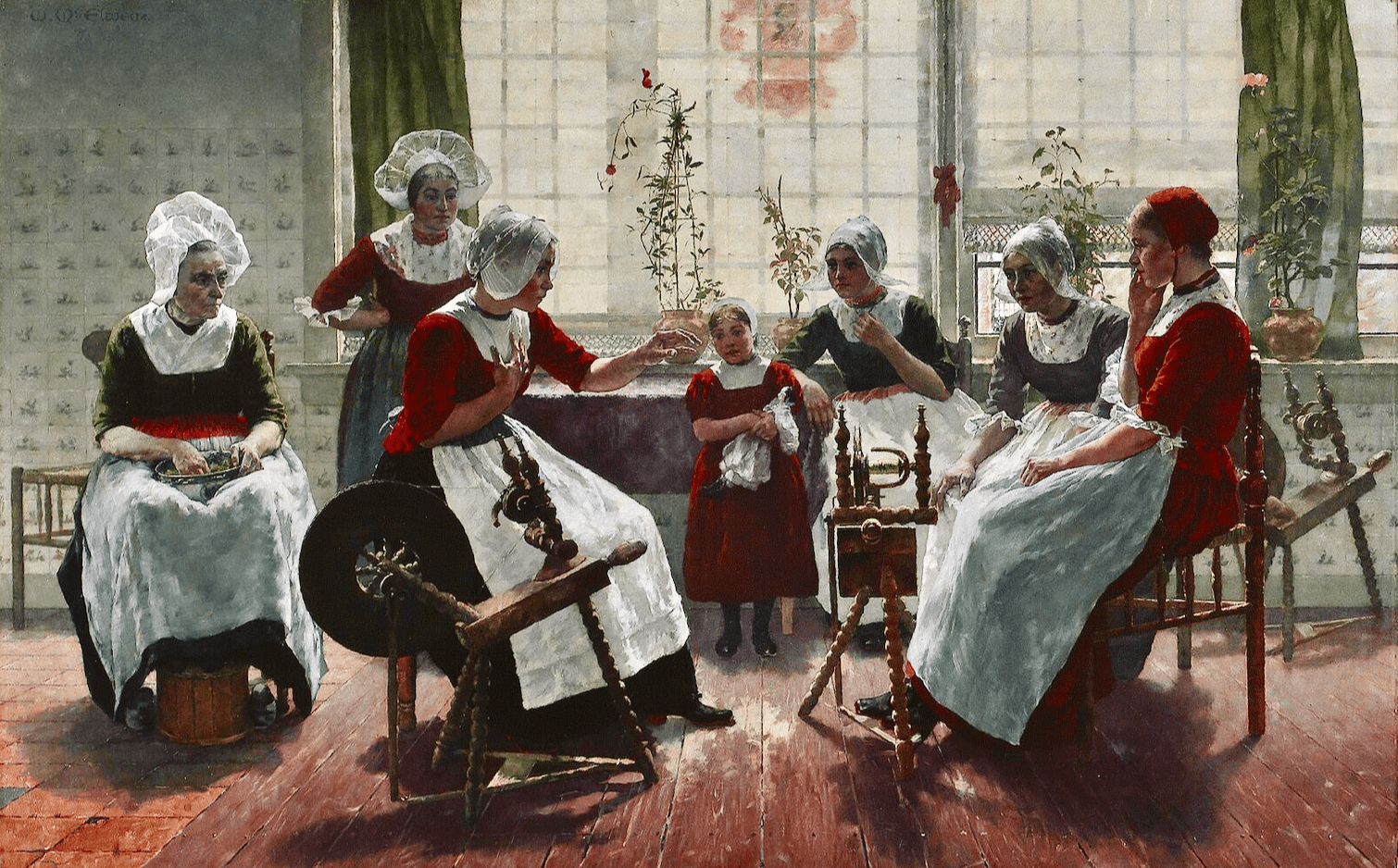
The featured image is “The Ghost Story” (1887), by Walter McEwen. This file is made available under the Creative Commons CC0 1.0 Universal Public Domain Dedication, courtesy of Wikimedia Commons.





I’m in full agreement, Bruce. Excellent piece.
For my money, the best Dracula film was the 1970s TV movie with Jack Palance as the count. He was positively feral.
then again, was probably about 12 when it was broadcast, and it made a big impression, prompting me to read Stoker’s novel–now that actually kept me up at night.
The thought of of Palance as Dracula causes me to sit up. Palance was perfectly cast in Panic in the Streets and Shane. I haven’t seen him in anything since. Hitchcock, famously, often cast against type, something that would be wrong for Dracula. Palance as Dracula suggests casting beyond type. For grown-ups, it might be hilarious, rather than scary. I laugh just imagining it, but I won’t underestimate Palance.
I haven’t seen the latest Dracula, so I can’t comment on that. But I would like to comment on and question the overall idea of the article.
You say “But even or rather especially in its darker moods, the horror movie can (and should) immerse the viewer in a mythology that makes him confront the struggle within himself between the better and worse angels of his nature, letting him see his own existence as the beast with the angel in him.”
I’m skeptical that the average viewer experiences this when they watch a horror movie. I’ve never had conversations with others about movies in such a way that makes me think they arrived at a similar conclusion.
I’m also skeptical that most horror movies accomplish this goal. I think thrillers do a better job. It seems to me that most horror movies either twist religion or fail to deliver on the goal you stated.
Do you have a list of other horror movies that you think accomplish this well?
I can think of a list of thrillers, dramas and sci fi movies that I think do a good job.
Some of the horror movies that I can think of that accomplished it best are considered cheesy: End of Days, The Stand.
Fallen almost did, but fell short when it had the demon possess a cat at the end…. The Exorcist almost did, but then Exorcist 2 came out….
If one’s aim is a work of fiction that will provide a moral, it’s probably better to leave off superstition and falsehoods like vampires. This pagan myth has not been Christianised in any form – there are no undead drinking the blood of the living. If one wants to make a fiction out of a pagan-type story, then it’s necessary to have no live-time mixing with the real, Christian world. The nineteenth-century Vampire story does blend the two, relativising Christianity, which becomes just another stage prop in a fictional, superstitious world.
Tolkien understood this perfectly. There is not a glimpse of Christianity in his make-believe world and its paganistic pre-history and creation myths. Yet the moral of the story and the behaviours are instantly recognisable to all of us who have grown up in a Christian world, just as they are foreign to true pagans. What a genius.
I appreciate this article overall as I too believe that when done well the horror genre can tell redemptive stories; and this occurs rarely in the present film industry. That said, I’d like to pick at a detail that I felt weakened this post. When you stated that Twilight was religionless teen angst that demands ridicule. I beg to differ. The Twilight series entailed a group of vampires that lived by a code of self-control favoring animal blood over human blood. This theme of self-control also dominates the story when the romantic leading vampire Edward refuses to consummate his love with his beloved until marriage. Does this not shout the Christian journey of controlling our passions? In this vampire lore Edward cannot go out into the light, not because he will burn, but because his unique beingness will sparkle like Jesus during the Transfiguration. Twilight is about the irredeemable monster seeking and finding redemption within the scope of its fantasy world. This is clear Christian parallelism. It may not restate the premise of salvation in its entirety but there is ample Christianity interwoven into the story that ridicule is hardly called for. It is true the films may not qualify as “horror” and I will not deny that they have teen angst but that is because they are written for young adults was written by a female and therefore leans toward popularity with females. Can’t there be “monster movies” made for young females? Do all films need to utilize an exact Christian worldview to communicate transcendent truths like truth, goodness, and beauty? I think that if you want to share a Catholic Worldview, you would be more open to take seriously a series that captured a generation of young women and not be so dismissive of its blatant religious overtones. The Twilight series supports the claims you made in this article! I encourage you to give that story a second look… or a first look, if the case may be.
Twilite is a sensual book that grants God-like attributes to the vampire Edward of omniscient oversight over Bella. God The usual defenses that represent Christ are useless against the “true vampires”: the cross for example relegated to a decorative element in Edward’s parents’ home. The last thing I would want are my teenaged girls reading Twilite: no boys of course bother with it.
Which is kind of interesting too now upon reflection: it’s the women who are the prized prey of Dracula: and the spell he puts them under is close to sexual seduction. Yes, it did indeed “capture” a generation of women hungry for a man who could protect them from the sexual desire of other males at a second’s notice, and also exercise the self control to “wait’ for them until marriage. No such man in real life exists, so once again we subject the sucesseptible hearts of young women to a fantasy version of male love and attention that does not exist. The tragic novel Madame Bovary, whatever else is thought about it, shows how mislead women can be by reading novels that expooit their “desire for men” [“your desire shall be for your husband”] without understanding the emotional knowledge and accompanying virtue that must needs temper and rule that : great desire: “and he shall lord it over thee”. God’s warning to Eve and all her daughters after the Fall.