
Beauty is there, if only we would heed its call. In the midst of the earthly city, with all its problems, we need to heed the call of the Heavenly City which is right there in front of us. My advice to everyone (writers included): go to church, discover beauty, discover God.
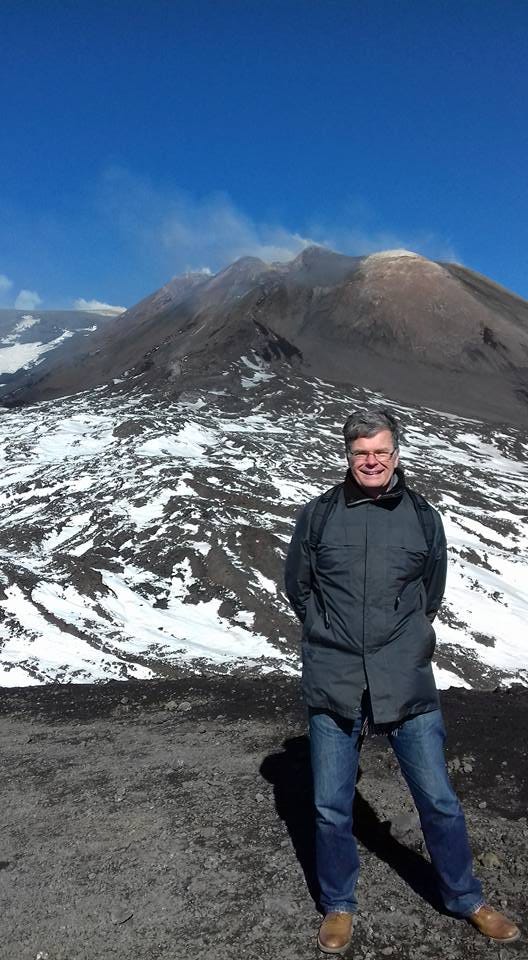
Alexander Lucie-Smith
The novelist Alexander Lucie-Smith is an English Catholic priest. He has authored a nine-volume series of mafia novels set in the Sicilian town of Catania. Like Mario Puzo’s Godfather stories, Lucie-Smith’s novels are embedded deeply into Italian Catholic culture. Although a Catholic priest, Lucie-Smith has not written a sweet Catholic morality tale—a Catholic immorality tale more like! The characters are unremittingly, wonderfully wicked, and the plots have all the suspense and soap opera drama of The Sopranos.
I reviewed The Chemist of Catania — the first in the series here, and have found the sequels to be equally riveting.
I find most new fiction a challenge, either because it is derivative, pretentious, and banal, or all three together. The Chronicles of Catania (my own name for the series) are original, simple, and absorbing. It has been a long time since I have found not just one book, but a whole series so difficult to put down.
Fr. Lucie-Smith and I had lunch together some time ago on one of my visits to London, so I got together to interview him about his life and his intriguing stories.
DL: Where do you serve as a Catholic priest?
The parish of Saint Clement’s, Ewell, which is in Surrey just outside London. It’s really suburbia, 25 minutes by train from Waterloo Station. We are a community of about 330 souls on a Sunday.
DL: Were you born into a Catholic family or a convert? Where were you educated?
I was born a Catholic and come from a long line of Catholics on both sides, though there were lots of converts among my ancestors too. My paternal great-grandmother was French, and on my maternal side I am related to the Blessed George Errington, martyr.
I went to a Catholic boarding school in Leicestershire called Ratcliffe College. I can’t say I really enjoyed being on the receiving end of education, but I had some inspirational teachers. My English Master, Fr. J.F. Morris, was dry but so inspiring, and thanks to him I read English at Oxford. At Oxford I had some wonderful tutors: Mrs Bednarowska, a person of unparalleled brilliance, and Bruce Mitchell, the world authority on Anglo-Saxon, and one of the best people I have ever known.
DL: What were your first attempts at fiction?
Well, they were not very good! But one day a friend told me ‘You should write about your family’ and I did. My first book ‘The Bishop of San Fernando’ is about Trinidad, my family’s ancestral home; the central character is a rather disappointed man who learns to live with disappointment. I thought that I had a great future ahead of me, but it turned out not to be the case. I wrote three well reviewed novels, and then…. Nothing.
DL: Who are your models and mentors when writing fiction?
When one tries to write fiction you need to ‘find your own voice’ – forgive the cliché. If you have read a lot like me, you tend to find yourself writing tribute books which are no good because they are not as good as the people you admire. One influence on me has been Sir Walter Scott, particularly his first novel, Waverley, and the most influential novel of the 19th century, Ivanhoe (a mixed bag but a book of incredible reach.) Scott sympathises with the losers. He knows why they (the Jacobites, the Saxons, the Jews) lost, and why in a way they had to lose, but his heart is with the losers.
The Mafia are losers, which sounds counterintuitive, but as Catholics we are always with the underdog, are we not? They are losing their souls… the most important ‘thing’ we have. In the end you may gain a great deal, but if you lose your own soul…. The Mafia are tragic.
The interesting thing is that over the last few years – heresy! – I have stopped reading fiction, at least new fiction. I reread old books, and I read history and biography mainly, and poetry, Tennyson being a great favorite. I imbibe popular fiction through the television… which does not infect you with a style. So the style I have is my own entirely, I think. I try not to be mannered in any way, but down to earth and unpolished. Quite a lot of the authors I once liked strike me as terribly mannered now. A lot of modern fiction I find unreadable.
DL: You are clearly not only an Italophile, but a learned and experienced lover of Italy. When did the attraction to Italy start and how did it focus on Sicily?
I like Italy but it drives me mad….. and eight years living in Rome was not paradise; the lack of privacy and space gets you down. I first went to Sicily aged eleven or so on a school trip. That trip really has stayed with me, and on my last but one trip I went back to the place we had stayed, fifty years previously, and there it all was. What drew me to Sicily as a place to write about is that as an island its distinct, and just the right size; I watched The Sopranos and was inspired to do a mafia saga but set in Sicily. I had also watched and read the Godfather novel and the film trilogy.
DL: Is crime-ridden Purgatory a real location? Is the Church of the Holy Souls in Purgatory a real church?
Yes and no. The very first time I went to Catania as an adult I got off the train and walked though the area known as San Berillo Nuovo to get to the main street, the via Etnea. San Berillo then was pretty grim, not helped by the fact that it was badly bombed in the war and has never been properly rebuilt. There are still ruins there. It was also menacing as the only people around seemed to be prostitutes, ‘women with ruined faces’ as they are described in the first book, and buildings suffering from ‘leprosy of the façade.’ So the fictional Purgatory is placed in San Berillo Nuovo, though it is fictional. The Church of the Holy Souls is imagined, but inspired by a church with a similar dedication elsewhere.
DL: It might be expected that if a Catholic priest attempts fiction it would be, perhaps, an inspiring historical novel, an allegorical and didactic tale, or fantasy a la J.R.R. Tolkien and C.S. Lewis. You have written an unsparingly gritty story of a Sicilian crime family that includes fraud, murder, incest, adultery, fornication, drug dealing, human trafficking, torture, and more. Have you had any pushback from your parishioners, friends, or bishop?
Yes and no. One can only write about what comes. I was standing in Catania in a square, and I saw man doing something very strange that I had never seen before – he was vaping! There was something about that that lodged in my mind, and when I went home, I sat down and started to write… that is how don Calogero di Rienzi was born. I have two brothers who were shocked by some of the incidents in the book and wondered if I had been horribly bullied at school (the answer to that was no). A few people have said it was too violent to read. One fellow writer told me it was ‘mephitic’, a new word to me, but he praised me for getting the atmosphere of crime right. The funny thing is I have never ever met a violent criminal in my life or witnessed violent crime. I suppose I just have a vivid imagination.
DL: Despite your characters unremitting wickedness, the Catholic religion also seems a central part of their lives. Without giving it all away, what’s the point? Shall we re-assess our smug and puritanical middle-class Catholicism? Shall we withhold judgement of the sinners? Is there a lesson here or are you just telling a ripping, good story?
There’s a very strong connection between the worlds of Catholicism and organized crime. Remember the Little Italy scenes in the Godfather II? This connection is atmospheric, not doctrinal; perhaps the connection is that both religion and crime are ‘organized’, and both stress family in different ways. But the fact is that mafiosi have to be Catholic or Jewish; you can’t have Anglican mafiosi. I do make it clear that Calogero is an atheist, but he loves Catholic tradition. The reason for this is because the Mafia is a very conservative and traditional body. It is not ‘fighting for a new Sicily’ as lefties would say, but harking back to the old way of doing things, indeed to the Sicily of its foundation, that of 1862.
Yes, Calogero and his fellow thugs are terrible sinners. As for middle-class Catholicism, I suppose it has its place, but, Catholicism from the beginning was the religion of the despised underclass of the Roman Empire: slaves, foreigners, women, children, those who did not count, the wretched of the earth. I am quite interested in the wretched of the earth as people.
DL: Your main character Calogero and his sidekick Traiano are ruthless, murderous mobsters, but somehow you get us to love them. Is that your intention? Why do we not reject them? Why do I want to keep reading?
There was an architectural critic who said there is no such thing as an ugly building; he’s right; insofar as it is a building it has got something about it. There’s no such thing as a boring character. I think you read on because of character and plot driving the thing forward. Why they act the way they do is fascinating to me, and I hope to the reader. When one realizes why people are acting the way they do, they gain our sympathy, even if it is rather misplaced.
DL: You have so far avoided any neat repentance and redemption scenes. You have also avoided the “Bad guys getting what they deserve” scene. The only thing “religious” is their participation in the rites of passage and the saga’s setting in “Purgatory,” but your purgatory is more like Hell, isn’t it?
Is there redemption? Yes, it is on offer, but the characters don’t take this offer up by and large. We are all trapped by our choices, while aware that things could be different. Yes, it is Hell. I am haunted by what Dorothy L. Sayers said when talking about Paolo and Francesca in Dante’s Inferno. ‘Hell is getting your own way – forever.’ Hell to me is knowing things could have been different, if only…. The whole series of books is presided over by the Spanish Madonna (I was inspired by a real church dedicated to the souls in purgatory in Ragusa.) There she is in front of them, pointing to salvation. Just look at Her, people! But we are so blind and so blinded….
DL: We look back to a kind of golden age of Catholic literature with Chesterton, Greene, Waugh, Tolkien, etc. What do you think is needed if there is to be a true renaissance of Catholic literature in the West?
For more Catholic literature you need more Catholic writers who feel Catholicism in their hearts, in their guts. I think Catholicism is visual, and there is scope for Catholic revival in film and television. The way in to the rediscovery of Catholicism is through the rediscovery of beauty. There is beauty woven through Calogero’s world. Catania is very run down but it is beautiful. Beauty is there, if only we would heed its call. In the midst of the earthly city, with all its problems, we need to heed the call of the Heavenly City which is right there in front of us. My advice to everyone (writers included): go to church, discover beauty, discover God.
__________
The Imaginative Conservative applies the principle of appreciation to the discussion of culture and politics—we approach dialogue with magnanimity rather than with mere civility. Will you help us remain a refreshing oasis in the increasingly contentious arena of modern discourse? Please consider donating now.
The featured image, uploaded by trolvag, is a photograph of Piazza Vittime della Mafia, Gangi PA, Sicily, Italy, taken on 22 July 2014. This file is licensed under the Creative Commons Attribution-Share Alike 3.0 Unported license, courtesy of Wikimedia Commons. The image of Fr. Alexander Lucie-Smith is taken from his Substack.



Leave A Comment