
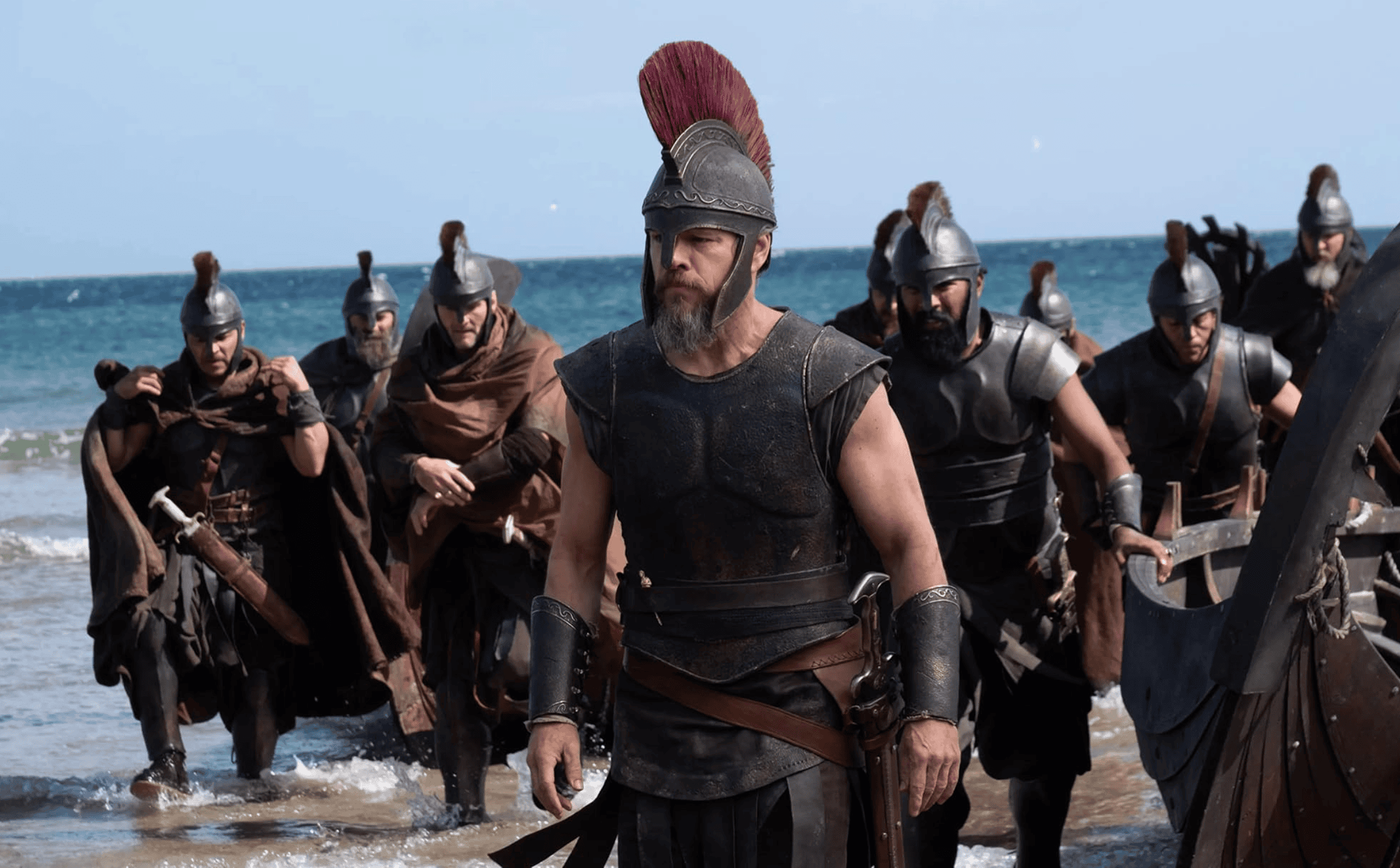
 The problem with Christopher Nolan’s The Odyssey is, ironically, that it is too Christian. Despite the hubbub from some online conservatives screaming about how “woke” it is (usually before seeing it), the real deficiency of the movie is that it whitewashes the barbarity of the ancient world. It makes Odysseus seem like a Christian, at least ethically.
Nolan invented a principle, shared by all in his version of the ancient world, he called “Zeus’ law”: treat every person as you’d like to be treated because they might be a god in disguise. It’s an amplification of the real Greek ethic of “xenia”: hospitality to the traveling stranger, for exactly the reason Nolan gives. But it is stretched so far that it practically serves as the Christian Golden Rule. In defiant counterpoint to the reactionary pre-critics calling for a boycott of a movie they hadn’t seen, other Christian and conservative commentators celebrate Nolan’s Christianization of The Odyssey. I don’t.
Nolan’s mistake is not that he discovers virtue in pagan Greece; Homer knew genuine virtue. It is that Nolan collapses Homeric xenia—a reciprocal and divinely policed code of guest-friendship—into universal charity and gives Odysseus the guilt of a Christian conscience. The film thereby allows modern viewers to enjoy Christian moral intuitions while forgetting the faith that formed them.
By portraying Odysseus as governed by a BC Golden Rule foreign to Homeric heroic culture, Nolan subtly suggests that the ancient world was not so different from our own; that the moral order was essentially the same; and thus, by only one more logical step, that Christianity did not make any radical changes but was just the latest religious dress on the same spiritual body. Hence, the viewer could conclude: Jesus made no real difference; He only changed the mythology behind the same ethics. Nothing could be further from the truth.
The Odyssey should be portrayed in all its classical barbarity, not because the original poem is too much a part of our cultural canon to be altered, as Elon Musk has suggested. Nah. Modern artists are free to wield their artistic license on mythology or fiction. Only, they had better improve it. And Nolan may indeed have produced an improved, cinematic version of Homer’s poem. It is beautifully crafted, as Nolan’s films invariably are; the acting is superb, especially Matt Damon’s performance. The moral lessons in Nolan’s film are better than in Homer’s poem. And that’s the problem. Nolan’s world before Christ, which was actually cruel and murderous, is rendered too much like ours.
A better take would have resembled what Mel Gibson did with Apocalypto. He drowned the viewer in the brutality of pre-Christian – in the sense of before being transformed by Christianity – Maya “civilization,” if a culture that cuts the hearts out of living human beings for its cult can be called a “civilization.” Then, at the conclusion, we see a Spanish shore party, rowing toward land, with a cross hoisted, a picture of whence came our true civilization.
Nolan Christianized The Odyssey and, in so doing, improved it as a moral piece of art but confused the viewer about where our morality came from. We Westerners need to face the fact that before Christ, our “civilization” was not head and shoulders better than the Maya. Even The Odyssey shows we were making human sacrifices too, though perhaps not on the scale of the Maya. Western culture, BC, is not really great and certainly not good. Sure, we had some brilliant philosophers and artists — Socrates, Plato, Aristotle, Virgil and Horace — Olympic Games, scientists who reasoned that the earth was spherical and calculated its circumference with remarkable accuracy, and some steps toward democracy and republican government. We had some impressive accomplishments. But absent Christianity, our culture was savage and debased. A side-by-side comparison of pre-Christian Western civilization and traditional Chinese civilization, with China’s inventions of printing centuries before Gutenberg, gunpowder, paper, and the compass, and its philosophers like Confucius, would put China on top. China’s counterpart to the Odyssey, Journey to the West, featuring the Monkey King Sun Wukong, is arguably more entertaining than The Odyssey’s stuffiness. The West, minus Christ, is not best. Christianity was the decisive force that civilized the West. It restrained its cruelty, gave moral purpose to its venturesome spirit, disciplined its peoples, and helped form a civilization that was not merely powerful but, at its best, good—something the aspirations of Aristotle or Marcus Aurelius could not accomplish by themselves.
The problem with Nolan’s movie is that he makes it harder to see that. Unwary viewers will think the morality they take for granted can be taken for granted; that it is just innate to society. Sure, Romans 2:14–15 tells us that people have some of God’s law written on their hearts. But we’re not talking about individuals but cultures. A good culture, as the name implies, cultivates that law and grows moral people and nations. Before Christ, there were moral individuals aplenty. But there were no truly moral cultures, including ancient Greece. Forgetting that fact is one step to losing it. This brings us to Nolan’s casting of a woman, Elliot (formerly Ellen) Page, who thinks she is a man, to play a Greek soldier. It’s a small role, but it mars the film. She appears like a somewhat effeminate teenage boy. Was Nolan trying to send a transgender message? Probably not. Most likely, he was echoing the moral universe of Hollywood in which he is immersed, one where transgenderism is celebrated as the new civil rights movement. So, wanting to be loyal to actors with whom he had previously worked, Nolan stuck Page in where he thought she would make sense: as a he.
As the Christian influence fades from our culture, beginning first among the elite in academia and the arts, like Nolan, they lose the moral sense of why mutilating oneself to try the impossible leap of crossing sexes, as Page has done, is wrong and shouldn’t be celebrated or even accepted. Nolan should know what happens when the Christian ethic is gone. What happens? We get a world much like the one he sanitized for his version of The Odyssey.
__________
The Imaginative Conservative applies the principle of appreciation to the discussion of culture and politics—we approach dialogue with magnanimity rather than with mere civility. Will you help us remain a refreshing oasis in the increasingly contentious arena of modern discourse? Please consider donating now.
The featured image is courtesy of IMDb.




This is the BEST and most VITAL review for those of us who believe in Christianity and who are concerned for our country and for others we know and do not know. Very grateful.
A thoughtful review. In my last book, How Jesus has Liberated Women Part I, I make the same point, with one chapter called “Penelope’s Long Wait,” because women in the ancient world WERE waiting for a hero greater than Odysseus, one tied to the cross as Odysseus was tied to the mast. (Clement of Alexandria made this analogy already.)
However, I’m not sure Nolan should have or could have made an Apocalypto style film, with Spider Man executing a dozen unfaithful waiting women at the end, and Will Hunting sleeping with goddesses shamelessly on the way home from sacking Troy. (And the Greeks did feel guilty about human sacrifice, thus the fate of Agamemnon, which is portrayed in this film.)
Well said John. We too easily forget (and so did Nolan) the practice of Zeus with Europa and Leda and Gannymeade and….
But the story of his visit with Hermes to Ephesus, where no hospitality was offered until he met Philemon and Baucus, serves as a comic backdrop to Paul and Barnabas arriving there.
The film also did not give us the trickster, Odysseus (where was the No Man joke?) and it kept showing men running to their boats (three times like a fairy tale). Nevertheless, it was visually sumptuous.
Thanks for your insightful review.
A provocative and thoughtful essay, particularly in its insistence that Homer’s moral universe must be understood on its own terms rather than rewritten to flatter modern sensibilities.
One of the most persistent errors in contemporary treatments of history and literature is presentism: the assumption that men and women of earlier ages ought to have thought precisely as we do, possessed our accumulated knowledge, and shared moral convictions that took centuries to develop. Historical understanding requires something more difficult. We must attempt to enter the world as its inhabitants understood it—to recognize its duties, loyalties, fears, religious assumptions and moral limitations—before passing judgment upon those who lived within it.
Odysseus was not a defective modern liberal, nor a Christian who had somehow failed to anticipate the Sermon on the Mount. He belonged to an aristocratic warrior culture in which honor, vengeance, household loyalty, hierarchy and reciprocal obligation formed the moral architecture of life. Homeric xenia was real and important, but it was not identical to Christian charity. It governed relations between host and guest within a particular religious and social order. It did not proclaim the universal moral equality of mankind, still less the obligation to love one’s enemies.
To blur that distinction is to diminish both Homer and Christianity. Homer should be allowed to remain Homer, rather than being made safe for modern audiences through the insertion of moral assumptions foreign to his age. Christianity’s moral achievement should likewise not be obscured by pretending that its universalism had always been implicit in the pagan world. The command to extend moral concern beyond tribe, household, status and reciprocity represented a profound transformation.
I would hesitate, however, to characterize the entire pre-Christian West as merely “savage and debased.” Christianity did not descend upon a civilizational vacuum. It inherited Greek philosophy, Roman law and political order, and the Hebrew understanding of a transcendent moral authority standing above kings and nations. The civilization that emerged was not produced by the simple rejection of antiquity, but by its transformation. Athens, Rome and Jerusalem were drawn into a synthesis that none could have created alone.
This is why the fashionable habit of judging the past exclusively by present standards is so intellectually destructive. It converts history into a courtroom in which the verdict has been determined before the evidence is heard. The past becomes little more than a parade of defendants charged with failing to hold the opinions of the twenty-first century.
Yet the alternative is not moral relativism. To understand an act historically is not necessarily to excuse it. Customs may be deeply rooted, religiously sanctioned and intelligible within their own civilizations while still remaining open to moral judgment. Indeed, the history of civilization is in large part the history of inherited practices being reconsidered, reformed or rejected under the pressure of broader principles of justice.
That tension has long interested me as both a historian and a novelist. It lies near the center of my novel, Altar of Ashes, in which an ancient practice is defended within a modern court through appeals to culture, tradition and historical difference. The difficult question is not whether the tradition had meaning to those who observed it. Clearly it did. The question is whether historical and cultural understanding must end in moral surrender.
We should neither falsify the past by remaking it in our own image nor romanticize it by placing its customs beyond judgment. The historian’s first responsibility is to understand. Judgment may follow—but only after the world being judged has been allowed to speak in its own voice.
This is one of those pieces that says, “Let’s squeeze Jesus in and see how he fits!” The impulse is tedious, and in this case the result doesn’t fly.
The idea that Odysseus should feel guilty for his deeds is present in pagan antiquity — in the Aeneid and other Latin sources from which Nolan derives much of his material. Incidentally, the idea that the “barbarity” of the ancient world needed to be restrained is also present in the Aeneid: “Furor impius intus,/Saeva sedens super arma, et centum vinctus aenis/Post tergum nodis, frement horridus ore cruento.”
The Golden Rule too — especially in its negative form, which is all that applies to Nolan’s film — has a long history prior to Christianity. It is present, for example, in the Mahabharata.
The real problem with Nolan’s “Odyssey” is that it diminishes its hero — and indeed all its characters of heroic stature. Instead of the determined, resourceful, and decisive figure presented in Homer, we get a weak, vacillating version. The wisest (or at least the shrewdest) of the Greeks is reduced to just another drab nebbish. Matt Damon, who played Jason Bourne, could have made a great Odysseus. But his promise in this role goes unfulfilled.
For some reason, moderns (and even earlier Christians) itch to work this foul diminution on the heroes of the Greco-Roman world. This is one facet of the midset that offended the general Roman populace, making them think, according to Tacitus, that Christians were characterized by “odium humani generis.”
Is Carpenter serious when he says that a director could improve on Homer, and that Nolan to some extent has done so? Beautiful filmmaking is one thing, and those lacking in imagination may require it. But it can only substitute for the glory of exalted language if you’re illiterate. The dialogue in Nolan’s film — bland at its best, and stumbling regularly into coarseness — is itself an insult to the source material.
Can we professed Christians please refrain from displaying “odium humani generis”? The most violent and “barbaric” scene in Homer’s “Odyssey” is the slaughter of the suitors. And it is possibly the most luminous scene in all literature. If you can’t cheer Odysseus on in this scene, without expecting him to feel guilty, you shouldn’t be coming anywhere near Homer’s poem in the first place.
This comment largely proves rather than refutes my thesis. I am not “squeezing Jesus” into Homer; I am objecting that Nolan has already done so—turning reciprocal Homeric *xenia* into a positive, universal rule and giving Odysseus a conscience foreign to Homeric heroic culture. The complaint that Nolan makes Odysseus weak and vacillating merely restates part of my criticism in different words.
The Virgil quotation is beside the point. *Aeneid* 1.291–296 is not about Odysseus feeling guilty; it is Jupiter’s Augustan prophecy that personified Fury will be chained when Roman order triumphs. Virgil wrote roughly seven centuries after Homer, and his epic ends with Aeneas killing the defeated Turnus in rage. If Nolan imported later Virgilian moral unease into Homer, that confirms my argument. Likewise, the *Mahabharata* is Indian, not Homeric Greek, and its negative maxim—do not injure others as you would not wish to be injured—is not Nolan’s explicitly positive “Zeus’ law.” I never claimed that pagans possessed no virtue or moral insight; I explicitly said otherwise. But as many have observed, the so-called “silver rule” of other faiths is far less radical than Jesus’ “golden rule.”
Most revealingly, the commenter demands that Christians cheer the slaughter of the suitors “without expecting [Odysseus] to feel guilty.” The suitors were certainly guilty of grave crimes, but Odysseus refuses restitution and exterminates them, including the pleading Leodes; the aftermath includes the hanging of twelve enslaved women and the grotesque mutilation of Melanthius. Calling this “possibly the most luminous scene in all literature” and insisting that Christians applaud it without moral reservation is not Christian humanism. It is the exaltation of pagan blood vengeance—and vividly demonstrates the moral gulf that Nolan’s Christianized Odysseus obscures.
Finally, Tacitus’s *odium humani generis* was a pagan slander against Christians whom Nero tortured, not evidence that Christian criticism of pagan heroes caused Roman hostility. Invoking their persecutors’ insult to shame Christians into admiring pagan cruelty is deeply ironic. I do not despise Homer or humanity; I take both seriously enough to refuse to pretend that Christ made no moral difference.
Best review I’ve seen so far. By far. Thank you. This makes sense.
I would offer one slight criticism. The Golden Rule was certainly emphasized by Christ, but it originated in Leviticus, Chapter 19, 1400 years before Christ.
Leviticus 19:1 “And the Lord spoke to Moses, saying, 2 “Speak to all the congregation of the people of Israel and say to them, You shall be holy, for I the Lord your God am holy. 3 Every one of you shall revere his mother and his father, and you shall keep my Sabbaths: I am the Lord your God.” … Leviticus 19:11 “You shall not steal; you shall not deal falsely; you shall not lie to one another. 12 You shall not swear by my name falsely, and so profane the name of your God: I am the Lord. 13 “You shall not oppress your neighbor or rob him. The wages of a hired worker shall not remain with you all night until the morning. 14 You shall not curse the deaf or put a stumbling block before the blind, but you shall fear your God: I am the Lord. 15 “You shall do no injustice in court. You shall not be partial to the poor or defer to the great, but in righteousness shall you judge your neighbor. 16 You shall not go around as a slanderer among your people, and you shall not stand up against the life of your neighbor: I am the Lord. 17 “You shall not hate your brother in your heart, but you shall reason frankly with your neighbor, lest you incur sin because of him. 18 You shall not take vengeance or bear a grudge against the sons of your own people, but you shall love your neighbor as yourself: I am the Lord.”
Homer’s Menelaus, Achilles, and Odysseus were — not this. By making Odysseus into a “Judeo Greek”, with a conscience? Nolan blurred these lines – and yes – made Judeo Christianity – seem less exceptional.
As Russell Kirk taught in his , the Judeo in Judeo-Christian is not silent, and the Israelis were given the strongest moral code in the history of the world, until fulfilled circa 30-33 AD. Kirk taught us, it was the wonderful fusion of the Judeo-Christianity morality, with the Greek rational thought, with the Roman laws, and English common law that brought us to Philadelphia of 1776 and 1789.
In the fullness of time, the Greeks became more Jewish, even as the Jews took on some of the Greek Logos…
It does not escape us that today? Israel, Greece, Italy, the UK, and the United States had balanced governments with individual rights…
Certainly, the original readers of Homer’s Iliad and Odyssey would not have recognized this production. Odysseus’s “arete” was “it’s better to be great than good”. Under Moses, it was better to be good than great.
Hello. First time visiting this refreshingly sensible site, but have already enjoyed the two stories I’ve looked into thus far. So, in this case, thank you for a well presented argument in favor of historic cultural realism and accuracy. As a boringly respectful optimistic agnostic who grew up in Amish country, the author’s review was very close to my own take-away regarding that artwork-over-history (or over anything remotely resembling accurate cultural anthropology) entertainment. But, yes, beautiful artwork. And, to be fair, art often employs creative lies as a means of _more artfully_ expressing truths. Picasso was right about that much. As a working musician and ‘old fashioned’ freehand graphic artist, I’m mostly in the Sir Roger Scruton camp regarding the importance of both truth and beauty. Keep up the top-drawer wordsmithing. I look forward to reading more.
Everyone seems to be complaining that Nolan does not present “my Odysseus” or “my Odyssey.” Allow Nolan the art of presenting “his” Odyssey, which, otherwise nosy of the critics find engaging . Isn’t that what epics are for…What is worth fighting about?
What a thought provoking and stimulating article! Though I agree with most of your argument, I would have to disagree with your implication that the lived implementation of Christianity was a continually effective source of moral values and civility throughout history, serving to wholly purify societies. The nuance and abject failures of western civilization — and of Christians — must also be acknowledged, even against the backdrop of the deeply evil or barbaric nature of humanity pre-Christianity. And of course, these failures aren’t an indictment of Christianity itself, but of the fallen nature of man — humanity’s perverted, selfish, and murderous attributes that led to the misrepresentation and exploitation of the religion. To touch on your example, the Spanish, though they (thankfully) weren’t routine cannibals, slaughtered thousands of indigenous peoples and instituted a harsh labor system known as encomienda. The origins of our “true civilization” are not just shaped by Christian values, but of the bloodshed and greed; the church and those acting in its name have at times been complicit in injustice, corruption, and oppression. All this to say that history does not diminish Christ’s teachings, and Christianity has certainly led to profound moral growth. However, its historical influence was not a perfect civilizer.
A thoughtful essay here but the narrative of Ancient Greece as exceedingly barbaric with no sense of morality leaves out the concepts of miasma, hilasmos, and pharmakos all of which were present in their respective civilizations.
Conservatives ahead of time were afraid the film would be woke. But afterward I too had the thought, no, it is the other side that might not like how Christian it is.
Nolan, probably unknowingly, is having his cake and eating it too. He assumes the blessings of the Judeo-Christian world-view, without the confines of the Ten Commandments or the shame of the Cross.
It is an interesting discussion for Christians to have whether this is a positive or a negative. The essay makes a great point certainly – without the revelation given by God through the prophets, the Incarnation, Scripture – we would all be lost at sea, far from home.
But if you take the Odyssey film less literally for Homer’s world, and more as a mythic story in its own right, there is much meaning that a Christian can rejoice in. (Our beloved Lord of the Rings never mentions Abraham, Moses, Mary, Jesus Christ, sin, heaven, hell – yet we love it as a Christian myth.)