
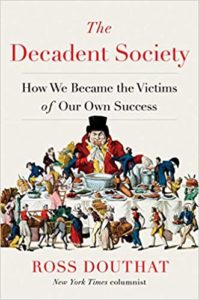
Will our own age of decadence collapse with this novel coronavirus? Ross Douthat, in “The Decadent Society,” foreshadows rather prophetically, not knowing at the time of its printing, that this possibility could arise.
 As I approach the second week of my 14-day quarantine, due to possible COVID-19 infection upon detachment from my previous military command in Japan, I find myself like so many other quarantined individuals around the world, either by personal choice or government mandate, with an unprecedented amount of newfound leisure time. Numerous outlets exploited this rare opportunity to suggest once-seemingly normal activities one can enjoy now that time constraints at the office no longer exist and families are forced to be in each other’s company for an unknown—albeit lengthy—period of time: regular family meals, the recovery of board games, or going for a stroll in the neighborhood. The last suggestion is not even possible in some of the hardest hit regions in northern Italy and an ever-more increasing number of countries including India, Brazil, and South Africa.
My own quarantine has become a blessing in disguise, as with enough courage and untapped motivation, the laundry list of books I’ve set out to read was approached and conquered. The book that caught my attention, in large part due to the book’s unmistakable relevance to the surreal apocalyptic crisis the world faces today in literally all aspects of human affairs, was Ross Douthat’s latest soul-searching book, The Decadent Society: How We Became the Victims of Our Own Success.
To begin, Mr. Douthat argues, as the title lays forth, that ours is a society marked by decadence, or perhaps has reached the next level of “sustainable decadence.” In a world subsumed in this bleak, dismal vision, the global populace is to a great degree content with a sedated lifestyle: filling empty souls with radical political ideologies of the past (both on the left and right), relinquishing control of our minds to the latest (made-in-China) smartphone and all its addictive elements, constraining the natural function of the female body in the name of autonomy and human rights at the cost a declining replacement fertility rate, and placing absolute trust of one’s future in an overburdened and unsustainable welfare system. The author employs the late French-American historian Jacques Barzun to illustrate what such a society looks like: “The forms of art as of life seem exhausted, the stages of development have been run through. Institutions function painfully. Repetition and frustration are the intolerable results. Boredom and fatigue are great historical forces.”
Any individual with their eyes not glued to their social devices will somewhat agree that this depressing observation is the reality we live and breathe in. Men and women of all ages, no longer wishing to bear the burdens of human suffering, opt for legalized self-assisted suicide; modern governments are so infected by the poison of bureaucracy, it ceases to function; and millenials find such boredom in physical reality, they engulf their entire day in virtual reality.
Towards the end of the book, Mr. Douthat suggests that catastrophes of significant proportions can end the streak of decadence with examples of a global famine unleashed by unchecked climate change or regional political turmoil caused by mass sub-saharan migration to the borders of southern Europe. The end of decadence, as we know of it, will not come from a cancerous cell within the body, but without. The imperial Aztec and Incan civilizations are mentioned to disclaim the notion that their primitive practices of human sacrifice and corrupt governance was the source of their decay. Rather, it was the foreign “antibodies” brought by the Spaniards that served as the external agent of civilizational death.
With this being said and given our circumstances, will our own age of decadence collapse with this novel coronavirus? Mr. Douthat foreshadows rather prophetically, not knowing at the time of its printing, that this possibility could arise.
He writes, “Or, alternatively, our age could end with an apocalypse that’s contingent on our technological proficiency, but that still happens entirely accidentally or as an act of terrorism or sabotage that gets wildy out of hand. This is a danger that the Aztecs and Romans didn’t face, but we do: our achievements mean that even under conditions of stagnation, even without the leap toward the kind of world-destroying artificial intelligence feared by certain Silicon Valley worriers, we have many different civilizational murder weapons lying around waiting to be used or to go off by themselves,” and he continues, “Our planes and trains and automobiles create endless vectors for deadly diseases to move more swiftly between societies than ever before. Our way of life depends on a technological infrastructure that various disasters could put to an existential threat.”
Now, I believe that this by-and-large “accidental” catastrophe, though research and proper journalism may prove otherwise, will leave our decadent lifestyle intact. As the Italian healthcare system is near the brink of organizational and logistical collapse and the U.K.’s own glorious National Health Service may soon meet the same fate, socialized medicine will continue to exist in most E.U. member states, albeit facing serious reforms. As the elderly population slowly passes away by this virus’ particular tendencies, no government or its citizenry will invoke a clarion call for higher replacement fertility rates. The use of contraception and abortion will remain the status quo. And an overwhelming large number of the global population will pursue their preference of living in virtual over physical reality.
While the above assumptions may prove true or false, I do believe the novel virus may partially disrupt our decadent society for the good. As millions of dollars are potentially drained from the coffers of prospective university budgets as the Chronicle of Higher Education reports, from the small liberal arts college, the state-subsidized university, to the prestigious Ivy-league campus, the once religiously held value of a campus “safe space” may wither away to non-existence. Having lost a quarter or an entire semester’s worth of inflated education, millennials may come to value serious intellectual discussion and be open to a worldview other than one’s own that can only exist in non-online classrooms.
Bishops of Catholic churches following the Novus Ordo rubric may prudently end the peaceful shaking of the hands, communion on the hand, and the awkward holding of hands due to updated health requirements. And as thousands of small businesses are forced to shut down and millions laid off, people may perhaps reconsider the vital role small businesses play in bolstering a city’s employment and rethink its support of national retail corporations which come and go at the whims of its billionaire employers.
Only once the general chaos wreaked by the coronavirus screech to a halt, though it may last up to a year, will its lasting fruit be revealed. Then we shall know if the end of decadence has truly arrived.
The Imaginative Conservative applies the principle of appreciation to the discussion of culture and politics—we approach dialogue with magnanimity rather than with mere civility. Will you help us remain a refreshing oasis in the increasingly contentious arena of modern discourse? Please consider donating now.
The featured image is “Romans During the Decadence” and is in the public domain, courtesy of Wikimedia Commons.



Good read – I wonder what decisions by families and towns during the pandemic might change societal values regarding local businesses vs large corporations, having more kids vs abortion-on-demand, liberal learning vs partisan ideology, virtual diversions vs physical engagements?