
In what kind of world is it fair that the United States should shoulder the burden of protecting totally wealthy societies from a corrupt and violent world?
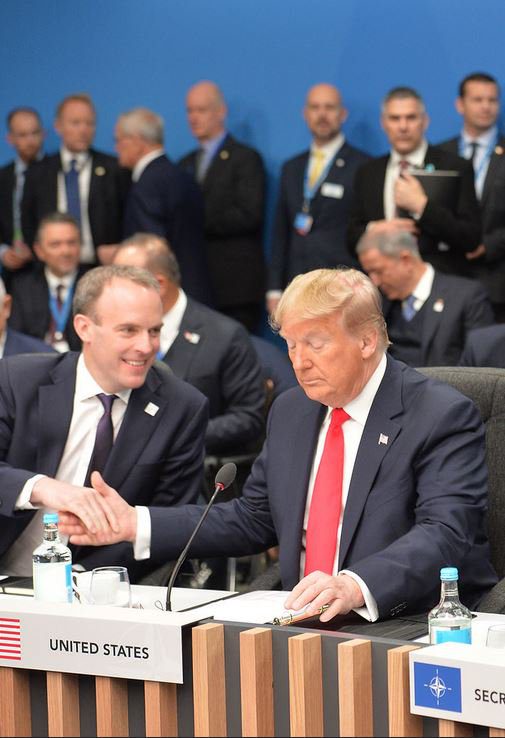 Though it would be hard to pin a tail on Trump’s ever-moving and erratic donkey of a myriad of statements on every topic imaginable, it’s pretty clear that the 47th president is not happy with the North Atlantic Treaty Organization. He’s not happy with NATO because of disagreements of the future of Greenland, because NATO refuses to pay for itself and free rides off of the United States, and because the NATO refused to help in the most recent war against Iran. Just today (as I’m writing this), Trump threatened to withdrawal thousands of U.S. troops stationed from Germany alone. Overall, America stations between 80,000 and 100,000 troops in NATO bases across the continent.
Whether Trump is making such claims from anger or from larger overall strategic aims is difficult to discern. But, it’s still worth asking, should America be in NATO or, frankly, in any alliance with any foreign power? Is it even constitutional?
Article I of the United States Constitution very clearly states that only the House and the Senate have the power to declare war with the president set to execute it (Article II): “The President shall be Commander in Chief of the Army and Navy of the United States, and of the Militia of the several States, WHEN called into the actual Service of the United States.” In the Federalist Papers, James Madison makes it very clear that the Legislative body, rather than the Executive or Judicial, is to lead and hold the prominent place in the Republic.
But, Article V of the NATO treaty states:
The Parties agree that an armed attack against one or more of them in Europe or North America shall be considered an attack against them all and consequently they agree that, if such an armed attack occurs, each of them, in exercise of the right of individual or collective self-defence recognised by Article 51 of the Charter of the United Nations, will assist the Party or Parties so attacked by taking forthwith, individually and in concert with the other Parties, such action as it deems necessary, including the use of armed force, to restore and maintain the security of the North Atlantic area.
Clearly, this obligates us to join in a state of war whether Congress has declared one or not. Nothing in the Constitution suggests that Congress or any part of the government has the right to abdicate its Constitutional responsibilities. That is, by what right on April 4, 1949, did the President and the Senate have to give away American sovereignty? Certainly, there is none. Thus, from an extreme constitutionalist perspective, the NATO treaty is illegal.
In the earliest days of the republic, both George Washington and Thomas Jefferson warned us against alliances with foreign powers. Here’s Washington in his Farewell Address:
The great rule of conduct for us in regard to foreign nations is in extending our commercial relations, to have with them as little political connection as possible. So far as we have already formed engagements, let them be fulfilled with perfect good faith. Here let us stop. Europe has a set of primary interests which to us have none; or a very remote relation. Hence she must be engaged in frequent controversies, the causes of which are essentially foreign to our concerns. Hence, therefore, it must be unwise in us to implicate ourselves by artificial ties in the ordinary vicissitudes of her politics, or the ordinary combinations and collisions of her friendships or enmities.
Only half-a-decade later, Jefferson agreed. In his presidential inaugural, he bluntly declared: “honest friendship with all nations, entangling alliances with none.”
We maintained such a tradition in America throughout the nineteenth century, through the Anti-Imperialist League in the Progressive Era, and through America First in the late 1930s. While such isolation may not be a practical ideal to hold in a terribly hostile world, it is an honorable and republican one. By their very nature, republics are always humble and insular and while democracies are always arrogant and expansive.
When the United States joined NATO in 1949, we were promised that it would exist for no more than twenty years. That would give enough time for Europe to rebuilt not only their economies but their security apparatuses as well. If NATO went beyond twenty years, we were told, it would have proven a failure. General Eisenhower famously stated: ““If in 10 years, all American troops stationed in Europe for national defense purposes have not been returned to the United States, then this whole project [NATO] will have failed.” Yet, here we are, 77 years later, still totally entrenched in Europe with 100,000 troops.
Even from a practical standpoint, though, NATO seems to have failed. Let’s take the case of Great Britain, our closest NATO ally. In 1991, Great Britain had three aircraft carriers, 50 destroyers and frigates, and 62,000 Naval men. In 2026, the same country has 2 aircraft carriers, 13 destroyers and frigates, and 38,000 Naval men. In 1991, the Royal Air Force had over 700 fighters and 88,000 Airmen. Today, it has 150 fighters and 31,000 Airmen. In 1991, the British army had 148,000 soldiers and 1,200 tanks. Today, it has 74,000 men and 150 tanks.*
To be sure, even our closest NATO ally isn’t carrying her weight.
What does this mean? It means that the American middle class pays not only for the defense of America but for the defense of Europe and Turkey as well. It allows the Europeans to have vast welfare programs and other government expenditures. In what kind of world is it fair that the United States should shoulder the burden of protecting totally wealthy societies from a corrupt and violent world?
Remember, Eisenhower told us that NATO should have accomplished its mission within 10 years. We’re now 67 years beyond that. When will it end?
Given that the NATO treaty denies American sovereignty as outlined in Articles I and II of the U.S. Constitution, and given that we’ve been paying for everyone else for 77 years, it’s worth reexamining the republican policies of Washington and Jefferson. Good relations with all, but entangling alliances with none.
__________
*Statistics taken from Reuters, April 16, 2026, “Iran War Exposes Weakened State of Britain’s Armed Forces.”
The Imaginative Conservative applies the principle of appreciation to the discussion of culture and politics—we approach dialogue with magnanimity rather than with mere civility. Will you help us remain a refreshing oasis in the increasingly contentious arena of modern discourse? Please consider donating now.
The featured image is “Donald Trump and Dominic Raab at 2019 NATO Summit,” and is in the public domain, courtesy of Wikimedia Commons.







You should mention that your statement that the the treaty violates Article I an II of the Constitution is not generally accepted by scholars, but is your own opinion. You fail to mention that Article 11 of the treaty says its provisions shall be carried out in accordance with members’ respective constitutional practices. It’s not as if nobody thought of this at the time.
Thanks for the comment, Alan. I’m pretty clearly drawing upon the ghost and spirit of Robert Taft in this.
I would rather see the United States defend Catholic or Catholic-leaning countries in Eastern Europe like Ukraine, than have it return to dominating and corroding Catholic countries in the Americas.
No more. If certain Central and/or Eastern European countries would like to be allies and form a defensive pack, let’s consider that. But Western Europe should be considered dead to us here in the US. What are we protecting? Their insipid leftism and suicidal empathy?
Insipid leftism and suicidal empathy? That was the US “look” only a couple of years ago, and it can easily return. Countries are long-term propositions. Europe contains the centre of the Church. It’s the world’s business to protect the heart of the Christian West that is Europe, no matter what state it is in now. With luminaries like Hegseth and Pastor Wilson, the US even less capable of leading, ideas wise, than Europe is. But it isn’t in danger or being run over by an Islamic or Russian bus as Europe is, and could give some motive for respect by helping Europe. Saying that Europe deserves death because it’s too old and decadent to help itself is the attitude of an ungrateful, stupid teenager who won’t live to see old age; everything of value the United States has was given to it by Europe.
But then, this is only wishful thinking on my part. Why should a country that cares nothing for the Holy Land and our places there, and the Christians there who revere them, be concerned about Europe? The Mormon Temple gets better protection than the Holy Sepulchre, it seems. We are fortunate to have the Pope to put these things in the right perspective.
Thank you Brad for this brief and cogent explanation. Yes,, we should withdraw as the European countries in their own union, if they desire such, are fully capable of their own defense. Quite frankly, I don’t see anyone who wants to attack them. Who would want the headaches involved in taking over a corrupt and decadent Europe. Let them take care of themselves and if they need help they can politely ask us. That gives us the option to say no thank you.. That might make them less interventionist. Well past time for this to end.
Better think again about who would like to attack some European countries. Yes, it is Russia, all over again. Yes, they never accepted the lost of the Cold War and of their influence in Europe. That is why they already forge a hybrid form of war against almost all EU countries.
In my opinion, Russia is the least of Europe’s problems. Europe is rotting because of its pathetic self-loathing and suicidal prostration before hordes of migrants from outside what was once Christendom.
Im not understanding why other countries do not pay the soldiers salary, housing and upkeep when they are stationed within their borders for their protection. Why do the American taxpayer foot the bill for a foreign country?.