
The question of human origins surely ranks high on the list of theological topics, touching on the deepest questions of who we are, where we came from, and where we are destined. In his new book, William Lane Craig has made an important contribution in the effort to combine faith and reason to shed some light on these great mysteries.
In Quest of the Historical Adam: A Biblical and Scientific Exploration, by William Lane Craig (421 pages, Eerdmans Publishing Company, 2021)
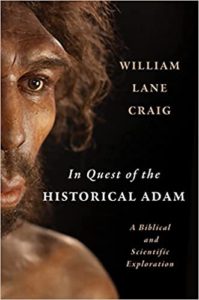 Both religion and science originate in the innate desire of human beings to know the truth, to discover the deeper order and purpose in the universe. Since the growth of modern science, many thoughtful believers have inquired more deeply into the articles of their faith in an attempt to reconcile them with what scientific discoveries have taught us about material reality, in the conviction that all truths are complementary. This is a project in which thinkers as far back as Galileo were engaged, as shown in Galileo’s discussion of science and scripture. It is also a passion of the contemporary theological scholar William Lane Craig, whose new book In Quest of the Historical Adam enquires into the ways in which scientific anthropology (the biological and social study of man) may contribute to theological anthropology (the spiritual and moral study of man).
According to Craig, we must have a worldview that takes in all sources of knowledge—the mysteries of revelation as well as the fruits of scientific reason. We must “integrate the independently discovered findings of contemporary science and biblical theology into a synoptic worldview.” Craig achieves such a synthesis in his book, and masterfully too.
Among the most mysterious sides of revelation are surely the opening chapters of the book of Genesis, which touch on the very origins of the world and human beings. Theologians have debated for centuries how to understand such topics as the creation of the universe and of Adam and Eve, the Temptation, the Fall. Thinkers both secular and religious have discussed endlessly what these texts might have to say to us in modern times. With the growth of modern biology, and particular evolutionary theory, it has appeared to many that the creation of the First Man ex nihilo (or as the Bible specifies, “of dust from the ground” and in “in his own image”) can no longer be seriously held as a literal truth. Homo sapiens is now seen to have evolved over tens of thousands of years from various parent species. Now, this creates a very serious question for the believer: When did man become man? When did man, created in the image of God and endowed with a rational soul, with spiritual stature and moral responsibility, come into the picture? Was Adam a single human being, or is he a symbol of humanity? And what do we say about the primitive forerunners of man? Were they human, or merely animals, or something in between? Do the accounts of Genesis still hold any validity?
Craig explains that essential aspects of humanity, including the ability to reason, to use language and to think symbolically, were in place earlier than scientists previously believed. Cave paintings dating from as far back as 30,000 years bear witness to a being that shared our capacity for symbolic representation and, very likely, appreciation of beauty and form. Artifacts of tools and dwellings suggest that proto-man already had significant powers of rational organization and foresight.
Putting these facts together with insights of genetics, Craig argues that it is plausible to believe that humanity had a “founding couple” whom we can identify with Adam and Eve of the Bible. If Adam and Eve were endowed with self-consciousness (not merely animal instinct), reason, will, moral responsibility and creative power, then we must posit a divine intervention—a leap sort of leap of nature in which God providentially infused the founding couple with the ingredients of full humanity.
In view of these insights, Craig stakes his claim that if Adam and Eve were historical persons, then they may have belonged to homo heidelbergensis, one of a number of early hominid species, and lived anywhere from 750 thousand to a million years ago.
In Quest of the Historical Adam is a curious and fascinating book, half theological study and half scientific study. The early chapters are concerned with determining precisely what sort of book Genesis is, since Judeo-Christian beliefs about man’s origins hinge on that text. On the one hand, biblical literalists (who were around in Galileo’s day, and in St. Augustine’s) have insisted that we interpret Genesis in the plain sense of the words, almost as if its intention was to teach scientific data. But Craig comes to a different conclusion.
I would observe that—if my own childhood recollections are any guide—children are complete literalists. They take stories as they hear them in their plainest sense, and that includes the texts of the Bible. It is only later, as we make the journey toward adulthood, that we become more sophisticated and begin to see the underlying moral truth, derived from the moral imagination, which may not ultimately be tied to a literal reading of the words.
At the same time, orthodoxy requires belief in a God who is beyond nature and can, if He wills, intervene miraculously in the world. Thus, Christ’s resurrection is a literal truth and no mere symbol or metaphor. The primeval accounts of Genesis are a different matter. They are not a historical chronicle in the same sense as the Gospels. Comparing the early chapters of Genesis with ancient near-eastern myths, Craig concludes that Genesis is “mytho-history,” a unique hybrid in which Israel’s history is grounded in a primeval past. The Genesis account of the origins of the world and man is not to be taken in a naively literalistic way. Yet it is clearly historically referential, employing genealogies that situate the events in Jewish history and mentioning actual places in the area of Mesopotamia. At the same time, it includes elements of anthropomorphism—the talking serpent, God “walking in the garden in the cool of the day.”
In deciding what to make of this, it won’t do to say that “ancient people believed in fantastic things because they lacked modern science.” Ancient Israelites knew as well as we that serpents did not talk, nor did they believe that God had a literal body. Precisely how ancient people regarded their myths (and by “myths” is meant not the fabulous and imaginary but sacred narratives conveying ultimate truths) has been much discussed. In his essay “Horrid Red Things,” C.S. Lewis insists that “we must distinguish the core of belief from the attendant imaging.” Ancient peoples typically saw sacred truths as clothed in material imagery, often in such a way that the idea was hardly separable from the imagery. But whether such imagery is to be “literally” believed or not does not affect the core meaning.
Assuming then that the primeval accounts in Genesis are to be classed as mytho-history, Craig asks whether we should regard Adam as a single historical person or a collective symbol of humanity, and whether this is essential for theology. This touches on the precise meaning of Original Sin, and how Adam’s sin is transmitted to his descendants. If Adam is a symbol only, how can “he” be regarded as passing sin on to us? Passages from St. Paul suggest that he certainly regarded Adam as an individual, not merely a symbol, whose sin was canceled out by Christ, the New Adam.
Yet there is more to this than meets the eye. When a biblical author such as Paul alludes to Adam as a real individual, he may be referring to nothing but the individual in the Genesis narrative, not declaring that he, Paul, believes Adam to be a real individual. There is a distinction between “truth” and “truth-in-the story.” Craig makes a number of such interpretive distinctions that will be useful for any reader of sacred literature.
Ultimately, Craig comes down on the side of the need to preserve the idea of Adam and Eve as real individuals, not symbols only. Although scientific discoveries have made us adjust our conception of man’s origins somewhat, this central idea can still stand, and on scientific legs too. So argues Craig.
And what of the humanity of pre-humans or hominins? Were they subject to God’s grace and judgment? Will we meet them at the eschaton? These are fascinating questions that are seldom raised by believers, and Craig has the boldness and imagination to explore them, without giving definitive answers.
Craig is a keen and experienced scholar whose method is thoroughly logical and who makes careful, nuanced, and prudent judgments. I was frankly overwhelmed by the breadth of his knowledge and his ability to catch and critique logical flaws in other scholars’ arguments. A non-specialist might well get lost in the technical discussions, but Craig draws everything to significant and rounded conclusions that will be relevant to the believer. The book is clearly structured, impeccably argued and, although quite challenging, should find a wide audience of intelligent readers.
The question of human origins surely ranks high on the list of theological topics, touching on the deepest questions of who we are, where we came from, and where we are destined. Craig has made an important contribution in the effort to combine faith and reason to shed some light on these great mysteries.
The Imaginative Conservative applies the principle of appreciation to the discussion of culture and politics—we approach dialogue with magnanimity rather than with mere civility. Will you help us remain a refreshing oasis in the increasingly contentious arena of modern discourse? Please consider donating now.
The featured image is Homo Neanderthalensis Adult Male Reconstruction. This file is made available under the Creative Commons CC0 1.0 Universal Public Domain Dedication, courtesy of Wikimedia Commons.






Based partly on artifacts, Craig proposes the Heidleberg Man as a common ancestor to both Neanderthals and Homo sapiens, “sometime between around 1 million and 750,000 years ago.”
Genetic DNA-based research has “strengthened the claim that all humans alive today are descended from a single African woman” who lived perhaps 140,000 years ago (molecular biologist Allan Wilson at a 1989 international Genetics Conference). Again (with Craig), not polygenesis or necessarily even polyandry, but a pair—and mysteriously the person-to-person revelation of each to the other as truly “other.” Even as the fully “Other” is also self-disclosed and perceived?
Craig awaits more conclusive artifacts, and appeals to anthropologists to characterize modern humans by abstract thinking, planning depth, innovativeness, and symbolic behavior. Then, he writes, a “radical transition […] that lifted [the founding pair] to the human level plausibly involved both biological and spiritual renovation.”
Accepting other criteria, not so artifactual, and more interior, for the integral (and indivisible) unity of the human person, the appeal is also made by others to the “ontological leap, the uniquely human factors of consciousness, intentionality, freedom, and creativity” (the International Theological Commission). A concept earlier advanced by Pope St. John Paul II:
“…[as] a moment of transition to the spiritual” [is a discontinuity not incompatible with the] “physical continuity which seems to be the main thread of research into evolution in the field of physics and chemistry […and anthropology?]. “The moment of transition to the spiritual cannot be the object of this kind of observation [the scientific method], which nevertheless can discover at the experimental level a series of very valuable signs indicating what is specific to the human being. But the experience of metaphysical knowledge, of self-awareness and self-reflection, of moral conscience, freedom, or again of aesthetic and religious experience, fall within the competence of philosophical analysis and reflection, while theology brings out its ultimate meaning according to the Creator’s plans” (“Message on Evolution to the Pontifical Academy of Sciences,” October 23, 1996).
From the view of God in eternity, all of His creation occurs in such a timeless moment. Are all of us from the “beginning” created simultaneously? And, destined gratuitously—in the eternal now—for the Beatific Vision. Yet, all are also marked profoundly by the fallenness of a sin “original” to ourselves rather than to the Creator. An event of both archaic expression and intergenerational descent affecting each soul always created immediately by God.
Please tell me……did the challenge to the simple and clear reading of the Biblical narrative in Genesis come from other contradicting texts (where??) in the Bible or from so called higher criticism attempting to mesh the mishmash of the human origins stories as told in other so-called science texts on the subject. All the current attempts to merge empirical science with historical “science” run afoul of 2 Peter 3 because they require a belief that processes and process rates have been approx. uniform through time. One cannot explain the origin of processes at work on the Earth today by appealing to processes that are not self existant.
In my humble opinion, the account in Genesis is eye witness account from our first parents, handed down through ages only to the Jews. Adam and Hava did in any case not know of their early childhood, so we do not know, if they came to be created directly from dust, or only indirectly so, through billions of solar years of intelligent design known as natural coevolution that culminated on the evening of the sixth angelical day of creation, with the chromosome fusion, great ape 2p2q -> human 2, which still distinguishes great apes from human beings. In any case, they came to be instituted in grace capable of God, virtues, and immortality, again, whether directly by the Lord God, or indirectly through their great ape biological parents. They knew that they were children of God, and were installed in the garden of delights, believing. The date and place is unknown, but I favour south east Africa, 2500000 solar years ago, with the advanced great apes as Australopithecus and our first parents as Homo habilis, and the garden of delights as what is now Ngorongoro.
Joseph Ratzinger’s excellent point of view
https://www.newyorkencounter.org/2015-theme-readings/2015/1/10/a-collection-of-readings-for-the-event-the-emergence-of-the-human-face
My chronology for the seven angelical days and beware that modern fake science will disagree for example they seek to erase human being by saying that tertiary-quarternian are obsolete and by renaming great apes from Pongidae to so called Hominidae and denying seven days
I. Philosophicum: 14500000000 solar years ago
Creation of mathematical space-time in motion
Then supernova burst ignites our solar nebula
II. Precambrium 1: 4550000000 sya
Creation of solar system and its celestial orbits
Earth gains water from Venus & life from Mars
III. Precambrium 2: 3750000000 sya
Creation of ocean & continent and prokaryotes
(anaerobic, aerobic, photosynthetic, archaeae)
IIII. Precambrium 3: 2550000000 sya
Creation of eukaryotes with reproductive cycles
Primitive fungi, plants, animals need calendars
V. Secondary: 545000000 sya
Creation of invertebrates and then vertebrates
Fishes, amphibians, reptiles, snakes, birds
VI. Tertiary: 65500000 sya
Creation of mammals and then great apes
Chromosomefusion great ape 2p2q –> human 2
VII. Quarternian 2500000 sya
Our first parents Adam and Heva age of reason
The Garden of Delights is probably Ngorongoro
Pleistocaenum ice ages and warm ages floods
Also called palaeolithicum or our golden age
Holocaenum present warm age agricultures
Also called neolithicum or our silver age cities
Then bronze age end of Genesis then iron age
Christendom can be referred to as pearl age
Craig’s book is up to date on the topics, biblical and palaeontological, and it is recommended for introduction to both sciences, but I still did not read it, because I read very slow in English. There is a bit of controversy, on the issue, who and where and when lived our first parents, Adam and Heva. Because, usually, who is said to be, Homo habilis, where is said to be in south east Africa, and when is said to be 2400000 solar years ago. But Craig on the other hand favours, Homo heidelbergensis, only 1000000 years ago. And nobody knows because the chromosome mutation from great ape 48 chromosomes to human 46 chromosomes by the fusion 2p 2q –> 2 is not verifiable or dateable in the fossil record. We only have skulls and jaws and assume that so and so must be the leap from ape to human.
Assume now that for each biblical year in the genealogy of Adam in Genesis chapter 5 there was 1000 actual solar years and that each of ten named generations from Adam to Noah was a great tribe who spanned each cycle of a warm and an ice age, apart from great tribe Noah (Homo sapiens) who spanned several warm and ice ages, 500000 solar years before neolithicum, and Sem Kam and Japhet were 13000 years ago. Then, Adam was 1346 biblical years old, when Sem Kam and Japhet were born to Noah, and great tribe Adam (humankind) was 1346000 years before neolithicum or 1359000 years ago, still in south east Africa, if I fancy Ngorongoro for the Garden of Delights. Whence, the possible compromise is that Quarternian was 1359000 million solar years ago, rather than 2400000 years ago which is too early, or 1000000 years ago which is too late, if one biblical year for a named person in Geness chapter 5 is 1000 solar years for a human great tribe in palaeolithicum. Then Homo habilis must be renamed to Australopithecus habilis, and Homo ergaster or erectus or heidelbergensis or whatever must be renamed to Homo adamensis, near Ngorongoro, only 1400000 solar years ago. It is emphazised that we cannot tell the chromosome mutation from the fossil record, so we simply cannot know
I am sorry for my miscalculation in my recent comment. Ten generations from Adam through Noah to Sem Kam and Japhet span 1556 biblical years which I then assume is 1556000 solar years before neolithicum which was itself 13000 years ago and then humankind origined 1569000 solar years ago and the nine generations from Adam to Noah are nine climate cycles averaged 117000 solar years and the tenth generation of Noah (Homo sapiens) is four climate cycles total 500000 years, and neolithicum began the fourteenth climate cycle, as was said 13000 years ago, but of course once again we cannot know. However ten biblical generations from Adam to Noah in Genesis chapter 5 probably means ten great tribes apart from those tribes who went astray and extinct through pleistocaenum. And Craig’s book is still recommended to the English speaking reader who wishes up to date insight.