
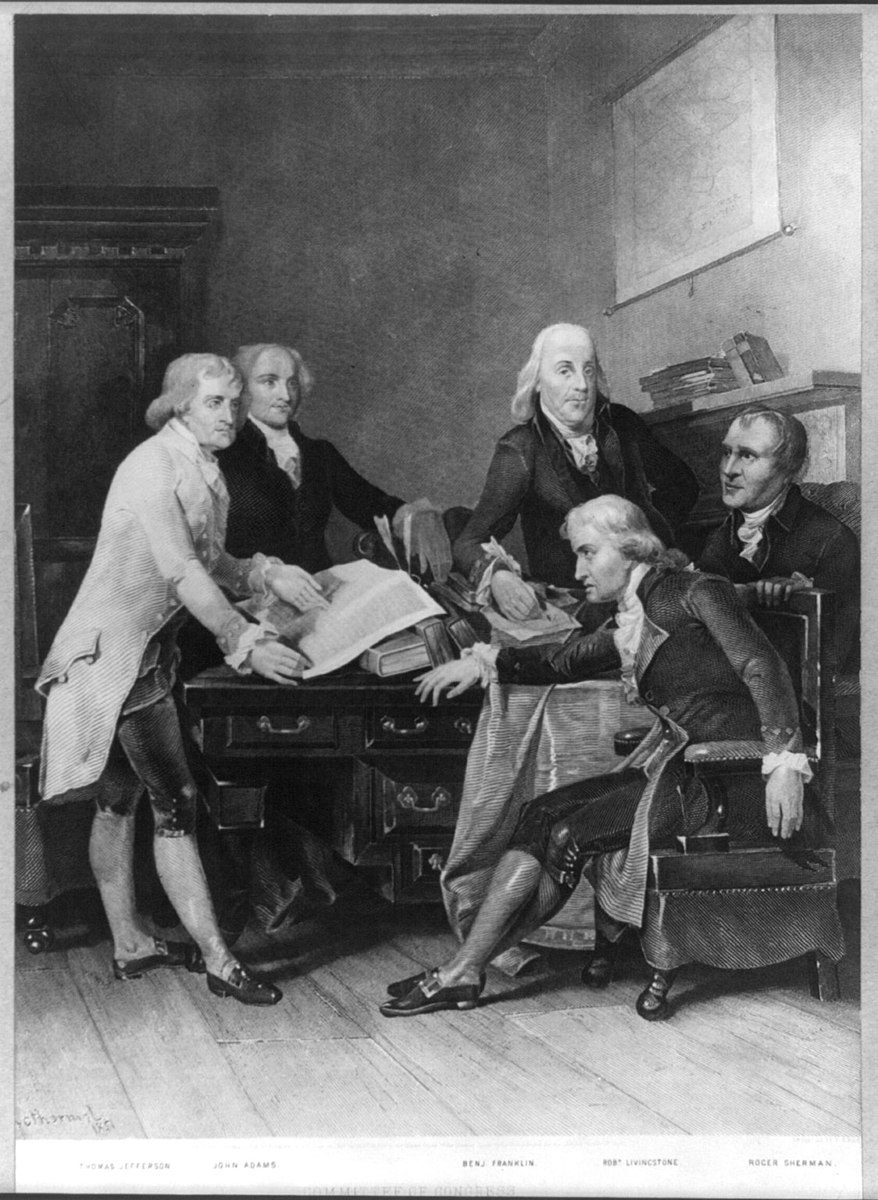
 Why exactly did Thomas Jefferson and Congress change John Locke’s famous declaration in favor of life, liberty, and property, to life, liberty, and the pursuit of happiness? Some, wrongly, have believed this to be a Jeffersonian attack on the notion of property. But, as Forrest and Ellen McDonald assure us in their own profound writings on the American Revolution, the Founders considered property to be sacrosanct. As such, Jefferson’s tweak of Lockean principles probably had more to do with rhetorical strategy and preference than outright philosophical rebellion. To be certain, Jefferson believed in the sanctity of property as a fundamental human right. In this, he spoke for the Founders as a whole.
George Mason’s Virginia Declaration of Rights—which Jefferson certainly would have had with him while writing the American Declaration of Independence—ties together property and happiness: “That all men are born equally free and independent, and have certain inherent natural rights, of which they cannot, by any compact, deprive or divest their posterity; among which are the enjoyment of life and liberty, with the means of acquiring and possessing property, and pursuing and obtaining happiness and safety.”
Of course, Jefferson and Mason are not alone in their appeal to Locke. Scholar Don Lutz argues that Locke was the fourth most-cited authority during the American Revolution, following St. Paul, Montesquieu, and Blackstone. In November 1772, for example (to name just one of many cases), Sam Adams wrote in his report on the Committees of Correspondence: “Among the natural rights of the Colonists are these: First, a right to life; Secondly, to liberty; Thirdly, to property; together with the right to support and defend them in the best manner they can.”
At the other end of the rebellion, in 1790 and 1791, with the revolution in hindsight, Founding Father James Wilson—in a series of lectures at the University of Pennsylvania—proclaimed property as sacrosanct as well. Here, it places it in the context of other rights and duties:
In his unrelated state, man has a natural right to his property, to his character, to liberty, and to safety. From his peculiar relations, as a husband, as a father, as a son, he is entitled to the enjoyment of peculiar rights, and obliged to the performance of peculiar duties. These will be specified in their due course. From his general relations, he is entitled to other rights, simple in their principle, but, in their operation, fruitful and extensive. His duties, in their principle and in their operation, may be characterized in the same manner as his rights. In these general relations, his rights are, to be free from injury, and to receive the fulfillment of the engagements, which are made to him: his duties are, to do no injury, and to fulfil the engagements, which he has made. On these two pillars principally and respectively rest the criminal and the civil codes of the municipal law. These are the pillars of justice.
Further, he notes, “Property must often—reputation must always be purchased: liberty and life are the gratuitous gifts of heaven.”
In her 1805 stunning history of the American Revolution, Mercy Otis Warren contends that property exists as a means and a space in which good can be done. Otherwise, it merely becomes the plaything of the corrupt: “If this should ever become the deplorable situation of the United States, let some unborn historian in a far distant day, detail the lapse, and hold up the contrast between a simple, virtuous, and free people, and a degenerate, servile race of beings, corrupted by wealth, effeminated by luxury, impoverished by licentiousness, and become the automatons of intoxicated ambition.” Property, though properly understood as an end in and of itself, must also provide the means by which freedom and virtue can be exercised.
It’s worth going back to Forrest and Ellen McDonald, however, especially in their 1985 book, Requiem, to see the import of property to the Founders. Five things, the McDonalds state, must be understood in regard to property and the Founders. First, one must be able to make a free transfer of property from one entity to another, regardless of whether the property is for agricultural or commercial purposes. Second, the Founders as a whole believed that economic growth, in and of itself, is a good for the commonwealth. Third, the Founders believed that the market, not the state (or federal government), should be the prime mover in economic matters. Fourth, and certainly related to the third point, prices should be set by the market, not by politicians. Fifth, government exists to provide the institutional and legal means by which capitalists can turn money into capital.
On the fifth point, however, there was some disagreement, as many of the southern Founders feared any form of paper money, seeing it as a means by which one could manipulate the currency. Thus, they only wanted species—that is, hard money—as currency.
As the McDonalds note, however, many of the Founders believed the economy should be strictly based on agriculture, rather than industry. After all, as the greatest theorist of modern economic theory, Adam Smith, had warned: Every worker “becomes as stupid and ignorant as it is possible for a human creature to become… in every improved and civilized society this is the state into which… the great body of people, must necessarily fall, unless government takes some pains to prevent it.”
The U.S. Constitution, it seems clear, embraced the sanctity of property as well, creating for all intents and purposes a massive free trade zone.
The strongest defense of private property, though, comes in the Northwest Ordinance of 1787, article 2. After re-asserting the common law, the Northwest Ordinance declares: “And, in the just preservation of rights and property, it is understood and declared, that no law ought ever to be made, or have force in the said territory, that shall, in any manner whatever, interfere with or affect private contracts or engagements, bona fide, and without fraud, previously formed.” Honestly, after such a declaration, could any question of the sanctity of property remain? Absolutely not.
The Imaginative Conservative applies the principle of appreciation to the discussion of culture and politics—we approach dialogue with magnanimity rather than with mere civility. Will you help us remain a refreshing oasis in the increasingly contentious arena of modern discourse? Please consider donating now.
The featured image is titled “Committee of Congress. Drafting the Declaration of Independence,” and is in the public domain, courtesy of Wikimedia Commons.



Just as long as you understand that the entire basis of this is an argument in 1787, which includes slavery and slaver ownership, and is completely reactionary based on economic development already underway,. That’s as Hamilton, Tench Coxe and Governeur Morris and many others knew. The philosophes, of which Adam Smith was one, absolutely did not believe that unmitigated and unfettered use of private property overrode all community interests.
Stephen, one of the most interesting of the Founders, James Wilson, said this about slavery in his 1790.1791 lecture series on rights and property: “Slavery, or an absolute and unlimited power, in the master, over the life and fortune of the slave, is unauthorized by the common law. Indeed, it is repugnant to the principles of natural law, that such a state should subsist in any social system.”
But wasn’t “property” inclusive of all one possessed, not just land, which might have been referred to as “estates?” In fact, land might well have been the least significant “property” man owned or sought to acquire.
John, I could be wrong, but my reading is that property really meant ownership of self. That is, are you willing (and able) to accept your own moral decisions? Are you willing to take account of your own soul? Yours, Brad
I’m not sure I agree with your assessment that Jefferson would certainly have had a copy of Mason’s Declaration of Rights at his side when he drafted the Declaration of Independence. The vote for independence was taken in the Virginia Convention on 15 May 1776. It probably took a day or so for the body to then draft the independence resolution that Richard Henry Lee introduced in Philadelphia on 7 June . The Virginia Declaration of Rights was not approved until 12 June 1997, the same day John Dickinson’s Articles-drafting committee was assigned and one day after Adams’ Declaration-drafting committee was assembled. So when did Richard Henry Lee travel from Williamsburg to Philadelphia with the resolution, or was it sent by courier to him already in Philadelphia? Lee or a courier had to have left Williamsburg several days, perhaps a week prior to 7 June, making it impossible form the person to have carried the approved Declaration of Rights with him.