
Fr. Marvin O’Connell was that rare historian who understood both the present and what the future demands. Calling for “a return to the Catholic ghetto,” he hoped his coreligionists would discover what living out the Catholic faith meant in a secularizing America.
Telling Stories That Matter: Memoirs & Essays by Marvin R. O’Connell. edited by William G. Schmitt (250 pages, St. Augustine’s Press, 2020)
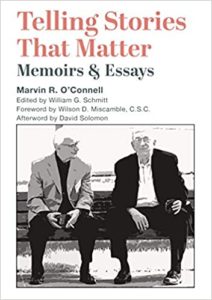 Father Marvin O’Connell (1930-2016) was a faithful priest and a gem of a historian. His books on the Counter-Reformation, the Oxford Movement, Pascal, the Catholic Modernist controversy, and the history of the Archdiocese of St. Paul-Minneapolis are delightful. So too his biographies of John Ireland, the first Archbishop of St. Paul-Minneapolis, and Edward Sorin, the founder of the University of Notre Dame, which, among other works, all told intelligent and gripping stories. This characteristic made him a gripping lecturer, one who made one want to know what was coming next rather than when the end was coming.
In Telling Stories That Matter: Memoirs & Essays, William G. Schmitt has put together the late priest and historian’s unfinished memoirs along with a number of other essays, including ones on figures such as More, Newman, Belloc, and J. F. Powers, as well as thematic essays on the craft of history, faith and the historian, and most intriguing of all, the future of the Catholic Church. While many historians seem unable to come to grips with the present or future, O’Connell was more capable than most at resisting the tendency to what we might call reverse anachronism. That might be due to his rather broad historical range—historians of one era are more likely to see it and it alone in the present. It may also be because he paid attention to the era in which he lived, so beautifully rendered in the memoir section.

Fr. Marvin O’Connell
O’Connell grew up in small towns in Minnesota (Pipestone, Owatonna, and Mankato) but matriculated at Nazareth Hall, the old-fashioned minor seminary in a suburb of St. Paul, at the ripe old age of fourteen. Though he eventually lost touch with most of his fellow students, Ralph McInerny, two years his senior, would later become a close friend and colleague when O’Connell landed at Notre Dame years later.
His memories of these times are vivid and critical, no less when recounting his advancement to the St. Paul Seminary (‘a collection of singularly ugly red brick buildings dating to the 1890s”) at the age of twenty. There he found great value in the study of philosophy with Fr. William Baumgaertner and theology with Fr. David Dillon but thought the six semesters of biblical study “an utter waste of time” and the course on fundamental moral theology “little better.” Worst of all was the fact that the course on Church history taught by liturgical reformer Fr. William Busch, which sensibly used Msgr. Philip Hughes’s three-volume history of the Church as a text, insensibly ended with the third volume of that text, which only reached the eve of the Reformation—leaving the last 450 years of Church history a blank for many priests.
After ordination he was determined to study and got the chance when he was given a Lingard Fellowship to study with Msgr. Philip Hughes at the University of Notre Dame. Like many a young man of the day with intellectual pretensions, the newly ordained Fr. O’Connell was a “Commonweal Catholic” who, “with the brazen self-confidence of the young. . .assumed that conservatives were stupid.” He also considered himself far above feeling anything of the “Notre Dame mystique.” Arriving at Notre Dame in 1956, however, he discovered friends who dispelled the view of conservatives, notably fellow student and New York priest Eugene Clark, and fell for the mystique when cheering on the Fighting Irish football team—oddly enough during a University of Oklahoma game in which the Sooners crushed the Irish 40-0.
O’Connell gives portraits of a number of figures who influenced or interested him in those days, but most touching is that of Msgr. Hughes, an Englishman from blue-collar Manchester who never went to Oxford and was puzzled by the tendency of Notre Dame professors to stick to rather narrow articles on history for the academic journals. Hughes believed historians should try to paint with a broader brush. O’Connell felt the same and, after Hughes’s death, was honored to be asked to complete a work of his mentor’s that was to have been in the prestigious “Rise of Modern Europe” series published by Harper & Row. That volume, The Counter Reformation, 1559-1610, gave O’Connell particular pride and also the joy of sending what money it made in sales to Msgr. Hughes’s elderly sister.
His career as a professor, however, began back in St. Paul at the then-College of St. Thomas where he learned how to give a historical lecture to colleges students who, then as now, considered events before their own memories “as remote as the Peloponnesian War.” O’Connell’s affection for that institution and St. Paul is evident in his memories of the place. Sadly, the autobiography breaks off before he moved to Notre Dame and rejoined Ralph McInerny. But if we do not get the memories of his time after the early 1970s, we get access to his mind in a judiciously chosen selection of essays.
Those who love Hilaire Belloc will be pleased that the professional historian defends him: “Flawed historian he may have been, but he played the role of prophet—spokesman, that is, for a message greater than himself—to perfection.” Those who wish to defend the Church honestly against external enemies will love his dissection of the myths and facts surrounding the Spanish Inquisition. And those who wish to defend the Church against her internal theologians will delight in two reviews of the once ubiquitous and now almost forgotten Fr. Richard McBrien’s books. Of one book on religion and politics, O’Connell remarks on McBrien’s evident “anxiety not to trouble us with distractions like evidence or coherent argument.”
O’Connell could be sharp-tongued. He could also be wrong. Several times in the volume he hinted at his own skepticism about the Church’s teaching on contraception. But he also had a bit of the prophet in him. His 1990 address to the Fellowship of Catholic Scholars, “An Historical Perspective on Evangelization in the United States: Shifting Concentration of Interest,” looks remarkably prescient three decades later. At a time when Catholics in the United States had achieved a remarkable degree of power and prestige, O’Connell noted the already cratering numbers of priests, baptisms, and weddings. He thought that the American Church had returned to the state of its earliest days—a quest for “survival.”
Though Catholics of his own age had struggled to become fully accepted in American society and shuck off what made them different, O’Connell observed that the results were not great. Catholic schools were dying and, apart from a few exceptions, Catholic colleges and universities were in the process of “[scrambling] to become as comprehensively mediocre as most of their counterparts.” Too many bishops refused to straightforwardly face the feminists and defend the teaching on the male priesthood, much less stand in the public square telling people, “Repent, for the kingdom of God is at hand.” Too many archdiocesan tribunal officials now believed, as one told him, that “no marriage is valid and binding, because nobody is mature enough to make a permanent commitment.”
O’Connell said many other things in this address, but what is important is the solution he called for: “a return to the Catholic ghetto.” He meant by this the need to understand Catholic faith and discover what that meant in a secularizing America; to rediscover a truly Christian “spirit of community and fellowship we have lost”; and to dare to live that out even if it no longer gained the same kind of secular respect it might once have done.
Few historians excel at understanding the present. Fewer have much idea of what the future demands. Fr. Marvin O’Connell was one of them, a man whose works instruct and inspire as well as delighting.
Republished with gracious permission from The Catholic Servant.
The Imaginative Conservative applies the principle of appreciation to the discussion of culture and politics—we approach dialogue with magnanimity rather than with mere civility. Will you help us remain a refreshing oasis in the increasingly contentious arena of modern discourse? Please consider donating now.
The featured image is courtesy of YouTube.


Thanks for this piece. Fr. Marvin was my cousin. Well, my first cousin once removed as he explained it to me. He was my Dad’s first cousin and shared stories of hanging out at the farm with my Dad and his siblings. He was such a gift to me when I had my reconversion to the faith. I cherish the time I got to know him via emails and visits. He encouraged my writing and was such an example of a gentleman and priest.
Miss you Marv…