
Classical music should not be an arcane special interest but an art form of universal and humane concern. Classical music provides a central cultural focus as do the classics of literature and art, and like those fields, ought to have a touchstone, an enduring norm and standard, and a repertoire of works which everyone should know.
 Classical music is an object of widespread reverence. This is certainly true for those who enjoy it and count it as an important part of their lives, but it also holds for many who have no particular inclination toward it. For this latter group, classical music is often something mysterious, awe-inspiring, even intimidating. As Stephen Klugewicz has pointed out in this journal (Listening Alone to Classical Music”), classical music often appears as a formidable complex of information involving musical genres and styles, composers, performers, and recordings. Both those who like classical music and those who don’t perceive it as a body of work about which you have to know a lot to enjoy it. And such complexity is, surely, one of the distinguishing marks of this body of music: it demands focused attention from the listener, it invites considered aesthetic judgment in addition to simple pleasure.
Because of the perceived complexity of classical music and the apparent difficulty of learning its mysteries, musical institutions have in recent times often taken efforts to demystify it. I’m the first to agree that classical music is too often weighted down by an overwhelming mass of information, and that this mass of information is often an obstacle to simple enjoyment, which I would agree is the ultimate end of the music. Much writing about music—including music history and music appreciation texts—is terrible in this regard; the reader is apt to get the impression that the whole point of classical music is a bunch of facts about a composer’s life and the mechanics of musical form. Instead, what I see as the core of classical music is an appreciation of its aesthetic, spiritual, and emotional qualities, which transcend (even though they may be involved in) the technical way the music is put together.
There have been a number of spokesmen dedicating themselves to explaining classical music to a broad public and who have done excellent work; one thinks of Leonard Bernstein in the mid-20th century with his wonderful Young People’s Concerts (just as useful for adults), or more recently Robert Greenberg of The Teaching Company. While of course explaining musical building blocks and form, these teachers get to the essence of what the music is in its expressive dimensions.
What is often ignored is the basic question of what classical music is. The very concept and term are far more recent than we might think. For most of the period when the repertoire we think of as “classical” was created, nobody concerned had any notion of what “classical music” was. This is true, by the way, of much of the language we use to describe the past; we superimpose terms of quite recent vintage on remote historical periods, thus running the risk distorting our understanding of history through anachronism.
One way we can begin to approach this topic is by examining the concept of a “classic.” Throughout the history of Western civilization, “classics,” most often literary works, have been cherished and revered as essential to human knowledge and have been passed on as an essential heritage. Throughout what we call the Middle Ages and the early modern era, the classics referred to the best literature of Greco-Roman antiquity. The term “classic” itself comes from Latin, from classicus meaning “belonging to a class,” with the implication of the first or highest class. Here we have perhaps the primordial definition of classicality, which is that which serves as a standard of excellence and is of recognized value.
This basic idea gets extended in various ways. In art and aesthetics, we talk of classicism as a category of artistic expression embodying certain aesthetic traits thought to be characteristic of the art and literature of ancient Greece and Rome. These are usually considered to include clarify of form and expression, balance, restraint, etc., and in latter times these have been contrasted with romanticism. What relevance, if any, this concept has to the concept of “classical music” will be part of what we will consider here.
It’s worth noting that one of the key features of Western classical music is the central role of the composer. At various times in history, improvisation and spontaneity of performers has had an important place—and at times the composer and the performer have been the same person—but central at all times has been the sense of order, control, and organization provided by the concept of the musical piece overseen by the musical author.
Thus far we have found a series of related definitions of classic or classical:
- classicality as a standard of excellence, especially as found in
- the art and literature of Greco-Roman antiquity, which in particular is seen to embody
- aesthetic qualities of formal perfection, balance, and controlled emotion
One thing we must acknowledge from the start is that “classical music” relates to that phenomenon we call Western civilization. There are musical traditions of other civilizations (e.g., India and China) that have been called analogously the “classical music” of those cultures and which are noble traditions in their own right. But when most people today use the term “classical music,” without modifier, it is Western classical music they have in mind.
“Western,” note, not “European.” Although having roots in ancient Greece (expressed in the musical theories of Pythagoras and Plato) and developing and flourishing in Western Europe, classical music has sprouted newer branches in North and South America, and Russia is a participant in the tradition too.
Western civilization is considered to begin with the Greeks and Romans, to continue through late antiquity and the Christian Middle Ages, and to proceed through the early modern and modern eras. Most of the arts—painting, sculpture, architecture, literature—afford examples from Greco-Roman civilization for us to draw upon. But music is a performance art, in many ways evanescent and intangible, and its preservation depends on having a system of written notation. And because no system of musical notation from ancient times has survived (our present-day notational system is a development of the high Middle Ages and later), we have no ancient music. In the realm of music, “classical” can’t refer to anything having to do with Greco-Roman antiquity because that music simply hasn’t survived, through oral tradition or otherwise.
This seems to me a critical point. It’s immediately apparent that our repertoire of musical works does not reach as far in history as the body of work in other arts (painting, sculpture, literature), and in fact most of the “classical” music we listen to is from a comparatively narrow range of time. When you go to an art museum you will see artwork from every historical era, from ancient times to today. By contrast, a typical classical concert contains music dating from only about three recent centuries, the eighteenth through the twentieth. (How the “early music movement” sought to redress this situation and widen the scope of the repertoire is something we will consider later on.)
A complementary point is that before the 20th century music was, more than any of the other arts, a present-focused art, built predominantly around newly-written works. The idea of drawing from a historical repertoire of music for performance and appreciation was a later development, which we will discuss by and by.
During the Renaissance, visual and literary artists looked back to what they believed the glory days of ancient Greece and Rome for inspiration. There was something of a parallel movement in music, when the inventors of opera in the 1600s dreamed of reviving what they supposed ancient Greek drama to be like. But dissimilarly to painting or literature, there was no actual ancient music to draw upon.
So, what exactly is the “classical” in “classical music”? I think the best way to go about answering this is to investigate the origins of the term. It might come as a surprise to many that neither Beethoven nor Mozart nor Bach, nor anyone before, had any notion of what “classical music” was, nor probably any notion of a sense in which music could be “classical.” The phrase was coined by early Romantic writers as they looked back on the previous generation of Haydn, Mozart, and Beethoven and sought to differentiate it from the new Romanticism. The earlier generation of composers now seemed classical or canonical: a revered standard that had stood the test of time. (Similarly, the generation of Haydn and Mozart had canonized the preceding generation of Bach and Handel as a venerable standard. This double canonization will have significance for us later on.)
Besides being classical in the Definition 1 sense, the Romantics also interpreted the Haydn–Mozart style as classical according to Definition 3—embodying formal perfection and restraint; at least it seemed that way when compared with the emotional effusion of the new Romantic music. Here was born one of the principal aesthetic dichotomies, classic and romantic.
It’s important to note that Western art has been continually replenishing itself by returning to Greco-Roman antiquity for inspiration, and many later classicisms have come about as a result of this. Thus, the three definitions of the classical (classical as standard of excellence; as characteristic of Greco-Roman civilization; and as embodying ideal aesthetic traits) are closely interconnected. This explains why it might have made sense to describe the music of Haydn and Mozart as “classical” even though it had no discernable connection with ancient Greece or Rome.
It was with this new conception of a “classical” canon that one might say a historical consciousness first entered music. Now, much more than previously, musicians were aware of operating against the weight of musical tradition or the musical past. Recall Brahms’ remark upon composing his first symphony: “You have no idea how it feels to hear behind you the tramp of a giant like Beethoven.” Previously, composers wrote principally for the moment, not particularly caring where they fit into musical history.
True, there was some concept of durability in music before Romanticism. Bach assiduously studied the compositions of previous generations; he even performed some of Palestrina’s motets. Palestrina’s flowing polyphony (the stile antico) was considered a classic model for later generations of composers. Still, for the most part music was geared to the new rather than the classic. Music was an intensely practical art, closely integrated with everyday life, and a fresh supply of it was constantly needed. Composers worked furiously to fill this constant demand whether for church services, banquets of the nobility, theatrical works, or whatever. The idea of a composer working painstakingly on a “masterpiece” for years with an eye to posterity did not exist before Romanticism. Needless to say, the music produced in these earlier times was in no way “classical” but contemporary, as contemporary as music could be.
The first signs of a change were in mid-18th-century London, which saw the beginning of musical societies formed to give concerts of “ancient music.” It’s worth noting that “ancient” in this context meant dating back only a generation or so (for a parallel, imagine calling Hollywood movie classics from seventy or eighty years ago “ancient movies.”) The work of the man of letters Dr. Charles Burney (1726–1814) signaled the birth of music history as a discipline. Presumably, Western music had now acquired enough of a history to treat as an object of study.
As a result of these trends, a taste developed for older repertoire, and with it an awareness that the musical past didn’t have to be swallowed up in a void and that “historical music” could be a part of the regular diet of listeners as well as new music. However, music of the past remained on the margins of musical experience, with the vast majority of performances being of new or recently composed work.
Moving forward two centuries, the balance between the old and the new in classical musical life has been completely upended. Now the vast majority of “serious” music (we’ll discuss that term a bit later) one listens to is from the past. To most people the very term “classical music” is synonymous with music of the past instead of music that is contemporary to our time. While there certainly is contemporary classical music, it plays no important role in the life of most classical music listeners. There are many causes for this, more than we can deal with in this essay; one of them was certainly the widespread lack of interest or outright rejection by audiences of more modern styles.
By the late 19th century, the term “classical music” was in general use, usually referring to the music before Romanticism. Yet even then there was not universal agreement on the existence of a “Classical period”; one writer described the “classical composers” as including Bach and his sons as well as Mozart, Haydn, and Beethoven.
Here we come to what I consider a great anomaly. Within this body of music which we call “classical” (lowercase c), we find a particular style period called Classical (upper-case c). But from what we have explored so far, it should be fairly clear that the word “classical” is being used in slightly different senses here. “Classical music” as a body of repertoire means classical according to Definition 1. The “Classical period” points to the aesthetic qualities delineated in Definition 3 (formal balance, grace, perfection, restraint) but appears also to glance at Definition 1 (an enduring standard).
Here is the problem. Why are we given to assume that Haydn, Mozart, and Beethoven constitute an “enduring standard,” a “classical period,” whereas the earlier period of Bach and Handel—what we now call the High Baroque—does not? Does the High Baroque not also constitute a “classical” standard? It does, of course, and here we put our finger on the anomaly. Calling the second half of the 18th century “Classical” is no doubt meant to distinguish some of its aesthetic features (balance, simplicity, etc.) from the more complex polyphony of the High Baroque. But the usage is certainly vague and confusing, not just to novice music lovers but even to people who have thought about music for years.
I submit that the naming of a “Classical period” was a confusing maneuver on the part of music historians. We ought to get rid of “Classical” as a style period entirely, or else modify it to “Viennese Classic” to emphasize that this was the age of Haydn, Mozart, and Beethoven.
It should be clear now that “classical music” is in origin a 19th-century term used to refer to the music of established masters of the past. But something interesting happened in the 20th century. This was the development of commercial pop music in all its forms—ragtime, jazz, rock, and all their progeny. Now the term “classical music” would still be used as a term of contrast, but the contrast was no longer with Romanticism, which had itself now moved into the orbit of the “classical.” The old dichotomy of “classic” versus “romantic” has now been replaced by the dichotomy of “classical” versus “popular.”
We can see, then, that the very concept of “classical music” was born out of a precise artistic situation. Because of the historical consciousness that came from Romanticism, people gradually developed an awareness of the existence of a “classical” repertoire. As time went on, “classical music” took on additional duties of pointing to the distinction between “serious music” dedicated to high artistic aims and to more “popular” types of music involved with commercial success; or between the “cultivated,” “artistic” music of the Western world versus the folk or vernacular music of many cultures.
And as the repertoire of classical music became fossilized, pop music filled in the gap left by contemporary “serious” music for some people; for others, the revival of earlier repertoires in the form of the “early music movement” filled that gap.
The early music movement sought to enlarge the musical repertoire by reviving works of earlier eras: the Middle Ages, the Renaissance, and the early Baroque, as well as bringing new insights into historical aesthetics and performing techniques to the standard repertoire from Bach onwards. This movement showed that classical music did not have to be confined to a narrow repertoire of a few centuries, and that the entire range of historical experience in Western music is really comparable to that of Western literature and painting. The early music movement enlarged the menu for our musical diet, aired out dusty scores from libraries and let them sound again, and gave us a better historical perspective on music as a whole.
All these developments, however, served to emphasize the pastness of classical music. Another factor has been the sheer over-proliferation of music of all kinds. There is simply too much to hear and absorb, and one way to sort through the chaos is to establish a limited core of classics.
This core of musical classics has grown over time, however, and this stands to reason because one of the features of classicality is its capacity to absorb new items. For Shakespeare the classics were the ancient Greeks and Romans; for us Shakespeare is a classic as well as Jane Austen, Dickens, etc. There are probably few people today for whom “classic” and “classical” denote exclusively ancient Greece and Rome, and a vast number of things have been added to the list of the classic over time.
***
Among the qualities associated in the public mind with classical music are, as alluded to at the beginning of the essay, serious or demanding focused attention or critical judgment. This of course must be qualified by the fact that some music written by the “classical” masters was in fact light music meant primarily for relaxation of entertainment, e.g., Mozart’s serenades. “Serious,” “light,” and “folk” musical genres have interacted throughout the history of Western music.
“Art music” and “serious music” are alternative terms for classical music that were often heard in the past, though rarely any more. Musicians in nonclassical fields understandably take umbrage at the suggestion that one can’t be serious or artistic about, say, rock or (especially) jazz. Thus, the term “classical music” is what we are stuck with.
But I’m inclined to question this convention. The terms “Western art music” and “Western serious music” seem to me highly useful and valid. Another possible term is “cultivated music,” to be contrasted with “vernacular” music. These terms emphasize that the musical repertoire in question has a high degree of complexity (which is undeniable), requires a high degree of skill to perform, and invites sustained attention, reflection, and criticism; it also requires a certain refinement of taste for its appreciation. Last and far from least, classical music is seen to embody emotional depth.
This last aspect, it’s worth noting, has nothing particularly to do with classicality or pastness. Besides intellectual depth and cultural prestige, classical music is also thought to have a greater richness of feeling and emotion. Many fans see classical music as involving all the dimensions of humanity: spirit, reason, and emotion. This is generally perceived to be tied into the more complex way classical compositions are organized compared with the typical popular song: classical pieces are longer and thematically more varied, with a wider scope for expression within a single piece. Popular music, being “lighter” in intent and simpler in content, does not aspire to such depth. (The question of emotion and music requires an essay unto itself, and it remains largely mysterious.)
Stephen Klugewicz in his essay mentions the curious fact that many people perceive classical music as being “relaxing.” This impression probably derives from the fact that classical music, both in its sound and in its style of performance, exudes a sense of order and rational organization and is not obsessively fixated on loudness or rhythmic stimulation as some forms of pop music are. Here we might see an instance of Definition 3 (classical as balance, order, and restraint) being implicated in the way we conceive classical music as a whole.
Perhaps the aspect most commonly associated with classical music in the public mind is pastness, a key element of classicality according to Definition 1. To be a classic is to belong to the past, whether recent or remote. Now, in becoming “classicized,” music (and art in general) to some degree loses a connection with the original context in which it was made. Musical works become abstract, idealized entities and, as such, are perceived rather differently from how their creators may have conceived them and the original audiences heard them.
There is a further, technological aspect here, alluded to earlier: the endless availability of music made possible by electronic reproduction encourages passive, indifferent listening and dilutes the emotional intensity the music was meant to have. It bears emphasizing that Bach and Mozart did not intend their masterpieces to be listened to in isolation in one’s home. Similar statements can be made about the visual arts: medieval altarpieces were meant to be venerated in a church, not viewed with abstract detachment in a museum, and so forth.
There are certainly exceptions to this. Some music can bears being separated from its original context because it was conceived as pure or “absolute” art, not art for specific contexts. I think that many of the great symphonies, because of this “absolute” nature, transcend their historical particularities and can be enjoyed in any context whatsoever.
By contrast, the music of a composer like Antonio Vivaldi is for me very much tied to the ceremonies and circumstances of its time and place. The early music movement has overseen the revival of Vivaldi and other formerly obscure or neglected composers and has expanded our acquaintance with the musical tradition in its full breadth. This is a splendid development. At times, however, the revival lacks discrimination; there seems to be an exhaustive impulse to collect every scrap the musical past regardless of value or interest. As every bit of the tradition is reclaimed from obscurity, classical music risks turning into a form of archaeology and a lifeless museum culture.
As a listener confronted with exhumed classical works, one is entitled to ask such questions as: “Why am I listening to this? Is it necessary that I hear it? Did this composer have any notion that this piece would be played 300 years after his death, or was it simply the fulfillment of a commission meant for an ephemeral occasion?” The purpose here is not to deny the eternal nature of music, to reduce it to its practical aspects or historical circumstances. It is rather to distinguish the truly classic from the merely ephemeral and forgettable.
The cult of the classic can thus pose certain pitfalls. Classic means permanent, enduring, universal, and this is precisely how we think of the body of music called “classical.” Nevertheless, there are degrees of universality within that body of repertoire, and musical works should be understood in their context and not merely as a generic collection of “masterpieces.”
This point is well illustrated by a lecture once given by the celebrated pianist Glenn Gould. Speaking on public television in the late 1960s, Gould chose this incendiary thesis: “How Mozart Became a Bad Composer.” Gould’s contention was that Mozart’s music went into decline in his late period, being haphazard in its structure and filled with empty scale patterns and arpeggios.
But Gould ignored the concrete historical and aesthetic context of Mozart’s concertos: the fact that they were primarily display pieces for Mozart himself, intended to impress the audience with his amazing piano-playing technique. Gould instead treated it as absolute music to be judged according to abstract aesthetic standards. He also failed to deal with the expressive content of the music, instead talking about it in terms of “solving compositional problems” and other 20th-century language that would have been incomprehensible to Mozart. Moreover, Gould only discussed one genre of Mozart’s output; that one piano concerto may have defects hardly proves that Mozart’s music as a whole declined. Gould ended the program by playing a Mozart piano sonata in a cold, mechanical manner that showed the limits of a formalistic and over-intellectualized musical approach.
There is an opposite pitfall to Gould’s over-abstract approach to classical music, and it consists of adopting a reverential, vaguely mystical attitude toward the great composers. Thus, writers seem to imply that musical creations were handed to composing “geniuses” from on high and that “inspiration” results in instant “masterpieces.” Coming from Romanticism, this quasi-mysticism is familiar to us from countless program notes and music appreciation texts. What is too often forgotten is that musical composition is a craft much like carpentry or architecture and it can be very hard work indeed. This is not to minimize the exalted, spiritual, and divine aspects of music, but only to remind us of the concrete, earthly side which also exists and which composers must face.
We come now to the problem evoked at the start of this essay: classical music too often appears as an intimidating cult. The great cultural historian Jacques Barzun had much to say about the decline of culture under the baggage of excessive technicality, academicism, snobbery, and aestheticism. Now classical music seems ready to collapse under the weight of too many layers of information: about composers, musical genres and forms, musicians of past and present, and multiple generations of recordings. It’s simply not possible to absorb this much information and still have time to enjoy the music, much less have room for other cultural pursuits.
What is needed is a return to simplicity—not a “dumbing down” of great music, certainly, but a distillation of its spiritual essence. Classical music should not be an arcane special interest but an art form of universal and humane concern. The definition of classicality (Definition 1) includes timelessness as one of its key features. The classical canon is, in its core, immune to changes in fashion. It is also universal in the sense that it appeals to many different cultures and is not strictly bound by its original historical and cultural circumstances. (“Universal” is of course a relative term. Almost by definition classical music will not appeal to everybody; it will always be a cultivated taste. At the same time, there’s no reason why it should be a narrow academic or hobby-like pursuit.)
As an example of how knowledge of classical music might be simplified, I submit that learning the precise details of musical form is unimportant for the lay listener. It’s sufficient to know that composers choose various formal schemes (such as sonata-allegro or variations) to give shape to their musical ideas and take the listener on a coherent emotional journey. One should of course know the basics of these forms, but it’s more important to respond to the musical gestures than to be able to identify the “second theme group.”
Even less is it necessary to know a mass of material facts surrounding the great composers and their works. What matters is the expressive essence of their music, the feelings and ideas they were meant to convey. One should emphasize the role that classical music plays in Western civilization, its humanistic and civilizing role, and how it expresses the full depth of human feeling. We should expound music’s technical features, yet acknowledge its essential mystery. And all the while we should not forget about the pure pleasure and delight that classical music can provide. There is no conflict between depth of emotion and pleasure, even entertainment.
One thing remains to be said about classical music, and that is that it provides a central cultural focus as do the classics of literature and art. Now more than ever we live in a culturally crowded world, with innumerable objects vying for our attention. That’s why it’s essential to have in every field of culture a classical canon—a touchstone, an enduring norm and standard, and a repertoire of works which everyone should know. To say that a certain body of music is classical is to say: “This is important; this is what you should listen to.” It is a means of bringing order to chaos. That for me is a major justification, perhaps the principal one, for that glorious and indispensable body of work we call classical music.
The Imaginative Conservative applies the principle of appreciation to the discussion of culture and politics—we approach dialogue with magnanimity rather than with mere civility. Will you help us remain a refreshing oasis in the increasingly contentious arena of modern discourse? Please consider donating now.
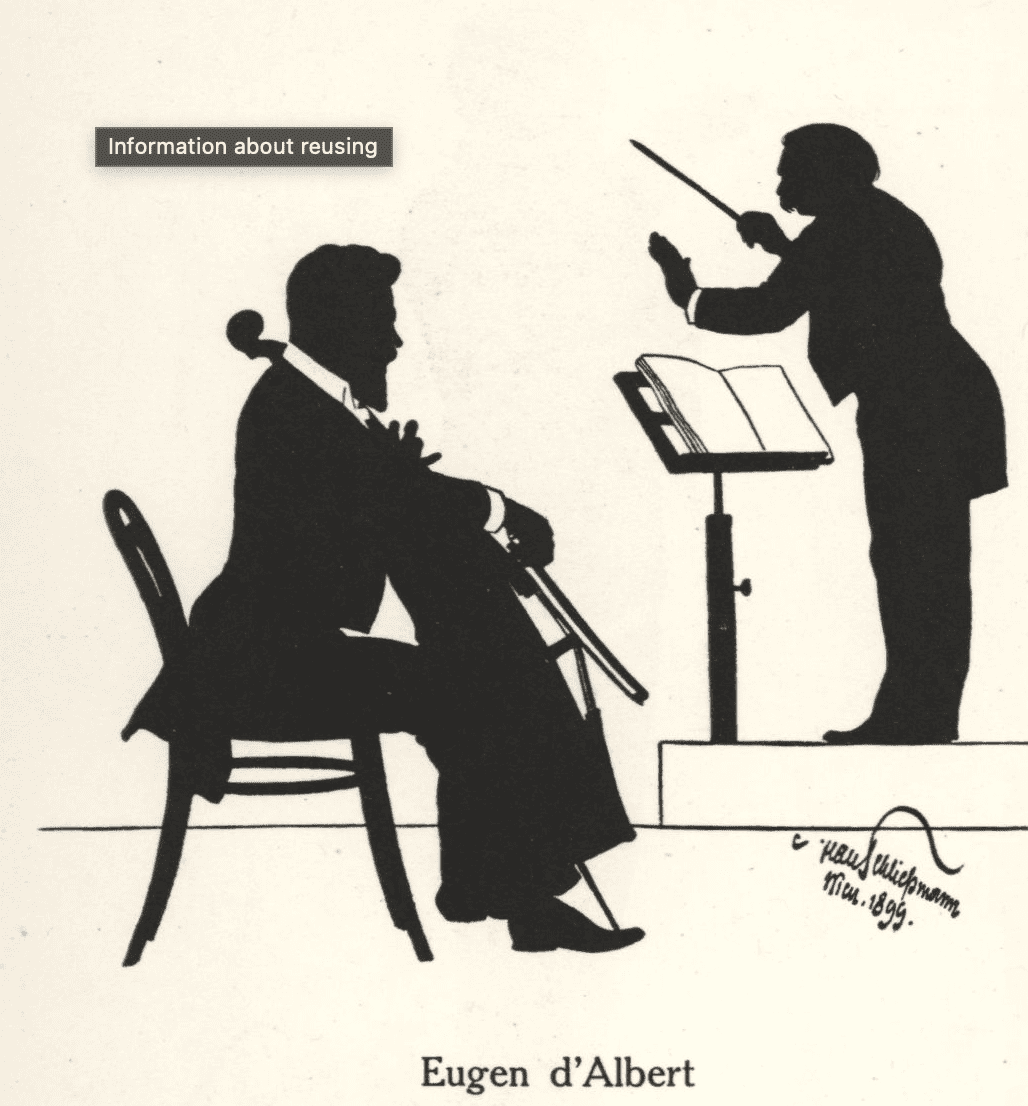
The featured image is “Hans Schließmann: Silhouette of Eugen Francis Charles d’Albert German pianist and composer” (created before 1920, published in 1928), and is in the public domain, courtesy of Wikimedia Commons.





Lot to chew on here. Thanks,
One subject that individuals of both political spectrum can appreciate & agree on.
Last week, WQXR in NY broadcast Verdi’s Falstaff from Bejing. I’ve seen a faultless performance of the Grand March from Aida from the Seoul Orchestra and Chorus.
Ironically, classical music is now denounced as an instance of Western cultural imperialism by second-rate academics who, in times past would have to write a peer-reviewed scholarly paper in order to earn a reputation. These days, all they have to do is grab a megaphone or write their drivel on some social media site. Besides classical music, philosophy, logic, math, science, punctuality, grammar, swimming pools, national parks are likewise considered “racist” by increasingly vocal, increasingly dominant, sectors of the “intelligentsia”.
I forget which Supreme Court justice wrote in an opinion something to the effect that he couldn’t define pornography, but knew it when he sees it. Much the same can be said about classical music. The term is a misnomer in that it wasn’t performed by Greeks or Romans, but by their cultural descendants two millennia later. For me, the term includes much of the literature between Bach and Rachmaninoff, with an increasingly lesser amount after his Paganini Rhapsody. Sad that everything he owned was confiscated by the Bolsheviks, and had to support himself by performing, with no time for composing in his last 20 years.
IMHO, “classical music” can include contemporary film scores by John Williams and others, but it does not include dreck that sounds horrible but was welcomed by “sophisticated” audiences of the NY Philharmonic in the 1960s.
Such is my humble opinion, and mine alone, opinions gradually developed over the decades since first watching The Lone Ranger some 70 years ago.
to Walt:
“Such is my humble opinion, and mine alone, opinions gradually developed over the decades since first watching The Lone Ranger some 70 years ago.”
Same here. Even after 55 years of intense classical music studies — as broadcaster, composer, pianist, journalist and author — I still rank “the Lone Ranger Overture” as one of my favs, and perhaps Beethoven’s pinnacle achievement.
Rossini’s “William Tell” overture?
Fascinating. I admit I don’t think I’m as much of an admirer of classical music as [the author], I don’t think I really find it much more emotionally rich than other forms, but I can agree on the level of skill required and its universality. A lot of it isn’t even that “hard” to get IMO as little children enjoy the classical music in cartoons without knowing all the background stuff. (Although that might be more Romanticists. I admit I may prefer Romanticists.)
Well, this was a lively discourse. I might tend to paraphrase, “I like it because I hear it.”
We all go through phases in life, love, and even music. Hildegaard of Bingen surely did not have the same “classicism” as did the Purcells, Handels, and Vivaldis of the time.
Surely though it’s the beholder of the form that leads us to beauty, enjoyment, fulfillment, and even Love, of how we 20th+ Century successors admire and view this music.
Acceptance can equal Joy, you know.