
Patrick Deneen’s book “Regime Change” is curiously post-Christian. Indeed, “regime change” conjures up images of forced virtue, authoritarian actions, and rigid programs to address serious problems. But what is needed today is not a regime change but a spiritual conversion, a reorientation, a new vision of the world.
 What makes Patrick Deneen’s new book, Regime Change: Toward a Postliberal Future, so controversial is that it is a “post” book.
Its dramatic call for regime change rests upon its “post” promise to deliver a radically different new state of things while staying within the present political order.
This is not an easy task. Some conservatives see the author’s proposal as a path to an uncertain (or even integralist) future. Most liberals think his “post” plan is a pretext to return to the past. Given the present polarization, everyone else wonders whether it can be done at all.
Describing the Problems Well
Prof. Deneen has always described well the problems afflicting American society. His last book, Why Liberalism Failed, demonstrated how the present liberal order is exhausted—not because it fell short but because “it was true to itself.” As liberalism progresses, it is the victim of the success of its internal contradictions. It creates its own conditions to fail, for which there is no “fix.”
In his new work, he continues his analysis. He points out how the nation’s elites are disconnected from the vast majority of a decadent citizenry. A global order has replaced local associations. America has lost its sense of place and community. A woke orthodoxy has taken control of so many institutions. As a result, things tend to disintegrate. Society is polarized, dividing into liberal pseudo-elites and resentful working-class populists.
Thus, the ground is prepared for something dramatic like regime change.
The Conflict Between Demos and Elites
The author insists on framing the debate around the division of these two classes. He believes a harmonious post-liberal future is assured if this great disconnect can somehow be bridged, fulfilling his “post” promise.
Dr. Deneen cites Aristotle’s classification of an age-old conflict between the “demos” (people) and the elites, which he also calls the many and the few. He presents today’s widening division as a fruit of liberalism. The problem is not elites but the need for good ones–certainly a true statement. The people that suffer from decadence must likewise return to virtue.
His regime change seeks to remedy the problem by mixing, blending and integrating the two parties. He envisions what he calls “aristopopulism,” which organizes society by allowing each party to benefit from the qualities of the other.
Proposing such unity is a good thing. However, the concrete program takes on an almost mechanical dimension by calling for increasing the social exposure between elites and demos. It is as if the close physical positioning of the two will be enough to effect significant harmony.
He believes officials should facilitate, foster and promote the public meeting of the two factions. The demos must pressure the elites to seek after the common good and not their self-interest. He proposes mixing measures like expanding vastly the House of Representatives (to 6,000 members!), locating major federal departments outside the beltway or instituting some form of universal public service for youth from both sectors.
The Limitations of This Prism
Class conflict is assumed to be the standard narrative of history. While tensions have always existed between the two, this perspective cannot be the only prism to interpret events.
Such classifications lend themselves to the dangerous simplifications that posit that all elites and demos will necessarily act as antagonistic class players.
Other universal and cultural factors also influence history in crucial ways. The sexual revolution of the sixties, for example, should be seen as a cultural phenomenon destroying morality that affects all classes—often in the same way. Religion, morals and family sentiments are unifying elements that can effect major changes outside the elite/demo dialectic. These frameworks give depth and nuance to understanding history beyond the class divide.
Traces of Pre-Liberalism
The social blending emphasis also eliminates a more philosophical approach as to how society should be organized. Thus, like liberalism, the author does not turn to universal principles. There is no reference to natural law theory. The Catholic writer carefully avoids those adopting models from Christendom’s medieval past.
He rightly criticizes the liberal systems proposed by John Locke, John Stuart Mill, and Karl Marx. However, he embraces Edmund Burke’s conservatism and attachment to tradition, accumulated wisdom, and custom (good in themselves) without a strong philosophical foundation. Thus, his solution is “a rediscovery of early modern forms of conservatism.” It is not post-liberal, as his title promises, but pre-liberal.
A Common Good Conservatism
The central theme of this pre-liberal Burkean regime change is a common-good conservatism that is supposed to provide the proper energy and enthusiasm to transform society. The author believes the present divide deprives the demos of “stability, order, continuity and a sense of gratitude for the past and obligations toward the future” they instinctively seek.
By bringing together elites and demos, Prof. Deneen’s proposal presupposes, perhaps naively, that today’s selfish society will be so overwhelmed by the possibilities of serving the common good that new elites will step up to the plate and direct society back to ordered liberty, the rule of law and traditional social structures.
Given the depth of today’s decadence, this grand rally around the common good seems a big assumption. An abstract common good would hardly be enough to galvanize postmodern souls corroded by self-gratification and creeping nihilism.
The only thing great enough to overcome these formidable obstacles is supernatural aid, which Prof. Deneen keeps outside his framework. Indeed, Christian civilization provided the necessary vital energy to move whole peoples to virtue through their love of a personal God.
A Post-Christian Context
In this sense, the “post” book is curiously post-Christian. That is not to say that the author does not value religion or excludes it from his proposal, quite to the contrary.
However, it does mean that the transformative power of Christianity is no longer considered, much less relied on. The discussion remains inside modernity’s denial of religion’s key role in public life. It still suffers from the context of postmodernity’s shattering of religious convictions. Thus, restoring Christendom is so far removed from the realm of possibility that it goes unmentioned.
For political players on the left and the right, Christianity is acknowledged as a social, not religious, reality. For many, religion’s role in a restoration is limited to a cultural factor of order, a moral guardrail or a social identifier. Under such conditions, religious people do not necessarily have to practice what they preach.
Thus, despite much honorable mention, a Christian revival is not the most important part of the regime change program.
The Greatest Union
This intense love of neighbor for the love of God is the missing ingredient needed for the transformation of postmodern society. It is not enough to move people closer to one another. The practice of Christian charity is a powerful unifying factor that easily bridges the elite/demo dialectic and can vitalize a common-good conservatism.
 The late medieval Saint Antoninus of Florence recognized the importance of Christian charity in public life and economy. He taught that charity regulated the affections and will of man and “binds men together in a brotherhood that is a true and perfect oneness. The entrance of charity into the social order makes it possible for men to be self-sacrificing in favor of the common good. Charity helps us love our neighbor as ourselves. It recalls to mind our common origin, our redemption by Christ, our sanctification through the Holy Spirit.”
If social union is the goal, there is no greater unifying factor. The dynamism of this call to charity worked the conversions of whole peoples. It established a social order with Christ as its center, organized in accordance with human nature and natural law.
Post-Regime Change
Thus, many proposals only see changes as the products of systems, government actions, and regimes. However, solutions will not come by just changing structures, vital though they may be.
Indeed, “regime change” conjures up images of forced virtue, authoritarian actions, and rigid programs to address serious problems that cannot be resolved in any other way.
What is needed is not a regime change but a change of hearts. It is what the Greeks called metanoia, which denotes a transformative change of heart, a spiritual conversion, a reorientation, or a new vision of the world. From the Church’s perspective, it signifies those great movements of history that give rise to new and sweeping ways of loving God and neighbor. They call forth the saints and renew the face of the earth.
The way out of the crisis is better found with a metanoia than a regime change. Such a transformation would be a welcome “post” proposal for an exhausted liberal world increasingly stripped of meaning and purpose.
The Imaginative Conservative applies the principle of appreciation to the discussion of culture and politics—we approach dialogue with magnanimity rather than with mere civility. Will you help us remain a refreshing oasis in the increasingly contentious arena of modern discourse? Please consider donating now.
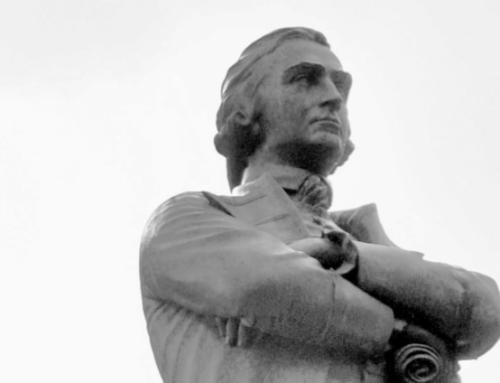
The featured image, uploaded by Dimitris Kamaras, is a statue of Saint Antoninus of Florence (Sant’Antonino Pierozzi), Cattedrale di Santa Maria del Fiore (Duomo), Florence [detail]. This file is licensed under the Creative Commons Attribution 2.0 Generic license, courtesy of Wikimedia Commons.




What is ignored by most conservative commentators is that most politicians are narcissists and sociopaths sprinkled in with a peppering of psychopaths. The mal-educated and media-medicated populace votes based largely on personality and promises rather than principles and values.
At the root of all this is growing mass loneliness, narcissism and absence of purpose, which I think your synopsis of the book covers fairly well. Your last paragraph summed it up extremely well in your last paragraph.
The statistical correlation beTween tyrannical behavior and the psychological condition called the “dark triad”. This was discussed by Jordan Peterson and Gad Saad recently (iat the time of this writing, of course). Those dark triad traits are being cultivated with the masses through social media and the education system and other mass propaganda machines.
The assumption that the “elites” are good natured people wanting goodness and beauty is where the idea that “the two factions can come together” falls apart. Marxists, nihilists, and deconstructionists want to destroy, not build. And that is what we are dealing with.
The answer is greater than ourselves, and your point about changing hearts hits the nail on the head. Christian faith in higher intervention leads to more prayerful and courageous evangelism. We must plant seeds of doubt in youth, not destructive, depressing doubt, but the kinds of ideals that lead them back to God -optimism about truth, beauty, and goodness. That’s a bold and radical message in this nihilistic society we have become a part of. And we will face ridicule and even persecution, but it’s time to plant the seeds, with full appreciation of what we are up against.
Thank you, John Horvat. Your book Return to Order was given to seven of my eight children last Christmas, and to a good friend, and will be given to my brother, a priest. Your analysis of the present moment is precient, as always.
This discussion would benefit from familiarity or close reading of Robert Spaemann’s masterful work
“PERSONS: The difference between “Someone” and “Something”. that was translated superbly by Oliver O’Donovan , OUP , 2006. In 18 chapter Spaemann provides vectors that would guide/shape “CHANGE”
Change of Heart is, quite obviously imbedded in notions of Personhood. Here are indeed levers for the debate about “Change:” A few hours of engagement with Spaemann’s work would yield solid gains for the Imaginative Conservative template,
Read Fr. Guardini’s book The Unlearned Lessons of the Twentieth Century. A masterpiece of compelling analysis. The post-modern Man is the new ” new man “, completely disengaged from the past, from all moral restraint, and indifferent to everything around him with which he is not directly involved. There can be little chance of metanioia for such a Man. He is master of his fate. Doesn’t even think in the categories of the past or such a thing as ” the common good “. To posit such a thing for him is laughable. And yet, Fr. Guardini remains steadfast in the face of the Leviathan of post-modernism. A remarkable achievement. He wrote this book in the early 1950s.
Excellent commentary. Thank you for acknowledging the primacy of the spiritual as essential to any good and lasting change.