
Macbeth loses his head and soul in the unknowing clouds of his own sin-deceived ego. So does Nietzsche. Far from seeing life as a quest for truth, they are left with nothing but their own bitter inquest on life, “signifying nothing”. This is the “deepest consequence” of their rejection of faith and reason.
 I’ve recently enjoyed six months of discussions on Henri de Lubac’s masterpiece, The Drama of Atheist Humanism, with Father Fessio and Vivian Dudro as part of our ongoing series of book discussions for the FORMED Book Club. One of the things that puzzled us was the choice of title. Why would de Lubac frame his study of the ideas of the major atheist philosophers of the nineteenth century as a “drama”? The answer to this puzzling question didn’t fully emerge until the final part of the book in which de Lubac dissects the decline and fall of Friedrich Nietzsche. It was only at this point that the history of humanism in the nineteenth century is revealed as darkly comic and deeply tragic, culminating in a providentially ironic denouement of such dramatic power that it could be seen as a delightfully grotesque tragicomedy.
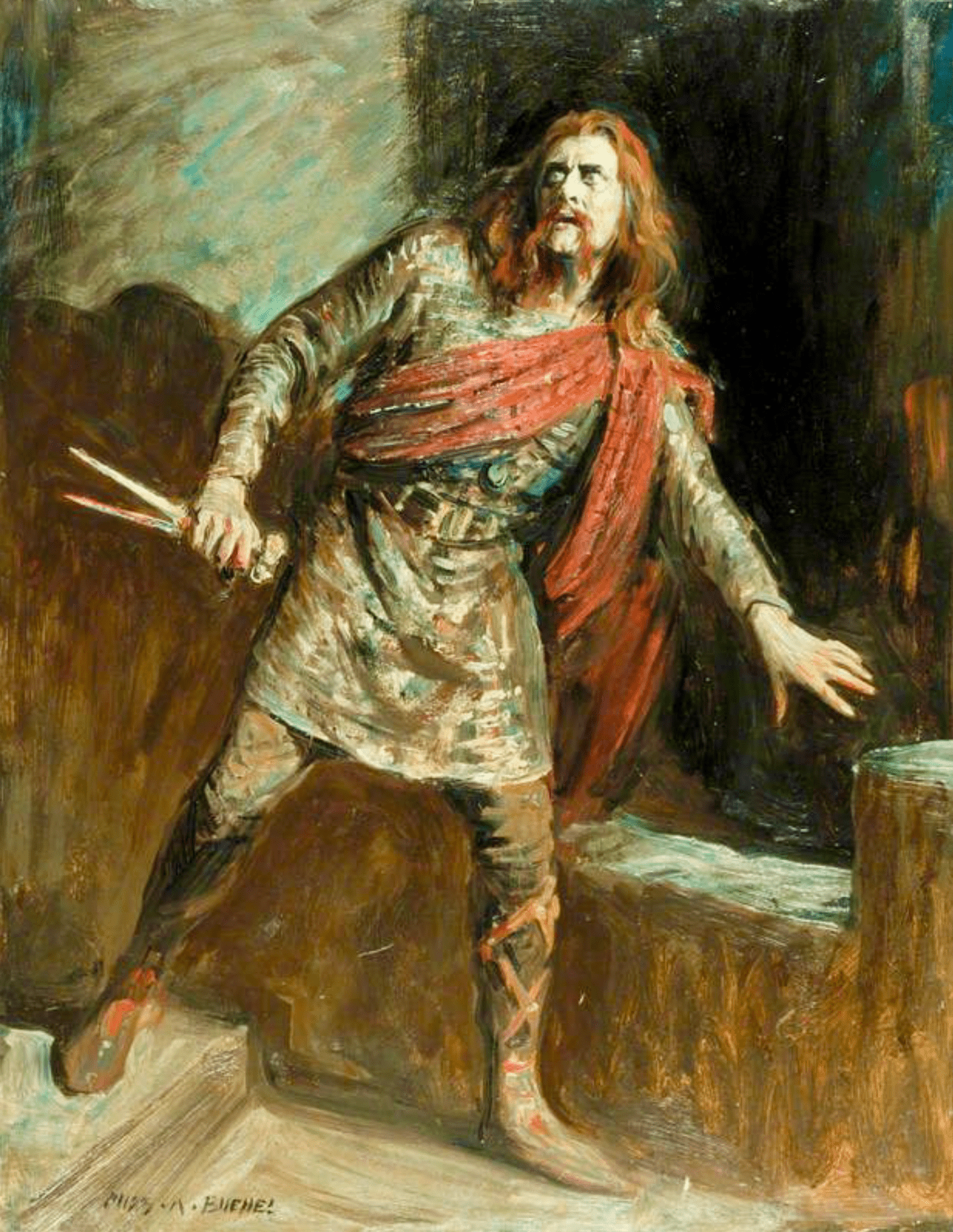
The drama that de Lubac narrates was such that it seemed to be worthy of the stage but then, as Shakespeare reminds us, the world is a stage and all the men and women of history merely players on time’s stage. It is, therefore, appropriate to see the striking parallels between the “real-life” factual character of Friedrich Nietzsche and the larger-then-life fictional character of Macbeth who prefigures Nietzsche in his manic pursuit of self-empowerment in defiance of reason.
Like his tragic Shakespearean forerunner, Nietzsche begins by abandoning reason in pursuit of power. From the very outset, his denial of the existence of God had nothing to do with any rational process of thought: “Atheism, is not, for me, the consequence of something else … in my case it is something that goes without saying, a matter of instinct.” In similar vein, his rejection of Christianity had nothing to do with any rational process of thought and everything to do with pride and its prejudices: “[I]t is our preference that decides against Christianity – not arguments.”
If Nietzsche’s atheism and anti-Christianity is irrational, there is nonetheless a reason for it, a rationale for his irrationality. The man who refuses to subject himself to reason is freed from the rational constraints that reason imposes. He is the “freed man”, liberated by the will to power (der Wille zur Macht), who can do what he likes and “to whom nothing is now forbidden”. The rule of reason, “this last bondage”, must be cast off. “[W]e have abolished the world of truth,” Nietzsche proclaimed; “nothing is true”.
The consequences of such abandonment of reason to the appetite for self-empowerment was obvious enough, even to Nietzsche. The philosopher, he wrote, is “a terrible explosive from which nothing is safe”.
“This being so,” de Lubac comments, “it was not surprising that the drama that had taken shape in human minds quickly reached the point at which it burst forth in fire and slaughter.”
Ironically, Nietzsche would have agreed with de Lubac. “I herald the coming of a tragic era,” he said, assuming the role of a self-proclaimed prophet of doom. “We must be prepared for a long succession of demolitions, devastations and upheavals…. [T]here will be wars such as the world has never yet seen…. Europe will soon be enveloped in darkness.” These words, written at the end of the nineteenth century, would prove to be truly prophetic of the new century about to be born. Europe would soon be enveloped in darkness. It would suffer two wars such as the world had never yet seen, with weapons of mass destruction, produced by those serving the will to power, beyond the imagination of more “primitive” peoples.
As for who would be to blame for such destruction, Nietzsche claimed that he would himself be responsible for it. “Thanks to me,” he wrote, “a catastrophe is at hand.”
His words were true enough, even though others would share the blame, including Comte and Marx, both of whom played leading roles in the drama of atheist humanism which de Lubac recounts.
As for Nietzsche, his ideas would prove not merely destructive but self-destructive. There is more than a suggestion, for instance, that he had ceased to believe his own philosophy and that the living of the lie might have contributed to his final descent into madness. “I must persist in my dream under pain of perishing,” he wrote. De Lubac is masterful in teasing out the psychological consequences of Nietzsche’s refusal to confess the lie that he was living: “He who smelled out so subtly and flogged so harshly the unconscious hypocrisies of others, he it is who has become in the final analysis, not a masked man, but the man of the mask, almost, as it were, a theoretician of the self-indulgent, obstinate illusion, an adorer of a fiction that he knows quite well in the depths of his heart to be a fiction.”
De Lubac’s reading of Nietzsche’s self-deception is borne out by the words that Nietzsche puts in the mouth of his alter ego, Zarathustra: “In truth, I advise you, get far away from me, defend yourself against Zarathustra! Better still, be ashamed of him. Perhaps he has deceived you.” Or, as de Lubac suggests, perhaps he had deceived himself.
As early as 1883, long before the onset of madness, Nietzsche confessed to being on the brink of suicidal despair: “I will not hide it from you,” he wrote to a friend. “Things are going very badly. Night overwhelms me more and more…. I believe that I am walking ineluctably to my ruin…. The barrel of a gun is now a source of relatively pleasant reflections for me….” A month later, he wrote that he was “no longer interested in anything”: “At the very depths of my being, a black and immutable melancholy…. The worst is that I no longer understand at all to what purpose I should continue to live, be this only for six months ahead. Everything seems wearisome, painful, disgusting to me.” Considering that Nietzsche’s whole philosophy is rooted in radical egocentrism, with the self as the centre of its self-empowered cosmos, it is the very self who is “everything”. Since this is so, the wearisome painful “everything” that is disgusting to Nietzsche must ultimately be a radical self-disgust.
We will conclude our survey of Nietzsche’s decline and fall in the company of his alter ego, not Zarathustra but Macbeth.
Having accepted the lie of the wyrd sisters that “fair is foul, and foul is fair”, Macbeth seeks to go boldly “beyond good and evil” blazing a self-delusional trail that Nietzsche would discover and follow almost three centuries later. Having chosen power over reason, Macbeth will live increasingly in the narrow and narrowing confines of his own head, making himself the centre of his own contracted and constricted cosmos. As he speaks to himself in secret, divorcing himself from others, his subjective perception supersedes objective reality. His decay is, therefore, as much a decay of philosophy as it is a decay of morality. The more he thinks of himself, the less he thinks of others, and the less he thinks of others, the less he thinks of the Other, i.e. the truth that transcends the self. The result is that his first thought of murder coincides with the murder of thought:
My thought, whose murder yet is but fantastical,
Shakes so my single state of man
That function is smothered in surmise,
And nothing is but what is not. (1.3.138-141)
As Macbeth’s pride takes pride of place on the throne of his soul, he begins to lose his sense of reality. Sin smothers reason so that the normal function of a man’s mind, which is to seek and find the truth, is “smothered in surmise” until “nothing is but what is not”. Thus, Macbeth’s nihilism, which will come to bitter and futile fruition in the final act with his dismissal of life as “a tale/Told by an idiot, full of sound and fury,/Signifying nothing”, is seen to have its roots in the play’s opening act with his turning away from fides et ratio towards infidelity and irrationality.
When we see Nietzsche in the light or the shadow of Macbeth, we see him as a disciple of his great fictional forerunner. Long before there was the madness of Nietzsche, there was the madness of Macbeth.
Macbeth loses his head and soul in the unknowing clouds of his own sin-deceived ego. So does Nietzsche. Far from seeing life as a quest for truth, they are left with nothing but their own bitter inquest on life, “signifying nothing”. This is the “deepest consequence” of their rejection of faith and reason. In losing sight of the significance of others, or the Other, they lose sight of the significance of everything else. In choosing themselves above others, they are not even left with themselves. They lose everything, perhaps even their own souls. They are left with the “nothing” which is nothing else but the real absence of the good that they have rejected, the ultimate annihilation to which nihilism points.
The Imaginative Conservative applies the principle of appreciation to the discussion of culture and politics—we approach dialogue with magnanimity rather than with mere civility. Will you help us remain a refreshing oasis in the increasingly contentious arena of modern discourse? Please consider donating now.
The featured image is a painting by Charles A. Buchel of Herbert Beerbohm Tree (1852–1917) as Macbeth in Macbeth by William Shakespeare. This file is in the public domain, courtesy of Wikimedia Commons.



If “nothing is true,” then the statement that “nothing is true” must itself be untrue, in which case . . . I believe that CS Lewis, somewhere in his writings, declared that ultimately rationalist materialism cuts its own throat. Nietzsche’s statement would seem to be a case in point. This reminds me of Chesterton’s assertion that “there are no rules” is itself a rule — and the most iron-clad of all.
Very interesting. Never thought of it that way. Ayn Rand should be in there too.
I was thinking the same thing reading the article. Objectivisim is a self-centered philosophy in the vein of Nietzche.
Would it be possible to find the references to Nietzsche’s quotes? I found some, but not all.
N. didn’t deny the existence of God. He said that people were ceasing to believe in Him, in which case, how do we decide what is moral? He disliked Christianity because it tells people what to believe instead of individuals deciding for themselves. It also makes a virtue of being weak. N. is, as you said, interested in self-empowerment—he believes we should do the hard work of becoming the best versions of ourselves as possible. He believes in both the Apollonian and Dionysian sides of ourselves. He believed in courageously facing suffering and living joyously. His father had a horrible brain disease and I believe N inherited that. N is also sarcastic in his writings, and satirical. He also had a good sense of humor and often made fun of himself in his writings. He was very ill through much of his adult life, which is why he often wrote in “aphorisms” rather than the full books he hoped to write. His writing was uneven and it is difficult to understand. His letters show him to be a kind man who advocated for, among other things, women’s advancement. I think saying that N was not a rational thinker and is all about power and control over others is a misreading. N. will never tell you what to think or do. Hence the line “Perhaps he has deceived you.” It is a reminder that we make our own meaning in life.
I’m far from being a Nietzsche scholar, but when reading what little N I’ve read, I find myself fluctuating between two extremes: either shooting holes through what he’s saying, or else thinking, “That’s me he’s talking about.”
In grad school ca. 1971, we had readings from the Russian nihilists. It was amazing how much they had the same tone as Ayn Rand.
Illuminating. Fascinating. All the while…Terrifying.
Ditto on FORMED. Who you worship determines destiny.