
Those who are blinded by materialism cannot see the landscape of history. They see systems instead of people, and empowerment instead of virtue. They can’t see the beautiful because they refuse to raise their eyes to heaven.
 The past is present whether we like it or not or know it or not. The past is where we are. We can’t be anywhere else in the present because of where we have been in the past. This is why the knowledge of history is so important. If we don’t know where we’ve been, we don’t know where we are; and if we don’t know where we are, we can’t know where we’re going.
The problem is that we can’t know where we are unless we know who we are. A false understanding of humanity will lead to a false understanding of history. Philosophical materialists, such as Auguste Comte and Karl Marx, believe that history is a sociological or socio-economic mechanism which obeys scientific laws. It is a machine or a system. They also believe that people are machines, mere organic mechanisms obeying scientific laws, mere cogs in the larger and more important sociological and socio-economic machine. It is little wonder, therefore, that believers in this deterministic view of history idolize the idea and idol of the perfect mechanism, the deterministically promised utopia, killing millions of human persons in the name of systemic “humanity” and progressive “society”.
Against this materialist and determinist view of history is the Christian understanding of history, which sees human history as a human story in which the protagonists are human persons made in the image of God, and therefore attracted by nature to goodness, truth and beauty, and yet also broken by the fall into sin. If this is so, the battle between good and evil is fought in every human heart and therefore in every human society, in all the ages of man’s past, present and future. History is not an ascent towards the perfect mechanical system in the future, the mythical “progressive” golden age of the utopian dreamer; it is a tapestry of recurring patterns in which the battle between good and evil is fought and told from one generation to the next.
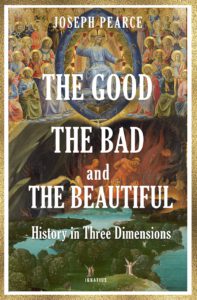 The Christian view of history animates and inspires A History of the Catholic Church, a new book by Piers Paul Read, which I would like to compare with two other recently published histories of the past two millennia, Triumph: The Power and the Glory of the Catholic Church by H. W. Crocker III, and my own recently published book, The Good, The Bad and The Beautiful: History in Three Dimensions. These three volumes share the same philosophical and theological approach to history and yet differ significantly.
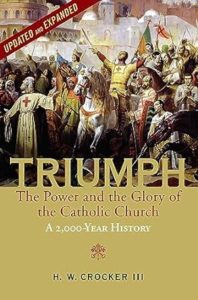
Taking the earliest first, Mr. Crocker’s Triumph, published at the beginning of the present millennium, is, as its title and subtitle suggest, a triumphalist trumpeting of the role of the Catholic Church in building and safeguarding civilization. Its approach is unapologetically apologetic, to employ a double-entendre paradoxically. It is apologetic, in the sense that it is a reasoned defence of the Church’s role in history, and it is unapologetic, in the sense that it is a deliberately provocative riposte to anti-Catholic and anti-Christian readings of history which seek to demonize the role of the Church.
 My own approach is different, albeit in a subtle and nuanced way. My goal was to show that history is not an ascent into a better future, ushered in by technological innovation and societal “progress”, nor is it a descent from civilization to decadence and barbarism; it is a battle between good and evil, a time-stitched tapestry of good, bad and beautiful threads. These threads reflect the three facets of man, who manifests himself in life and therefore in history as homo viator, homo superbus and anthropos. Homo viator is pilgrim man, the good man, who sees the journey of life as the quest for heaven; homo superbus is proud man, the bad man, who refuses the appointed journey and chooses to “do his own thing”; anthropos is poetic man, who looks up in wonder at the beauty of the cosmos, singing its praises by the making of beautiful things. Homo viator sacrifices his life for others, making the world a better place in consequence; homo superbus sacrifices the lives of others for himself, making the world a worse place in consequence; anthropos shows us the light of goodness and truth in the form of beauty, edifying the mind and heart in thanksgiving.
In order to illustrate how these three threads have woven their way through every century since the time of Christ, I chose to write a separate chapter for each of the twenty centuries, subdividing each chapter into sections on the good, bad and beautiful in each particular century.
 Piers Paul Read’s approach differs from mine, in the sense that it might be considered epochal. He subdivides his own overview of the historical landscape into epochs. Part One covers the period from Christ until the rise of Islam; Part Two takes us from Charlemagne and the birth of the Holy Roman Empire to the brink of the Protestant Reformation; Part Three spans the almost three centuries from the Reformation to the French Revolution; Part Four covers the century or more from the French Revolution to the First World War; Part Five takes us from the Russian Revolution to the end of World War Two; Part Six covers the period from the Cold War until the election of St. John Paul II to the See of Peter; and the final part spans the papacies of John Paul II and Benedict XVI, ending at the death of Pope Benedict on New Year’s Eve 2022. Whereas my own book scans the entirety of the landscape of history, focusing equally on each century, Piers Paul Read’s book surveys the whole landscape but focuses more intently on more recent history, telescoping in on those parts of the historic landscape that are closest to us.
As for which of these three approaches to history is the best, it’s sufficient to say that each is much better than Marxist and other materialist accounts of history. Those who are blinded by materialism cannot see the landscape of history. They see systems instead of people, and empowerment instead of virtue. They can’t see the beautiful because they refuse to raise their eyes to heaven. It is in this light, which is the light of goodness, truth and beauty, that I am happy to trump the praises of Mr. Crocker’s triumphalism and Mr. Read’s more measured but telescopic epochism (to coin a neologism). I will desist from blowing my own trumpet, merely concluding with the observation that I share with Mr. Crocker and Mr. Read the desire to show the human story in the light of Christ and the Church He founded. May the light which enlightens history be praised.
The Imaginative Conservative applies the principle of appreciation to the discussion of culture and politics—we approach dialogue with magnanimity rather than with mere civility. Will you help us remain a refreshing oasis in the increasingly contentious arena of modern discourse? Please consider donating now.


Leave A Comment