
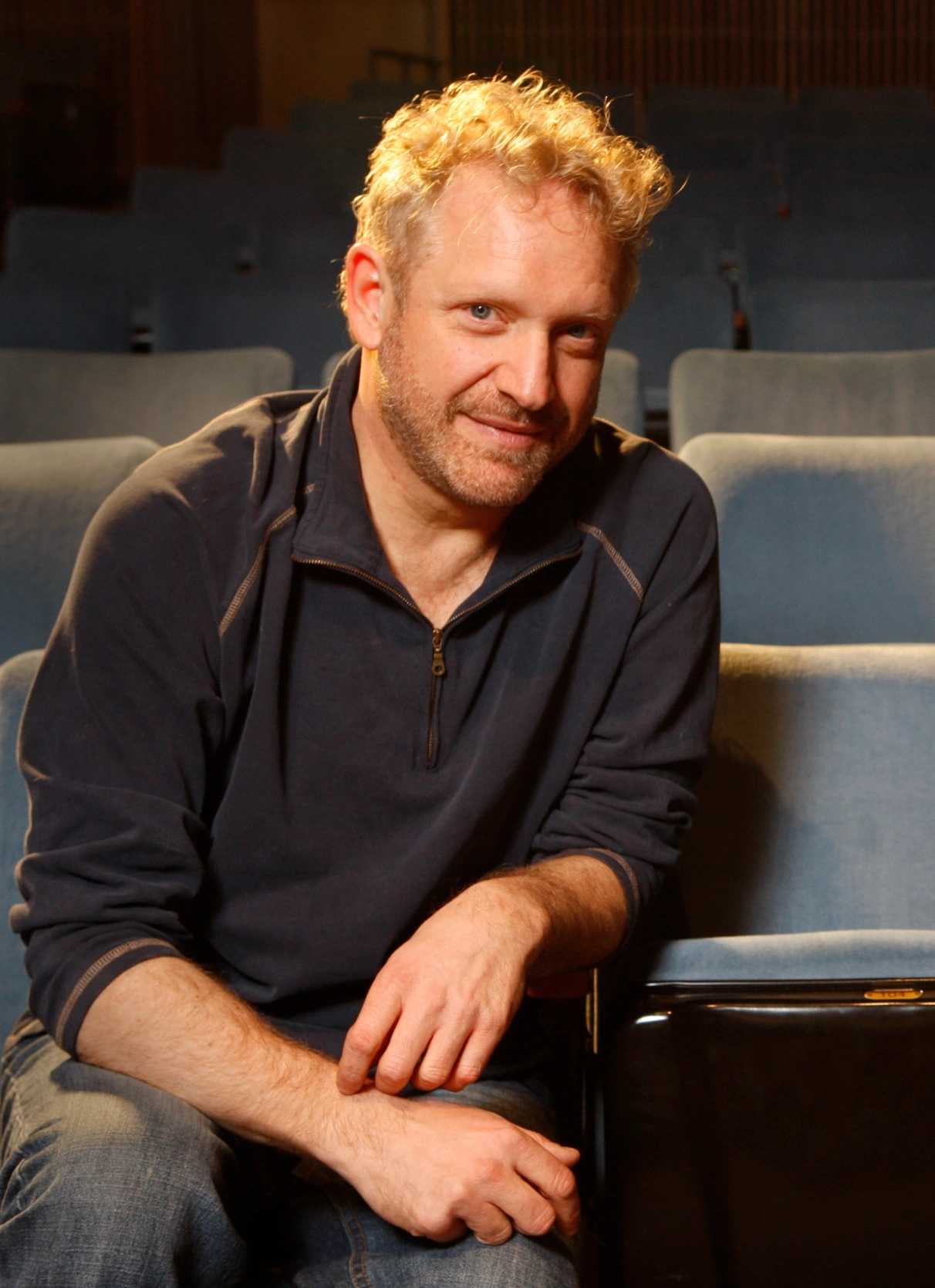
 Fifty years ago, when E. F. Schumacher published his international bestseller, Small is Beautiful, he gave it the subtitle “economics as if people mattered”. In 2006, when I published my own book, Small is Still Beautiful, I gave it the subtitle “economics as if families mattered”. In 1977, when Christopher Derrick published his book, Escape from Scepticism, he gave it the subtitle “liberal education as if truth mattered”. Inspired by these precedents, it seems to me that the perfect “subtitle” or creative motto for the work of Michael Kurek is “music as if beauty mattered”. In an age of musical ugliness, marked by atonality and discordance, his works sound forth resonantly like a clarion call of artistic renewal and cultural restoration.
Considering the attractiveness of beauty, in contradistinction to the sordid seductiveness of deformed ugliness being offered by many of his contemporaries, it is not surprising that Dr. Kurek’s music is proving so popular. A few years ago, a collection of his tone poems went to number one in Billboard’s contemporary classical music charts. These musical poems were inspired by the beauties of Creation which have moved the Muse of poets throughout the ages, the light of the moon, landscapes and seascapes, but also by the challenge of writing for the internationally acclaimed musicians for which the works had been commissioned. “I was partially inspired by the great artistry of the world-class performers who commissioned, performed, and recorded that music, which is, for a composer, something like getting to drive full-out on a motorway in a Lamborghini sports car. These virtuosos could play just about anything.” As for categorizing these compositions in terms of genre, Dr. Kurek describes them as being “not only traditional but neo-romantic”. He believes that the secret of their popularity is rooted in the reality that “all humans are wired by God to be emotional beings and are thus moved by music that reflects human emotions, tenderness, love, and compassion back to them”. Music “speaks to them in a way that objectifies in real sound the hidden interior life for which mere words are often inadequate”.
As a great admirer of the works of J. R. R. Tolkien and C. S. Lewis, I am especially fond of Dr. Kurek’s Second Symphony, “Tales from the Realm of Faerie”, which was inspired by their works. “I wanted to find an analogy to their work in music, if possible,” he explains, “the interior world of the imagination and of childlike wonder.”
Unsurprisingly, Dr. Kurek is most excited and animated when discussing his current and most recent works. He has just completed a ballet dedicated to the late ballerina Raffaella Stroik (of the St. Louis Ballet), which was commissioned by her parents upon her very premature and tragic death just a few years ago. Raffaella’s father, Duncan Stroik, is a very distinguished architect and an impassioned proponent of traditional church architecture. Respecting and reflecting his daughter’s love for traditional ballet, he was looking to engage both a composer and a choreographer whose work is in a traditional style and devoted to the transcendental values of beauty, truth, and goodness.
The memorial ballet, newly finished, will premiere in June 2024 in South Bend, Indiana. Apart from the exciting and enticing prospect of the live premiere, Dr. Kurek also hopes to record all 75 minutes of the ballet music with a large symphony orchestra on an audio-only album (what we used to call a CD before so many people went entirely digital). Although the overhead costs of doing so are very expensive, he is hopeful that sponsors and donors can be found to make it possible. “I have had a wonderful response from those who have heard mockup recordings of the music,” he says, “and I believe many might enjoy this as much or more than anything I have ever written.”
Dr. Kurek has also been working on his Third Symphony, which is inspired by his love of England and its landscape. His Symphony No. 3: “English” has four movements: Upon a Walk in the English Countryside, Stonehenge, The Lady of Shallot, and The Major Oak of Sherwood Forest. “I am not tone-painting here in any kind of literal sense,” he explains, “but rather allowing each of these inspiring subtitles to speak to my subconscious and suggest the general tone or mood of the music that comes out of me.” He describes the Third Symphony, which runs to 55 minutes in length, to be his “longest, strongest, and most serious classical work to date”. At the time of our conversation, he was about to write the last half of the final movement.
As with the ballet, Dr. Kurek hopes to have the new symphony recorded by a top-class European symphony orchestra. “So many times, people complain to me that they felt like a captive audience at a concert when the ensemble begins to play new music they dislike and believe to be ugly. If that is the case, then I would ask them to consider making a statement by funding beautiful music and helping to make known the kind of new music they would like to see return in the classical music culture. For this project, I have set up a fundraising page and do appreciate gifts.”
This concludes the second and final part of my conversation with Michael Kurek. [The first may be found here.] In closing, I would simply like to reiterate and reinforce his request that all imaginative conservatives and lovers of beautiful and traditional music will consider becoming patrons of his breathtakingly beautiful art by supporting his fundraising efforts. Beauty can save the world but only if we allow it to be seen, or in this case heard.
The Imaginative Conservative applies the principle of appreciation to the discussion of culture and politics—we approach dialogue with magnanimity rather than with mere civility. Will you help us remain a refreshing oasis in the increasingly contentious arena of modern discourse? Please consider donating now.
The featured image is courtesy of Michael Kurek’s website.



I wasn’t formerly aware of any new composers working within the tradition of the old masters. His Symphony 3 sounds especially intriguing. I’ve subscribed to Kurek’s YouTube channel and am listening to him now, loving it.
My impression is that contemporary composers today have the freedom to write in whatever style they want – avant-garde, traditional, whatever. The tyranny of serialism and extreme modernism is a thing of the past. We are now in a situation of complete pluralism as regards how to write new music.
Now, the downside to living in a pluralistic era is that the era lacks any defining style, and you cannot write music without a style. So the question and challenge for a contemporary composer is: how can one come up with something compelling and original? We certainly have the entire history of music as a model, but how can one fashion something new out of it that is not merely imitative or derivative?
Hi, I very much wish your first paragraph were true, but it very much is not. The tyranny of postmodernism now reigns at most universities. Yes, minimalism and collage enjoy a pluralism with the older atonal and aleatoric styles, but tonal, narrative traditionalism will not get a professor tenure or a college senior admission to graduate school in composition.
Thank you for your reply. Not being part of the academic music world, I didn’t know this was the case. I appreciate your distinction between postmodernism (minimalism, etc.) and traditional narrative tonality, and distinguishing these both from atonalism. It is useful to keep these distinctions in mind, because not all “tonal” music is necessarily traditional narrative tonality.
Composers like Kurek are sorely needed! Excited to see work like this being done.
I would be interested to hear Mr. Kurek on where Arvo Pärt fits on the spectrum – his music is tonal but seems to eschew a sense of narrative. It has been called “spiritual minimalism” and thus would appear to be related to postmodernism in some way.
I think it depends upon which piece of his you are talking about. His first claims to fame were of what I call the “minimalism in slow motion” genre. There is some commonality in spirit with Gregorian chant, in that it is peaceful but not strongly goal directed (or at least it takes its time getting to a goal). There is an ambience of beauty that appeals to the hurried modern mind. On the other hand, for me personally it can be fascinatingly “spooky” for a few minutes and then quickly becomes boring. The harmonic palette is too minimal, compared to the 19th c. Romantics. But just as I would not dismiss ancient chant, I would not dismiss this music, even though I would not want to hear it very often myself. Gorecki and Tavener have works much in the same vein. I think there is certainly more that is arguably beautiful than the “ugly” atonalists. But yes, I would say it essentially is known in academe as postmodern, or post-minimalist.