
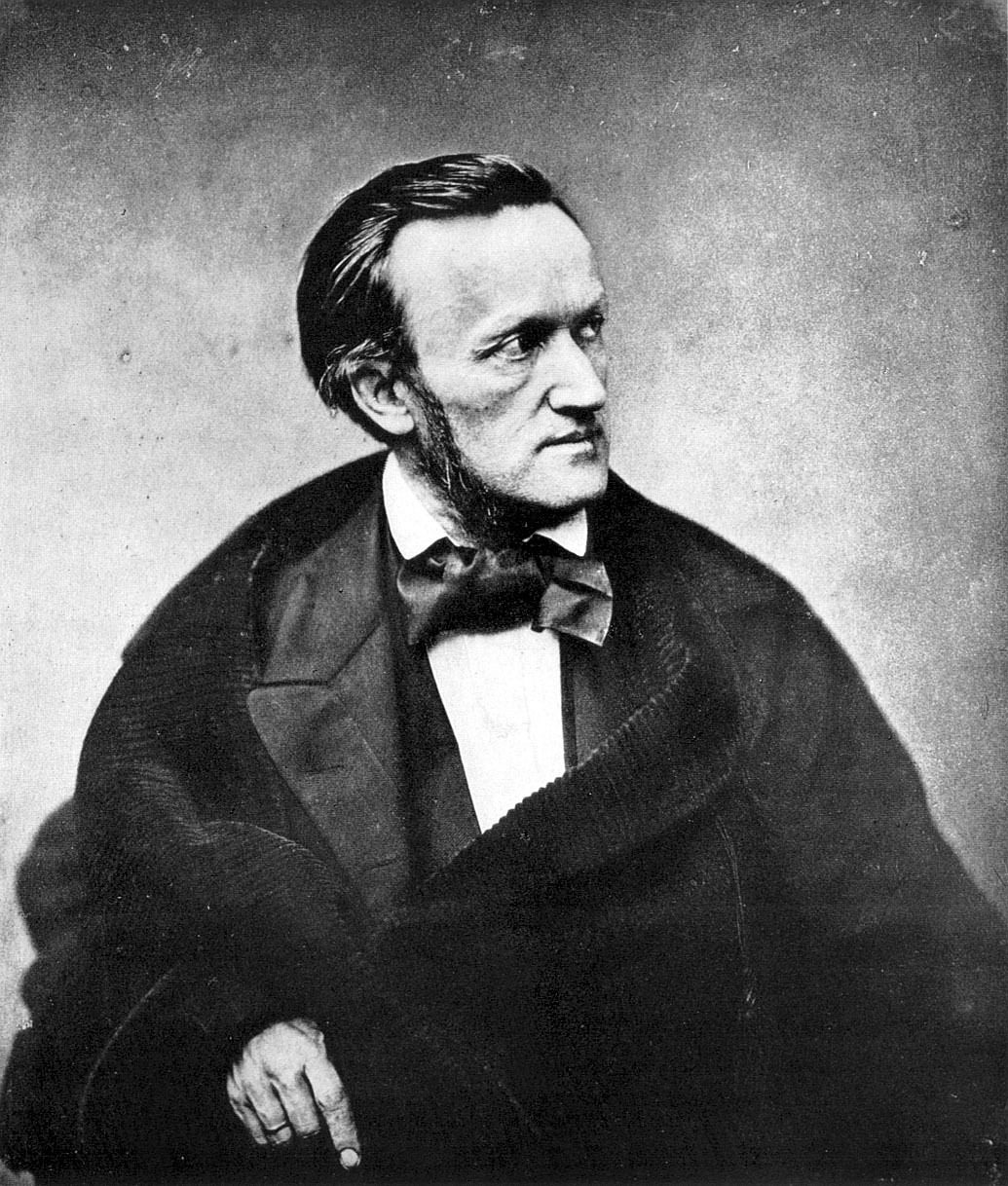
Richard Wagner’s legacy has been overshadowed, and some would say permanently marred, by the manner in which he became the poster child of Hitler’s grotesque Third Reich. Yet should we condemn his music for this reason?
Nice to see your music selections. But Wagner, your favorite composer! Say it ain’t so, Joe!
 The above-quoted words were written to me by a friend after he had read an essay of mine in The Imaginative Conservative in which I listed some of my favourite works of classical music. The essay praised the music of Tallis, Byrd, Verdi, Fauré, Allegri, Schubert, and Bach, and ranged in scope from anonymous songs from fourteenth-century Catalonia to modern film scores by Richard Einhorn and Howard Shore. My friend had no problem with my waxing enthusiastic about Schubert’s Piano Quintet in A Major or Beethoven’s Sixth Symphony nor, for that matter, did he question my praise of Vaughan Williams, or my admiration for the romantic patriotism of Sibelius or Smetana, or the minimalism of Arvo Pärt. All was fine, so it seemed, until I revealed, or perhaps confessed, that my favourite composer, whose work I admired above all others, was none other than Richard Wagner, the mercurial and some would say mad genius who seems to be the bête noire of many Christian music lovers. My crime, in the eyes of my friend, was my description of Wagner’s Tannhäuser Overture as “probably the one work of music that I admire above all others, and is by the one composer that I admire above all others,” to which I added that “this soaringly impassioned tour de force transports me out of myself into somewhere better.”
Why is it that the genius of Richard Wagner continues to be so controversial? Perhaps his legacy has been overshadowed and some would say permanently marred by the manner in which he became the poster child of Hitler’s grotesque Third Reich. There’s no doubt that the Nazis coopted Wagner’s genius to give credence to their “volkish” desire to make Germanic myth and art the quasi-religion of the Reich, thereby supplanting “semitic” Christianity with something more worthy of the Herrenvolk. But why should Wagner be held accountable for the manner in which maniacs perverted the purpose and meaning of his work a full fifty years after his death? Why should all that is good and noble in Norse and German mythology be forever cursed because of its being abused by Hitler and the Nazis? “I have in this war a burning private grudge against that ruddy little ignoramus Adolf Hitler,” J.R.R. Tolkien wrote to his son Michael in 1943. “Ruining, perverting, misapplying, and making for ever accursed, that noble northern spirit, a supreme contribution to Europe, which I have ever loved, and tried to present in its true light.” Should Tolkien’s Lord of the Rings be condemned merely because he took his inspiration from the same “noble northern spirit” which had inspired Wagner’s own Ring cycle?
My friend might concede that Wagner should not be condemned as a precursor of Nazism merely because the Nazis embraced him, tainting his reputation by tarring him with their own blood-stained brush. With such “friends,” Wagner might indeed complain that he doesn’t need any enemies! But what of his association with Nietzsche? Isn’t this more problematic?
It is true that Nietzsche had originally championed the work of Wagner and had befriended him but it is also true, and hugely significant, that he broke off his friendship and spent the final years of his life ranting against Wagner’s selling out to Christianity. He saved particular scorn for what he condemned as Wagner’s affirmation of Christian concepts of chastity in Parsifal, the great composer’s final opera. Far from disagreeing with Nietzsche’s accusation that Parsifal was a Christian work, Wagner described the opera himself, in a letter to his patron, King Ludwig II, as “this most Christian of works.”
Describing Parsifal to his wife Cosima as his “last card,” Wagner’s final great work can be seen as something of a Christian swan song, a bowing out on a Christian note. And yet anyone who has seen the opera will know that it’s hardly a work that is unproblematic from the perspective of orthodox theology. As the German Wagnerian scholar Ulrike Kienzle has commented quite correctly, “Wagner’s turn to Christian mythology, upon which the imagery and spiritual contents of Parsifal rest, is idiosyncratic and contradicts Christian dogma in many ways.” And yet, even conceding that this is the case, Wagner’s final work still represents a crucial and significant turn in the direction of the Christian faith, a fact that anti-Christians, such as Nietzsche, could not help but condemn.
The point is that Wagner was pointing in the right direction in the final years of his life, and moving in the right direction, flirting with Catholicism itself. Like all men, he is homo viator, a man on the journey of life, or more correctly a man on life’s pilgrimage. To be sure, he remains controversial but I am not the only Christian, by any means, who admires his work. One thinks of Fr. Owen Lee, the great expert on Wagner, famous for his interval broadcasts from the Metropolitan Opera, and also of Sir Reginald Goodall, the doyen of conductors of Wagner’s Ring Cycle, who was a convert to the Catholic faith. One thinks also of the great Catholic philosopher, Dietrich von Hildebrand, who wrote a whole book examining Wagner’s relationship with the Faith. And then there’s Maurice Baring, the great literary convert and friend of Chesterton, who described Wagner as a “restless soul, for ever seeking bliss,/athirst for ever and unsatisfied.” Dare we hope, in spite of all the controversy, that Wagner has now found the bliss he was forever seeking and that his thirst for the Divine has now been satisfied?
This essay was first published here in October 2017.
Republished with gracious permission from the St. Austin Review (June 2017).
The Imaginative Conservative applies the principle of appreciation to the discussion of culture and politics—we approach dialogue with magnanimity rather than with mere civility. Will you help us remain a refreshing oasis in the increasingly contentious arena of modern discourse? Please consider donating now.
The featured image is a photograph of Richard Wagner in Paris (1861), and is in the public domain, courtesy of Wikimedia Commons.





There’s always that Verdi – Wagner split between aficionados. I do prefer Verdi, but there is much to enjoy in Wagner. There’s also much that puts me to sleep. 😉
Thank you! I love Wagner’s music, especially TANNHAUSER and DIE MEISTERSINGER VON NURNBERG.
Wagner himself does appear to have been a jerk; perhaps all the beauty and love that was in him went into his music.
Again, thanks.
I still think Parsifal:Prelude Act 1 is among the most beautiful pieces written especially listened to during
a sunrise. But then some would say I’m a conservative and thus a fascist. To which I reply, ah well, you’re an ideologist.
Wagner is also one of my favorite composers. Since Hitler ate apples and wore neckties I guess some people would devise some cosmic connection in their imagination regarding those things. Poor souls.
Parsifal is suffused with the Light of God . The symbols and music radiate the Holy Spirit. The archetypes of Christianity remain in the piece, but it is throughly Europeanized in the spirit of a timeless Dark Ages and cleansed of the Levant. One is at home in Parsifal as in the shadowy church ruins scenes of Caspar David Friedrich. The pure fool who is Parsifal moves us backwards and forwards to the simplicity of empathy and compassion for all of the pain and suffering of life and yearning of the soul for its place beyond the space and time of our sufferings. Of all of Wagner’s opera, Parsifal was least appreciated by the Nazis, and by Nietzsche for that matter, because of its Buddistic, anti-life spirit of resignation rather than Will to Power and the drive of our human and tribal genetics. And so while the Christianity of Wagner’s final opera may be problematic, even more problematic is its place in the ideology of Nazism.
The problem is that Wagner was strongly anti-Semitic and devoted to a German nationalist sentiment which would later flower into Hitler and Nazism. So I don’t think it’s simply a matter of guilt-by-association (Hitler liked Wagner, therefore Wagner must be bad). The fact is that Wagner believed some bad things himself.
Agree!
“Should Tolkien’s Lord of the Rings be condemned merely because he took his inspiration from the same ‘noble northern spirit’ which had inspired Wagner’s own Ring cycle?” You mean about how the noble race of Numenor went into decline because their descendants intermarried with “lesser strains” of men? That idea seems to have been popularized, if not invented, by Madame Blavatsky, and of course it was central to the whole Nazi myth — the the point where the SS sent anthropologists to Tibet to find evidence of the Aryan / Indo-European origin in Atlantis.
That might not be enough to reject LOTR altogether, but it should introduce some hesitation about overstating the perfection of the work, as though it were as pure image of the Catholic Faith, with Galadriel as the Blessed Virgin and lembas as the Eucharist. Tolkien was no Nazi, but Nazism was less of a break from the common assumptions of the time than people then or now want to admit. No doubt you and I likewise unwittingly concede too much to the errors of our day.
Thank you so much for your essay. Certainly, I also see a very close link between Wagner’s music and Catholicism. I find Wagner as an existentialist philosopher that expressed all his though trough these masterpieces, and as opposed to Nietszche, he believed on the final salvation of mankind. I really find so much peace reading Dostoyevsky and listening to Wagner.
Great article. It’s amazing how many connections there are between Tanhäuser and the modern world, specifically the epidemic of pornography addiction among men and how it takes away their ability to love and replaces it with lust. It blew my mind when I watched it recently. Wagner’s operas are a gift from God.
Wagner was ruined for me because the first piece I heard from him was Tristan Und Isolde and that is just torture.
Great article! If one wants to ignore the great music of Wagner because of a post- Hitler definition of anti-semitism, one might be depriving oneself of great inspiration.
Enjoyed!
Wagner is antisemitic in a manner that was hardly radical in his time even among members of the Christian churches – he just was able to expose stereotypes of Jews in a particularly powerful medium. If cultural antisemitism will be our criteria for cancelling great art say goodbye to Shakespeare too, and doubtless many more writers, composers and artists. Indeed we have reached the stage that Christianity itself is being judged as antisemitic and the Christian Bible condemned because it teaches the Jews have sinned and their unfaithfulness to God (the whole story of the Old Testament after all) has resulted in their spiritual “birthright” being passed to the gentiles
I was surprised to not find any reference to Roger Scruton, the great English conservative philosopher and cultural critic, who wrote major works praising Wagner
I have seen it argued that Wagner did not intend characters like Alberich, Mime and Beckmesser to be representations of Jews.
No. The main problem with Wagner is not guilt by association with Hitler of Nietzsche, but his paganism. Wagner’s work does not portray God, but the anthropomorphic gods of paganism, emerging out of the world, which is why Roger Scruton loved his work. Pretty music for some. But Wagner’s message, NO!
My impression is that Scruton’s love of Wagner is not tied to Wagner’s portrayal of the anthropomorphic gods of paganism. For Scruton loves operas by Wagner that do not involve this portrayal.
Unfortunately, Scruton likened God to Wagner’s Wotan, who must “achieve… serenity” from “absolute control over the universe… that preceded his own rise… and obeys its own inscrutable… law”; God “needs” to take on the human condition in order to “enjoy love” (The Face of God, pp. 174, 176).
I love classical music-it satisfies me to reach to God and Jesus. I am just a person and a business man not a musician.
I do not know the depth of Wagner but I do know that evil will try to use all to reach its end -Satan quoted scripture to our Lord Jesus –
Tolkien saw the beauty of music in “Simarillion –
I believe you laid out a strong case for Wagner against the diabolical approach of Hitler and his mad cohorts
I enjoyed your article to a certain degree. However, I would have appreciated a more in depth analysis of the thesis should we condemn an artist because an ugly faction admired them. You confined yourself to a parade of primarily catholic thinkers and critics who admired Wagner (which is informative and delightful in itself) without providing any analysis on why they admired Wagner’s work. I do not find that to have advanced the discussion. It just shows that many other people are in agreement with you.
Where may I find the book Hildebrand wrote about Wagner and the Faith?
Wagner’s music is magnificent but it’s a pity that he glorified paganism. And yet in The Ring, it could be a prehistory before the world wide flood. Funny though that in the Ride of the Valkyries, the ending sounded strangely like an airplane, even though he never heard an airplane. Interesting.