
Medieval man gave blue to Our Lady as her color. She rescued it from its barbarian captivity and elevated it for all the world to see. Devotion to her gave rise to a rich civilization full of the vitality and color the ancient pagans lacked.
 Most people imagine that antiquity was much like our own times. They think people back then did and appreciated the same things we do. We do not realize how Christianity opened up a world of beauty, joys and delights that pagan peoples did not enjoy. We take many magnificent cultural achievements for granted.
So it is with the world of color. Christianity developed rich notions of color that differed from those of primitive and ancient peoples. The peoples of antiquity, for example, expressed little appreciation for the colors surrounding them. Their literature makes little mention of them.
The Mystery of Gladstone
In his excellent substack Via Medievalis, Robert Keim writes about this curious lack of color in antiquity. Comparing the times, we can see how much Christianity has improved our lives.
He notes that William E. Gladstone, Prime Minister of the United Kingdom in the latter half of the nineteenth century, was a scholar who studied the Homeric epics. Throughout the literary texts, Gladstone noticed very little mention of color. It was as if the epics were played out in black and white.
The color blue was particularly absent. This lacuna was especially strange considering that Homer wrote about the ship voyages of his characters as they sailed the deep blue sea and surveyed the blue skies. These heroic figures were surrounded by blue, yet Homer makes almost no mention of the color.
In fact, Gladstone noted that all color was expressed imprecisely. The same word in Greek often indicates the hues and colors we call by different and distinct names. The Greek poems contained only the most crude and elemental form of color expression, where black and white prevailed.
This shocking omission so struck Gladstone that he thought perhaps the Greeks suffered from an eye defect or lack of evolution by which the color vision enjoyed by humanity today and for centuries was absent in antiquity. He believed this tragic mystery was perhaps caused by a physiological defect, rather than a cultural deficiency.
A Cultural Problem
Such biological musings were later proven wrong. Modern eyes are no different from those of ancient times. What was different was the meaning attributed to colors. The richness of a culture is what brings colors to the attention of a people. Greek literature, for all its literary brilliance, was still somewhat primitive in its expression of color.
Renowned medievalist Michel Pastoureau traces the changing perception of colors. He claims the Middle Ages brought colors to life. Thus, he wrote several books, each analyzing a specific color.
His book, Blue: The History of a Color, is a brilliant analysis of how the color blue evolved over time. The author explains how culture shaped the perception of blue during antiquity. He resolves Gladstone’s mystery about why blue was especially excluded from Greek epics.
Blue Is Associated with Barbarians
The ancient world did not have a special dislike for blue. However, the Greeks and Romans did make associations that determined their treatment of colors. In this case, both Greek and Roman cultures associated blue with the barbarians and their dark, threatening world.
The barbarians dyed their bodies and hair blue. The color figured in their superstitious rituals. Thus, blue became associated with references to death and the underworld in their culture. Wearing blue was strongly discouraged since it was considered ugly and troubling. Until the end of the Roman Empire, blue was looked upon with suspicion and disdain.
The Coming of the Middle Ages
This attitude gradually changed. With the advent of the Middle Ages, a rich culture emerged that brought color to life. Theologians and scholars began to find symbolic, metaphysical and mystical meanings in colors, which they used to express attributes of God, virtues and principles that aided in the practice of the Catholic Faith.
With the barbarians’ conversion, people no longer had reason to scorn the color blue. They recognized that blue had a special beauty and a world of meaning, and they sought ways to utilize it.
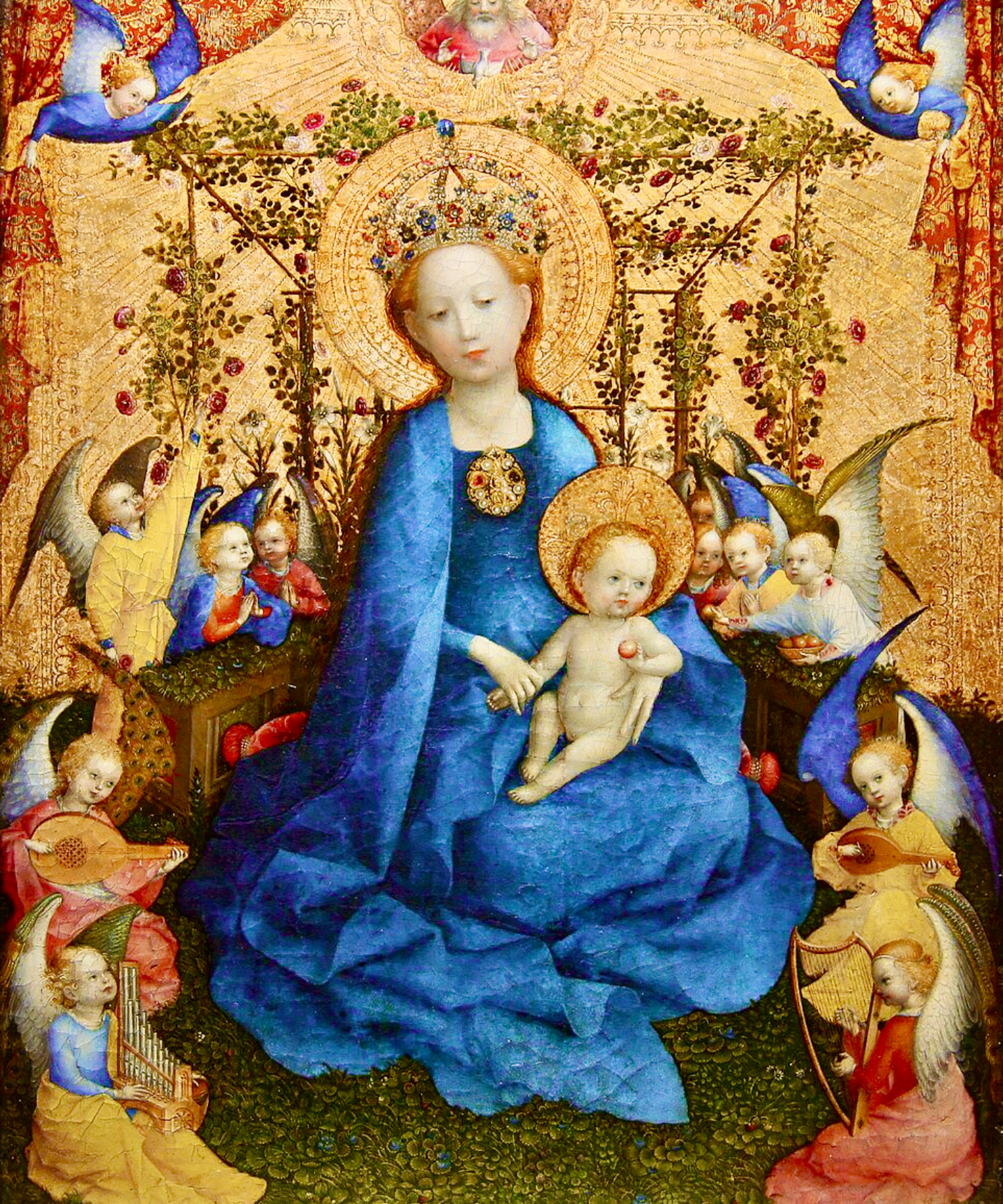
There can be no doubt about what happened next. Dr. Pastoureau explains how medieval Christians offered this sublime color to Our Lady as a tribute to her many qualities, mercies and graces. The artistic record unequivocally shows an explosion of blue honoring the Mother of God in the twelfth century. Suddenly, the deep “Marian blue” became prominent in art, stained glass, painting and culture as a way of depicting the excellence of the Holy Virgin.
The Vast Symbolism of Blue
Blue honored her well. Our Lady’s name, Mary, is derived from the word for sea (mare), which is often blue. She was so pure and without stain that she was assumed body and soul into the heavens or the blue sky upon her death.
Medieval Christians drew inspiration from the Byzantine tradition, where blue was the color of royalty and empresses. Blue symbolized the divine realm where Our Lady reigns as Queen of Heaven and Earth.
Blue represented the Holy Virgin’s purity and Immaculate Conception. In certain Spanish dioceses, blue is a liturgical color used on the feast of the Immaculate Conception, a Marian feast.
Blue came to symbolize the devotion of those who sacrifice much to honor her.
How Our Lady Gave Us Back the Color Blue
Blue opened up a world of expression to honor and celebrate the Mother of God, to which medieval man enthusiastically responded.
Thus, Robert Keim concludes: “Its symbolic evocations—the heavens, the waters of life, the rivers of paradise, rare beauty, supernatural fecundity, the hottest flame of charity, the sea of trials and dangers through which all must sail to reach the port of eternal salvation—are in themselves a hymn of praise to the Virgin of Nazareth.”
Medieval man gave blue to Our Lady as her color. She rescued it from its barbarian captivity and elevated it for all the world to see. Devotion to her gave rise to a rich civilization full of the vitality and color the ancient pagans lacked.
However, she was not content to receive this homage. As a true mother, she gave blue back to us so that our eyes might delight in it and we might then use it to sing her praises.
__________
The Imaginative Conservative applies the principle of appreciation to the discussion of culture and politics—we approach dialogue with magnanimity rather than with mere civility. Will you help us remain a refreshing oasis in the increasingly contentious arena of modern discourse? Please consider donating now.
The featured image is “Madonna of the Rose Bower” (circa from 1440 until 1442), by Stefan Lochner, and is in the public domain, courtesy of Wikimedia Commons.



Interesting topic. The ancients do seem to have seen color differently. The color referred to as “purple” in ancient times was not purple as we know it (which is actually violet) but rather scarlet red. Thus, the “royal purple” worn by ancient monarchs was scarlet.
The name Mary does not derive from the Latin “mare” but rather from Hebrew Miryam, of unknown origin although there are many theories including “bitter sea,” “rebellion,” “beloved,” etc. from either Hebrew or Egyptian origins.
Yeah, I think that idea on the origin of the name Mary inspired a prayer but is likely a mistake.
As for the color blue the ancient Egyptians do seem to have been the main example (exception?) of an ancient people who did make use of it and had a word for it. Although I got the sense some Central Asians may have used it too. However the Greeks, well going by some sources, may have cared more about how light or dark a color was. Or may have been one of those societies who thought of blue as a shade of green. Those cultures saw the color same as us but thought in terms of its relation to green.
All that said Marian devotion does seem to have a fair amount to do with a rising use of the color blue starting in the Byzantine Empire. Some things I’ve read indicate Muslims associated Christians to the color blue or made us wear something blue. Fascinating!
Whilst the social and cultural foundations of associating the colour blue with Mary are interesting, I am surprised the author neglects to explore the biblical origins of this association. The book of Numbers reports that the ark of the covenant was covered with a cloth of blue. “When the camp is to set out, Aaron and his sons shall go in and take down the veil of the screen and cover the ark of the testimony with it. Then they shall put on it a covering of goatskin and spread on top of that a cloth all of blue, and shall put in its poles. (Numbers 4:5–6). Surely blue is associated with Mary because she is the Ark of the New Covenant?
“Medieval man looked at all things symbolically … he elaborated a marvelous culture, art, a civilization that gave a foretaste of eternal happiness in Heaven” – John Horvat, ‘Return to Order’, p. 319.
Certainly Christianity did well to associate blue with Our Lady, but the use of blue in Christian art began in antiquity, not the Middle Ages (Saint Mary Major, for example). The Greeks and Romans prized blue in their painting, but it was rare due to its prohibitive cost, being derived from the rare lapis lazuli.