
There is truly no place quite like the Bible Museum because, in it, our faith is made manifest with concrete clarity. It is a place of ongoing learning and discovery that presages that eternity in which we will continuously unravel the mysteries of God’s truth.
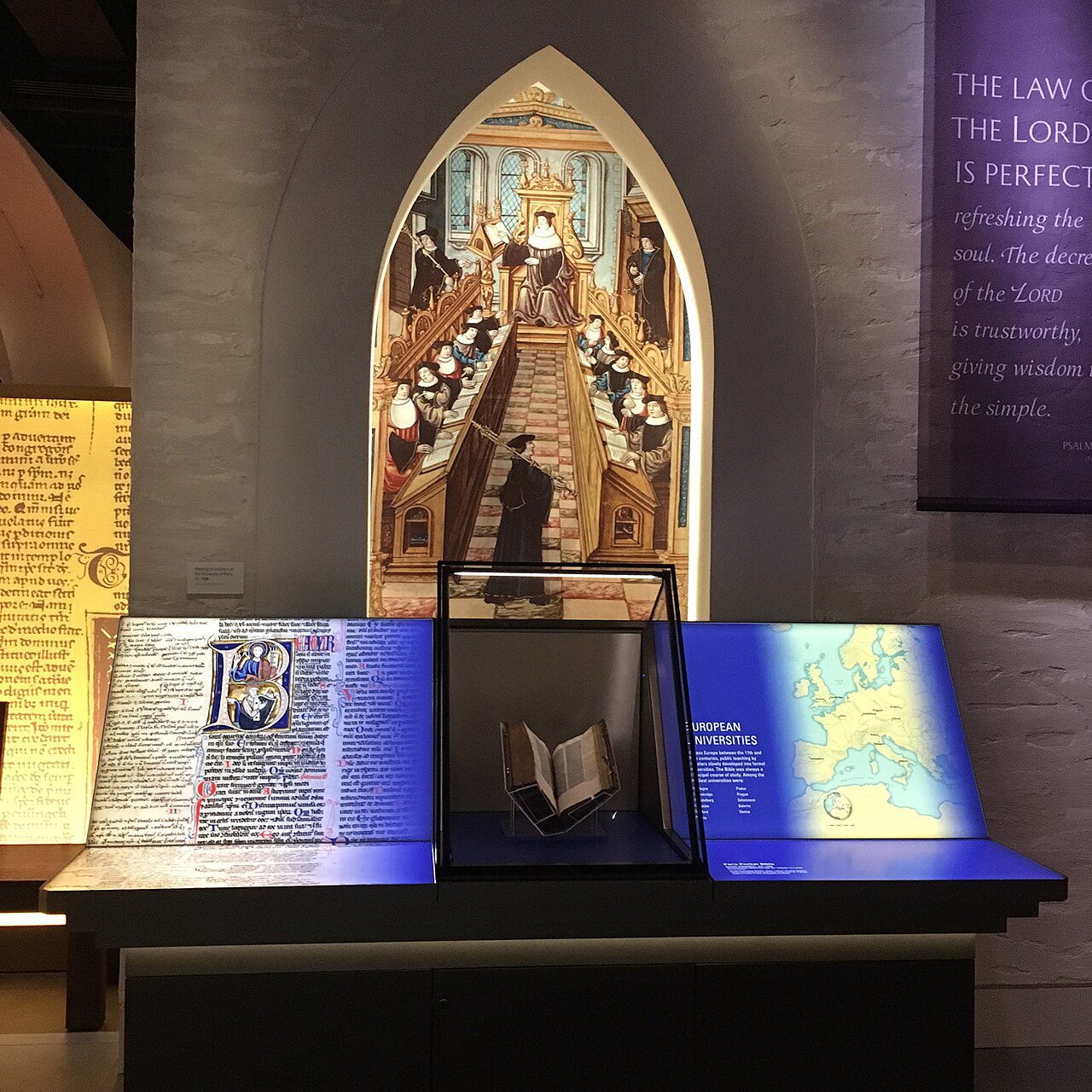 Whenever I need a respite from the hermetic life of a writer, I like to go to a museum. Strolling in a museum’s hallowed halls I can be totally myself, letting my thoughts wander where they will and tasting the fruits of culture in a free and easy manner, on my own schedule and at my own pace. I most often choose an art museum, of which there are many examples in the nearest city to me (which happens to be Washington, DC). But lately I have been spending more time at one of the newest additions to the city’s circle of museums, the Museum of the Bible. It is a place where I always feel at home. Though aspects of our faith will be on display in much of the painting and sculpture in the various art galleries, here the faith becomes something deeper, something more than cultural bric-a-brac (as it tends to become for the art connoisseur). For in the Bible Museum the word of God is not secondary but central. It was created as a showcase for how scripture has permeated our entire culture and civilization. In a fragmented world, it offers a focal point, centering on the world-altering significance of the Word of God.
This is because the museum was designed by people who take theology and belief seriously—scholars, certainly, but not the type of scholar who aspires to a spurious “neutrality” regarding the deepest existential questions. Yet the museum’s purpose is not so much evangelistic as simply to tell the objective facts about the Bible and its influence. The Bible Museum is indeed a museum for everyone, not just academics, since the questions and topics it airs are relevant for all human beings. The museum fosters a connection to the past—to our spiritual heritage in the patriarchs and prophets and apostles and the spiritual writings of God’s people.
Although founded and maintained by Evangelical Protestants, the museum is ecumenical and nonsectarian in outlook. On a typical day you will see among the crowd Catholic priests, brothers, and sisters, as well as some Orthodox Jews. Since the museum’s debut nine years ago, one of the attractions on the first floor has been a room of art and artifacts from the Vatican Libraries. The museum’s framers had a tightrope to walk in avoiding doctrinal controversy, and I think they did an admirable job. It isn’t absolutely perfect Catholic-wise, but I am grateful for a place that stimulates me to thought and argument, and as a rather evangelical (lowercase “e”) Catholic with a strong orientation toward biblical studies this place is very congenial. The Bible Museum is a friendly and open environment, and a spacious and beautiful one too.
Over the Christmas holidays I took my parents to see the museum; it was their first time there and my fourth or fifth. And while the museum’s regular features are enough to enrich any curious visitor for hours, it’s the special exhibits that are now making the museum a hot ticket. The big attraction this year is…drumroll, please…the Dead Sea Scrolls. Yes, the famous biblical manuscripts from the Second Temple period discovered by chance in a cave in Qumran, Israel in the middle of the last century. They will be with us for most of this year, offering the singular experience of a lifetime.
I want to stress that the Bible Museum is an immense place, a kind of wonderland for the believer and lover of scripture. You never know what you are going to bump into. While perusing the sixth-floor gift shop, I turned and lo and behold…a Dead Sea Scroll. Yes, right out in the open was a glass case containing an immaculately preserved specimen of the manuscripts. You could see how, for our ancient ancestors, to read a book was literally to continuously unfold the text: a different experience of reading than the paged codex-type book that we know today (and that St. Augustine, for instance, would already have known).
Most of the scrolls preserved in the actual exhibit are much the worse for wear, consisting mainly of fragments darkened by time. But they are of precious value. In the context of modern archeology and biblical studies, the discovery of the Scrolls was epochal. They are the oldest copies of the Bible ever discovered. They bore witness to an entire religious world previously thought lost to history, a world of intense conflict and expectation that sheds light on the coming of Jesus. The Essenes, a radical Jewish sect, are thought to have created and stored the Dead Sea texts. Their messianic and apocalyptic beliefs form a significant parallel to, and anticipation of, the emergence of Christianity. In 68 A.D. the Roman troops under Vespasian crushed Jewish resistance in the Qumran area, and the caves became a time capsule of a moment of sacred history.
On the Dead Sea Scrolls are found the Books of Moses, Isaiah, and the Psalms, among other biblical texts. Before the Scrolls were discovered, the earliest known copies of scripture dated only from the Middle Ages. Yet the ancient Scroll texts match current-day readings of the biblical books remarkably well, giving a powerful sense of the continuity of knowledge across time. We are reflecting on the same words, images, and ideas as our ancestors two thousand years ago. What’s more, the prophetic and apocalyptic texts in the caves of Qumran confirm that the themes of kingdom, judgment, and the coming Messiah were the seedbed from which Jesus’ ministry took shape. As one writer has declared, the Scrolls are “living proof of God’s faithfulness”—also, I would add, of the basic coherence of our civilization. And we Americans can now behold them in person in our nation’s capital.
The museum’s third floor offers an even more immersive experience in the form of a walk through a recreated Judean village, which brings the holy country alive. Needless to say, this exhibit is great for youth, but the various texts and re-creations offer plenty of substance and wonder for adults as well. On the second floor you will learn of the impact the Bible has had in history, including the American founding. Arnold Friberg’s famous George Washington painting The Prayer at Valley Forge is on display here. As you ascend higher in the museum, you reach the sixth and highest floor where theatrical productions are given in a special auditorium (a play based on C.S. Lewis’s life has been a recent offering).
Back on the ground floor, you may temporarily view the Megiddo Mosaic, an artifact from the earliest Christian place of worship ever discovered. In contrast to the Dead Sea Scrolls, it is in an amazing state of wholeness, consisting of an entire mosaic floor to a third-century Christian house of prayer. You can walk around it and wonder at how this mosaic bears witness to our spiritual ancestors, their risk-defying faith and courage. Push a button on the wall and—wonder of wonders—you can hear a reconstruction of a second-century Christian liturgical chant.
There is truly no place quite like this museum because, in it, our faith is made manifest with concrete clarity. Sacred persons and places become real instead of pious abstractions. In one exhibit you can see various small items—jewels, coins, rings, keys—which citizens dropped by accident while immersing themselves in a mikvah, or Jewish ritual bath in Jerusalem. Seeing a first-century earring drove home the reality of biblical times for me in a way that pages of exegesis might not. I like to joke that the museum is the next best thing to going to the Holy Land itself. Perhaps it is not a joke at all.
The Bible Museum is in fact serious, dense, and rich. There is so much to take it that a single visit can hardly do it justice. That is why I intend to take out a membership so that I can attend whenever I like at reduced cost. It is an excellent place to dwell in, intellectually and spiritually and sensorially, satisfying the thirst for divine knowledge that many of us have. And it just may help reroute our modern minds. It can raise us above the “culture wars” and sociopolitical obsessions that occupy so many minds. Even more, visiting the Bible Museum could help us overcome the compartmentalized thinking that has plagued modern thought, leading us to think more scripturally in the categories that made sense to Our Lord and his contemporaries: those of creation, fall, redemption, exodus, prophesy, atonement, kingdom, new creation. Against the modern view of religion as merely private spiritual experience, the museum reminds us that our faith is historical, concrete, and public—every bit as public as the other public buildings in this very public city.
And the public has responded. The museum, which is open seven days a week, is flooded with visitors of every nation and ethnicity: Ethiopians, Near and Far Easterners, Saxons and Latins alike. With such a cloud of patrons, the Bible Museum seems to furnish an image of the heavenly city that we are promised in the future age. The elevators on each floor, taking you higher and higher, are like portals to other levels of knowledge and insight (am I being too lyrical?). For the scriptural writers, the kingdom we are promised is not exactly “heaven” but rather a restored, heavenized earth—a new world in which (to use a creative metaphor) heaven, the divine dimension, has become transparent like glass to earth, the human dimension.
This is the reality of which secular utopias are a distortion, because they seek to create a paradise on our own initiative and according to our own lights, without the help of grace.
The other way, much more profitable, is to let ourselves be molded, formed, and guided by divine influence—not least by the thick, dense, richly embodied and historicized world of the Bible itself. Places and institutions like the Bible Museum can help us rediscover (or discover, as the case may be) and immerse ourselves in that world, in the whole biblical universe. The museum, like the Dead Sea Scrolls, documents God’s continuing plan.
Until God’s kingdom project is fully completed, places like the Bible Museum can orient and educate us, contributing to the renewal of mind and spirit for which St. Paul called. This museum is a place of ongoing learning and discovery that presages that eternity in which we will continuously unravel the mysteries of God’s truth.
As I take some Mediterranean refreshment at the Milk and Honey Café upstairs and contemplate what I have seen and experienced this time around, I look forward to the next visit and give thanks that a place like the Museum of the Bible exists right here and now. May God bless and keep it!
__________
The Imaginative Conservative applies the principle of appreciation to the discussion of culture and politics—we approach dialogue with magnanimity rather than with mere civility. Will you help us remain a refreshing oasis in the increasingly contentious arena of modern discourse? Please consider donating now.
The featured image, uploaded by Fishermade, is a photograph, “Museum of the Bible Washington DC (27 September 2018). This file is licensed under the Creative Commons Attribution-Share Alike 4.0 International license, courtesy of Wikimedia Commons.




Leave A Comment