
Ambrose successfully drove out the Arian heresy from his diocese. The odds were often stacked against the saint. But in these difficulties, Ambrose relied on the spiritual weapons that Christ gave him.
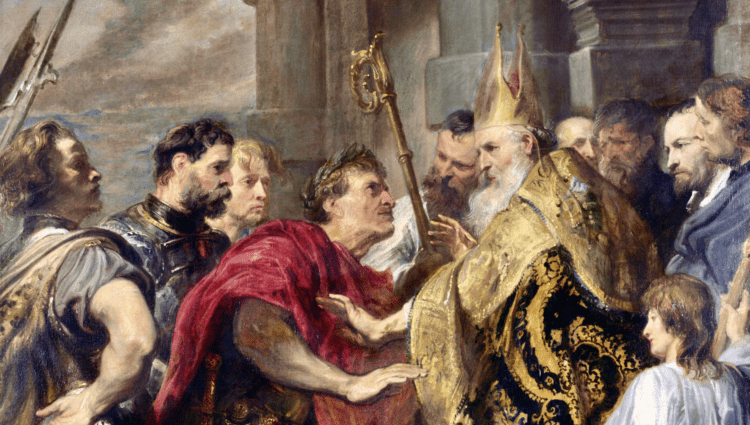 Imagine that your city has been breached by attackers. You are tasked with defending your homeland, but you have no weapons. What should you do?
Saint Ambrose found himself in such a situation. After being made the Bishop of Milan, Ambrose immediately had a problem on his hands: an enemy had breached the gates of his city. That enemy was the heresy of Arianism, a Christological error that denies the full divinity of Jesus Christ. How would Ambrose fight back?
Throughout his time as shepherd of souls, Ambrose relied on three spiritual weapons to combat the heresy of Arianism and fight for the glory of Christ: sacred study, constant prayer, and fervent preaching.
First, consider Ambrose’s dedication to sacred study. When he was made bishop, Ambrose had only been baptized for a week, so he studied as much as he could: “He had to apply himself… to close study of the sacred Scriptures, [so that] he might prepare himself to become the defender of the Church, which was attacked… by the false science of the Arians” (Dom Guéranger, The Liturgical Year). But free time is scarce as a bishop. Saint Augustine recalled what Ambrose did in those precious moments: “When he was not with the [crowds], which was a very brief period of time, he restored his mind by reading” (Augustine, Confessions). Whenever Ambrose was not with his flock, he was studying. He was internalizing the knowledge of God in the depths of his heart. A lover of the sacred page, Ambrose filled his mind with the words of his divine king to fight those who challenged the heavenly throne.
Constant prayer also characterized Ambrose’s life: “He was… most assiduous in prayer day and night” (Paulinus of Milan, The Life of Saint Ambrose). Ambrose encouraged others to follow this practice: “You can at the same time be here and present to the Lord. Your soul must hold fast to him, you must follow after him in your thoughts, you must tread his ways by faith” (Ambrose, Flight from the World). Ambrose found his strength in praying to Jesus Christ, which he did even amidst crisis. When the Empress Justina, an Arian, tried to seize the cathedral, Ambrose and his flock barricaded themselves in the church to prevent it from being taken. While under siege, Ambrose composed hymns and had his flock chant the psalms, which prevented the people “from succumbing to depression and exhaustion” (Augustine, Confessions). It worked: the cathedral remained a place of worship for the true faith. God rewarded the prayers of Ambrose with the heavenly protection of his church.
Finally, Ambrose was a fervent preacher. When Ambrose was an infant, bees swarmed in and out of his mouth, making his biographer recall the proverb “Good words are a honeycomb” (Paulinus of Milan, The Life of Saint Ambrose). Ambrose’s preaching was like honey in the mouth. Even before his conversion, Augustine was taken by the “charm of [Ambrose’s] language” and his spiritual interpretation of Scripture, which removed “the mystical veil” (Augustine, Confessions). Ambrose’s preaching was powerful because he trusted in heavenly aid. One time an Arian entered the church, intent on debating Ambrose, who was in the middle of preaching. Then the man noticed something odd: an angel was “speaking into the bishop’s ear while he was preaching, so that the bishop seemed to be proclaiming the angel’s words to the people.” Immediately, the man converted and started defending the faith he formerly criticized (Paulinus of Milan, The Life of Saint Ambrose). Because Ambrose remained close to God in study and prayer, he could trust in divine assistance to help him proclaim the divine message.
In the end, Ambrose successfully drove out the Arian heresy from his diocese. The odds were often stacked against the saint. But in these difficulties, Ambrose relied on the spiritual weapons that Christ gave him. Though we find ourselves over a millennium and a half after the days of St. Ambrose, the spiritual weapons of study, prayer, and preaching never lose their edge. As our Lord Jesus called Ambrose, so he also calls us to strive for the proclamation of the Gospel in truth and love. And that is something certainly worth fighting for.
✠
Republished with gracious permission from Dominicana (April 2026).
The Imaginative Conservative applies the principle of appreciation to the discussion of culture and politics—we approach dialogue with magnanimity rather than with mere civility. Will you help us remain a refreshing oasis in the increasingly contentious arena of modern discourse? Please consider donating now.
Image: Anthony van Dyck, Saint Ambrose barring Theodosius from Milan Cathedral




Great inspiration. I have opportunities to speak with others about the Faith. I find in my old age I’ve been watching mind dulling but nice TV and not reading/studying as much as I’d like. This article goes a great way to smarten me up. Thank you.