
Put simply and starkly, Michael Anton sees little reason for optimism about America. How is a multi-ethnic society to be governed? The most common method is some form of one-man rule, whether “monarchist, Caesarist or tyrannical.” But America is different. Or is it?
Michael Anton, Dispatches From the Late Republic: The Culture, Politics and Prophets of American Greatness, Decline and Rebirth (387 pages, Encounter Books, 2026)
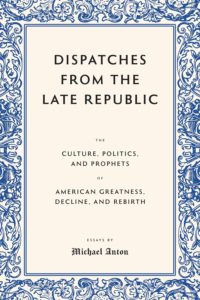 Four questions loom immediately. Is Michael Anton declaring the American republic to be “late” as somewhere in its late or even last stage? Or is he deeming it to be “late” as in already expired? The title suggests a possibly affirmative answer to the second question, while the subtitle hints at a possibly affirmative answer to the first question. Or both are possible answers to either question. Thirdly, is Anton elevating himself to the status of prophet? And if so, is he claiming to be a prophet of the “rebirth” of the American republic?
Having rocketed to a measure of fame, or at least infamy, Anton would have had to be numbered among the possible re-birthers as of 2016. That surely would have been the case when he was revealed to have been the author of “The Flight 93 Election,” the entirety of which Rush Limbaugh read on the air shortly before Donald Trump rocketed to the presidency.
And today? Here we are, a decade removed from the 2016 presidential election, and the hour is not just late, but later. Just where does Mr. Anton think we are in 2026? Spoiler alert: He neither knows nor claims to know.
But no matter. The fight is worth fighting, no matter the lateness of the hour—or even if the hour is already too late. And Michael Anton is always worth reading, no matter when or what.
An essayist of the first order, Anton has given us a glimpse into the wide range of his interests and his concerns. And that alone is at once not just a good reason to read this book, but a perennial problem for most everyone on the right. How so? Like those on the left, Anton is a political animal. But he is necessarily a political combatant rather than congenitally or instinctively so. Once again the “how so” question looms. That question is answered by the contents of this book: Unlike most all of those who are active and on the political left, Anton has–and lives–lives that are divorced from politics.
For Michael Anton, politics is a very important part of life, and wielding power is a very important part of politics. But politics is far from the whole of life, especially when one has a family to love and cherish, a novel to read, a meal to prepare, or a swim to be had. The highlight of his time in Washington was not necessarily his service in the first Trump administration, but possibly his White House kitchen service as a volunteer chef.
And therein does lie a problem. On the one hand, Anton knows how important politics is, but on the other hand he also knows that politics isn’t everything. And all the while he also knows that he is up against a left that is consumed by politics—and by acquiring the power that comes with it. Therefore, one has good reason to suspect something else that Anton likely knows: namely, that all too often this is anything but a fair fight.
How could it be otherwise, since one side sees politics and power as the be-all and end-all of everything, and the other side doesn’t.
For the Michael Antons of this world, the purpose of politics is to make it possible for people to pursue life, liberty, and happiness—and to pursue them privately as they see fit. For the opponents and enemies of the Michael Antons of this world, the purpose of politics is to steer, direct, and at times control all such pursuits. In other words, the fight is something less than a fair one when it comes to ends as well as means.
Quite recently, this crucial difference was inadvertently revealed by a Minnesota Democratic-Farmer Labor state senator following a brief shutdown of the legislature. Pleased that it was over, she stated that it was important that they get back to the “business of improving the lives of Minnesotans.” Anton’s response to such a line would likely be that that’s the business of the people of Minnesota and not that of their representatives.
Still a fairly young man, Anton has been about the business of studying and learning for the whole of his adult life and then some. One of the results of that business is this book, which is a collection of essays, many of which first appeared in the Claremont Review of Books over the course of the last decade, and then some.
Therefore, it might be said that this book review is a review of the book reviews of one Michael Anton. To be sure, it is occasionally more than that, but it would still be worth reading—or re-reading, if it was only that.
The topics include Anton’s home base of California in general, as well as San Francisco, the Beach Boys and gold—and grapes—in particular, his mentors and colleagues (including Harry Jaffa, Tom West, John Marini, Angelo Codevilla, and Michael Uhlman), the novelist/historian Tom Wolfe, the diplomat/historian George Kennan, not to mention food (as in its preparation rather than consumption) and ocean liners (as in their conception and construction rather than the actual traveling experience).
The book lacks an index, but what’s left of my memory tells me that there is no direct reference to Woodrow Wilson, and yet this president and presidency loom over a good deal of the book. This is especially the case in chapters devoted to John Marini (titled “I Must See Marini!!!”) and Angelo Codevilla.
A senior fellow of the Claremont Institute, Marini is the author of Unmasking the Administrative State, which was published in 2019. But at the time that Donald Trump announced his candidacy in 2015, Anton had “already been reading (and listening) to Marini for more than twenty years.” More than that, Marini’s “analysis of the insidious ways the administrative state undermines democratic politics prepared (Anton) to begin to understand the then-emerging populist revolt against bipartisan orthodoxy.”
If that is a fairly mild way to put things, Anton is fully prepared to unload on the Wilsonian progressive approach a few pages later. The “true subject” of the Marini book, Anton continues, is how the country progressed (?) from “there” to “here,” or how we moved away from “our Founders’ understanding of justice, morality and politics” to the “tradition-and-history-destroying, common-good-denying, anarcho-tyrannical, pathologically altruistic dystopian oligarchy currently throttling the West.”
In a few other direct, if slightly less incendiary, Anton words, the United States “is not now, and has not been for some time, a constitutional republic as the Founders and their heirs understood that term.” Much of this book is partly a fleshing out of that line, partly a direct or indirect attack on the Progressive and progressive destruction of the Founders vision, and partly forays into how to live a good and decent life despite it all.
In the end, is living such a life possible and is it enough? Anton broadly hints that it might have to be, since the hour is late. Today’s crisis has been brewing for a very long time–at least since Wilson. And there is no hope or possibility that our political or intellectual elite will solve or resolve anything–especially not when they are a large part of the problem.
As Marini sees it, our elites “deny the seriousness of the crisis and see Trump himself as the greatest danger.” And as Anton sees it, the “crisis is real, and our elites are too arrogant, venal, greedy, blinkered, and stupid to resolve it.” Pulling his punches is neither Anton’s inclination nor prime tactic.
But he is not ready to surrender or acquiesce: “I do not at all doubt or deny the severity of the crisis. But I absolutely believe that it is better to understand its roots than not.” The same might be said for Justice Clarence Thomas, who was almost cancelled by the elite thirty some years ago. Actually, it was Justice Thomas who scrawled those words after reading Marini’s book, and not Anton, who adds that “we must see Marini!” at the end of his essay.
In the meantime, we can also read Anton. Smack in the middle of his book is an essay Anton penned sometime near the middle of the decade between 2016 and 2026. Titled “Unprecedented,” it was originally published in 2021 in the New Criterion, which had asked its contributors to address the theme “Western civilization at the crossroads.” To be slightly more specific, Anton then had little doubt that the “west is on the precipice of something enormous.”
There is little evidence in this book that such doubt has been removed or otherwise put to rest. But at the same time Anton was, and remains, somewhere other than in the “foolhardy” business of “making predictions.” Still, he was and is not about to refuse to make judgments. The United States may no longer be a republic, but it has “yet formally to transform (if it ever will) from republic to empire.”
So what then are we, if we are no longer a republic, “much less a democracy?” Anton offers this: The United States is “a kind of hybrid corporate-administrative oligarchy.” Oligarchy? Is Michael Anton announcing a conversion to the Bernie Sanders tribe? Not at all.
Well, perhaps he might have found common ground with the Bernie Sanders of yesteryear, specifically the Bernie Sanders who once questioned the wisdom of mass immigration. But that is not the Bernie Sanders or the Democratic party of 2021 and beyond.
Put simply and starkly, Anton sees little reason for optimism. How is a multi-ethnic society to be governed/run? The most common method (or “one might say only” method) is some form of one-man rule, whether “monarchist, Caesarist or tyrannical.” But America is different. Or is it?
Americans have prided themselves on their “exceptional track record of assimilating peoples from all over the world.” But certainly, as of 1921 and beyond, the United States has “not merely abandoned but utterly repudiated the traditional understanding of assimilation.” To be sure, Anton intones, would-be Americans are in fact still being encouraged to “assimilate.” But to what? It appears to Anton to be no further than to “the anti-Americanism of the average Oberlin professor.”
In sum, the United States is trying to accomplish something “unprecedented,” and in more ways than one. After all, it’s also the case that those who rule America “advocate and celebrate careerism, consumerism, self-centeredness, casual sex, delayed marriage (and) non-fecund couplings.”
Is there an end game to all this? Not that Anton can tell, and not that the left has spelled out. The idea is apparently to “insist on changing everything” and not stopping “until nothing familiar is left.”
All of this sounds like “late republic” actually translates to dead republic without the possibility of any rebirth, especially given that such a rebirth would itself be unprecedented. But Michael Anton is not ready to give up. Nor is ready to abandon his other lives. And why should when he still has so much to expound on and so much to live for?
__________
The Imaginative Conservative applies the principle of appreciation to the discussion of culture and politics—we approach dialogue with magnanimity rather than with mere civility. Will you help us remain a refreshing oasis in the increasingly contentious arena of modern discourse? Please consider donating now.
The featured image is “After the Day’s Work (Arriving Home)” (between circa 1924 and circa 1926), by N.C. Wyeth, and is in the public domain, courtesy of Wikimedia Commons.





Leave A Comment