
The popular myth, retold almost daily by members of Congress, that the Constitution established three separate, but equal branches, of government has no basis in fact. The true intent of the Framers was for the Congress to be supreme because it is the nature of representative government that the most representative branch should be most powerful.
The Myth of Coequal Branches: Restoring the Constitution’s Separation of Functions, by David J. Siemers (242 pages, University of Missouri, 2018)
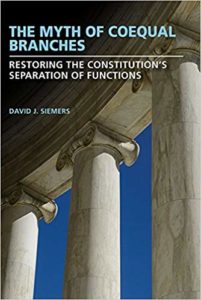 In 1959, James Burnham, in Congress and the American Tradition, pretty much laid out reasons for the decline of Congressional power and the rise of an imperial Executive. David Siemers, a professor of political science, makes the same case, but explains it in a way that bean counters in Departments of Political Science make their arguments.
There is much more to this story than Dr. Siemers is interested in telling.
If the lack today of talented members of the Congress of the United States can be explained, it may be traced to the notion that the Constitution is composed of three coequal branches, but also to the 17th Amendment, ratified in 1913.
In 1787 as Delegates to the convention in Philadelphia prepared to meet, it was generally agreed that the government that would work in America was not the British model. The model they followed was the one practiced by the American colonies—the model of legislative supremacy.
The outline of the new government first presented on May 19, 1787 by Edmund Randolph is known as “the Virginia Plan.” Randolph resolved that the new government should consist of a National Legislature, Executive, and Judiciary. The National Legislature was to consist of two branches; the lower House was to be elected by the people of the States; the upper by the lower branch. The National Executive was to be chosen by the National Legislature. Both the Executive and the Judiciary would constitute a Council of Revision to examine the acts of the Legislature, with a veto over the acts of the Legislature.
The only aspect of Randolph’s plan that could be interpreted to limit the Legislature was Resolution 8 that provided for a Council of Revision. The provision for a Council of Revision as an aspect of the new government was ultimately defeated, not once, but three times, on June 6, July 21, and August 19. James Madison was the principal Delegate behind this attempt to check the Legislature. Madison was persuaded that if a revolution were to occur in America, it would be perpetrated by the Congress. Instead, he vigorously supported the unsuccessful attempt to establish a Council of Revision as a part of the new Constitution. Thus, despite Madison’s efforts, the institutional structure originally established by the Constitution left a supreme and almost unchecked legislature.
To the Framers of the Constitution, the three branches of the national government were unequal—not equal. Of the three branches, the legislature was supreme, the Executive was more powerful than the Judiciary, but, for that reason the Framers suspected that if any mischief were to occur, it would probably occur in the Executive.
The popular myth, retold almost daily by members of Congress, that the Constitution established three separate, but equal branches, of government has no basis in fact. The true intent of the Framers was for the Congress to be supreme because it is the nature of representative government that the most representative branch should be most powerful.
That was the view of the majority of Delegates at the Philadelphia Convention and was summarized by remarks at the Convention on Monday, June 4, of Gunning Bedford, Jr. of Delaware who said that absolutely no check upon the Legislature should be tolerated. “The Representatives of the people were the best Judges of what was for their interest, and ought to be under no external control whatever.”
Little known today, Bedford was, from 1784 to 1789, attorney general of Delaware and an active participant in the debates at the Philadelphia Convention.
How then did the false notion of coequal branches come about, and why should we be concerned?
That is what Professor David Siemers attempts, as he explains “how Congress might reestablish the separation of functions and, with it, regain the position as the ‘first branch.’ ” In other words, Dr. Siemers is not a “dry as dust” academic, but is offended by confusion about the original design of the Constitution.
That is to be admired and distinguishes Dr. Siemers from a crowd of academic “complainers” who fault the Constitution for failing to meet the high standards of the many Politically Correct voices that populate the crowd of academicians who populate our colleges and universities today. But, though Dr. Siemers does an excellent job demonstrating who is responsible for this confusion, he is, at best, tentative about the reasons this confusion began—sometime around 1910.
Before then, two statesmen rose in support of Congressional supremacy: John Calhoun and Henry Clay.
Calhoun, responded to an assertion by President Jackson in 1834 that the President and Congress were coequal by denying the legitimacy of such an assertion. President Jackson, it will be remembered by students of Alexis de Tocqueville, was “a man of violent temper and mediocre talents.” Tocqueville writes of Jackson that
no one circumstance in the whole course of his career ever proved that he is qualified to govern a free people, and indeed the majority of the enlightened classes of the Union has always been opposed to him.
A second statesman, Henry Clay, Dr. Siemers writes, “argued most strenuously for congressional power . . . and his speeches frequently enumerate his party’s belief in congressional power.”
Congress should be able to override vetoes by a simple majority vote, cabinet officers should consider themselves under the direction of the law and the Constitution more than under the personal direction of the president, congressional approval should be required for the dismissal of administrative officers, the president may not change the meaning of a law through interpretation, and control of the Treasury should be in the hands of Congress.
Well said, but then when did a change of mind occur?
Here Dr. Siemers points his accusing finger at our law schools, but fails to relate their advocacy of a false myth to the Progressives who began to have influence at the turn of the 19th century.
As a student of the Debates in the Constitutional Convention and the debates in the State Ratification Conventions, Dr. Siemers surely resents law professors who never studied our Constitutional history.
He writes, “By the late 1910s, the idea of coequal branches was ‘in the language’ at least among young lawyers, some of whom were undoubtedly working in politics and aspiring to high office. The idea was ripe for appropriation by those who believed that coequal branches would be beneficial.”
This was the point at which Dr. Siemers might have placed this confusion in some political and philosophic context, After all, this was the heyday of the Progressives who successfully amended the Constitution in 1913 to provide direct election of members of the U.S. Senate.
Dr. Siemers makes no reference to that!
With the Great Depression and election of President Franklin Roosevelt and his “New Deal,” Dr. Siemers writes, “it was common to describe the branches of government as coequal.”
As I, too, studied our Constitutional history and once or twice taught a course on the Constitutional Convention, William Shakespeare’s sentiment expressed in Henry VI, Part 2, Act IV, Scene 2 is mine as well.
Our attorneys-at-law have made themselves into a “New Class” that makes opposition to tradition, religious faith and the mores that sustain our political order subservient to legal procedures. “Procedure” is, after all, their business, but that is being used to assert the power of a New Class to reorganize how we understand our Constitutional order.
Though Professor Siemers does not explain why this has occurred, he does don his “bean counter” hat and compiles a list of every instance of use of the term “coequal branch” in Congressional speeches and hearings from pre-1850 to the 2010s. He finds that use of that term reaches its apogee from the 1960s through the 2010s for a total of 1,494 times that the term appears!
As if to affirm that the Republican Party is “the Stupid Party,” Dr. Siemers traces the introduction of coequal branches to a “conservative,” California Senator William Knowland, who should have known better. By Dr. Siemer’s count, Knowland used the term “coequal branches” thirty-nine times.
Knowland was followed by Richard Nixon who became “the primary backer and publicist of coequality in the 1970s.” Even Wisconsin conservative Congressman Melvin Laird continued the confusion!
Only one lone Republican Congressman from Iowa, Steve King, of all people, disputed that the branches were coequal. Cong. King, an outlier in “the Party of Lincoln,” was stripped of his committee assignments after he questioned why the terms “white nationalist” and “white supremacist” were considered offensive.
Dr. Siemers sees a better advocate, and hope in resurgence of Congressional power, in Sen. Mike Lee (R-UT) who in 2016 launched something called the “Article I Project.”
Its backers want Congress to more directly control government spending, end legislative deference to agency-made regulations, and end the use of ‘legislative cliffs’ in budgeting that yields forced appropriations by emergency. Their view is that ‘the Founders made the Congress the ‘First Branch’ of the federal government–the most powerful and the most accountable.’
Well said, Sen. Mike Lee!
The Imaginative Conservative applies the principle of appreciation to the discussion of culture and politics—we approach dialogue with magnanimity rather than with mere civility. Will you help us remain a refreshing oasis in the increasingly contentious arena of modern discourse? Please consider donating now.
The featured image is courtesy of Pixabay.




When I read the headline of this essay. I expected to find some discussion of the Supreme Court, some of whose members have done more to undermine the Constitution and, the Nation, than either of the other two branches.
Eye opening article. And isn’t it interesting the trend toward concentration of power? Great website. Glad I found it because the content is substantive and provocative. Well done.
I have been a student of the Constitution and of presidential history for a number of years now. While this article is interesting I did not find its arguments compelling enough to persuade. I still go back to the text of the Constitution itself and I find nothing there there that would specifically state that one branch has primacy over another.
The Constitution clearly makes Congress the supreme branch of the Federal Gov’t, as seen in these provisions:
–The Constitution says that only Congress can impeach and remove from office the President, the Vice-President, the members of the Supreme Court, any member of the President’s Cabinet, any federal judge, etc. The decision of Congress to impeach and remove is not reviewable by any court, so, in practical terms, Congress can impeach and remove the President for any reason and at any time.
–By contrast, the President cannot remove from office any member of Congress or any member of the Supreme Court, or any federal judge.
–The Constitution says that only Congress can authorize federal gov’t taxes or federal gov’t expenditures.
–By contrast, the President cannot authorize federal gov’t taxes or federal gov’t expenditures.
–The Constitution says that only Congress can make the decision to start a war or to end a war.
–The Constitution says that only Congress can make a treaty with a foreign nation.
In light of this overwhelming evidence, those who argue for “co-equal branches,” or for a Presidency that is supreme, simply do not believe in the Constitution or the rule of law. Period. End of story.
So the founding fathers wanted Congress to be the most powerful. It’s a little unsettling to learn that everything you were taught is a lie but at least now I can make sense of this current Congresses actions. It certainly takes quite a bit of luster off of being a US Supreme Court Justice. Anyone who’s got even a tiny bit of imagination or even a slight hint of Machiavellian streak in them would be able to dominate at least the Courts in my humble opinion. If Congress has the power to pack the court, that just turns the court into a circus and Justice Roberts the head clown. So much for independence in the court. You want a certain leaning, no need to wait for someone to die or retire. The Supreme Court is dead, long live the Supreme rubber stamp.
Excellent article, I have been trying in various ways to dispel this rumor for decades in my own limited capacity.
A simple illustration of the inequality built into the Constitution between the three branches is the fact that Congress may remove, by impeachment, officers of the Executive Branch and jurists of the Judicial Branch. Neither of the other two Branches has that ability under the law. Furthermore, if the Founders intended for the three branches to be equal, why didn’t they include it in the document?
The Federalist papers imply heavily that the branches are co-equal without directly saying those words.
In Federalist No. 51, James Madison noted that in a republic, the legislative authority “necessarily predominates”
It’s clear that Congress is predominant. It’s given the power to regulate the other two branches. Those can’t regulate Congress:
Article I. The Legislature shall have Power . . .
Section 8: To make all Laws which shall be necessary and proper for carrying into Execution the foregoing Powers, and all other Powers vested by this Constitution in the Government of the United States, or in any Department or Officer thereof.