
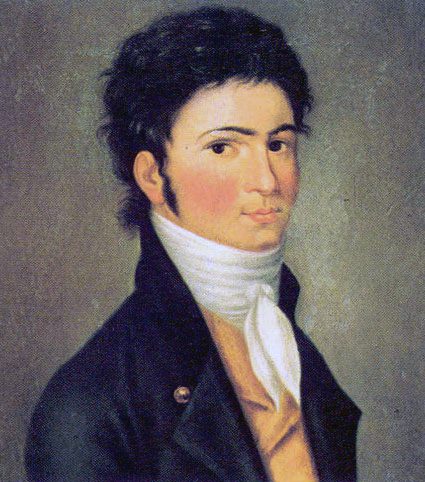
 As this year marks the 250th anniversary of the birth of Beethoven, I’ve been inspired to muse upon his oeuvre and to ask myself which of his many works could be considered the best. It is, however, necessary to say upfront that there are two kinds of “best.” There is the objective “best” and the subjective “best.” The objective best is that which is the best, whether I like it or not or know it or not; the subjective best is that which I like the best, whether anyone else likes it or knows it, or cares.
Clearly the objective best is better than its subjective counterpart. The first has some claim to an intrinsic truth which transcends the perception of it; the other can only claim to be “true” in terms of my own personal and particular perception of it.
Without wishing to get sidetracked by the sort of philosophical digression which constitutes a stylistic transgression, we should insist, as is necessary in this age off relativism, that the objective best does exist, whether we know it or not or like it or not. It exists because beauty is not in the eye of the beholder but in the thing beheld; if we do not see or hear such beauty, it is because we are blind or deaf.
A few examples should suffice to illustrate the objectivity of beauty. Beginning with Beethoven himself, we can see or hear that he is a greater composer than Burt Bacharach, even were we to prefer the popular compositions of Bacharach to any form of classical music. Similarly, we can see that Leonardo is a much better artist than our three-year-old, even were we to prefer the three-year-old’s depiction of a snowman to Leonardo’s depiction of The Mona Lisa. We might prefer to listen to Bacharach than Beethoven whilst driving the car, or we might prefer to have the picture of the snowman rather than a print of The Mona Lisa adorning our refrigerator, but these personal preferences detract nothing from the objective beauty of the works of Beethoven or Leonardo, which transcends in reality our personal preferences and prejudices.
Enough!
Back to Beethoven.
It seems that those who know much more than I about music consider Beethoven’s Third, Fifth, Seventh or Ninth Symphonies to be his best. And then there are the sublime sonatas. Objectively speaking, any of these might be considered Beethoven’s best, but would anyone seriously suggest that the delightfully simple Für Elise is Beethoven’s greatest work? Although we might select it as one of our favourites, we could not claim that it is the best in terms of what Gerard Manley Hopkins would call the sheer “achieve of, the mastery of the thing.”
Having played with the distinction between objective and subjective beauty as a recurring theme or motif, I would like to suggest that my favourite Beethoven work has at least some claim to being the best objectively, aware as I am that I am begging to differ with many of my musicological betters.
According to the contemporary composer, Michael Kurek, whom I admire greatly and whom I consider something of a mentor in matters musical, great musical compositions are “sculptures in sound,” inviting comparisons with Michelangelo’s Pietà, and that they can evoke the power of narrative, analogous to the power of literature. If these two criteria are taken as being valid, and I don’t see how they can be invalidated, we can argue that Beethoven’s Sixth Symphony is a musical masterpiece par excellence. It’s evocative portrayal of the pastoral idyll employs woodwind instruments to mimic the song of cuckoo and nightingale, “sculpts in sound” an aural vision of a babbling brook, country dancing, a thunderstorm and its aftermath, and culminates suggestively in a prayer of thanksgiving for the sheer beauty of it all. The overall effect on those with ears to hear and eyes to see is to startle us into being who we’re called to be. It edifies. It lifts us up. It magnifies the soul so that the soul can magnify the Lord.
Another reason that Beethoven’s Sixth Symphony has a claim to being Beethoven’s best is its pioneering position in the history of music. Although his earlier symphonies broke the mold in a formal sense, it was the Sixth which blazed the trail for the genre that became known as the tone poem. One can see the influence of the Sixth Symphony on Schubert’s Piano Quintet in A major, written only eleven years later, especially in the latter’s own evocation of the babbling brook. In the giant wake of Beethoven’s own pastoral tone poem, we have the works of Liszt, Smetana, Debussy, Richard Strauss, Sibelius, and Vaughan Williams, to name but an illustrious and eminent few.
Having made my case, I will suggest, with an appropriate degree of trepidation, that the Sixth Symphony has a claim to being considered the best of Beethoven’s works in the purely objective sense. I will also not only claim but acclaim, with no trepidation whatsoever, that it is my own personal favourite. On the latter point, I trust that even those of my friends with a much better ear will grant me their charitable indulgence.
This essay is part of a series commemorating the 250th anniversary of the birth of Ludwig van Beethoven. See also “Further Reflections on Beethoven’s Best Work,” by Michael Kurek.
The Imaginative Conservative applies the principle of appreciation to the discussion of culture and politics—we approach dialogue with magnanimity rather than with mere civility. Will you help us remain a refreshing oasis in the increasingly contentious arena of modern discourse? Please consider donating now.
The featured image is a portrait of Beethoven in 1801, by Carl Traugott Riedel (1769–1832), and is in the public domain, courtesy of Wikimedia Commons.




Tough question, but I would go with the Gosse Fugue.
Grosse Fugue, that is.
His most innovative work was the one which stunned his contemporaries and it was not the Sixth but his Third Symphony, arguably one of the two or three defining works in classical music. The 6th sits behind it, the 5th, and the 7th. So thought his time.
a miracle happened once as i lived in the country
i was alone, listening to the sixth
joyful arrival…there i was
by the brook…well, there was a creek in my yard…close enough
merry gathering…ah, i can imagine
then…the clouds were gathering with the strings. i was completely amazed!
then, with the music, it stormed. thunder and lightning, right on cue with the music.
the storm subsided with the music
the end of the miracle, was when the sun came out with the flute.
i stood there, with tears of gratitude as i have tears now, after all those years of this miracle i was gifted with that remains with me for all eternity.
The Sixth Symphony sits right in the middle of his nine symphonies—not numerically, but meritoriously. It trails the Seventh, the Third, the Fifth and the Ninth . . . and by a long stretch.
It also falls well behind the Fifth Piano Concerto, the Violin Concerto and the Waldstein, Pathetique and Appasionata Sonatas.
No work by Beethoven had a greater impact than his Third Symphony.
I would say that the Eroica is the best of the symphonies, that the Hammerklavier Sonata is a contender but that if you take the five Late Quartets together, nothing surpasses that.
Subjectively–for me it is his 5th Symphony. I like to listen to it frequently by myself so I can turn the volume way up and blast it as I drive. I think of it as starting with “fate knocking” and ending in joyous victory.