
Documentary filmmaker Cameron O’Hearn’s “Mass of the Ages” argues that in the abbreviation of the Roman Catholic liturgy after Vatican II, there was much left out of the Traditional Latin Mass.
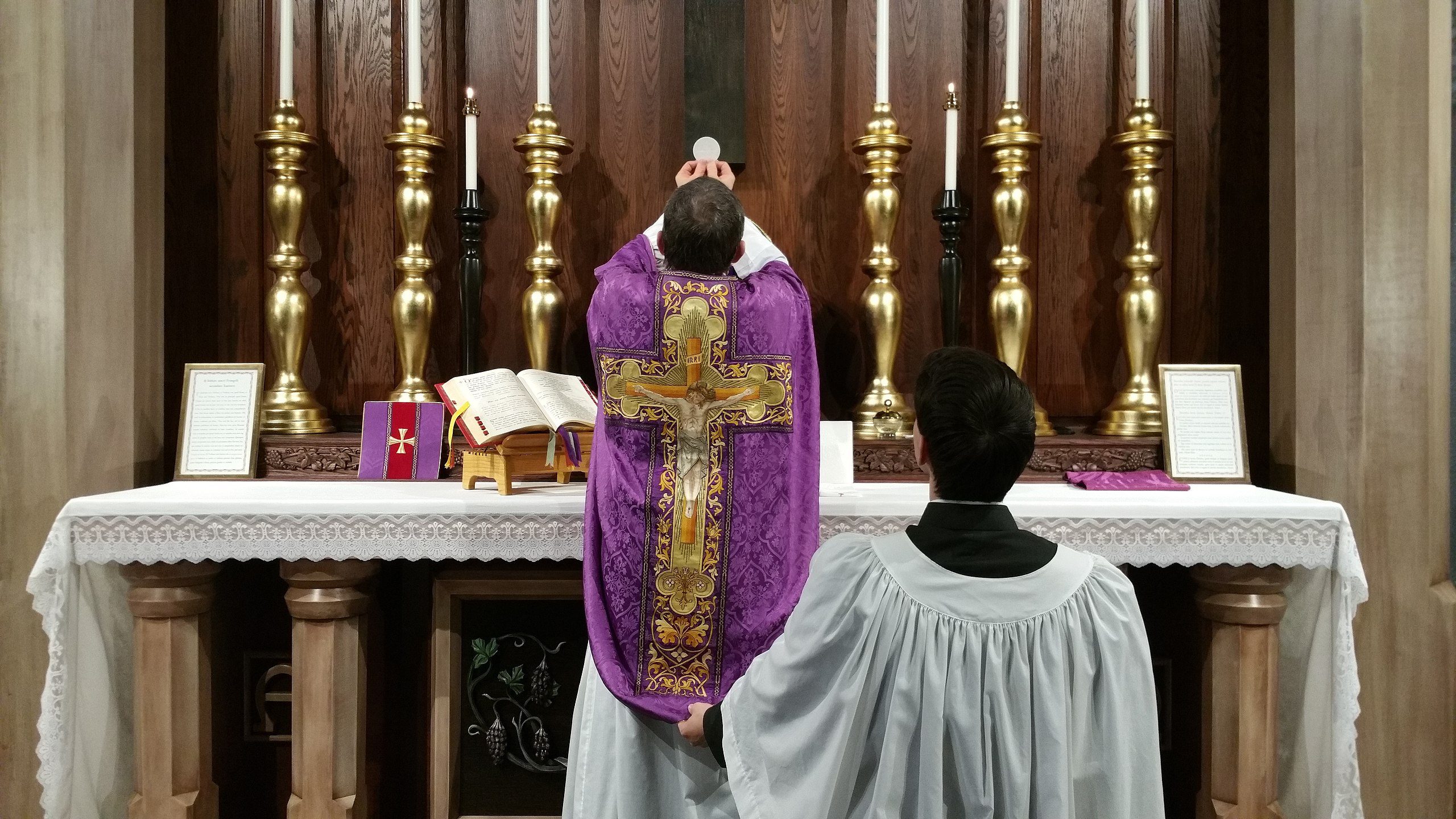
In an essay about Pope Francis’s recent legal document restricting the practice of the Traditional Latin Mass (TLM), I wrote that his legislation, though making things difficult for laypeople and priests attached to the TLM and designed to discourage them, would be “much more likely to steel the resolve of those who make the argument that the Roman Rite should return to its earlier form.” The reason is. . .well, you should just see the movie.
The movie? Yes, and it’s actually very good. Documentary filmmaker Cameron O’Hearn has directed and produced the first of three episodes of a new film titled Mass of the Ages. The second two planned episodes will likely have a more argumentative edge as they look at the sausage grinding that led to Catholic liturgical reforms and critique them, but Episode 1 has a fairly serene and irenic mood. Titled Discover the Latin Mass, it does a very good job at introducing the viewer to some of the big picture differences between the newer form of the Roman liturgy and the older form, to laypeople and priests who have discovered it, and to what the liturgy can look like when done well.[i]
The opening credits are fittingly delivered over a close-up of a traditional Catholic Church with altar rail and high altar. The action begins, however, with two brief sections, one personal and one societal, that will serve as backdrop for the film. The personal deals with Kristine Mauss, a widowed mother of four children, praying at her husband’s graveside for the strength to raise her children in the faith she and her husband, who died at 41 of a brain tumor, held. Mrs. Mauss is a pretty blonde heading into middle age, not an intellectual but an ordinary woman in the pews who wants to raise her children with the awareness that this life is short and eternity is long. Her first salvos are not about rubrics or Latin pronunciation but about living the faith. When oldest Mauss daughter was eleven, there were no real Catholic friends for the girl and at her parish’s religious education class, she was the only one who knew the Hail Mary prayer. Mrs. Mauss was looking for a community to support her and her children in the reverence and joy of a life centered in Christ. She found it at the TLM.
The next section of the film is a series of soundbites from mainstream media sources covering: the declining numbers of baptisms, marriages, and priestly ordinations happening in the Catholic Church; the broader social and mental health dysfunction happening in America; and finally a series of interview-bites with famous actors who were raised Catholic but clearly left that behind. Of those who have any sentiment for their childhood faith, only Jimmy Fallon, who served Mass in a fairly traditional atmosphere with his grandfather at an old New York parish, expresses a sadness about his failure to attend Mass—and he specifically attributes his failure to keep it up partially because of his experiences at parishes in Los Angeles that had praise bands and required congregants to hold hands “all through Mass.” In short, the film begins with a solution—Mr. and Mrs. Mauss’s traditional Catholicism—and then the problem: post-Vatican II liturgical and ecclesial life.
John Anderson, the Wall Street Journal television critic, wrote in his review in the Jesuit magazine America that this opening is “pure nostalgia,” for Mr. Fallon and the other celebrities never served as altar boys in the old rite as he, the critic, had. Thus their longing for at least a dignified and Catholic-seeming liturgy has no bearing on the questions. There is a great deal of silliness in Mr. Anderson’s review. He claims falsely that the film is arguing that the return of the TLM will end suicide, war, and loneliness. Based on this absurd reading, he claims that though it is not Triumph of the Will, to be sure, Mass of the Ages is definitely bordering on “fascistic.” Mr. Anderson’s criticisms hinge largely on a heads-I-win-tails-you-lose approach.
The members of the clergy and theological community make points about an abbreviated liturgy, the “casual distribution of the Eucharist,” as one priest puts it, and the disappearance of Gregorian chants—but those issues really seem superfluous and irrelevant. But who wants to argue with a young mother of four whose principal goal in life is “walking my children into heaven”?[ii]
If you aren’t a scholar and you find solace and strength for your faith, you are really a sucker who, understandably, fixates on something else to avoid your grief or whatever. If you are a scholar who has substantive claims, you are simply a pedant traveling in the superfluous and irrelevant. But is the “abbreviated,” chant-free, and casual liturgy really the potayto versus potahto or is it more like homoousion versus homoiousion?
Mass of the Ages does not argue that the newer form of the Mass is exactly homoiousion—the rejected term at the Council of Nicea that designated the Son as Certainly Like-God-But-Not-God. The newer liturgy is certainly valid and not heretical. The film does, however, argue that in the abbreviation of the Roman Catholic liturgy there was a lot left out. Taylor Marshall, the controversial traditionalist author and speaker, uses the image of a beautiful diamond for the Eucharist. It is still a diamond whether in the old liturgy or the new, but the question is which setting actually makes the brilliance more evident. Again, critics such as Mr. Anderson might see this as evidence of a purely aesthetic judgment. But it’s worth asking, first, whether the question of beauty is simply relative in the first place. True beauty is the brilliance of truth. And the beauty of the older liturgy has much to do with the truths evident in the rituals and also the words that are present there, but less so in the newer liturgy.
Take the question of Scripture’s place in the liturgy. While many advocates of the post-Vatican II reforms like to boast about the adding of an Old Testament reading to the Mass (like the other ancient liturgies such as the Liturgy of St. John Chrysostom celebrated by Eastern Orthodox and Eastern Catholics, the TLM has a New Testament Epistle reading and a Gospel), the many eliminated prayers were “shot through with Sacred Scripture, with the Word of God,” as theologian Peter Kwasniewski says in pointing out (with handy graphics illustrating) the many Psalms that what were abandoned in the abbreviation.
Critics of the Latin Mass often say that it is mere nostalgia, but what makes the film interesting is to hear people raised in the newer rite, such as Baylor University patristics professor Michael Foley, talk about how they discovered these realities as adults. Professor Foley talks about how he discovered that the newer form of the Mass was not just an English translation of the old when in a doctoral program in theology at Boston College. From that discovery he was led to a great many other discoveries about what was left out and what was changed.
Perhaps more affecting than even the laypeople and scholars who have discovered the older form of Mass are the priests who did so, often not of their own volition. One wonderful segment with Msgr. Eugene Morris, a St. Louis priest and seminary professor, includes his testimony about learning the rite at the behest of his then-archbishop Raymond Burke. Msgr. Morris describes his first, mistake-laden attempt at celebrating the less elaborate form known as the Low Mass and weeping nearly as much as he did when he was ordained a priest because of the beauty, simplicity, and profundity of the rite. “With all the mistakes, there was still something natural to it, and I realized that I was actually able to pray.”
Fr. Joseph Illo, a priest now serving as a university chaplain tells a similar story about his introduction to the rite, but it is a story about a family at a parish he served that had both forms of the liturgy that is so memorable. A mother of four who “hated” the Latin Mass finally said to Fr. Illo:
It’s about control. I realize now that in the Novus Ordo, I’m in control. Or the priest is in control. Or we are in control of the liturgy. But in the Latin Mass I don’t know what’s going on a lot of the time and it’s clear that I’m not in control. But there is someone in control because it’s so perfect that the rubrics and the execution of the liturgy helps me to believe there is somebody in control of the Church—and it’s not me.
A quick cut back to Msgr. Morris then gives the priestly lesson. He describes discovering through celebration of the old rite his own “haughtiness” and pride in doing things better than other priests—a natural feeling given the centrality of the priest as a personality making decisions in the newer rite. What Msgr. Morris discovered about his priestly identity through the older rite is, “It’s nothing about me and everything about God.”
Such points are powerfully made. As good as much of this is, however, there are a few weaknesses that I hope will be remedied in the next episodes. First, there is an occasional problem of what we might call externalism in some of the language. Mrs. Mauss talks about Tradition, capital-T, quite a bit as well as the thoroughly different way of life that should accompany the majestic liturgy which is being advocated. So far, so good. Similarly, Fr. James Jackson talks about a funeral for a teenage girl in an ordinary Catholic parish celebrating the newer rite. He notes the casual canonization of the young girl, which would lead most ordinary observers to think that the only requirement for attainment to heaven is dying. He notes that nothing of the liturgy or the way it was celebrated deals with the difficult questions of sin or judgment. Again, so far, so good. In both cases, however, what is missing is the element of the truly personal.
The reason for the downplaying of natural personality and control on the part of the people and priest talked about by Fathers Illo and Morris is to allow the Divine Personality to be made evident in the liturgy. Tradition bears witness to Christ. The thoroughly different way of life is the life of the Holy Spirit who now teaches us how to pray and when and how to act. And the question of sin and judgment is one that should raise the topic of the judge who also takes away the sin of the world. In short, the Holy Name of Jesus might be deployed more in this film in certain key spots lest some stereotypes about Catholics—such as letting Church and Tradition get in the way of or substitute for a friendship with Christ—be inadvertently encouraged.
The second criticism, and perhaps one that is being addressed in future episodes, is that of potential idealization. What hammers home many of the points made are the liturgical scenes themselves. Fewer scenes are of actual Masses being celebrated than there are of priests and acolytes demonstrating different parts of the liturgy. This allows the filmmaker to film at different angles in a way not possible in a real liturgy and also to see the liturgical actions done absolutely perfectly in cinematic light. This has obvious value but also perhaps plays into the tut-tutting of such critics as Mr. Anderson, who remembers serving as altar boy at the older rite and wants to assure us it was not all that.
To be blunt, Mr. Anderson is probably right in this sense. When the older form of the Roman Rite was the dominant one, it was not so well done as it is now and it was not so well understood. The reason is that, today, to celebrate and attend the TLM is largely a choice made by serious Catholics who have discovered it and become devoted to it. When it was just what was done in every parish, it was subject to some, if not all, of the same abuses by priests as the new rite: carelessness, irreverence, and a tendency to speed through and get it over with. Laypeople who went merely out of duty or because Mom made them were less likely to engage in the kind of serious praying along with the priest as now. More acknowledgment of these historical realities in the future historical episodes would indeed ward off the complaints of “propaganda” and the absurd claim that the filmmakers believe the Latin Mass will bring on a utopia smelling of incense.
These criticisms are, however, at the edges. The episode is delightful and informative. Fewer than 50 minutes long, it is definitely worth the time. As of this writing, the movie has gained 325 thousand views on YouTube since its release on August 15. Given that most estimates of Latin Mass-ers in the United States top out at about 120 thousand, it is a safe bet that this film is being viewed by a lot of people who are not already familiar with the rite. My guess is that it will not only steel the resolve of those proponents of the Traditional Latin Mass but likely spur others to check it out.
The Imaginative Conservative applies the principle of appreciation to the discussion of culture and politics—we approach dialogue with magnanimity rather than with mere civility. Will you help us remain a refreshing oasis in the increasingly contentious arena of modern discourse? Please consider donating now.
[i] Mass of the Ages, Episode 1
[ii] John, Anderson, “Review: ‘Mass of the Ages’ uses classic propaganda tactics to make the case for the Latin Mass” America, August 13, 2021.
The featured image, uploaded by Andrewgardner1, is licensed under the Creative Commons Attribution 4.0 International license, courtesy of Wikimedia Commons.




“Professor Foley talks about how he discovered that the newer form of the Mass was not just an English translation of the old.”
This is a valuable point. We speak of “the Latin Mass” as shorthand for the older form of the Mass. But as we know, language is not the main differentiating feature between the new and the old Mass. (The Novus Ordo may be celebrated in any language, including Latin.) Rather, it is the dialog form. In the old Mass, the priest says the prayers and is answered by the acolytes. In the new Mass, the people make the responses to the prayers. This was done to encourage a more outward participation by the people (something which Pope Pius XII also called for.)
I happen to believe that if well implemented and celebrated, the Novus Ordo Mass will look and sound rather more like the old Mass. This can be achieved if we include more Latin (for example, the Mass Ordinary sections), sing Gregorian chants and traditional hymns, and reinstate the Introit and Communion prayers – and perhaps more importantly, turn the priest back facing east and reinstate the altar rail in churches where it is lacking.
Your point is well taken. This “reform of the reform” of the Novus Ordo mass was one of the objectives of Pope Benedict XVI’s motu proprio “Summorum Pontificum.” Unfortunately, this goal was not given enough time to come to fruition. My fear is that Pope Francis’ recent motu proprio will turn the clock back to 1970. Without the old mass as the measuring stick, there is little incentive for the Novus Ordo mass to improve and to be conducted more consistently with the liturgical tradition of the Church.
My current pastor has slowly “up graded” our Novus Ordo Mass. The people are much more devout & attentive. I like the English & have gone much deeper into scripture as result. Love the bits in Latin & Greek. But still a way to go. Miss the Confiteor. Hymns are better theologically, but musically deficient. Some form of Gregorian would be huge step up .
I have gone to Latin Mass while traveling and do not want to go back completely. But there should be a way to meld the best of both to help everyone grow in faith & love for God.
The traditional Latin Mass is the greatest ritual of White Magic ever conceived by the human race.