
Fr. Paul Mankowski uses tough language at times, but he also conveys a great deal of wisdom. His diagnoses might seem abrupt to those to whom they apply, but the reader notices a genuine sympathy for those in the priesthood or denominational bureaucracies who have quite often sold their souls or allowed them to be dribbled away for something even less than Wales.
Jesuit at Large: Essays and Reviews by Paul V. Mankowski, S.J., edited by George Weigel (237 pages, Ignatius Press, 2021).
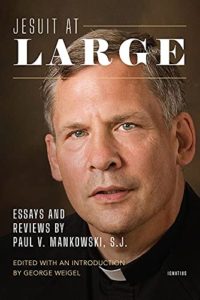 In his introduction to Jesuit at Large, a collection of some of the best essays and reviews of the late Fr. Paul Mankowski, S. J., George Weigel quotes from Fr. Kevin Flannery’s homily at his friend’s funeral Mass. Fr. Mankowski was, said Fr. Flannery, much like a man to whom he was devoted: St. John Fisher, the only one of the English hierarchy who would not accept Henry VIII’s divorce from Catherine of Aragon in order to marry Anne Boleyn and subsequently the “prototypical, principled ‘odd man out.’”
Fr. Mankowski was indeed odd and out. In a time for the Jesuits that Mr. Weigel describes, in one of the greatest understatements in history, as “extremely difficult,” a young Paul Mankowski, who had a girlfriend, degrees in classics and philosophy from the University of Chicago, and the desire to live a fairly ordinary married Catholic life, entered this famous religious order after only the faintest contact with the order. “In early May of 1976,” Weigel quotes Fr. Mankowski, “I was clobbered, out of nowhere, by the very strong certainty that God was calling me to give up that future and become a Jesuit.” After formation and further study at Oxford and the Weston School of Theology in Cambridge, Massachusetts, he was ordained and then took up doctoral work at Harvard in comparative Semitic philology. He was geeky enough that his dissertation was on Akkadian loan words in biblical Hebrew, a volume that, when published, became a “standard reference work.”
A funny thing happened on the way to that dissertation, however. While working in Cambridge on that dissertation in 1996, a fellow Jesuit told Fr. Mankowski that the papers of the Jesuit moral theologian John Ford were in the New England Jesuit province archives. That Jesuit asked Fr. Mankowski for help in translating some of the Latin in Ford’s papers and notified Fr. Mankowski of a box of materials about the candidacy of Fr. Robert Drinan, S. J., who had been allowed to run for Congress in 1970 and spent five terms representing Massachusetts and voting and advocating for legislation that went against Catholic teaching, most notably in the area of abortion, before being forced to step down by Pope John Paul II. Fr. Mankowski had already heard, in a dinner-time conversation with Drinan’s former Jesuit provincial, Fr. William Guindon, about how Jesuit leadership had misled Fr. Pedro Arrupe, the superior general of the order at the time, about the candidacy. He had also heard about how then-Jesuit but socially and politically conservative John McLaughlin—yes, he of The McLaughlin Group show—had been kept from similarly running for office.
Fr. Mankowski’s foray in the archives, completely authorized by those responsible for them, yielded a treasure trove of damning documents showing that Fr. Guindon’s after-dinner talk was no exaggeration. But Fr. Mankowski had been prohibited from writing anything other than his dissertation by his own provincial because he had written an article the previous year on priestly sexual abuse of minors and had recommended that priests with same-sex desires be released from the priesthood. Given that the material he had found showed a massive scandal in the order, he passed on photocopies of the relevant material to St. Louis University historian James Hitchcock, who then stitched the material together into a narrative with little commentary on it. Fr. Mankowski insisted on a note being appended to the article showing that he was the one who had copied the materials.
The reaction was swift and severe. Jesuit leadership refused to investigate the materials or the scandal involved in Drinan’s candidacy and the deceit involved in fooling Fr. Arrupe. Instead, they accused him of deceit and malice in his own dealings and then effectively made Fr. Mankowski a non-person, an odd man out, and a Jesuit at large. They kept him for many more years from writing in his own name or exercising any real leadership in the Jesuit order while taking advantage of his language skills to have him teach at the Gregorian University in Rome.
Perhaps the least literary piece in this collection of his writings is the 42-page memorandum he wrote in 2007 setting out what he did and what his superiors did in this case that sealed his fate. Never published before, it is a factual account that is nevertheless gripping in its honesty and worth reading for those who wish to understand the difficult plight of the Jesuit order and the Catholic Church in general.
But people did not and do not read Fr. Mankowski, whom Richard John Neuhaus dubbed a “papal bull,” simply for the facts. If he was like St. John Fisher in obstinate faithfulness, his writing had the clever and well-constructed sparkle and edge of Evelyn Waugh, whom he discusses in a 2017 review of Philip Eade’s biography of the man. Fr. Mankowski applauds Waugh, few of whose even minor characters “fail to amuse” and whose lethal pen was always just as lethal when it came to his own flaws. Fr. Mankowski notes that though he had from his youth the “ability to give pain and give delight, Waugh found it a lifelong task to learn how to edify; neither by his pen nor in his personal life did he wholly succeed.” And yet, “[i]t is a testament to his character, and his faith, that he tried at all.”
Fr. Mankowski himself had both of Waugh’s abilities and the one he aimed for but didn’t hit. His essay “Voices of Wrath: When Words Become Weapons” is one of the finest debunkings of the notion of “inclusive language” one can find, a debunking that shows the grasping for power behind such obsessions. It edifies those of us who are more concerned with truth than with power. Several essays from the early 1990s on the American Academy of Religion and on mainline religious practice in the United States similarly break down what is ugly and give voice to what might help. In “What I Saw at the American Academy of Religion,” much of the comedy comes from the simple and probably unfair tact of quoting the scholars involved and extending the thought. Of one panel on “Teaching the Womanist Idea,” he offers a presenter’s notion of “African-American quilting” as a practice that would define black women, adding, “presumably in an effort to resist the hegemony of Anglo-feminist quilting theorists.” He notes at the end his sudden realization that the word that failed to make any appearance is “love.”
In “Academic Religion: Playground of the Vandals,” he begins by describing a Presbyterian statement on sexuality (“Keeping Body and Soul Together”) as having the “characteristics increasingly distinctive of American church bureaucracies: a cute journalistic title, a manifesto-like swagger, the facile syntax of Psychology Today, and a predictable exhortation to Do What Thou Wouldst, caringly.” In this article he notes the ecumenical reality of what we might now call the progressive and academically-credentialed (if not accomplished) “deep church state” that seems to run much of organized Catholic, Protestant, and perhaps even some Orthodox life. They preach emancipation from moral norms and a kind of deconstruction of any traditional understanding of God. “From a theological point of view,” he notes, “this enlightened religion has the awkward disadvantage of being atheist, but clearly the cavil carries little weight with adherents among the new clerks.”
Such cultural and religious diagnosis is both witty and strikes this reader as undeniably true—truer today than when the words were written. This is especially true of his essays specifically on Catholic problems. “‘Tames’ in Clerical Life,” written in 1996 (and published anonymously because of his then-ban on non-dissertation writing) should be required reading for bishops and seminary formators. The clerical type it describes possesses “great sociability with an incapacity for true friendship,” and a corresponding “over-adaptability” in both dress and personas. If the bishop is “orthodox” or “conservative,” they’ll go along with that! If not, well, they’ll go with that, too. They might be gay or straight. They are not ideologues about doctrine or sexuality or anything else, but they end up being the enforcers of those who are because they are so afraid of going against these ideologues lest they “be thrust to the margins of the institution.” They predictably rise on the ecclesiastical greasy pole quite easily, leading to the kind of episcopal leadership all too well-known by Catholics: “outward managerial competence and personal moral cowardice” that ensures too often that problems are hidden beneath a façade of personal good will and fester until they break open.
Tough language, but also a great deal of wisdom. Fr. Mankowski’s diagnoses might seem abrupt to those to whom they apply, but the reader notices a genuine sympathy for those in the priesthood or denominational bureaucracies who have quite often sold their souls or allowed them to be dribbled away for something even less than Wales. One of the best examples of this sympathy is his review of Fr. Wilson Miscamble’s biography of Fr. Theodore Hesburgh, the man who gave Notre Dame and himself a place in the worldly academic firmament but somehow seemed not to enjoy much of it. “He passed his life in the gaze of the Lidless Eye of his obituarist,” notes Fr. Mankowski, before recalling the one incident in the biography of pure ordinary joy—a supersonic ride on a Lockheed SR-71 through the ministrations of President Jimmy Carter. “Able for once to be a boy as well as a man, the author of The Humane Imperative got himself a ride on the fire truck to end all fire trucks. He had bought much shabbier wares at a much dearer price; one hopes he enjoyed it.”
He was no Fr. Ted! The price Fr. Mankowski paid for his own honesty and refusal to be tame in the face of corruption and ersatz religion was dear indeed, but he bought rewards with his honesty, courage, and insight that will richly pay the reader of these essays. The reward he received is, I suspect, in heaven where moth and rust do not destroy.
The Imaginative Conservative applies the principle of appreciation to the discussion of culture and politics—we approach dialogue with magnanimity rather than with mere civility. Will you help us remain a refreshing oasis in the increasingly contentious arena of modern discourse? Please consider donating now.



It’s hard to keep a good man (and the Truth) down!