
“The Green Knight” is probably the best movie adaptation that we Christians could dare hope for from the modern world: well-researched, thoughtful, and meditative. Go see the film. Revel in its beauty. But use your Christian understanding to claim what you want from it so you may better serve Christ.
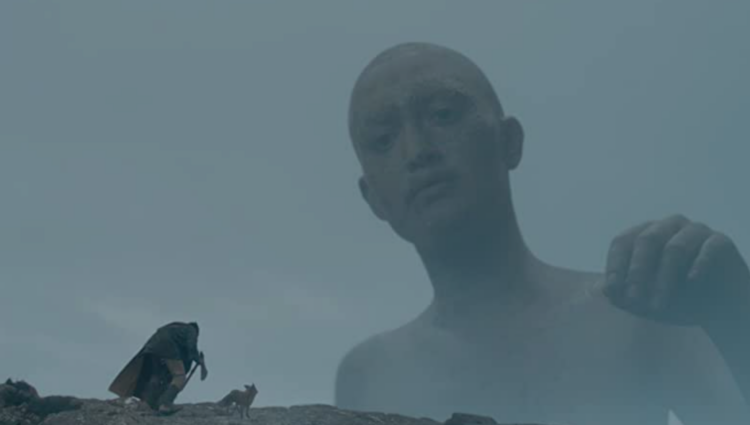 The Green Knight is a spectacular and gorgeously beautiful film. It is probably the best live-action Arthurian film to date. It may very well join the ranks of Peter Jackson’s Lord of the Rings and Disney’s The Lion, the Witch, and the Wardrobe, as a genuinely good live-action fantasy movie that shall be turned to time and again over the years as an example of how to do a movie about knights and magic and monsters right. But it is not a Christian movie.
Perhaps this should not be a surprise in light of the world’s journey to paganistic atheism, but it is a saddening thing, especially when I think of how powerful and truly wonderful this movie could have been if the filmmakers had just retained the Christian element that is so profoundly a part of the original work.
The movie is a work of art, even without the Christian element. Every frame is a Pre-Raphaelite painting, every sound effect crushingly real. I am no cinematographer, but I can say with every confidence that the film was an aural and visual masterpiece from start to finish. I was in love with the world, the costumes, the sets, the vibrancy of the colors, everything. The filmmakers made excellent use of long, lingering shots to make each of the many adventures and scenes in the film feel as if it was given more than enough time to claim its proper place in the movie.
The film follows the original story fairly closely in terms of plot, matching it at many moments beat for beat and only occasionally filling in and embellishing, but never subtracting anything that would detract from the original. This is what puzzles and saddens me the most. The filmmakers clearly did their research, portraying with a shockingly precise acuity the wacky, bizarre, and terrifyingly deadly tone of the world’s magic and its fantastical creatures; relating the primal pagan force of the Green Knight and nature, and the cycle of the seasons and life and death which lies near the center of the story; even having a semi-historically accurate Christian presence in the court of Arthur, with mentions of Mass, the appearance of a bishop blessing a knight with holy water and praying in Latin, and the icon of the Theotokos gilded on the inside of Gawain’s shield, and the five sorrows of Mary and the five wounds of Christ.
As a student of the text, I understood almost every reference to the original, every decision by the filmmakers that related directly to the original text. Which is why I can confidently say that they missed the forest for the trees.
At the center of the story of Gawain and the Green Knight are the themes of time’s cyclical nature through the four seasons of life and death, the power and terror of nature, and the question of paganism in relation to Christianity. The movie addresses these themes with great care, taking extra time in one scene to describe the earthy nature of the Green Knight and asserting that ultimately the Green of nature is not a sign of life, but of decay, fungus, mold and decomposition, ever at war with the Red of the blood and lust of men. This is where the film shows its atheistic, pagan tendencies most. It shuns the Christian answers of the original story in favor of its own. While the poem joyfully concludes with the Christmas miracle of penance and compassion, implying that Christianity is the force that breaks the pagan cycle of life and death by promising everlasting life, the film gleefully concludes that since there is nothing after death, one ought to die sooner rather than later, facing his death with his head held high. “Is that it? Is this all there is?” Gawain asks at the end of the film. “What else would there be?” the Green Knight replies. This is the best the pagan, atheistic world can offer: nothing.
The irony should not be lost on an educated Christian audience: this film shows perfectly the cyclical turn, the regression, of the modern world back into paganism and atheism. The filmmakers can study and pretend to understand Christian works of art, they can even mention Masses and show icons and have priests say lines in Latin to be accurate to the original book, but it is all hollow, meaningless. I was supposed to feel the same watching an icon of the Theotokos be broken in two on screen as a Neo-pagan watching someone wear the Hammer of Thor in a Vikings show. Christianity has become just another prop piece for the modern world.
Sir Gawain and the Green Knight is at its heart a story about the dichotomy between Christianity and paganism, about how Christianity–through Christ’s compassionate and sacrificial love–has claim to and power over the preexisting pagan forces, primal and powerful though they be, full of life and death in equal measure. The film The Green Knight utterly fails to capture this idea, because its makers fail to comprehend this. But given the modern world, it would be almost unfair to expect them to be able to.
This film presents a wonderful and harrowing journey, as any true knight’s quest or pilgrimage ought to be, full of dark horror and mystic beauty and daring courage in the face of death, and sure to keep audiences on the edge of their seats the whole time. Christians should be warned that it is, however, more than a little raunchy and earthy, and one scene in particular is quite steamy, but it makes sense for the story, and boy what a beautiful story it is, muddled by the moderns though it be.
Indeed, The Green Knight is probably the best movie adaptation that we Christians could dare hope for from the modern world: well-researched, thoughtful, meditative, deliberate, and lingering. Go see the film. Revel in its beauty. But use your Christian understanding to claim what you want from it so you may better serve Christ.
The Green Knight has fallen short of true greatness, but it is a tragically short fall indeed.
The Imaginative Conservative applies the principle of appreciation to the discussion of culture and politics—we approach dialogue with magnanimity rather than with mere civility. Will you help us remain a refreshing oasis in the increasingly contentious arena of modern discourse? Please consider donating now.
The featured image is courtesy of IMDb.


Nathaniel: Thank you for this! As an Arthurian devotee since childhood (The Once and Future King, Robert Taylor and The Knights of the Round Table), I’ve probably seen every movie on the subject. Your critique of Green Knight is right on; I enjoyed it for all the reasons you cite, understanding that we must replace its nihilism with the hope and joy of Christ’s message. However, I also was perplexed and left unsatisfied by lack of meaning for the symbolism you discuss and for the relationships between characters as originally understood. Who, for example, are the giant women? Who is the girl in the woods who inexplicably becomes queen? Can you recommend a good essay expanding on your points? With more understanding, I will watch it again.
You’ve expanded my world Good article.
I see the battle over the self as a higher accomplishment when weighed against the realities of our mortality. Perhaps it’s about what his decisions mean and why he should make them–why he should be a man of character and what real honor means–when there is no reward for it. I think that it is harder to be good in a finite world and accepting your mortality where there is an easier path that was given to you, that you didn’t have to find on your own, is the bigger choice. It’s funny when I talk to intelligent Christians who have well thought out reasons for their “whys” how often we believe the same thing in the opposite direction. We have very similar values, and very different ideas about what that means.
I finally watched the movie last night, partly on the recommendation of this essay. I found that the movie could only have been made by someone possessed a demon. At every step of the movie, courageous chivalrous and moral choices were trivialized or turned into evil decisions. Witness how, in the original story, the rejection of the Green Knight’s wife’s seduction was portrayed as vulgar, pornographic consummation. Or the critical early scene where “Gaarwain” hopped up almost immediately to play the game with a unknown knight, rather than being moved with courage and compassion for his king who was about to give his life to give his own life for the honor of his kingdom when all his own knights trembled in fear.
No! Avoid this horrendously evil movie, steeped in moral relativism, upside down portrayals of manliness, and an ending that hints of exactly the opposite outcome in the original text. This is an evil movie that will haunt you, at least until the next morning. I am much worse of for having ever watched this travesty of what I should have realized was a typical hollywood CGI-enhanced heap of dung.
Pagans aren’t atheists and atheists aren’t pagans. Some of us also believe in eternal life with our ancestors and the gods.
Actually, no. I see the footprints on a Christ-haunted director who thinks he is turning Christianity on its head but he most certainly does not do paganism any favors. Instead of showing Christianity has a failure, he shows a war between Christianized pagans versus pagans. His version of King Arthur and Queen Guineveire are not truly Christian at heart. They believe in Christ and Christian virtue, sure, but as a means to authority, power, and glory. If the really were Christian, they would have shown The Green Knight out the door and not read magic cursed letters. This is a reflection more on Christian kings of the past who failed to totally repudiate paganism from their Christianity, leaving behind a wake of war and blood on their path of conquering the pagans.
But bravo on the director on not giving more powerful pagans a victim status. Instead, every pagan character, including Gawain in this version, is a selfish if not an outright predator over the weak and vulnerable and poor and powerless for sex and power and the manipulation of nature’s power for their own ends. Lady Bertliak’s deriding Gawain for not being a knight is an accusation of Gawain’s false pretenses for wanting to be one: for false glory rather than as a code to master himself to be the Christian ideal of a protector. The virtues are ultimately to keep the powerful from preying and exploiting the powerless. The Green Knight is not a good guy by virtue of symbolizing Nature, but at least he treats Gawain justly, especially in his lack of partiality for anyone’s status.
The more ambiguous characters, the thief and Lord Bertliak, are certainly not the good guys.
The true hereos are two poor Christians, one sinner and one saint: Essel and St. Winifried. They are the ones challenging Gawain to be truly good, to not exploit women and the powerless. Essel asked him to do the right thing and lift her out of a life of poverty and promiscuity for survival by marrying her. But his lust for reputation and glory without doing the conversion of heart to rightly acquire it is stronger than his lust for the flesh. St. Winifred, a virgin martyr, simply wants the justice of receiving her head back and not having her bed defiled by another weasel of a man.
The director turning Essel into Lady Bertliak and St. Winifred into the potential spouse for Gawain highlights the further injustice Gawain causes in seeking to have his way on the two women he desires, an illusion of appearance that Morgan Le Fay creates to fabricate a journey towards glory for her son. But alas, she cannot fully control The Green Knight and has to concoct additional means of protection to keep him alive, especially with talking foxes and green magic belts. Only when Gawain takes off the paganism by taking off the belt and accept responsibility for his actions does he become a man. And the little girl taking his crown in the end still drives home the point: God created the weak things of the world to confound the strong.
This is a version of the Arthurian legend for postmodern men today.