
As a believer I would therefore like to offer the atheist a modest analogy. It is music. Think of God as Music with a capital “M” and religion as music with a lower-case “m.” Religion is not too difficult to understand, but like music, it is difficult to do well.
 I sympathize with contemporary atheists. A young person raised in a non religious family and educated by the American secular system is understandably bewildered by religious claims. The air he breathes is atheistic. The whole society he swims in is polluted by atheism. I have outlined in my recent book Beheading Hydra sixteen different masks of atheism that are woven in and through modern American culture.
From time to time I have tried to put myself into the shoes of such a contemporary young atheist. If his godless upbringing and atheistic education are combined with loneliness, a broken home, confused sexual identity, and existential alienation, no wonder religion seems bewildering and the existence of God seems improbable.
Should he begin to view religion with a sense of curiosity he will soon be lost in the maze of supermarket-style choice. Should he visit the Church of God or the Church of Christ? Methodist or Moonies or Mormon or Moravian? Presbyterian or Pentecostals? Amish or Anglican? Quakers or Shakers? How does he know the religious outfit is even a church, for their marketing belies the fact. They call their congregations “Roundup, Relentless, Recovery or Renew.” Meeting in redundant supermarkets and called “Inner Spring” or “Refresh,” they could be a mattress outlet or a health spa.
Should he get interested in modern American Christianity, he is likely to not encounter religion at all, but a pastiche of therapy and rules for respectability sweetened with a swirl of “spirituality.”
Should the aspiring atheist search beyond the ecclesiastical shopping mall that is American Protestantism, he will encounter the vast array of New Age spiritualities, freshly-marketed Buddhism, trendy Hinduism and Islam with a happy face. Pushing the quest further, he may well learn how to dabble in the occult—being introduced to it through anything from shock-horror rock bands and movies, role-play video games, New Age weirdness, or esoteric philosophies.
No wonder the Twitter atheist makes sophomoric taunts to the traditional theist like, “So you believe in a magical pixie in the sky, do you?” Or “I understand your religion expects you to believe in a snake that talks to naked people.” The somewhat more serious atheist demands “evidence” for the existence of God, but when it is pointed out that he is asking for material evidence for the immaterial and that his request is therefore intrinsically absurd, he scurries off or resorts to another ignorant insult.
Should he look into one particular religion with any serious intent, he will invariably find it crowded with hypocrites, frauds, charlatans, and devotees arguing among themselves about arcane points of theology, liturgy, or morality. No wonder he scratches his head and concludes that the whole religion-God business is bunk.
As a believer I would therefore like to offer the atheist a modest analogy. It is music. Think of God as Music with a capital “M” and religion as music with a lower-case “m.”
Is there such a thing as Music? We might suppose, for the sake of argument, that a person might doubt the existence of music. Indeed, a person born deaf, brought up by deaf parents and educated in a school for the deaf would have every reason to doubt the existence of Music.
Should he go to an orchestra concert or a rock concert he would be bewildered and bemused by the behavior. “What are those people doing all dressed up in tuxedos with crazy-looking contraptions stuck in their mouths or tucked under their chins? Why are they swaying about? Who is that fellow up front in a formal suit waving his arms about? Why is the room full of people sitting still watching them? At the rock concert the behavior is even stranger. The performers are clutching contraptions to their pelvises and writhing about. Another sits behind what looks like a collection of kettles and pots bashing them with sticks. The people are not just watching, they too are writhing about, jumping, and whirling as if possessed. And they all say they believe in this thing called Music! Clearly they are all insane.
Then we explain that no one in their right mind can disbelieve in Music. Music is common to humanity. Every human culture everywhere in the world in some way or other makes music. Which brings us to music with a small “m,” for music is the way humans embrace and express this greater thing called Music.
The greater thing “Music” is abstract. It is a concept. It is a category. However, it becomes real as humans make music—and they make music in a multitude of ways. From the plaintive voice of a child singing Faure’s Pie Jesu to the primitive groans and chants of a jungle tribe—from the exquisite tones of Mozart’s clarinet concerto to the deafening drums of a hard-rock band—all of these and much more are music made real.
Furthermore, it is music even when it is done badly. Little Sally hitting the wrong notes as she practices Mary Had a Little Lamb for her piano lesson, Aunt Margaret belting out a Broadway tune out of key in the local drama group, the awful church choir, and the excruciating violin solo at the school talent show—all of these are music too.
So perhaps this simple analogy will help the poor bewildered atheist to understand God and religion a little more. God exists and religion is the way human beings try to connect with Him and share in his life. God is like Music. Religion is like music. God is real. Religion is what we do to experience his reality in our lives.
Religion is not too difficult to understand, but like music, it is difficult to do well.
The Imaginative Conservative applies the principle of appreciation to the discussion of culture and politics—we approach dialogue with magnanimity rather than with mere civility. Will you help us remain a refreshing oasis in the increasingly contentious arena of modern discourse? Please consider donating now.
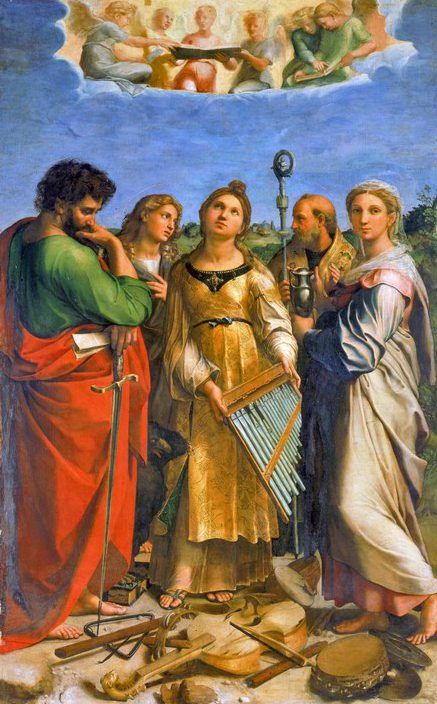
The featured image is “The Ecstasy of St. Cecilia” (1514) by Raphael, and is in the public domain, courtesy of Wikimedia Commons.






I read your article with interest – but I am disappointed in your description of your “atheist” example as young, un-curious, commercialized, taunting and insulting and ignorant. Your tone only serves to alienate someone who might otherwise be sympathetic to or willing to consider your premise.
Yes, I felt similar. I’m an atheist myself but I am a libertarian in the Ron Paul sense. I don’t need to believe in god to give my life meaning or to believe in the ideas of liberty. That said, I do enjoy reading some of the articles on here.
That was the sort of atheist with whom I was sympathizing. I did not suggest that all atheists were of that ilk.