
Willmoore Kendall’s works on political science were pathbreaking and survive the test of time. Even today, it is impossible to understand the equal democratic legitimacy of the presidency and Congress without his “Two Majorities,” or the critical role of local-based political parties without his “American Party System,” or how the whole Constitution works to solve democracy’s eternal problem of faction without comprehending his “Intensity.”
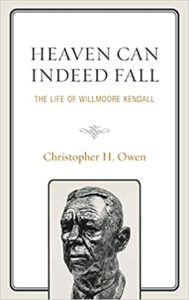 My view was that it would be impossible to write a good biography about the complex 20th-century academic superstar named Willmoore Kendall. But historian Christopher H. Owen has done so, with the enigmatic title Heaven Can Indeed Fall: The Life of Willmoore Kendall.
Owen attempts a summary, listing 15 principles to represent the subject’s philosophy, probably at the insistence of an editor. But he wisely adds at the end of the list that “Kendall’s political teaching rested on no one of these points but required maintaining a balance among them.” Can even a magician levitate a dozen or more simultaneously?
Kendall’s principles actually kept evolving over time. While he ended a conservative hero at the University of Dallas and before that as an editor at National Review in the 1950s, he made his reputation in the 1930s beginning at Oxford, then the University of Illinois, Champaign, and Yale as a socialist Democrat. In between he identified as a communist, being called the “resident leftist” when working at UPI in Madrid, and then became a pacifist, agnostic, and Catholic.
The author calls Kendall’s long-time relationship with conservative movement pioneer William F. Buckley Jr. “messy.” As Buckley’s professor, Kendall provided the “conceptual framework” for his break-out book “God and Man at Yale” and helped set the tone for his political movement generally by guiding National Review magazine as a top editor. Buckley then supported him financially through underemployed years and ills; but Kendall finally walked away from him.
Intellectually, Kendall began with Rousseau’s local-community popular majoritarianism, before fundamentally reinterpreting that doctrine. He revised his views of John Locke at least three different times and understood Eric Voegelin and Leo Strauss at least two different ways each, among many other luminaries. He had difficulty getting along with almost anyone for any long period of time, especially other intellectuals, who retaliated by hampering his careers. He could be winning too, succeeding in longtime intelligence work for the U. S. government (with a Communist background at Oxford!), and he was often successful even in a hostile academic world.
His pastor father was a dominant influence on his life but his relationship with him shifted over time. His father was blind but incredibly determined to succeed. He learned to communicate well and had his wife read for him allowing him to earn advanced degrees. He became a (mostly) successful pastor and very successful orator and lecturer. He was a domineering father, “relentless” in keeping track in person or by mail with his “child prodigy” son over his lifetime. Resisting Dad’s moral principles, drinking heavily in a teetotaler house, he was forced from home. But a strong bond continued until death, with advice often resented by the recipient.
But Willmoore became a genius. His “Two Majorities” political science blockbuster brilliantly demonstrated how Congress and the President had different constituencies, and so, different majority bases of legitimacy, augmenting the formal Constitutional balance. His “democratic party system” explanation (with Austin Ranney) restated popular rule institutionally rather than abstractly, questioning the great John Dewey. His piece on the “intensity problem” and how the Constitution solves it consistent with majority rule earned publication in the authoritative American Political Science Review. All were recognized as major political science insights.
Even so, the changes in beliefs over time were monumental. The absolute majoritarian position taken from Rousseau dominated his early years; but as early as his 1956 book with Ranney modified it substantially and more creatively. Owen emphasizes that this change occurred just “before he modified it [his whole majority position] radically over the ensuing years.” Kendall ended supporting James Madison’s balance of power Constitutionalism, when he had previously called checks and balances “Machiavellian machines.”
Kendall’s longest and most intriguing intellectual journey was with John Locke, who has also been a longtime focus of this reviewer. In 1941, the University of Illinois Press published Kendall’s doctoral dissertation as John Locke and the Doctrine of Majority Rule. The book made his intellectual reputation nationally almost overnight. He challenged the widely-held belief that Locke was the primary intellectual support for the Declaration of Independence’s freedoms. He correctly emphasized that Locke had not begun his Second Treatise by justifying free individuals in an open state of nature, but actually began with individuals in community, not fundamentally free but with the community able even to kill those who transgressed its standards.
Kendall found Locke “confused” in wanting both the state to keep order and for the individual to be free, violating the logical principle of non-contradiction. Indeed, Locke’s legitimization of an individual right to revolution in response to arbitrary rule was “absurd.” This, of course, undermined the legitimacy of the American Revolution and the legality of its new regime, leading Owen to note that this interpretation seemed more Kendall than Locke. Still, Kendall had even impressed philosopher Eric Voegelin, who wrote Kendall in support of his interpretation (which became Voegelin’s view on Locke in his History of Political Ideas).
Through the fifties, Kendall kept his Rousseauism, as modified with Ranney, but then changed dramatically to Madison, first to Buckley privately in 1957 and then more publicly in the Midwest Journal of Politics in 1960 with his “Two Majorities.” As Owen characterized the transition, Kendall was fundamentally “reformulating his work in the light of reading Leo Strauss and Eric Voegelin,” emphasizing the importance of virtue. Kendall’s “keystone essay” in his 1963 The Conservative Affirmation (titled “The Ultimate Issue”) brought Kendall back to Locke and his influence, especially on conservatives. Locke, he said, in fact had actually rejected the whole “great tradition” of virtue in Socrates and Plato and turned it into the relativism of Hobbes and Rousseau: “The Lockeans in America are the liberals,” not conservative at all.
As Owen put it, by 1966 Kendall admitted he had changed radically:
Reviewing his own work from a quarter-century before, Kendall saw it as insightful but naïve. He had noted the contradiction between Locke’s support for majority rule and his defense of natural rights. By reading Strauss, however, Kendall now understood that Locke had no ‘latent premise’ for majority rule. Rather Locke had concealed his real views to make them compatible to contemporaries. Kendall now believed Locke had prioritized the individual right to property above all else, that his praise for Christian morals and majority rule simply disguised support for untrammeled individualism.
Strauss himself found Kendall’s new conclusions had demonstrated that he was “the only man who, without being my student understood marvelously what I thought and intended.” Only by accepting Strauss’ belief in Locke’s “secret writing” did Kendall reject his previous belief that Locke did have a belief in “natural political virtue.” This reviewer has argued elsewhere that Strauss came to that conclusion by simply arbitrarily discarding Locke’s values because they came from Revelation, so by definition any “praise for Christian morals” could not be considered Rational.
That will not fully divert us here, but one must merely note that both Strauss’ and Kendall’s interpretations of Locke were based on an over-rationalist understanding of philosophy, rejecting synthesis as illogical, pursuing what F.A. Hayek called “constructivist rationalism” rather than the more “critical rationalism” of Locke or Burke. Interestingly, Owen notes that Kendall himself once aimed at trying to create a synthesis between Voegelin’s virtue and Strauss’ reason.
What is unquestionable about Kendall is that his more formal political science work was pathbreaking and survives the test of time. Owen notes that his posthumously-published (with George Carey) Basic Symbols of the American Political Tradition is still widely read and admired. Even today, it is impossible to understand the equal democratic legitimacy of the presidency and Congress without his “Two Majorities,” or the critical role of local-based political parties without his American Party System, or how the whole Constitution works (or can work) to solve democracy’s eternal problem of faction without comprehending his “Intensity.”
Indeed, in today’s hyper-divisive America, “Intensity” should be required reading for everyone.
The Imaginative Conservative applies the principle of appreciation to the discussion of culture and politics—we approach dialogue with magnanimity rather than with mere civility. Will you help us remain a refreshing oasis in the increasingly contentious arena of modern discourse? Please consider donating now.
The featured image is “City of Washington from Beyond the Navy Yard” (1833) by George Cooke, and is in the public domain, courtesy of Wikimedia Commons.


Leave A Comment