
There is only one power that can destroy this evil at its source within us, and that is the power of infinite love. When we do all in our power to invite infinite love into our hearts, we are doing the most important thing we can so that evil may be defeated and good may prevail.
 In 1215 when Magna Carta was being signed in England, the most successful reforming council for a thousand years was taking place in Italy. It was called the Fourth Lateran Council. St Dominic, St Francis of Assisi, St Bonaventure, St Thomas Aquinas and four major new religious Orders were involved in spreading the reform all over Christendom. When asked why these new mendicant orders were teaching and preaching outside their monasteries, it was St Thomas Aquinas who replied simply: their job was firstly to contemplate, and then share the fruits of their contemplation with others. These words summed up the new reform which St Francis saw as nothing other than the “Gospel of Our Lord Jesus Christ”, but it also summed up the spirituality of the first Christian communities before monasticism was founded. It was the fruits of this contemplation, the infused virtues and the gifts of the Holy Spirit that dazzled the ancient pagans with a quality of pure human goodness and loving selflessness that was never seen before.
If the Second Vatican Council had produced a document detailing a modern representation of the ancient God-given spirituality that his Son handed on to his first followers, as it should have done, then its conclusion would have mystified its readers. The measure of the shock and bewilderment that would have reverberated around the Church would be the measure of just how far we have departed from our spiritual origins. Priests and prelates, as well as the laity would look at one another in disbelief, for the mystical prayer they were told “began in mist and ended in schism” would be back on the agenda. There would have to be an authoritative restoration and reinstatement of mystical theology in all seminaries, houses of religious education and Catholic universities to teach the profound prayer that enables the Holy Spirit to lead us through meditation to the mystical contemplation of God, in, with and through Christ. Mystical theology had been long since taken off the syllabuses in seminaries and houses of Catholic further education. However, deep renewal will only get underway again when it is reinstated and taught by practitioners.
When I was the managing director of Walsingham House retreat and conference centre in North London, I asked my old theology teacher to become the principle visiting theology lecturer, a post that he filled until my tenure came to an end in 1981. When after several years I asked him to take on the role of teaching mystical theology I received the biggest shock of my life. He simply said that he knew nothing whatsoever about the subject. My shock was multiplied many times over as I approached other theologians and received the same sort of response. I had to teach the subject myself, for all the theology in the world would quite literally be pointless unless it is underpinned by the Church’s time-honoured teaching on how to die to self and carry a daily cross in prayer beyond first beginnings.
When I asked why I was summonsed to Rome at the end of the 1970s to teach Mystical Theology, I was told there was no one else able to do it except from a purely academic and historical point of view. Invitations then came in to speak from all over the world on a subject that since the condemnation of Quietism nobody seemed to know anything about. For many years to come my initial findings that very few priests and religious were taught how to pray was confirmed over and over again. The enthusiasm of those who, after attending my courses in Rome encouraged their superiors to invite me to speak, was not matched by the vast majority of my audiences. And yet when the terrible cases of sexual abuse by priests and religious hit the headlines everyone was flabbergasted and could not see the reasons why.
If only the meditation that leads to mystical contemplation had been taught in all houses of clerical and religious education, the selfless loving learned in contemplative prayer would have introduced them directly to the love they would otherwise have experienced in the Sacrament of Marriage. We all need to love and be loved. If those who take a vow of chastity are not simultaneously taught how to come to know and experience God’s love, then they could eventually seek counterfeit love elsewhere, sometimes with the disastrous consequences that we have all seen. Unfortunately, the gap created by the demise of true authentic Christian mystical spirituality has been filled by psycho-sexual-anything-goes New Age movements that are to be deplored. However, I do not want to end on a sombre note. I have come across many good people who are cooperating with the Holy Spirit and have travelled far and deeply in the spiritual life, but sadly with little help and usually much opposition.
I was fortunate to be taught theology by a theological genius who studied Scholastic Theology in the 1950s during the revival of Thomism. He received the highest attainable distinction, a summa cum laude and was carried on the shoulders of his fellow students to celebrate his achievements. Although it was not a subject that could be studied formally at the time, he managed to master the “New Biblical Theology” that would be so vital for the Second Vatican Council that was about to be called. I want to make a clear distinction between what was called at that time the New Biblical Theology, and what after the council came to be called the “New Theology” with which I want to disassociate myself. It became like a hydra with many heads, each head becoming increasingly blind to authentic Catholic teaching and tradition as the years have progressed.
In 1964, I hoped to continue my studies on a higher level, first by going to Rome to study Scholastic Theology in more detail, followed by further studies in Biblical Theology in Germany, France and at the École Biblique in Jerusalem. It was then that I met a Franciscan priest, Fr Anthony, who said I should rather go to San Giovanni Rotundo in Apulia to sit at the feet of Padre Pio. He would not be able to add to my knowledge of Thomism and had probably never heard of the New Biblical Theology, but I would find in him the fullest possible embodiment of the “Primacy of Love”. Sadly, by the time I was able to arrange a visit to San Giovani Rotundo, Padre Pio had died on September 23rd, 1968.
However, I was privileged to meet a monk who had reached the pinnacle of the spiritual life at the end of one of my lecture tours in Africa. Fr Gregory was in my opinion another living saint. He was a Cistercian monk who was trained at the Trappist monastery of Mount St Bernard, near Coalville in Leicestershire, England. He and several other monks opened a daughter house at Mbengwe in the republic of Cameroon many years before. When I was privileged to meet Fr Gregory who was eighty-five at the time, only he and three others remained from the original group. The Nigerian Abbot presided over a large and spiritually thriving African community that I likened to the paradise described in James Hilton’s book The Lost Horizon called Shangri-La.
Fr Gregory told me he spent thirty years in the Dark Night, in which there were moments when he thought he had lost his faith. Then one day he became ill and was confined to the monastery’s infirmary. From the moment he was laid up in bed he experienced what he called a weak but ongoing ecstasy that he not only experienced in his head but in his whole being. By that he meant that he was at all times lost in God, but at no time did the experience render him unconscious nor less capable, but rather more capable of his work than ever before. Then on three separate occasions just as he was about to receive Holy Communion, he heard these words, “Only you have been keeping me out.” He emphasized that he knew without a doubt that he was listening to the voice of Christ himself. Furthermore, he insisted that the words were not spoken to him in his head, but out loud and in words, “as loud as you are speaking to us in the monastery church”.
He told me how he had found the most help from the book The Cloud of Unknowing in what was the most testing period of his whole life during those years in the Dark Night. We both agreed that the book is a mystical masterpiece brimming over with the sort of practical wisdom that can only come from a fellow practitioner. What few critics it has had, sadly reveal themselves to be out of step with the Catholic mystical tradition. I would give it particularly to those who thought themselves well advanced in the spiritual life, and able to lead and guide others. If they “clasped it to themselves with hoops of steel”, I would know that they were genuine practitioners, on the right path, and able to guide others too. If, however, they dismissed it or condemned the work, then they would be condemning themselves and the role they had set for themselves as a guide for others through the darkest moments of the spiritual life.
That there be no misunderstanding let me be quite clear that the prologue to the book makes abundantly clear that, if I may paraphrase the author, it should be positively hidden away from the general reader for it would indeed mislead them and they would in their turn misguide others. A good example of this is how those who belong to the many mantra movements that are unfortunately so popular today, misuse it. They do this regularly by claiming that its use of monosyllabic words are, in fact, mantras as used by gurus from the East and the West to attain almost instant mystical states. In fact the words used by the author of the Cloud are not techniques to generate inner psychological states of mind, but short prayers, acts of love directed towards God.
They are known in the Catholic tradition as “prayers of the heart”. Even then they are not recommended for beginners but only those who after meditating on God’s love as embodied in Christ, and for many months, more usually years, the Holy Spirit gives them the gift of contemplation. It is only then that the book can be recommended to those now in the mystic way. The author wrote the book for a twenty-four-year-old young man who had just been led into the Dark Night of the Soul. Anybody in the same position as the young man or the sisters for whom St John of the Cross was writing, will find this book just what they are looking for, a spiritual lifeline, and the help and consolation for which they are in dire need. The very essence of his teaching is that all we can do is to keep making simple acts of love to penetrate through the “Cloud of Unknowing”. He takes this phrase from the Fathers of the Church, who in order to describe the mystic way, liken it to the ascent of Moses up Mt Sinai, passing through the clouds to receive God’s laws at the summit.
Like all who would follow him to seek the new law of God, which is love, the mystic has to pass through a “Cloud of Unknowing” as Moses did. The “prayer of the heart”, as the Desert Fathers called it, or short prayers of love were taught from earliest times. They were used to express the deepest desire of the mystic and to support what the author of the “Cloud” called our “naked intent upon God”. What was originally called the “prayer of the heart” often came to be called the “prayer of faith” by weather-worn travellers who knew the reality of travelling through the Dark Night most especially at the beginning when the “prayer of the heart” was all but bereft of heartfelt feeling. But the time comes when God becomes the sole giver and we become the receivers. When this happens God sends out a spiritual light of incredible power that pierces down through the “Cloud” to penetrate and then possess the mystic. However, the author will not take upon himself to speak of this with his “blabbering fleshly tongue”. So, dear reader, if you want details of ecstatic mystical states then you will have to look elsewhere but if you want good orthodox inspiration and advice for your journey “when the well runs dry” then look no further than to this spiritual treasure and do not listen to counterfeit mystics who malign it. I find it grossly offensive when those who cannot understand this “holy work” do not just condemn it but ridicule it.
From time immemorial human beings have tried to keep the evil that is in us all in check by issuing laws, rules and regulations, with sanctions and penalties for offenders to keep the demons within from bursting out. However, despite the laws, the evil that is within does burst out, not just to commit individual crimes, but national and international atrocities as internecine wars commit unmentionable acts of brutality and barbarism. Only an arrogant fool believes that we can oppose this evil and destroy it ourselves. Endless fascination with the evil in the world and in the Church can become like a pernicious drug addiction that can at best paralyze a person into inert apathy, or at worst can make us porous to evil, possessing us with the stuff that sinners are made of.
There is only one power that can destroy this evil at its source within us, and that is the power of infinite love. When we do all in our power to invite infinite love into our hearts, we are doing the most important thing we can so that evil may be defeated and good may prevail. There is hope then and we can do something, precisely because we have been created in the image and likeness of God and yearn to love him and be loved by him. This hope becomes more than a vague longing when we try to do all in our power to strengthen and fortify this longing with the infinite loving unleashed on the first Pentecost. It is this love that continually flows out of the Risen Christ that enables us to generate and practise acts of selflessness in prayer. When, through practice, divine and human love combine, it is to produce a new and invincible brand of contemplative loving that cannot be penetrated by evil. It can open up the passageway through which our love can finally enable God’s unalloyed and infinite love to do what is quite impossible without it.
It was from Fr Gregory that I first heard a monk explain to me how he chose short prayers from the liturgy to support his longing for God when mystical darkness enveloped him. It was in this action with his attention fixed on God, that divine and human love combined and contemplative loving was generated. He was adamant that this was the practice of countless monks before him, as far back as the Desert Fathers. I have never forgotten Fr Gregory because I believe that in meeting him I met the man I am striving to become, at least in some small way, a living embodiment of the man who rose again from the dead on the first Easter day.
___________
This essay is chapter fifty-three of The Primacy of Loving and is published here by gracious permission of the author.
The Imaginative Conservative applies the principle of appreciation to the discussion of culture and politics—we approach dialogue with magnanimity rather than with mere civility. Will you help us remain a refreshing oasis in the increasingly contentious arena of modern discourse? Please consider donating now.
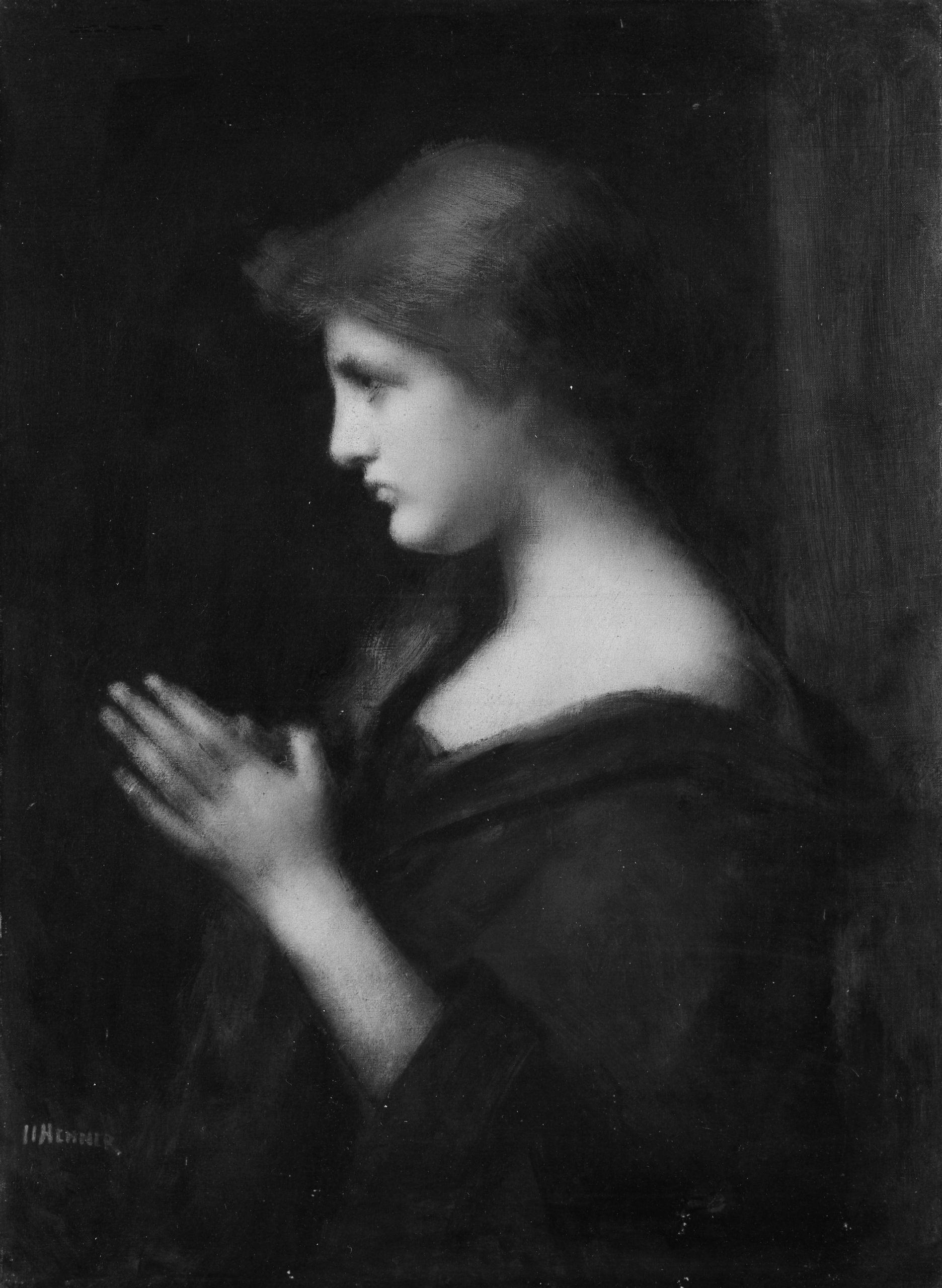
The featured image is “Young Woman Praying” (between 1849 and 1905), by Jean-Jacques Henner, and is in the public domain, courtesy of Wikimedia Commons.



Leave A Comment