
In Willa Cather’s “The Professor’s House,” there’s the new, modern, luxury home built by his wife with prize money Professor St. Peter was awarded following the publication of his eight-volume history on the Spanish explorers in America. The Professor has spent years on the history. But the luxury of the new home represents materialism and so lacks soul.
I. A Suggestive Statement: What Is Civilization?
Tom Outland’s mentor, Father Duchene, offers an explanation expressing reverence for the Mesa Verde “Cliff City.”
….when they first came upon this mesa [they began] with] an orderly and secure life [to develop] considerably the arts of peace…. I see them here, isolated, cut off from other tribes, working out their destiny, making their mesa more and more worthy to be a home for man, purifying life by religious ceremonies and observances, caring respectfully for their dead, protecting the children, doubtless entertaining some feelings of affection and sentiment for this stronghold where they were at once so safe and so comfortable, where they had practically overcome the worst hardships that primitive man had to fear. They were, perhaps, too far advanced for their time and environment.
 There’s more of course in that the Father who has been preaching to a variety of southwestern tribes says that he felt a reverence for the place and hopes that an archeologist would come and revive this civilization in a scholarly work. It is after all a sacred spot built by a people who had no incentive other than a natural yearning for order and security. They built themselves a place and humanized it.
Why, then, begin this article with Father Duchene’s extended monologue? For one it’s in the middle of the book and about the time Tom Outland is about to dash off to be a hero, but also long before America enters the war but when he does go to war, ironically, it’s not for his country but for civilization.
*****
For another kind of answer one might turn to Godfrey St. Peter, an aging professor who at the beginning of Willa Cather’s The Professor’s House is recalling the beginning of his great work and the desire to do it and the difficulties attending such a project, striving together in his mind all those years when he had the courage to say to himself “I will do this dazzling, this beautiful, this utterly impossible thing.”
It took him fifteen years and the eight volumes gained the title The Spanish Adventurers in North America and the whole brought him fame and fortune.
There there’s this nugget:
Forty years after her death, James Woodress published Willa Cather: A Literary Life. Woodress writes that Cather thought by which she meant remembered, that she had read Prescott’s The Conquest of Mexico.
Conquest is a different word than Adventurers, but there’s something suggestive here albeit we know that Prescott established modern, archival-based historical research, and we know St. Peter did the same, but Prescott’s aim was guided by a theory that allowed him to weave notes and records into their proper place in history to fit his theory. Prescott’s theory was concentrated on a great man theory such as political or military figures The theory was also informed by history as dramatic, as literary epic, civilizational conflict, the clash of cultures, and focusing on how Spanish civilization overwhelmed the indigenous Mexican and Southwestern native cultures.
The problem?
Was Prescott’s theory wrong since it may have been based on misconceptions about the Mexican and Southwestern native societies? One might argue that the theory owns a hubristic notion.
Assume for a moment that Professor St. Peter also owns a theory some of which emerges during an exchange with some students and is remarkably like Oswald Spengler’s Decline of the West which argues that cultures pass through stages and when entering a final phase, well, transition into a materialistic civilization, if that’s the right word.
More on that in a bit provided my reader continues to hold interest in my thesis here.
So, 15 years of studying and digesting and sorting and weaving. But what if Professor St. Peter was wrong and his theory owned a similar hubristic notion which by now one might wish to call “a theory mastering history.”
And what would be the effect on our “Professor” now transitioning into an older age and complicated by the clash of cultures in World War I still in close memory magnified by the death of Tom Outland.
And also complicated by the materialism of his family feasting on the monetary gains from Tom Outland’ invention.
Wouldn’t such be almost asphyxiating to a deeply absorbed man?
*****
We team-taught a class devoted to Willa Cather, a history colleague and me, and I do mean devoted. When we arrived at The Professor’s House, I mentioned that her 1922 novel One of Ours had received scathing reviews, which contributed to a bit of malaise on Cather’s part. One reason was that the novel was being classified as a war story, which was not her intention. Rather, the story is about Claude Wheeler, a Nebraska native who is actually a neighbor from Cather’s Nebraska days, killed in World War I. When she learned of his death… well, some of him was buried in France but some was left alive in her. And her further point is that all the ideals that rationalize war own little in the way of a conclusion except meaninglessness with the deaths of too many and too much agony.
Which left her pessimistic that World War I was a war to end all wars buy another flash of cultures opening fissures deeper and wider and surely more problematic.
Thus, in many respects we can be assured that Godfrey St. Peter’s mid-life crisis is centered on Tom Outland’s meaningless sacrifice in World War I and informed by Cather’s further conclusion that the 20th century progressive movement into history was not progressive at all.
Think of it this way, I explained to the class: The character of Claude Wheeler is a grandchild of the frontier but his yearnings propel him toward another frontier perhaps more bloody. Much the same can be said of Tom Outland and lends credence to his story placed in the middle of The Professor’s House.
My argument is that if One of Ours is placed as a bookend, there’s a way to read The Professor’s House as the other bookend and as an evocative masterpiece… but unlike most modern novels Cather has created an introspective, wonderfully redemptive story.
Both novels, however, are under-rated; the reviews are wrong, and there are no technical or aesthetic mistakes.
In this essay I hope to explain why.
II. Some examples of forces working against a very fine novel
The reviews were tepid with comments like subtle and rich but not her greatest; out of her philosophical depth.
In his September 23, 1925 review of Willa Cather’s The Professor’s House, Joseph Wood Krutch argues that the book’s effects are “purely artistic ones.” In spite, however, of the many fine touches, the novel fails to live up to the promises of earlier pages. “Fragmentary and inconclusive, it starts off off in several directions but never quite arrives at any of the proposed destinations.”
The novel is one more explanatory instance of Cather’s attitude toward the modern world. Reading the review which Krutch offers in all seriousness is a bit like shaking hands with a cactus. Still, he confesses, she stands firm and she did over her life challenge the fashionable arguments for scientific progress which she believed led to bleak views of the universe. Her solution became a revival of pantheism, or so he thought, suggestive only but not redemptive.
And there’s plenty of critical picky attention paid to the book’s tripartite structure as neither purposeful nor balanced and some carping criticism about how wealth and fame turn an America of a noble past into an ignoble present cheapened by getting and spending.
It was, furthermore, a landmark year, 1925, which witnessed the publication of oFitzgerald’s The Great Gatsby, Woolf’s Mrs. Dalloway, Dreiser’s An American Tragedy, Hemingway’s In Our Time, Lewis’s Arrowsmith.
One might say it was a year of modern classics unleashed and about which The Guardian announced, the best year for literature adding to the above list Dos Passos’ Manhattan Transfer, and Gide’s The Counterfeiters, and lest we forget, three years prior that landmark modernism novel, Ulysses.
Oh, and The New Yorker began publishing, that witty reflection of life in and around New York City which one might categorize as irony empty of spirit.
Alas, not included even for a modest nod among the stalwarts is Willa Cather’s The Professor’s House also published in 1925.
Such a shame.
Is there any reason, therefore, to make a good claim that the novel is in all rights a classic and Cather’s most profound book perhaps even the equal to Death Comes for the Archbishop?
Not if we accept the New Critics’ argument that Cather had deviated to the point of becoming much like a spinster schoolteacher in a Zane Grey cowboy western.
III. Her Last Word: Not Under Forty
Turn we for a moment to a book Cather published in 1936, Not Under Forty, in which she offered a critique of modern literature. It’s a compilation of essays championing traditional values arguing that the world broke in two after World War I and that younger readers (those under forty) wouldn’t appreciate the older literary world she valued. To add to her critique, she discusses authors she admired including Henry James whom she always regarded as a mentor. It was her last book published and her last word and her strong anti-modernist stance.
So we can make a claim that she is hardly a spinster school teacher if we shape an argument that her values were those which one can find in all her works which are transcendent, spiritual, and very good, and that she mastered the art of the novel at least as Henry James again would have it and long regarded as the foundational guide regarding the novel as a free and serious art form in which the supreme virtue is its “air of reality” and advocating subjective experience, and the psychological depths of character.
To be proven, of course, in the following pages with the following caveat:
There are narrative portions in the novel devoted to exchanges between St. Peter and Augusta. Edit those sections and the novel is no longer redemptive but modern and might thus have gained approval from the “modern” reviewers who would have interpreted St. Peter’s failed attempt at the novel’s conclusion as suicide. Keep those sections and “ponder” them and the novel is redemptive and likely disapproved by the modern reviewers.
IV. Briefly, what then is a redemptive novel?
An answer to the question as to whether the novel progresses as if guiding a broken character from, let’s say, negative, existential crisis-like circumstances to redeemed and restored, perhaps even with a spiritually enlightened ending. It’s also messy, if that’s the right word, but such is the chaff of modern reality, of despair, but into the life of St. Peter, a lifeline of hope.
Think of it this way: rather than the nothingness of existentialism what Professor St. Peter is suffering is the dark knight of the soul which is marked by loneliness, loss of joy, and a questioning of one’s identity or purpose even spiritual dryness, isolation, withdrawal. The solution is sometimes to suggest that the process involves shedding the old ego to allow for a spiritual transformation.
And since I mention dark night of the soul which leads me to suggest that although not a convert Cather’s literary imagination is sacramental, exploring themes of faith and instances in our lives in this world which arrive like empathy, as grace.
V. Then, Too, There’s This:
Veblen’s The Theory of the Leisure Class was published 26 years before Willa Cather’s The Professor’s House. Veblen discusses how wealth affects human behavior especially conspicuous consumption which, according to Veblen, does not confer social status apart from searching out and advertising a family crest to be displayed above the great room hearth. He also argued that a wife, unemployed, of course, is an economic trophy that attests to a husband’s social and economic prowess. In other words, she can be displayed as a form of his conspicuous leisure and as an object of his conspicuous consumption. Agreeing with Veblen, Willian Dean Howells argued that such a system impelled wasteful consumption and the egotistical pursuit of social prestige and thus about which a novel might be written.
With that in mind it’s not unusual for scholars to argue that Cather’s novel is directly informed by Veblen especially the portrayal of characters’ obsessions with material items, including, as I mentioned earlier, all that fuss and fiddle over doorknobs.
As an aside, it’s unclear what Cather might have said about the Volstead Act except for the word “sherry” which figures in the novel and is, by the way, stronger than white wine. Or so I’ve been told. And there is one phrase from the narrator who argues that prohibition is unthinkable so let’s hear it for ardent spirits.
But I stray from my thesis….
Turn we then to Willa Cather’s The Professor’s House which Howell’s might have argued is a novel quite fitting for American fiction, Alas, the “dean” of American letters passed from this earth in 1920. And I would add that it’s a novel which would have garnered approval from Henry James, he the author of The Spoils of Poynton.
VI. The Professor’s House: An Ibsen-like Cast Of Characters Featuring the Family in Their Major Roles
If a novel could by analogy be a “house of fiction,” there are three physical houses in Cather’s novel. There is Professor St. Peter’s shabby but original cramped house with his study on a top floor he shared with a seamstress, Augusta.
Then there’s the new, modern, luxury home built by his wife with prize money St. Peter was awarded following the publication of his eight-volume history on the Spanish explorers in America. The Professor has spent years on the history. But the luxury of the new home represents materialism and so lacks soul. His wife encourages him to leave his top floor study arguing that the new home will offer him his own private bath and a much better study befitting a scholar of international reputation.
And the third, the grand manor house, Outland, the Norwegian lakeside mansion being built by his daughter and son-in-law presumably to memorialize Tom Outland, but which is actually an extravagant use of the fortune Outland left behind with the exploit of his patent. The two intend to create one room of the home as a museum-like testimony to Tom Outland which Outland himself would likely think of as “grotesque, and an idea that would have been better if they left it alone.”
But there’s also the Mesa Verde cliff dwellings which are not traditional homes but need to be understood as untainted beauty. We learn about these Southwestern dwellings in the second part of the Novel which acquaints the reader with the character Tom Outland who at the beginning of this section explains to St. Peter his visit to the Mesa and climbing to the Cliff City had discovered through the box canyon. He and a partner began to excavate discovering clothing, surgical instruments and various artistic touches especially in the pottery which suggested an artistic people. The wonder is what might have happened to these people and why and how they disappeared. An affinity develops between St. Peter and Tom since both seem to own a reverence for the site which in Cather’s time was one of many sites ransacked, an indication of lack of respect, a modern vice.
Against this, as we shall see, Cather poses the creeping commercial culture hollowing out America; add to an undermining and vulgarizing education which also meant to abolish the type of cultural studies so valued by Professor Godfrey St. Peter who becomes depressed not only by creeping age and the pressures to make the university into some kind of trade school under the mantra of showing results.
Godfrey St. Peter, then, a professor of history, and once again the author of the multi-volume Spanish Adventurers in North America for which he won a substantial cash prize and has been used to build a new house although he prefers his older home which for him is his sanctuary. He struggles with aging but then who doesn’t. He is a character Henry James would reference as the “center of consciousness” and around whom rotate “satellite” characters. Close reading suggests he’s a complex man. He loves his work but realizes he could be losing interest even in life itself. We know that as the novel develops, he says he has never contemplated suicide but events in the third section the novel in which he nearly loses his life suggest that such a death could be an unconscious desire for suicide.
Or something much more accidental….
So, the fortune has made Lillian St. Peter, the professor’s wife, a sort of social maven who pushes and prods and has come to describe her husband as intolerant. She further becomes jealous of Tom Outland; and she has taken up the causes of her sons-in-law also by using the fortune to push their careers forward. One should also note the profound differences starting early in the marriage when St. Peter took the first academic post offered but less the quality of the college and more from an early love for Lillian. Over time, however, she becomes critical of St. Peter’s social behavior complicated by what she sees as taciturnity and introversion. But like most of these satellite characters, Lillian is spiritually deprived.
Rosamund Marsellus, eldest daughter, fair-haired beauty, engaged to Tom Outland who is killed in World War I but who leaves his invention patent to Rosamund who marries Louie Marsellus. The two become well-off because of Outland’s invention and can be understood as members of the leisure class. She is, however, remarkably different from her earlier behavior but the money from the commercialization of the invention has made her pretentious, extravagant and ostentatious. St. Peter prefers not to be around her since the money has made her not only hard, but insensitive and miserly adding to the distance between herself and her sister, Kathleen. And again, spiritually deprived.
Louie Marsellus, married to Rosamund, whose extroversion and social ambition make him insensitive. He at one point makes the argument that he enjoys “dressing” his wife and thus making a show of her to demonstrate his wealth. With his wife, they become the primary exploiters of Outland’s invention. His focus in life is his display of wealth and leisure activities. After Louie becomes executor to Outland’s patent, St. Peter thinks of his son-in-law as an opportunistic war-profiteer and in a comparison with Tom Outland, well, not measurable.
There’s also the emerald necklace/turquoise bracelet scene in which Louie displays a very expensive necklace commenting on how he enjoys dressing Rosamund with such but recalls she having oncer worn a burnished silver turquoise bracelet and wonders where it might be. Rosamund blushes for a bit since it’s been confined to the back part of a drawer, out of sight and out of mind. The bracelet was given to her by Tom Outland but now, well, of less value. So again, spiritually deprived.
As for the grand Manor House he is building with his wife, there is much ado about doorknobs of a certain kind for the married couple’s chateau which again has acquired the name, “Outland.” He is Jewish and is described by Cather as an exotic of sorts compared to the very small social world of Hamilton. We know little of his background unless he symbolizes an anti-Semitic archetype. And the larger problem here is the representation of Louie which has both puzzled and disturbed critics. The question, then, is whether the novel gains or loses with St. Peter’s negative views of his son-in-law compared to the very positive views of Tom Outland. It’s also important to understand St. Peter’s profound sorrow at the loss of Tom Outland who registered for the draft and lost his life in the war whereas the Jewish character likely did not register for the draft albeit he is apparently within a few years of Outland’s age. There’s also the issue of Rosamund and Louie becoming engaged rather soon after Tom’s death and the rush to the altar to avoid conscription.
Scott and Kathleen McGregor, the professor’s younger daughter married to Scott. He had hopes of becoming a novelist but has instead spent his time writing advertising jingles and editorials for a small-town paper. The fact that his ambitions have not been realized has caused him to radiate bitterness. To complicate matters, he was a student at the same time as Tom Outland, Then, too, he is scornful toward Rosamund and Louie because of their material pretentiousness and social climbing ambition..
Kathleen is the younger daughter; she’s an amateur artist who in earlier days adored her sister. With wealth from the Outland Vacuum, however, she has grown jealous and resentful by the way Rosamund and Louie look down at others especially her and her husband. Both spiritually deprived.
Augusta, then, a seamstress who shares the attic space in the old house with St. Peter. She embodies humanity and common sense and a Catholic faith and who saves the professor’s life especially in a pivotal event near the novel’s ending. To be accurate, the novel succeeds because of her faithful spiritual reality which stands against the materialistic modern emptiness. She’s anchored in her faith which is a corrective influence if not a life-affirming force. More on her in a bit since she will come to represent the redemptive aspects of the novel.
Finally, there is Tom Outland who is something of a genius and who becomes a surrogate sort of son for St. Peter. He helped St. Peter with his book and also becomes endeared to St. Peter’s daughters. He esteems the simple life and is offended by a materialistic upper middle-class style of life. He invents with help the Outland Vacuum, patents it, and leaves the patent to Rosamund. He is remembered by all with fondness if not love. And although dead before the main action of the book, his moral center haunts the narrative as, perhaps, the spirit of the vanishing frontier; his story occupies the middle section of the novel as a legacy. One might note that his death can be chalked up to some kind of noble sacrifice to all the faceless forces working against the arts of peace.
VII. And So, Book One, St. Peter Alone
Having said that, turn we then to Willa Cather’s very fine redemptive novel, The Professor’s House.
With this caveat from Henry James, a mentor to Cather who believed in and followed his literary example:
There are key aspects: (1) a slow detailing of a fictional moment; (2) psychological realism focusing on the internal consciousness of a character; (3) slowing down time to focus on immediate experience; (4) solidity of specification to build an air of reality….
Keep in mind this idea: How would Henry James read Cather’s novel noting for the moment that the novel comes very close to a Jamesian situation with a Jamesian psychological character, Godfrey St. Peter.
As for point of view: the narrative is delivered through a third person limited perspective focusing again on the consciousness and inner life of St.Peter. Sentence-by-sentence, scene-by-scene the narrator emphasizes his emotional detachment, mid-life malaise, reflections on memory, success and loss as he navigates moving out of his old home. The narrator allows the reader to experience his disillusionment with his family and career while finding comfort in his old sturdy.
The effect is as if a camera were quietly following along behind St. Peter alone in his old house where he had lived since his marriage, brought up his two daughters while detail piles on detail.
The moving was over and gone…
St. Peter was alone in the dismantled house…
It was almost as ugly as it is possible for a house to be…
As he walked slowly about the empty, echoing rooms…
His appearance is narrated in close detail suggesting the Spanish look of a conquistador but with a suggestion of cruelty.
A long brown face with an oval chin over which he wore a close trimmed Van Dyke like a tuft of shiny black hair…
With this silky, very black hair he had a tawny skin with gold light in it…
A hawk nose and hawk-like eyes—brown and gold and green set in ample cavities…
Thick, curly black eyebrows turned up sharply at the outer ends…
Wicked looking searching eyes which had lost none of their fire but just now the man behind them was feeling a diminution of ardor…
In fact he looked like a Spaniard…
And then comes the moment still alone when he looks out onto his back walled-in garden which had been the comfort of his life, a French garden which was where he and Tom Outland would sit and talk half through the warm soft nights.
But then on this September morning St. Peter knew he could no longer evade the effects of change by tarrying among his autumn flowers; his old house was now a dead, empty house. This was the place he had worked but not he alone.
The next detail is important: he shared the cubby of his study with Augusta, the sewing-woman, niece of his old landlord, a reliable, methodical spinster, a German Catholic and very devout. Still, she enjoyed the banter supported by what she knew was his ultimate delicacy.
But this September morning the door opened and there stood Augusta herself.
St. Peter stood; Augusta loved his manners. He invites her to talk and in confidence he explains that he and Lillian have separated.
But why talk just so with Augusta unless they have enough familiarity for him to just so “confess.” A word, by the way, I’m using consciously.
He and Augusta sit down to talk it over to the point in which she becomes vexed with him about her dress forms which she needs to move to the new house, but he shouts that they “shan’t be moved but she should go and buy some new.”
If this were an Ibsen-sort of moment on stage, the audience would be disturbed by the outburst and how it represents a berating which seems to be out of character but is a descent into a life without joy, a life of disillusionment, weary, and his older social life dying and his self-knowledge that he has no choice but to move forward, accepting his isolation and a life of apathy vectoring into despair.
He’s in denial, as was his namesake, and needs reinstatement.
What follows is an outburst one might read as mean-spirited but really is his need for some simple, enduring, dare I say loving, connection.
It’s cynical when he fairly shouts at Augusta to remind him “when it’s All Souls’ Day or Ember Day, or Maundy Thursday, or anything?’
Well, the anything is an everything and when observed sanctifies the seasons and focuses our attention and so different from everything pulling him away from the egotistical heartlessness that frightens him. And it’s here that one can imagine why Cather names him “St. Peter” since the name represents the argument that anyone who requires faith is obliged to pay for it dearly.
What are these other than commemoration days in the Christian church, penance days intended to foster spiritual renewal, or a day set aside to pray for poor souls or for oneself and to obtain a plenary indulgence.
We live by these days during which there is no fussing about doorknobs or emerald necklaces or manor houses with expansive views.
Augusta was vexed with him now, and a little ashamed of him. She said she must be leaving. St. Peter, alone again, hears her well-known tread as she descended the stairs.
The narrative continues with this motionlessly seeing from this center of consciousness. He notes that he had worked on his great project again for fifteen years during which time his daughters were little girls. There were the sabbatical years in Spain, time spent in Old Mexico, dashes to France, but always back to the sewing room where he sorted and wove his notes and records and ideas into “his” history.
But fairly considered then there is this “his” history and the sewing room where he could get isolation from the engaging drama of domestic life that went on below. No one was tramping over him and he lived “his” history with only a vague sense of what went on below or coming up the narrow stairway.
What’s interesting here is that his proper place in this history of “his” should also have been with his family.
He was a deeply absorbed man.
He recalls how he was by no means an asset but had managed to have some luxuries except for the furnace heat which did not rise to the third floor and which did not include an electric light. He preferred faithful kerosene lamps and a round gas stove that had no flue and which operated imperfectly to the point in which the gas contaminated the air which led to leaving the window open but with the danger that a sudden gust of wind could blow the wretched gas stove out altogether; a deeply absorbed man might be asphyxiated before he knew it.
It’s called, of course, foreshadowing.
It’s also called “colloquy,” this mental discussion St. Peter holds with himself as he continues knowingly that he had burned the candle at both ends but thinking about it at his advancing age made his headache.
But he believed and the narrative is marked by this sentence that “Desire is a creation, is the magical element in that process.”
Perhaps so or perhaps such an epigram attached to the summary of one’s life could be misleading.
****
A week or so later into September which had become warm, windy, golden with the smell of ripe grapes, St. Peter found himself in his campus office and in conversation with a few students on whether science has given us any new amazements or any richer pleasures.
St. Peter comments that science has taken us away from the real problems. The subtext, of course, is that progressivism has taken us away from the real problems.
The fact is that the human mind has always been made more interesting by dwelling on old riddles even if it makes nothing of them. It’s always been better for the human mind to dwell on the old riddles.
What follows in this discussion between St. Peter and his students is worth quoting in full:
I don’t think you help people by making their conduct of no importance—you impoverish them. As long as every man and woman who crowded into the cathedrals on Easter Sunday was a principal in a gorgeous drama with God, glittering angels on one side and the shadows of evil coming and going on the other, life was a rich thing. The king and the beggar had the same chance at miracles and great temptations and revelations. And that’s what makes men happy, believing in the the mystery of their own little individual lives. It makes us happy to surround our creature needs and bodily instincts with as much pomp and circumstance as possible. Art and religion (they are the same thing in the end of course) have given man the only happiness he has ever had….
….life was a rich thing
….art and religion the same thing
….have given man the only happiness he has ever had
And so he professes but is what he professes true and that all that was needed was to have theologians without sacrilege change the prayer a little: “Thy will be done in art as it is in heaven.”
The issue with Augusta is one thing but with the students another thing, Is what St. Peter professing sacrilege? His wife, Lillian, concludes only that what he was doing was in “bad taste.”
Has the word “professor” placed in front of St. Peter lost its honor?
What emerges with close reading, then, is that Cather is using St. Peter to voice Oswald Spengler and his seminal two volume historical work Decline of the West, which identifies the gradual decline of the west from that golden adage of cathedrals into a rigid materialistic civilization. If that’s the case, then Christian civilization as St. Peter would understand it, was in unavoidable decline to be replaced in a new era which was no longer Christian,
Let us turn then to Book XI to the second “theological” discussion between St. Peter and Augusta. It’s Christmas Day and he’s on his way to the old house with a packet of sandwiches.
He meets Augusta coming from Mass. He asks if she is coming some time to deck the forms still in his study. He likes to see them looking smart.
She laughs but scolds him about some of the things he says but then adds that she tells people he doesn’t mean half the things he says. The emphasis is mine.
She adds gravely about the slighting things about the church that he says in class and to remember that the students are not as smart as him and that he “ought to be careful.”
He then asks about the “Mystical Rose, Lily of Zion, Tower of Ivory” and whether those references are in the Magnificat.
She chides his lack of religious instruction. He blames his Methodist mother and the fact there was no Catholic Church in his Kansas hometown and wonders what then is the Magnificat which she then says as beginning “My soul doth magnify the Lord” which he thinks was about the Virgin. She says with firm exclamation: “Oh no, Professor! The Blessed Virgin composed the Magnificat.”
And then, the narrator notes, “St. Peter became intensely interested, ‘Oh she did?”
Augusta spoke gently as if she did not wish to rebuke his ignorance and then described what is best understood as an historical moment during which the angel announced that she would be the mother of our Lord, this Blessed Virgin, who composed the Magnificat.
The day passes with the Professor mechanically at his work until the bells from Augusta’s church pealing out their meaning to tell him that the Christmas Day was gone.
Why does Cather place this scene in the novel?
Well, apart from all else surrounding St. Peter, a prayer is arising celebrating in history a revolutionary message highlighting God’s preference for the poor, the hungry, and the oppressed and acting as a mission statement for Jesus whom, I might add, in history is magnified through acts of justice, opposing worldly powers and embracing humility.
And a seed, perhaps, planted in St. Peter’s mind, heart, and soul and which can grow, or not.
What happens next in the novel are various scenes in which St. Peter’s mind attempts to fasten upon some fugitive ideas.
Turn we then to Book Three which follows Book Two, the interim story of Tom Outland which explores a young cowboy’s exploration of the western landscape which Cather phrases as carrying in his pockets the secrets of (old) trails and stones and watercourses. His parents migrated west when he was a baby but died leaving Tom ignorant even of his birthdate. His whole identity was dependent upon life on the frontier. He was tall and well-built and a remarkable specimen of manly beauty.
What though did Cather have in mind? Perhaps an argument that Tom was an incarnation of the true Western experience and a true adventurer and not just another a conquerer. If he is a man of clear conscience, too, well he blurs the notion of western expansion as manifest destiny but carefully distinct from the contemporary history in Books One and Three and which suggests that Cather endorses the frontier narrative standing in juxtaposition to the modernism in Book One and reappearing in Three. In other words, Cather’s formulation, her purpose, in Book Two as an interlude which implies a certain kind of romanticism with cultural values found in other Cather novels including, of course, Death Comes for the Archbishop.
By analogy, perhaps, it’s the Book Two interlude and those pieces of turquoise set in the burnished silver of Books One and Three.
Hard to imagine the novel without this representation of true beauty.
*****
When the first of August came around the Professor realized that he had trifled away nearly two months at a task that should have taken less than a week. When not at work, which largely had come to mean being actively amused, he went to sleep. He was also contemplating a mental dissipation which he thought meant a return to the original unmodified Godfrey St, Peter as a boy and the beginnings until he became the man he was now but still the Kansas boy remembering and bringing up long forgotten memories which he thought also that what might be left are only a few years in which a man can consider his estate if he was living those few years near the end.
In fact, as the fall term approached, he was thinking that he might not be alive during the fall terms.
When he went to see his doctor, he asked if he were low in his mind. St. Peter said no and that he enjoyed doing nothing. Even with the feeling that he was near the end of his life which he analogized was like walking across the-country and suddenly finding himself near the sea.
The fall term opened and came the day when he went wearily up the stairs to his cubby and lay down on his couch which had become a refuge from ever increasing fatigue. He remembered some lines from Longfellow about a house “was built / Ere thou wast born; / For thee a mould was made / Ere though of woman earnest.” He thinks he could almost believe himself in that house already—that is his coffin.
And so a bit of memento mori, while he remembered times when the loneliness of death had terrified him.
And for a while he did not go out of the house or leave his tidy cubby, A rainstorm blew in. And it became cold.
He believed he was safe for the night and lit the stove and lay down on the couch. The fire made a flickering pattern of light; he watched it and fell asleep.
The wind was increasing but he was deep in sleep.
When he awoke he was cold and numb and felt sick and dazed.
His long anticipated coincidence had happened. The thing to do was to get up and open the window.
How far, though, was a man to exert himself against accident?
At midnight Augusta’s church was ringing the hour.
She was there sitting in her old sewing chair by the lamp wrapped in a shawl reading a little much-worn religious book that she always carried.
She had heard him fall and rushed to the cubby and opened windows.
It was an ugly accident but she had the presence of mind to pull him out literally into the hall.
All’s well that ends well she quips.
He asked her to stay the night; at would be a comfort.
She sits down and take up her little religious book.
She was needed and something about her presence made death less uncomfortable.
As he lay on his couch St. Peter relaxed and thought how he would rather have Augusta with him just now than any one he could think of.
And although the paternal relations could be painful, she was still Augusta, a world full of Augustas with whom one was outward bound.
And then this:
All the afternoon he had sat at the table where Augusta was now reading. He was lying there thinking over his life; he was thinking where he had made his mistake and supposed he might have to live without sherry.
With the accident, then, that temporary release from consciousness had been beneficial. He had let something go—and it was gone and he was not the same man.
At least he now felt the ground under his fee. He thought he knew where he was and that he could face the Berengaria and the future.
A redemptive moment?
St. Peter it’s important to note is the gate keeper of Heaven but also a man who denied Christ three times. He is not, furthermore, God-free, but in the process narrated in the time with Augusta reading at the table he realizes he has lost so much of his natural self, especially his spiritual life. He did physically save himself but with Augusta sitting there she has become his moral guide, a corrective, a remedial influence even if all of the would have the taste of bitter herbs as the truth often is.
All of which of which are represented by Augusta who sits at her table reading her religious book and if one were to picture the scene is to liken a figure from a Dutch painting.
He relinquishes his ego but has gained fortitude. He sees Augusta as humankind but surely not artificial like his wife but with true and ancient properties.
How else to understand the word Berengaria, a famous luxury liner ship of fools upon which his family will set sale and make their way home but also Queen to Richard II of England but compared to the people of the Cliff City. Spiritually empty, that is except for the Queen who in history is known as sustained by her faith in Christianity and a model of piety.
All of this is history, is it not? And the way to mediate between the past and the present with fortitude and the future.
A Postscript
Professor Daniel James Sundahl
A Vignette: The Jeweler’s Table At The Antiques Roadshow
Carl Menger was at the jeweler’s table substituting. He had a white tablecloth spread nicely and on the tablecloth but under good lighting was a cup of water, an emerald necklace, and a turquoise bracelet set in burnished silver.
People stopped by but quizzical. Carl asked each one which of the three items had the most value? The paper cup of water? The emerald necklace with no hallmark set in 18-carat gold with perfectly matched tear-drop emeralds surrounded by myriads of full-cut diamonds? Or the bracelet which was in silver which had little shine but set with 20 dime-sized cabochon turquoise? He explained that it was Native Southwestern American made by the Pueblo people, likely Anasazi, with the stone colored in shades from sky blue to greenish blue, and a few with dark spiderweb matrix patterns and very likely from the Black Widow mine. He added that the Pueblo people held a belief that pots filled with turquoise could be found at the ends of a rainbow.
Unlike the necklace, the turquoise stones were not matched but in size only.
Of course, the value depends upon context, is subjective, is scarce, can be based upon utility, market factors, and so on.
No one chose the cup of water.
Most chose the emerald necklace.
__________
The Imaginative Conservative applies the principle of appreciation to the discussion of culture and politics—we approach dialogue with magnanimity rather than with mere civility. Will you help us remain a refreshing oasis in the increasingly contentious arena of modern discourse? Please consider donating now.
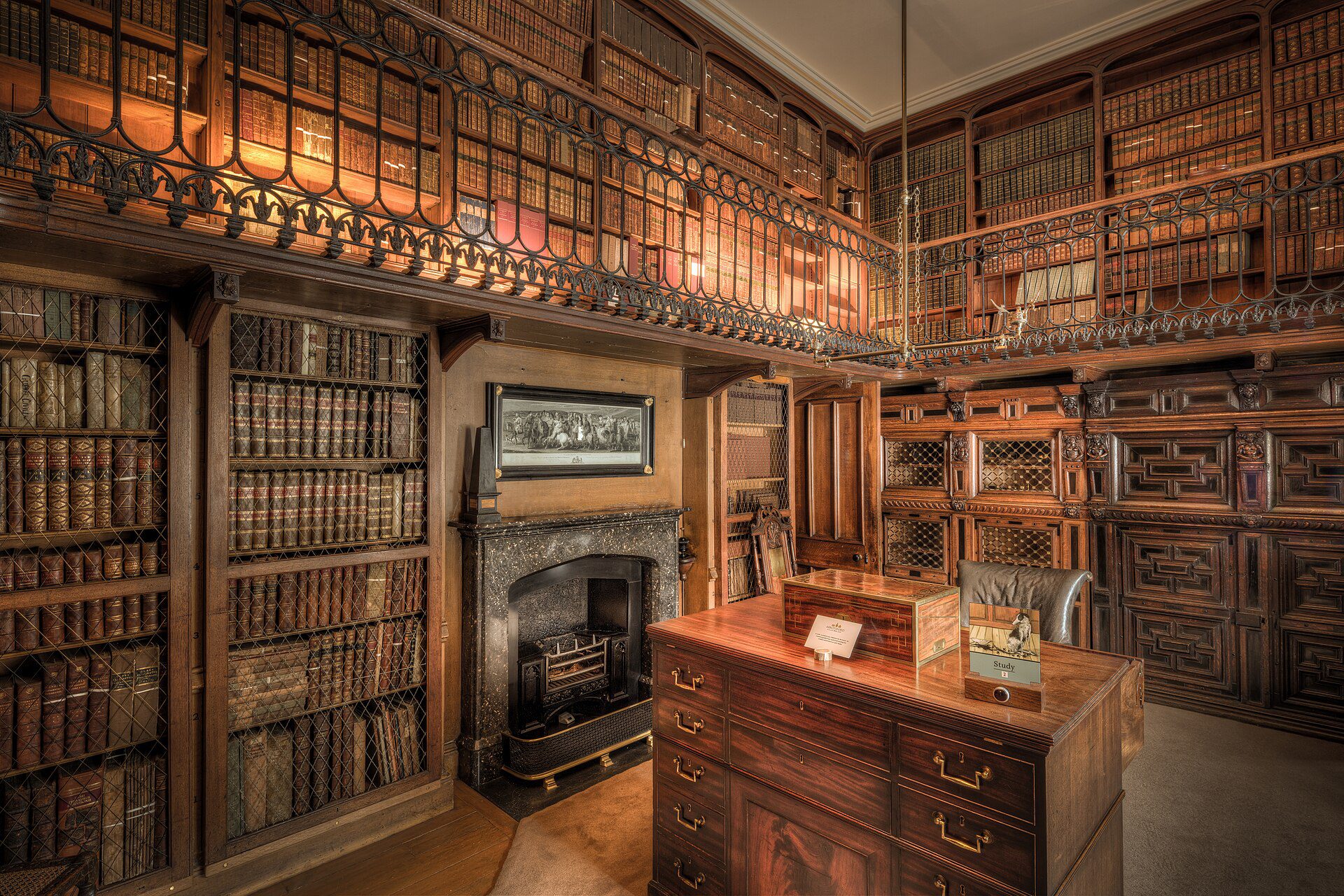
The featured image, uploaded by Michael D Beckwith, is “The Library” (6 March 2018). This file is made available under the Creative Commons CC0 1.0 Universal Public Domain Dedication. courtesy of Wikimedia Commons.





Leave A Comment