
Insofar as we understand Plato and Aristotle, we understand where the great thinkers of Christendom, the great writers of Christendom, are coming from. If we don’t understand those philosophers, we will be groping and grappling in the dark, or at least in the twilight, trying to make sense of something three or four parts removed from its source.
This is an edited and abridged version of a part of Joseph Pearce’s ongoing conversation with Polish scholar, Jan Franzsak, which is being published in the Polish journal, PCh24.pl. This is its first publication in English.
 JF: Would you say that, for an average reader, it is important to get to know at least some works of ancient philosophy to understand literature, to understand the great works of literature?
JP: Yes, especially Aristotle and Plato – and Socrates via those two. They’re foundational. Basically, most Christian literature is either explicitly or implicitly Aristotelian or Platonic. Insofar as we understand Plato and Aristotle, we understand where the great thinkers of Christendom, the great writers of Christendom, are coming from. If we don’t understand those philosophers, we will be groping and grappling in the dark, or at least in the twilight, trying to make sense of something three or four parts removed from its source. We understand Augustine if we understand Plato; we understand Aquinas if we understand Aristotle. So it’s important to read at least the major works of Plato and Aristotle if no others.
JF: Can you think of any particular text that such an average reader should read?
JP: The most important text of Aristotle is the Nicomachean Ethics – that’s the foundation, in some sense, of the philosophy of ethics, moral philosophy. But I would also say, for those of us interested in literature, to read his Poetics, because there are some great insights into literary meaning as opposed to literal meaning in that. And as regards Plato, well, Plato’s Republic obviously is an absolutely essential work.
JF: In your book, Literature: What Every Catholic Should Know, you list 100 works of literature that we should know because these are really great books that everybody should read. I know that to make such a selection is a risky task because you always have to omit works which you think are also important, but I am still a little bit surprised that you didn’t include the Confessions by St. Augustine.
JP: Well, that’s a very good criticism. Actually, I wrote the introduction to the Our Sunday Visitor edition of the Confessions. I love it. In another of my books, 12 Great Books, I include a chapter on the Confessions as one of the twelve. So I have made amends, if you like, in other places.
I suppose if I were to try to defend myself, that list of 100 books doesn’t include Aristotle’s Ethics nor does it include Plato’s Republic. In other words, it’s a list of 100 works specifically of literature. And although the Confessions is very literary – as is, for instance, John Henry Newman’s Apologia Pro Vita Sua, which is another great autobiographical confession – they are really works of non-fiction. And so I was erring on the side of that which is indubitably literary, as opposed to works of non-fiction, because once you start including works of non-fiction, then why not Plato’s Republic or Aristotle’s Ethics or Augustine’s City of God or at least a selection of the Summa Theologica? I mean, once you open out beyond literature – and that book is Literature: What Every Catholic Should Know – once you broaden it, then all of a sudden it becomes impossible to narrow it down to 100. So that would be my defense. But obviously it’s one of the great works of Western civilization and of Christendom. And as I say, in my book 12 Great Books, one of the 12 great books I discuss is Augustine’s Confessions.
JF: I think that the Confessions is a type of literature – not only like a kind of testimony, but a kind of literature – that I would say is typical in our times because there are many diaries that are being published. And because of that I think it is a fundamental work, too.
JP: I agree. It’s also probably the progenitor of the whole genre of autobiography. So it’s a first, a foundational text. So I’m certainly not in the least trying to claim it’s not important enough to be on the list. I’m merely trying to explain why I erred on the side of works which are strictly literary – not literary in the broader sense. The Bible is literary in the broader sense, but I was focusing solely on pure literature as in poetry and fictional narrative. So that’s why it’s not there. Whether it should be there is a moot point, and I’m not disagreeing with you, but I’m just explaining why it isn’t.
JF: But you do mention St. Augustine in Literature: What Every Catholic Should Know, because you talk about what he writes about interpretation and allegory.
JP: That’s right. In De Doctrina Christiana, Augustine gives us the tools by which to read literarily in his discussion of natural signs and conventional signs. These are very important tools for reading allegorically or literarily. So Augustine is truly foundational in showing us how to read literarily.
JF: Okay, I understand your reasons for not including Confessions in the 100 books every Catholic should read, but you included The Consolation of Philosophy by Boethius. Surely this is also a work of philosophy, not literature. So why this particular work?
JP: That’s actually a good question as well because you could argue that Boethius’s Consolatio is a work of philosophy, a foundational work of philosophy. It’s not a work of literature. And that would be a good point, and that would be true. My reason for including it, apart from its historical significance as a foundational text in Christian philosophy, is that it is also a text which uses the literary genre of formal allegory, with the persona of Lady Philosophy who is a personified abstraction. The employment of personified abstractions is a very important literary technique, the literary genre of formal allegory, which we need to know about and be able to distinguish from more subtle or nuanced forms of allegory. It’s included in my list, apart from its place as a foundational text of philosophy, as a work which establishes the genre of formal allegory.
JF: And it contains some poetry too because there are poetic fragments. So from this point of view it’s obvious that it should be included, right?
JP: Yes. And Boethius’s De Musica, which is a very important work in terms of its influence on the culture of Christendom, is not on the list. It’s not a work that’s known as much these days, but it’s an absolutely important and foundational work in the study of music in the broadest sense of the muses – not merely the instrumental music that’s played with musical instruments, but God’s deeper music of creation in the cosmos. As creatures made in the image of God, the imago Dei, we are also creators who can make music, not merely music in the sense of symphonies or operas or polyphony, but in the broader sense of novels and poetry and sculpture and cathedrals. So yes, in order to understand our own place in the cosmos as those made in the image of God the poet, God the musician, God the composer, De Musica by Boethius is a crucial work.
JF: And by the way, that concept was used in The Chronicles of Narnia, where the world is in a way sung into existence.
JP: Yes, absolutely. So Aslan sings Narnia into being, and Narnia is Aslan’s Song. But also in The Silmarillion by Tolkien, Middle-earth is brought into being as the Great Music – God as the composer of the great symphony of the cosmos. So both Tolkien and Lewis, being medievalists and well-versed in Boethius’s understanding of music, bring this understanding – the music of the spheres, the music of the cosmos – into their own works.
__________
The Imaginative Conservative applies the principle of appreciation to the discussion of culture and politics—we approach dialogue with magnanimity rather than with mere civility. Will you help us remain a refreshing oasis in the increasingly contentious arena of modern discourse? Please consider donating now.
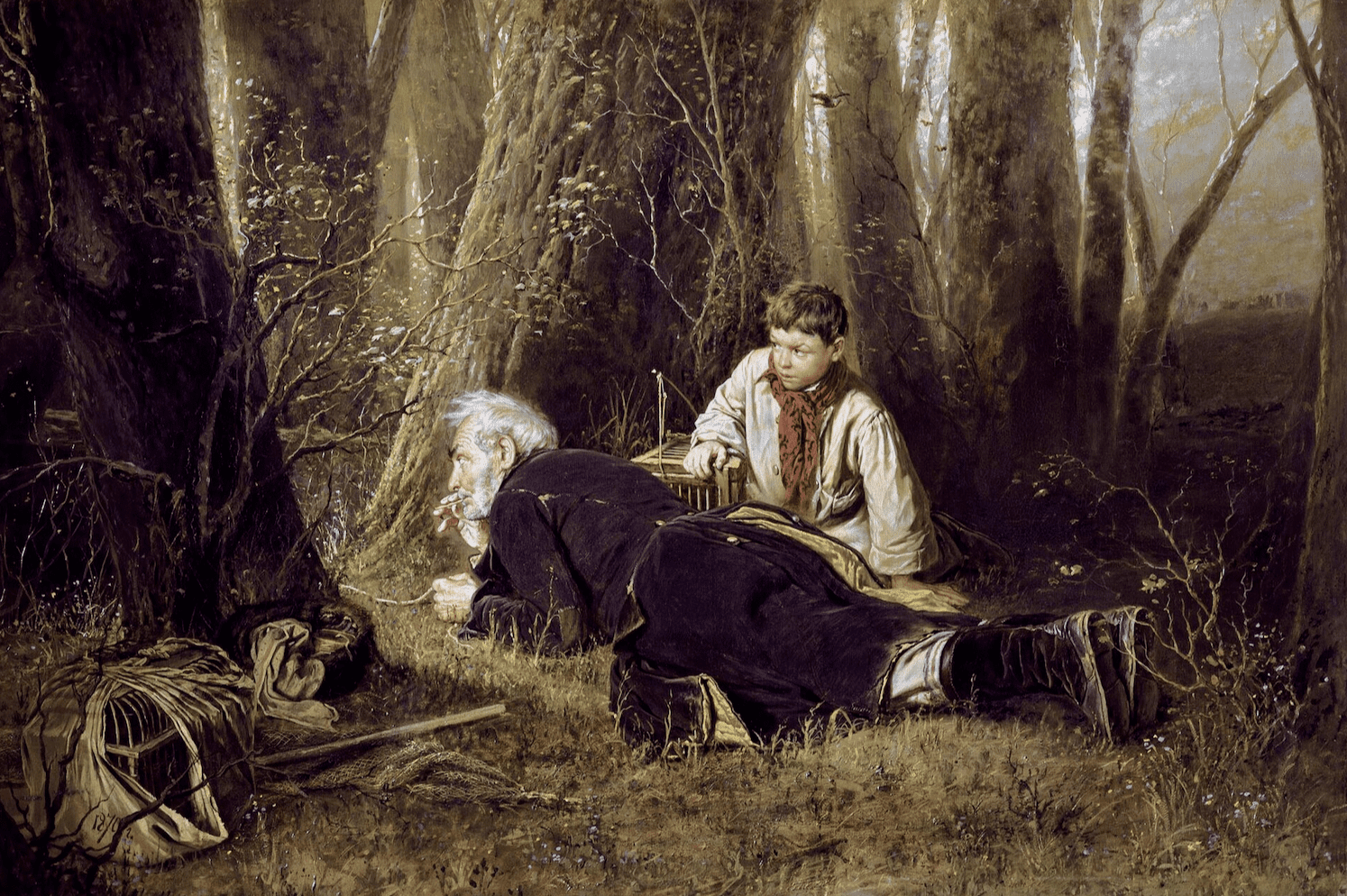
The featured image is “Birdcatcher” (1870), by Vasily Perov, and is in the public domain, courtesy of Wikimedia Commons.





Leave A Comment