
Strange though it might seem at one level, our Lord seems to have been a general contractor. Or perhaps it is not strange. After all, if he is indeed the Word by whom the Father created all things, it is perhaps fitting that he would do in miniature what he does at the level of the universe itself.
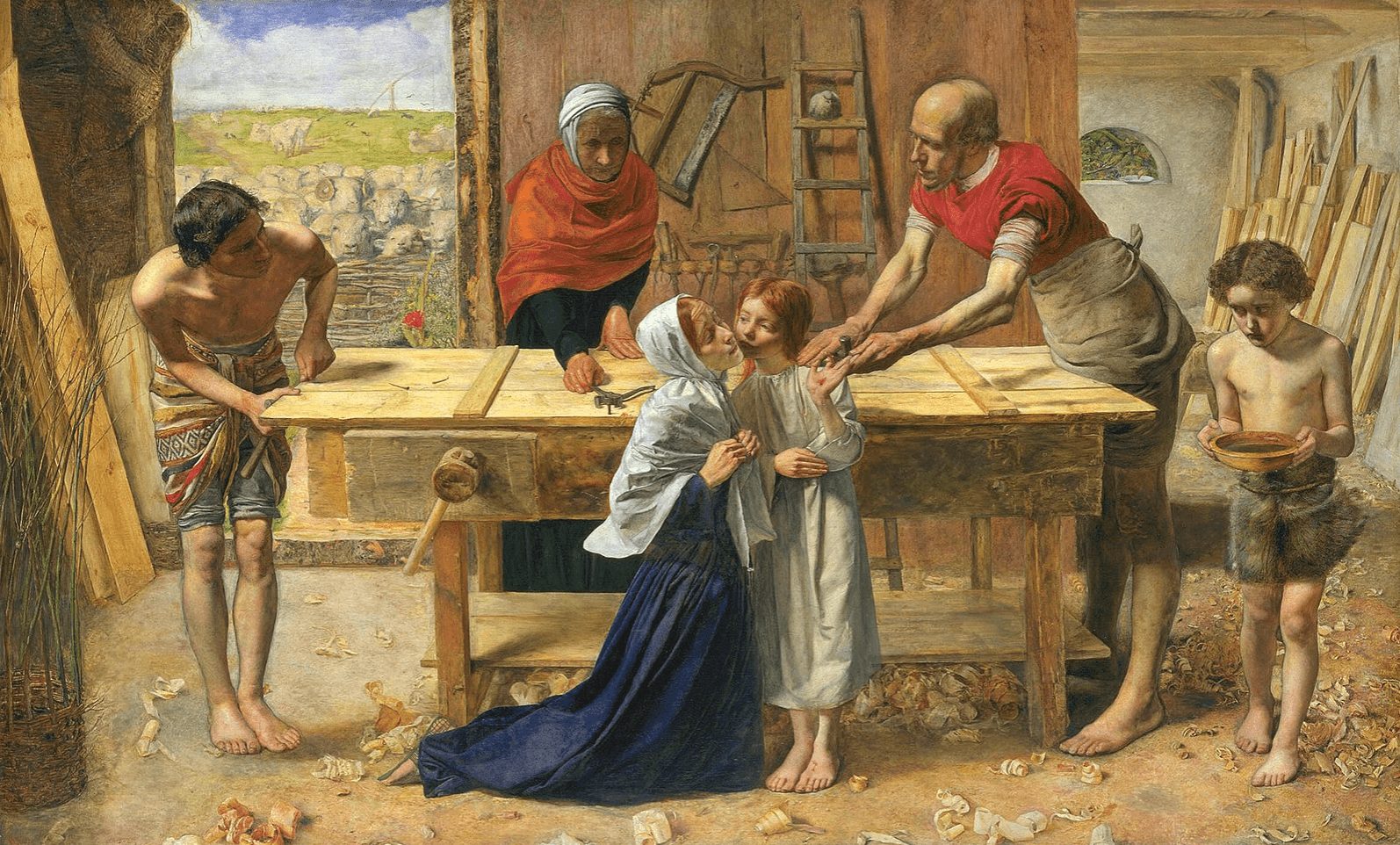 Lent is soon upon the Christian world. A time of focus on the public ministry of Jesus of Nazareth as it led him to a death that completed his sacrificial life of doing his Father’s will wholeheartedly and without blemish. This season follows closely upon the broader Christmas season that marks the Lord’s birth as a child as helpless as you and I were.
Both of these seasons are full of wonder for the believer, and even those who do not believe yet find Jesus of Nazareth one of the most compelling figures in history. What I’ve often wondered about, however, is what has been called the “hidden life in Nazareth”—that period of time about which the Gospel writers are so silent. After the incident in the Temple at age twelve, we hear not a peep about the one who explained to Mary and Joseph that his failure to join the family caravan home from Jerusalem was because he “had to be in his Father’s house” (Luke 2:49) until the beginning of that public ministry, traditionally said to be around age thirty.
Eighteen years of activity about which we hear nothing. Yet what we know about this period is itself full of wonder and some lessons for us. And we do know something. According to Mark 6:3, he was, like his father, known as a carpenter. “Is not this the carpenter, the son of Mary and brother of James and Jose and Judas and Simon, and are not his sisters here with us?” Given Joseph’s disappearance from the Gospel story after the finding in the temple, it seems likely that our Lord himself took over the family business before he began his three-year ministry and journey toward crucifixion, resurrection, and ascension into heaven.
This is significant for a few reasons. First, when you think about our Lord’s life, the running of a business was what he did for most of it. What was hidden about his life during this period was not his humanity but his divinity. He who did not consider equality with God something to be grasped also did not consider having that equality with God something that the people around him needed to grasp either. He was perfectly content to be known as a carpenter until such a time as his Father willed otherwise.
Second, contrary to the way some people would like to depict Jesus, it is pretty likely that, though he wasn’t rich, neither was he a poor man, one of those day laborers in his parables who go around looking for work in fields or on projects. He was certainly not a hippie or a revolutionary. We may think of his work in too narrow a term because of the usual English translation “carpenter,” making us think of him as limited to small projects such as the table he is shown making in Mel Gibson’s film The Passion. But while the only thing we see him making in the Gospels is the whip with which he drove out the money changers from the Temple, tektōn, the word in Greek that we translate as carpenter, is perhaps better designated as “builder.” The New Testament scholar Martin Hengel called it “a Greek word which means mason, carpenter, cartwright and joiner all rolled up into one.”
In short, strange though it might seem at one level, our Lord seems to have been a general contractor. Or perhaps it is not strange. After all, if he is indeed the Word by whom the Father created all things—the Pantokrator—it is perhaps fitting that he would do in miniature what he does at the level of the universe itself. He for whom the cosmos is itself a doll house or toy theatre made himself small such that he could play his part amidst his creatures whom he had given life and free will in order that they could join him in ruling that cozy universal theater.
Yet there is something even more wondrous and revelatory about this life in his family business. Given my experience with such men and perhaps yours, I suppose it is not surprising that he who promised to prepare a dwelling place for us refused to tell us when exactly he would return—and that many people doubt he’ll ever get around to it. The business of supernatural faith—especially that hope we have that he will come to judge the living and the dead—is a bit like that of our natural dealings with contractors.
But there is a third element to this hidden life, namely in the Christian approach to property that this entails. As a business owner, Jesus was a man who most certainly knew about the making of money. Think back to that description of him in Mark 6. All those brothers and sisters, those relatives, were likely supported by the family business. According to scholar John Schneider, Nazareth’s proximity to Sepphorus, a city that had been destroyed around 4 B. C. by Herod after a rebellion and was being rebuilt by Herod Antipas afterward, means that builders from Galilee would likely have prospered. Indeed, Nazareth was in a region full of cosmopolitan cities that spoke Greek and were connected to important administrative centers. It was a kind of crossroads of a number of different trade routes. Jesus would likely have had a lot of connections on LinkedIn.
That hidden economic life perhaps explains a bit about the calling of his disciples and what he really expected out of his followers. Jesus the General Contractor chose for his own disciples not the wise or the learned of his age, but largely speaking, other people who knew about hard work. Peter, Andrew, James, and John were all commercial fishermen, a job which, given the staple diet of the area, was likely somewhat lucrative. Peter’s mother-in-law was wealthy enough to have a house in Capernaum that could serve as the home base for the Twelve. The Disciples were not hippies or subsistence farmers; instead, they seem mostly to have been like Jesus himself in coming from family businesses. Schneider says “we might view most of them as ‘the righteous middle,’ while some were ‘righteous rich.’”
Now, you might say, “Sure, he was involved in business and had property, but he left that all behind! And so did his disciples!” We see that: “And Jesus said to him, ‘Foxes have holes, and birds of the air have nests; but the Son of man has nowhere to lay his head’” (Matthew 8:20). Not only that, but the disciples themselves testify that they seem to have followed him in this poverty. Sure, they came from business backgrounds themselves, but they, like our Lord, have left that behind. Peter asks in Matthew 19:27: “Lo, we have left everything and followed you. What then shall we have?”
And this question itself comes right after one of the most famous scenes in the Gospels, the calling of the rich young ruler, who is told that if he is to be perfect he must go and sell all he has, give it to the poor, and follow Jesus. When the young man “went away sorrowful; for he had many possessions,” our Lord explains to the Twelve: “Truly, I say to you, it will be hard for a rich man to enter the kingdom of heaven. Again I tell you, it is easier for a camel to go through the eye of a needle than for a rich man to enter the kingdom of God” (19:22, 23-24).
Surely, we might reason, if you have had property, you best get rid of it! After all, in Acts 2, we read that after Pentecost, “And all who believed were together and had all things in common; and they sold their possessions and goods and distributed them to all, as any had need” (2:44-45). Christian communism, as some will triumphantly shout.
But here’s the thing about all this biblical material. None of it says everybody should get rid of all his or her property. Indeed, if we look beyond the Twelve and the Rich Young Ruler and a few property owners who got their material through ill-gotten gains, there is no command to divest all of one’s property. That experiment after Pentecost in communal living doesn’t seem to have lasted too long. Later groups of Christians, especially the monks, would follow Jesus’ command to the Rich Young Ruler in a literal way and only have communal property. But this was never seen as a requirement. Instead, what we see is that property owners of various sorts are compelled by their faith to share of their goods with others. Those who have studied the early Church have noted that what was remarkable about it was not that it was a Church of the poor—in the sense that everybody was poor—but that it was a Church in which the poor were part of one body with those who were wealthy and those who were what we might call middle class. Joseph of Arimathea, the one who buried Jesus, was designated as both “a disciple of Jesus” and “a rich man” (Matthew 27:57).
The hidden life of Jesus the Creator of all was a life as a creator on the scale of buildings. The life of the one who assures treasures in heaven was spent in making enough treasure on earth to support his family. The life of the one who is the one mediator—the middle-man—between God and the sons of Adam was likely spent in the middle of the people of his village, neither poor nor rich.
Though Christ’s ministry was a life of asceticism, miracles, and extraordinary behavior, it was preceded by a life no less extraordinary in meaning and power even though it called no attention to itself. For during this period of middle-class business dealings, he was doing his Father’s will just as much as in the time in which he was causing people to wonder at precisely who this carpenter could be. The will of God might well be that we sell all that we have and beg. But so too it might well be that we work, make money, care for our families and the poor, and pray and study the Scriptures in a way that draws no attention to the fact that we are about our Father’s business. Knowing what God wants of us and when is a matter for ongoing discernment. That season of Lent ahead might be the perfect time to ponder the hidden life of a general contractor who was always about his Father’s business even in the midst of the family business.
Author’s Note: Parts of this essay were presented to the St. Joseph Business Guild at its January dinner.
The Imaginative Conservative applies the principle of appreciation to the discussion of culture and politics—we approach dialogue with magnanimity rather than with mere civility. Will you help us remain a refreshing oasis in the increasingly contentious arena of modern discourse? Please consider donating now.
The featured image is “Christ in the House of His Parents or The Carpenter’s Shop” (between 1849 and 1850) by John Everett Millais, and is in the public domain, courtesy of Wikimedia Commons.




Excellent. I like writing that fleshes out concrete aspects of Jesus’ life. His economic life is not something I had much considered before.
Thank you!
Absolute proof of the excellence of Jesus’ hidden life comes when He is Baptized by John and God says,” This is my beloved son, with whom I am well pleased.”
Great point–I wish I had thought to say that.
This is a nice discussion but we should go to the sources. A lookup of the word tekton in LIddle and Scott’s Greek Lexicon tells us that it means wood-worker. It also tells us that carpenter is a good translation, which excludes masonry, stonecutting, metalworking, etc. Modern general contractors oversee all aspects of construction, master carpenters only wood. Joseph was a carpenter, a tekton.
You may be right, though there seems to be a bit of a debate on how this Greek word worked. I’m no Greek scholar, but found that Hengel was not the only one who thought the word had a broader range than just wood work. Some support the idea of wood alone, some support the broader Hengel idea, and some say that it was primarily a job with wood, but also dealt with masonry and metal in certain ways. As I respond to Jack below, I felt justified using the broader sense because there was support for it and I wanted to tell a joke about the expectations we have for contractors and our Lord’s return. If I republish this at some future point, however, I’ll think about it.
Wonderful article! You inferred so much about Jesus life from so many varied verses. With fresh and imaginative language. Thank you for taking the time to write! I have forwarded your article in to several people.
A thought occurred to me regarding the term carpenter or builder. This foundation refers to the preparation of a building. Jesus was laying down the foundation for building His Church just like all builders must do. He took the time to establish this foundation until the time was right to begin building on this foundation from choosing his apostles to his teachings and performing his miracles to finally, his Paschal Mystery. We can see this edifice still standing today and it is for everyone to be a part of it. We Christians are co-workers and fellow builders of the Body of Christ.
Good point!
Thank You! Thank You! Thank You! A mystery of mine is now explained….I look at Jerusalem and see rocks and stone…not trees and wood. I think….wait a minute….how could Jesus be a carpenter? Where are the trees he used in his trade? Now it makes sense!
Your article was very interesting, thank you. A general contractor is by nature of the definition a manager of sub-contractors (tradesmen). His tasks are to market and advertise, provide estimates to clients, secure contracts, assign different subs to jobs, manage their work, verify completion of work, and collect final payment.
With the definition of carpenter that you provided, I believe it would be more accurate to say that Saint Joseph was a tradesmen and highly skilled in the mechanical arts in general.
Dave
Fair enough. I wrote on the assumption that our Lord had inherited his business and would likely have run it and thus been the chief on any site. Given Hengel’s understanding that the tekton was more of a builder with a variety of skills (and the joke I wanted to tell about the long-awaited expectations of contractors), I thought it was close enough to run with.
An intriguing meditation. I do not think, however, that we can give tecton a simple definition as “business owner.” That seems just as bad as saying he was a revolutionary. And for the same reasons. Many folks like business owners, and never like revolutionaries. Or just the opposite.
I do like to meditate on Scripture by picturing and pondering. So on that level, Go for it! On the level of prayer, the question might be, “Does the image of Jesus as “business owner” challenge me in any way, when I have pictured it, and pondered it?” Or change me?
Study of scripture goes further, though. Why did the Gospel writer use that word? Consider this: Can you imagine that the Gospel according to Mark is not hiding the divinity by that word? Builder. Creator. God. Not just the fact that he built things historically, but what does that bit of story say beyond the literal? Just as raising dead sons and little girls, and walking on water also point to “Jesus Christ, the Son of God” as the Gospel writer says in the very first sentence.
Thanks for the comments. As I’ve observed to others above about the use of general contractor, I felt justified in doing so because the scholarship isn’t entirely clear on the degree of specialization. As for focusing on the fact that he ran a business, my point was to both defend those who work in the world against those who think of this kind of life as unworthy in comparison to “full-time Christian service” (as Protestants sometimes say) or religious/monastic life (as Catholics and Orthodox sometimes say) with their attendant monetary poverty. While these points might be true in the abstract, a) ordinary life is a very good preparation for special vocations and b) even if it is the entirety of one’s life, it can be an imitation of Christ in a variety of ways.
I like your observation about Mark’s possible intent in using the word!
An interesting article, and informative. But, when I saw the headline, I was absolutely sure there would be a C.S. Lewis reference in there. Alas.
“Imagine yourself as a living house. God comes in to rebuild that house. At first, perhaps, you can understand what He is doing. He is getting the drains right and stopping the leaks in the roof and so on; you knew that those jobs needed doing and so you are not surprised. But presently He starts knocking the house about in a way that hurts abominably and does not seem to make any sense. What on earth is He up to? The explanation is that He is building quite a different house from the one you thought of – throwing out a new wing here, putting on an extra floor there, running up towers, making courtyards. You thought you were being made into a decent little cottage: but He is building a palace. He intends to come and live in it Himself.”
― C.S. Lewis, Mere Christianity
Jesus had to work, just like other men did. He ran a business. He was a contractor, a builder, and did He have to meet a payroll? Likely. Did He have to ensure that people paid Him? likely. Did He have to deal with people who didn’t pay their bills? Likely. He also imposed Himself those types of things.