
Christians wish to assert the truth that each person is a unique individual whose eternal worth and meaning is greater than his sexual inclinations or gender choices.
 Some time ago on social media I asked an honest question: Why was it incorrect to refer to African Americans as “colored people” but it was okay to refer to them as “people of color?”
At once a Twitter mob descended and I was branded a racist. In the midst of the scuffle one African-American gentleman took the time to answer my question. He explained that “colored people” was a term that defined and categorized a person according to the color of their skin whereas “people of color” acknowledged their humanity first and their distinctive racial characteristics as a secondary trait.
I liked that explanation, and I’ve been happy to use the term “person of color” despite its clumsy diction and awkward syntax.
The explanation establishes a principle that helps one navigate the stormy sea of political correctness. The principle would be: First affirm each person’s innate dignity as a person—not as a member of some sub set, religious minority or racial/ethnic group. My neighbor is my neighbor. The fact that he is an Irish Catholic, a Vietnamese Communist, a Polish polka musician, or a Chinese Baptist is of secondary interest and import.
This seemed all well and good, but then imagine my surprise and consternation when I discovered that, in the face of the Black Lives Matter protests, that it was incorrect to say “All Lives Matter” or to assert that there is only one race—the human race. At that point we were told that such sentiments were not satisfactory because they denigrated the black civil rights cause by an ideologically-driven leveling. So we were to see people of color as “colored people” after all. Was I wrong to discern an inconsistency there?
Then it became more disconcerting and confusing. When referring to people who are erotically attracted to their own kind, it became standard practice among some conservative writers to refer to such folks as “having same-sex attraction.” This, it seemed to me was in keeping with the correct principle of seeing the person first as a human being with all the rights and dignity of one of God’s creatures, and to identify him secondly according to his particular sexual inclination. This, however, was rejected by members of the LBGTQ community. We were told that this terminology was degrading to them as they were proud to be identified as homosexual, lesbian, bi-sexual, queer—or any other titles of unusual sexual desire—and now gender identity.
Christians wish to assert the truth that each person is a unique individual whose eternal worth and meaning is greater than his sexual inclinations or gender choices.
This identification of a secondary identity which replaces the primary identity echoes a theme that has resonated in my mind through several issues. Whenever we value a lesser good to the neglect or denigration of the primary good, we end up destroying both goods. So, for example, exalting a form of unity (say on the national or local or sectarian level) instead of unity with the source and summit of unity (i.e., God), we ultimately destroy both that lesser unity and the unity we might have attained with God.
Likewise, when we identify ourselves or anyone else only by a secondary form of identity, we destroy both that identity and the higher identity of our shared humanity. If I refer to an African American as a “colored person” or a “n-word,” I denigrate and destroy not only their secondary identity as a member of that racial group, but also their primary identity as a fellow human being. Likewise, when a person identifies only by his sexual preference, he denigrates both his sexuality and his intrinsic human worth.
Carl R. Trueman explores the roots of this profound identity crisis in his important book, The Rise and Triumph of the Modern Self. Digging into the background of our modern identity crisis, he shows how it is essentially a philosophical and theological crisis at the foundation of our culture.
On the other hand, when we affirm ourselves and others as primarily creatures of our God and King—and if baptized, then also his adopted children—then we can also affirm our secondary identities, and when, because of our fallen nature, those identities clash with our identity as adopted children of God they can, by his grace and our perseverance, be properly integrated and adapted to his divine will.
The Imaginative Conservative applies the principle of appreciation to the discussion of culture and politics—we approach dialogue with magnanimity rather than with mere civility. Will you help us remain a refreshing oasis in the increasingly contentious arena of modern discourse? Please consider donating now.
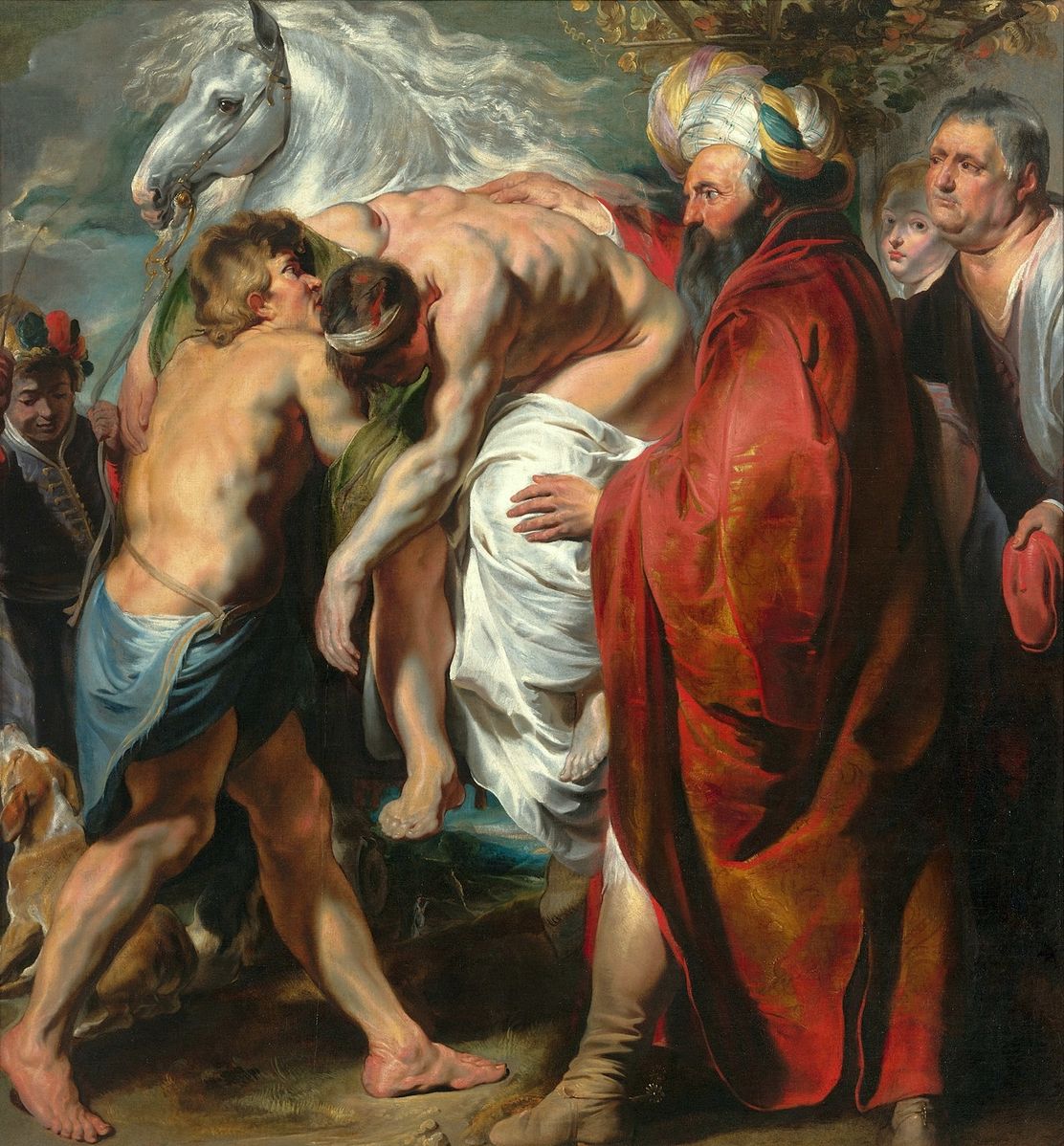
The featured image is “The Good Samaritan” by Jacob Jordaens, and is in the public domain, courtesy of Wikimedia Commons.



The crazy world we live in today! Great article! As I am a Michigan Wolverine fan and support the police, am I being racist when I say, “Let’s Go blue”!
A very interesting article which deals with the semantical questions with which I’ve also often struggled. However, whilst we may all aspire to ultimate truth we were created as individuals with an individual responsibility to “paddle our own canoe”. If we believe in God we must also acknowledge that part of His purpose is to diversify, which presupposes the concept of loyalty to one’s own kind and all that implies. One may glory in God’s radiant diversity and love but one cannot be loyal to the World.
“…whereas “people of color” acknowledged their humanity first and their distinctive racial characteristics as a secondary trait.”
Isn’t this EXACTLY what the woke cult is all about?
Fr. Longenecker states, “If I refer to an African American as a “colored person” or a “n-word,” I denigrate and destroy not only their secondary identity as a member of that racial group, but also their primary identity as a fellow human being.”
But “colored person” was a standard, polite way to refer to black people for centuries, including being used by black people themselves. Nothing denigrating about it. It is still used in phrases like “The National Association for the Advancement of Colored People.” Likewise, “Negro” is still heard in phrases like “Negro spiritual,” “United Negro College Fund,” etc. It, too, is not an inherently offensive term at all. The “N-word” is on a completely different level from these, being I believe insulting and offensive by nature.
It seems that if we are going to define what is offensive and what is not, we are going to have to make some serious linguistic and historical distinctions.
I think to make sense of why “coloured” is considered offensive, while “people of colour” isn’t, despite being semantically identical, you can see it as a combination of 2 things: the euphemism treadmill (https://en.wiktionary.org/wiki/euphemism_treadmill) and the fact that words used to describe those looked down upon will pick up negative connotations. The word for black people in a society that associates bad things with black people will itself become seen as derogatory., therefore there is a tendency to create a new word free of the negative associations.
From Alice Through the Looking Glass: “”When I use a word,” Humpty Dumpty said, in rather a scornful tone, “it means just what I choose it to mean—neither more nor less.”
“The question is,” said Alice, “whether you can make words mean so many different things.”
“The question is,” said Humpty Dumpty, “which is to be master—that’s all.”