
After all the talk about the Crisis in Christianity is over, this is the root of the crisis: that the worship of the Almighty—the one who is the source of Beauty, Truth and Goodness—has been reduced to banality, subjective opinions, and a compromised morality.
 In a recent essay here, I remarked on Eastern Orthodox theologian Alexander Schmemann’s observation that the source of all unity is the Unity of the Holy Trinity, and that any attempt at unity other than a sharing in the Divine Unity ends in division. In other words, “unity from below” leads not to true unity, but division. This is because unity—when it is achieved within a small group— must entail the exclusion of those who are not in the group. The pursuit of any lesser unity therefore destroys unity.
This same paradigm can be applied not only to unity, but also to beauty, truth, and goodness. As the Holy Trinity is the source of all beauty, truth, and goodness, the pursuit of any lesser beauty, any lesser goodness, or any lesser truth—in exclusion of the Divine Source of beauty, truth, and goodness—will lead ultimately not to beauty, but to ugliness, not to truth, but to lies. Not to goodness, but to evil.
If one pursues the beautiful through art that excludes the source of beauty (the Divine), the art will be at least subjective, sentimental, and shallow and at worst aggressive, iconoclastic, ugly, and rebellious. If one pursues any kind of truth that is divorced from the Divine Source of all Truth, then the statement of that truth will be subjective, sentimental, and shallow. At worst it will be aggressive, manipulative and will lead to lies and deception. If one pursues any good cause without reference to the ultimate source of goodness, that good cause will disintegrate into petty self-righteousness, faux victimhood, and ultimately into evil, as the “do-gooder” attempts to impose his subjective version of the good onto others.
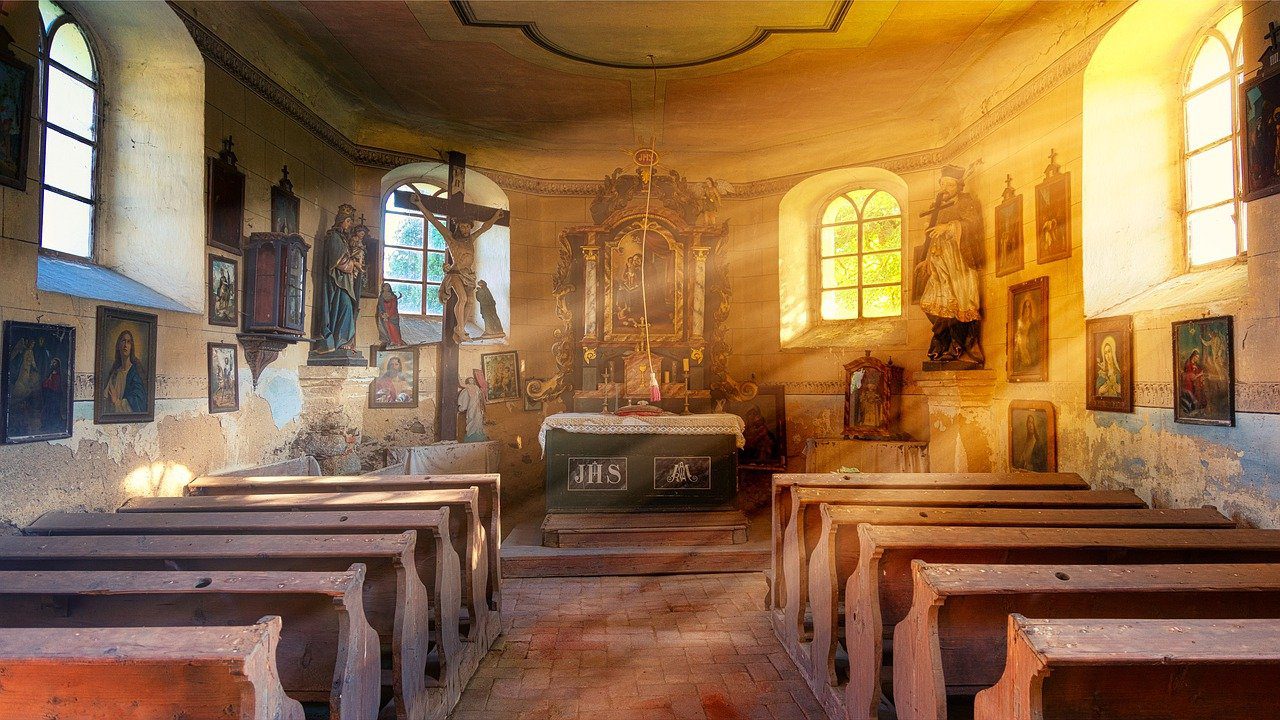
What response might one make to this hypothesis? How does one reference the eternal source of Beauty, Truth, and Goodness in one’s attempt to pursue what is beautiful, good, and true? There is really only one way for human beings to tap into the eternal source of Beauty, Truth, and Goodness, and that is through worship; and the only reliable and time-tested form of worship that offers an immersion in Beauty, Truth, and Goodness is liturgy.
In the Divine Liturg,y very ordinary men and women come together to connect to the source of Beauty, Truth, and Goodness by “full participation” in the liturgy. This much-abused catchphrase from the documents of the second Vatican Council has often been misunderstood. Well-meaning but ignorant liturgists think “full participation” means “everyone at Mass has to have a job to do.” So they load up the procession with the choir members, the ladies who arranged the flowers, the cub scouts, the Knights of Columbus, and a cadre of boy and girl altar servers dressed in what look like bleached flour sacks gussied up with a rope around their waist. “Extraordinary ministers of Holy Communion” abound, and ushers and helpers hover around with insidious intent.
“Full participation” is not “everyone with a job to do at Mass,” nor is it indicative of some bland egalitarianism. Instead it is a call for each worshipper to participate fully—body, mind, and spirit—in the action of divine worship. It is a call for each one to be plunged into Beauty, Truth, and Goodness and so connect with the very source of all Beauty, Truth, and Goodness.
To accomplish this, the liturgy itself must be Beautiful, Good, and True. If the architecture is brutal, the artwork anodyne, and the music banal, the quest to participate fully in the Beauty of the Beautiful One is lost. If the behavior of the celebrant and participants is evil, the hypocrisy of their action is manifested, and the participation in the Good is lessened. If the preaching is no more than a bland collection of bromides or a politically-correct pep talk, then Truth of the Gospel is compromised, and the worshippers lack the ability to participate fully in the Truth. They do so because they are being offered a lesser or partial expression of the truth.
After all the talk about the Crisis in Christianity is over, this is perhaps the root of the crisis: that the worship of the Almighty—the one who is the source of Beauty, Truth and Goodness—has been reduced to banality, subjective opinions, and a compromised morality.
What is the answer? It can only be a re-connection of the liturgy with beauty, Truth, and Goodness by itself being celebrated with a focus not on watered-down good works, political activism, and sentimental interpersonal kind-ness, but to re-vivify a liturgy that is unashamedly beautiful, true, and good.
The traditional celebration of the Mass is built on the triune foundation of Beauty, Truth, and Goodness. This tradition cannot be further destroyed lest we destroy the very ladder that allows us to ascend to full participation in the Divine Source of Beauty, Truth, and Goodness. The recent attacks on traditional Catholic worship are no less than attacks on mankind’s opportunity to participate in the divination won by the Savior’s triumph.
It is obvious that a traditional celebration of the Mass is rooted in a love for the Beautiful, Good, and True. It is now up to the proponents of the highly-subjective, sentimental, and shallow celebrations of the Novus Ordo to explain just how their folk songs, flying-saucer churches, dumbed-down hip-hop sermons and New Age spirituality help anyone connect with the Everlasting Fount of all that is Beautiful, Good, and True.
The Imaginative Conservative applies the principle of appreciation to the discussion of culture and politics—we approach dialogue with magnanimity rather than with mere civility. Will you help us remain a refreshing oasis in the increasingly contentious arena of modern discourse? Please consider donating now.
The featured image is courtesy of Pixabay.




Roger Scruton would be proud. Thank you.
Some people believe it is not theological disagreement which leads to people abandoning church attendance, but the overweening banality of the services.
When there is no beauty to uplift the soul, no truth higher than a worn-out platitude, no good greater than getting to the post-Mass coffee and donut, folks will vote with their feet and search (usually in all the wrong places) for something – anything – else of substance.
As always, trying to be “relevant” to any particular point in time detaches one from eternity, and the “relevant” fad swiftly becomes an out-of-touch fossil as the ephemeral world sweeps past it.
As Father notes, the only Permanent Thing is Eternal.
I came to add a comment about the brilliance of your essay Fr. Longenecker, but after reading the first two above, I cannot do better. So I shall just add, “ditto ditto”.
I was delighted, and relieved, when I read the earlier essay, borrowing from Eastern Orthodox theologian Alexander Schmemann, discussing the difference between “unity from above” vs “unity from below”. Finally, someone has put into words what I struggled with for some years now – the falsity of the kind of ‘unity’ brought about by holding on to each other rather than holding on to Christ.
I am somewhat dismayed by this instalment because:-
(1) In the dismissal of “folk songs” and “flying-saucer churches”, the suggestion is Beauty, Truth and Goodness can only be found in the form that the Western church/civilization is accustomed to; and
(2) In the face of poverty, persecution or other sub-optimal circumstances where we lose the beauti-ful physical surroundings of the church (building), again, as the Western church/civilization is accustomed to, the suggestion is we lose the ability to connect with God.
The history, testimony, and experience thus far of the Universal Church, including and especially that of the Catholic Church goes in the opposite direction. It asserts, however imperfectly, that the God of Abraham, Isaac and Jacob can be found in folk songs arising from non-Western civilizations and sung in non-Latin based tongues. It claims that God does baptize, redeem and transform the work of human hands, however abject and miserable (e.g. a prison cell in the middle of a death camp), into an offering acceptable to Him, a place He visits with His Presence, and so make it Beautiful, True and Good.
We (and our culture / language / civilization) do not own the Way; the Way owns us.