
The good life for “Stan” Evans was the simple life. A populist conservative, he both preached the virtues of the common man and lived the life of the common man—and all with the benefit of an uncommonly fine mind.
M. Stanton Evans: Conservative Wit, Apostle of Freedom, by Steven F. Hayward (391 New York: Encounter Books, 2022)
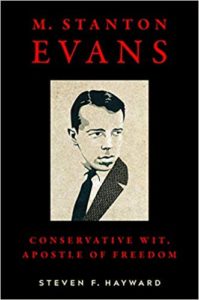 M. Stanton Evans thought that anyone with “their head screwed on right should be conservative when they are young.” And then, so long as one’s head remains properly screwed, the young conservative “should become more conservative” with the benefit of years. Evans may or may not have had himself in mind when he proffered those words, but they surely do apply to this witty apostle of conservatism. In any case, a better description of the intellectual trajectory of one M. Stanton Evans there could not be. Or maybe not. Please stay tuned.
No doubt Evans was simply offering his version of Churchill’s famous line, while getting a good laugh—and making a worthwhile point—in the process. Nonetheless, biographer Steven Hayward assures us that at no point in Evans’ long life did he so much as flirt with anything other than some version of post-World War II conservatism, much less with any version of twentieth-century liberalism. In other words, never did he sprout, much less “grow” in a leftward direction. It might have happened, but it didn’t.
After all, this Texas native was a Yale graduate. Having survived that temptation, Evans subsequently spent many years in America’s heartland, where he edited the Indianapolis News when he wasn’t moonlighting as a National Review columnist for fellow Yalie, William F. Buckley, Jr.
While Indiana was home for this transplanted Texan, there would always be occasional journeys east. One such foray took him back to Connecticut, close to Yale, and ever closer to the heart of the Buckley orbit. Specifically, it took him to the Buckley family grounds, the founding of Young Americans for Freedom, and a major role in the drafting of the Sharon Statement. Not yet thirty, he was already at work trying to do what he could to screw younger heads on right.
Of course, at some point Washington did beckon. It generally does for those with political interests, whether of a left- or right-wing variety, including even those whose heads were so well screwed on that the political persuasion of their owners ranged somewhere between conservative and more conservative. An increasingly conservative Evans finally answered that call as he zeroed in on forty.
It’s not that M. Stanton Evans won a race for a seat in Congress. In fact, biographer Steven Hayward never seems to have detected so much as a moment when “Stan” Evans might have been so much as tempted to take that step. A journalist and an educator to his core, Evans may also have worried that a political career would result in a detour from his path to an ever-more conservative position.
Nor did Evans abandon the Midwest for the nation’s capital to sign on with this or that bureaucracy, this or that think tank, or as an aide to this or that member of Congress. He wasn’t bent on wading into the swamp or draining it. For that matter, a forty-something Mr. Evans never sought to join the Reagan Administration, despite his longstanding anticipation of a Reagan presidency.
The Washington life was never Stan Evans’s idea of the good life. As far as he was concerned, Washington during and after the Cold War was too “much like the Soviet Union—without the amenities.”
The good life for Evans was the simple life. A populist conservative, he both preached the virtues of the common man and lived the life of the common man—and all with the benefit of an uncommonly fine mind. A devotee of rock ‘n roll music, he did hold out for balanced meals—so long as he could be assured of a Hardee’s at each end of town.
A man of his ideas and tastes, not to mention strength of character and sense of humor, Evans had little reason to worry that he might succumb to Potomac fever. True, Evans did wonder why “one of us” all too often ceased to be “one of us” after acquiring a “position of power” in Washington. Which may explain why he avoided such positions. Keeping one’s head screwed on right can be a full-time task.
But not quite. Actually, the move to D.C. was thoroughly consistent with his never-ending effort to screw on right the heads of those who were increasingly likely to be much younger than he. This journalist-turned-educator went to Washington to establish the National Journalism Center (NJC).
The idea was not necessarily to create a cadre of young conservative journalists to counter the liberal mainstream. Rather, it was to train budding journalists to be fact-based journalists.
Evans didn’t want his products to practice what he called “ventriloquist journalism,” meaning so-called journalists who sought out sources to confirm their already-established storylines.
At the same time, Evans was not necessarily out to produce “conservative journalists.” In fact, he regarded that very term as an oxymoron. That said, he did assume that that the typical college graduate was an economic illiterate. And he did presume that economic literacy would contribute to getting heads screwed on right.
Inflation was an issue during the Carter years, as it is again an issue today. Here is the lede of an aspiring young journalist then: “Inflation came in at 1% last month, led by increases in the price of energy, food, and housing.” And here is Evans’s reaction: “This is the logic that wet sidewalks cause rain.”
One of the aspiring young journalists in the early years of the NJC was the author of this affectionate biography and wonderful tribute. Such words might be interpreted as a criticism, but that is not how they are meant. Both M. Stanton Evans and Stan Evans very much deserve to be remembered.
Married briefly, he had no children. Then again, his offspring were those he trained, inspired, and amused, whether at the NJC or at Troy State University, where he taught journalism on a part-time basis for years. He also left two important legacies: 1) a tradition of challenging Republican presidents, including Ronald Reagan, either to keep their heads screwed on right or to convince them to start the process (think not just one, but two, Bushes); and 2) a body of writing that includes first-rate scholarship, especially his magisterial The Theme is Freedom.
A Goldwaterite before and after the good senator was the same Goldwaterite that he had been before and in 1964, Evans was suspicious of Richard Nixon before and during his presidency. As he once joked, there were only two things that he didn’t like about the Nixon administration: “its foreign policy and its domestic policy.”
If that line doesn’t quite capture both his assessment of Nixon and his sometimes mordant sense of humor, how about this: “I didn’t support Nixon until after Watergate. After wage and price controls, Watergate was a breath of fresh air.”
M. Stanton Evans may or may not have grown more conservative with age, but his sense of humor never wavered. May or may not? If Hayward it right, both Evanses, M. Stanton and Stan, were always pretty darn conservative. Like his father, Medford Bryan Evans, he defended Joe McCarthy when he was a relative youngster. And in his twilight years he buttressed that defense with Blacklisted by History: The Untold Story of Joe McCarthy and His Fight Against America’s Enemies and Stalin’s Secret Agents: The Subversion of Roosevelt’s Government.
As a young grad student, I had occasion to interview State Department veteran, Loy Henderson. My then-project was the State Department and the Soviet Union during the interwar years. Afterwards we were chatting about the Wisconsin senator. I commented that he had probably come along after the problem had passed. Henderson quickly corrected me. If only I had had Mr. Evans on hand to keep my head screwed on right.
The Imaginative Conservative applies the principle of appreciation to the discussion of culture and politics—we approach dialogue with magnanimity rather than with mere civility. Will you help us remain a refreshing oasis in the increasingly contentious arena of modern discourse? Please consider donating now.



Love M. Stanton Evans. He actually rode in my car in Columbia, SC as he was the guest speaker at a YAF convention.
I’ve long wished that I had met Mr. Evans, and that wish only intensified as I read this book.
Thanks to the IC for publishing this review and to Chuck Chalberg for writing it. Steve Hayward’s book does justice to a wonderfully witty, very wise and charming man.
I first met Stan at Great Elm, WFB’s family home in Sharon, Connecticut where 100 young people gathered for a weekend to form what became Young America’s for Freedom.
Friday night and all day Saturday, we debated the conservative and libertarian principles in which we believed, but upon which we could not come to an agreement on a statement of them.
Then Stan arrived Saturday night and after spending some time listening to our wishes for the group, in his beautifully expressive drawl, he recited to us what became the Sharon Statement.
I was asked to record his words and to have them ready for a vote the next morning. At 5 AM, Sunday, I slipped them under the door of the Kolbe brothers from Arizona, who presented them at breakfast.
Today, the Sharon Statement and the Port Huron Statement are listed side by side in college text books as representative of the political differences among the young in the tumultuous sixties.
Thus began my long friendship with Stan. Three of Russell’s and my daughters attended his National Journalism Center and were assigned internships appropriate to their interests.
The experiences they had in DC and the training they received at the NJC enriched their lives and gave them invaluable knowledge for which they remain grateful.
We all owe a great deal of gratitude to Stan for his efforts to inspire and inform generations of young conservatives how to defend their principles and to convey them to others.