
That more faith-based fiction is being published is encouraging. It means the imagination among the faithful is not dying, but thriving, and those of us who are readers should risk the time to read new authors, like the three whose work I review here.
Perhaps it is because I am turning my time and talents toward writing fiction that I am becoming aware of the increasing amount of faith-based fiction that is being produced.
The new media has enabled authors to publish their work without the usual shame and scam traditionally associated with self-publication. With print-on-demand technology, books can be produced cheaply for a niche market. E-book technology and online publishing is an easy do-it-yourself industry, and homemade audio books can be produced and distributed with a laptop and a good internet connection.
Faith-based publishers are also taking the risk of publishing and promoting books by new authors. Three books have come across my desk recently that are worth a mention here.
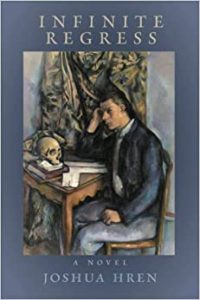 Joshua Hren’s novel Infinite Regress is the story of Blake Yourrick, a lonely and depressed young man existing in a string of dead-end jobs, who is dealing with memories of an alcoholic, abusive father, the death of his mother, and a sour relationship with an old college mentor—a defrocked and eccentric priest.
I receive lots of books to read and review, and my approach to all of them is the same: If the cover interests me, I begin reading. I stop reading once the author has lost my sympathy and attention. I got to page 26 with Infinite Regress, and I’m sorry about that. I wanted to like this book, but alas poor Yourrick! I simply did not sympathize with him. The lad was so plunged into the darkness of his urban underbelly world that I quickly grew weary of the introspection, doom, and gloom.
However, I would rather have had Mr. Hren’s dark vision than a “religious novel” that was no more than a pious, saccharine tract. We need the grit and grime to eventually see the glory.
Mr. Hren’s style also seemed overdone and at times pretentious—the names obvious and the allusions arcane. A slum lord named Rick Dolt? The Hotel Eumenides? The descriptions were often over-written, self-conscious, and perhaps the whole effort was trying too hard to be literature.
I am perfectly happy to admit that my not liking this book is my own fault. I am increasingly impatient with high-brow books, and confess to being a fan of popular fiction and films that simply tell a good story. Perhaps I’m simply a lazy reader more inclined to pulp fiction than ponderous fiction. Mea culpa.
Despite my disinclination for this book, Mr. Hren is clearly a talented writer with a passion for his craft. I hope he goes on to win a wide readership and appreciation, and I’m going to go back and pick up the book and try again.
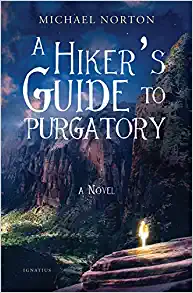 The second work of fiction I have waded through is A Hiker’s Guide to Purgatory by Michael Norton. In this book, published by Ignatius Press, Dan—a seventy-something man—dies and goes to purgatory. Being an avid hiker, he finds himself at the trailhead of a congenial landscape. He too has an alcoholic father with whom he needs to be reconciled.
Suffice it to say that Dan embarks on his journey through the beautiful wilderness, and as he hikes, he recalls his mis-spent life, works through his regrets, meets his Dad, and at the end also meets his lovable dog Buddy. If Joshua Hren’s novel plunged the reader into the doom and gloom, Michael Norton’s is the opposite. Mr. Norton’s purgatory is all sunlight, mountain streams, and fresh air. Yes, there are some barren desert places and some pains to be undertaken, but the bright happiness of purgation overwhelms.
I also wanted to like this book, but I found too many of the scenes—especially in the second half—to be saccharine and sentimental. Father and son meet up and finally have the bonding fishing trip they never had on earth, then they march off arm in arm to a happy heaven where they are joyfully re-united with all their friends and family. I persevered with A Hiker’s Guide to Purgatory but felt at the end that it was a missed opportunity: that it was more of a sentimental devotional piece than a gripping novel. Too often Dan’s experiences seemed to me to rise to mild regret rather than heart-rending, purgatorial agony and there were theological and psychological insights that were absent. Maybe I was unconsciously comparing the book to C.S. Lewis’ The Great Divorce.
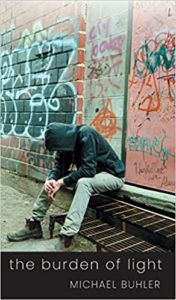 The third book of new fiction is a collection of short stories by a Canadian teacher named Michael Buhler. The Burden of Light actually balances nicely the problems I had with Mr. Hren and Mr. Norton’s books. If Mr. Hren was wallowing in the dark, and Mr. Norton was wallowing in the light, Mr. Buhler’s collection does not shy away from the darker side of life. “Drug Addict” portrays an addled hooker and her addict pimp, but does so with surprising sympathy and insight. “Death in Schumacher” helps us see the death of a poor woman through the eyes of a carefree thirteen-year-old. Mr. Buhler’s story “The Intellectual” reminded me of Mr. Hren’s Yourrick—the hero being a disillusioned, overly cerebral young man.
Mr. Buhler’s collection of stories is somewhat uneven—I suspect there may be too much of an echo of Flannery O’Connor in his story “Happiness,” yet without O’Connor’s subtle satire and deft observation. Whereas Mr. Norton’s writing is rich in its description of the beauties of the wilderness, Mr. Buhler’s two-part story “The Red Canoe” evokes the Northern wilderness better by plunging the hero into a survival crisis. This story was a fine piece of writing to my mind, and Mr. Buhler ought to expand it to a novella.
While my opinion of two of these three books is not high, I applaud the authors for doing the hard work and taking the risk of writing fiction. I am grateful for Angelico and Ignatius Press for publishing Joshua Hren and Michael Norton. That more faith-based fiction is being published is encouraging. It means the imagination among the faithful is not dying, but thriving, and those of us who are readers should also risk the time to read new authors.
The Imaginative Conservative applies the principle of appreciation to the discussion of culture and politics—we approach dialogue with magnanimity rather than with mere civility. Will you help us remain a refreshing oasis in the increasingly contentious arena of modern discourse? Please consider donating now.





Always enjoy your articles, Father! Thank you.
May I recommend Earth Fire and Soul Fire by Allyn Ransom?
It is a very good article. Thanks for writing it, Father Longenecker.
Infinite Regress was hilarious; I laughed out loud, especially at the mock police report and the scene in the telemarketer office.
I agree with Fr. I tried reading Infinite Regress, but but I simply did not have the patience for the stilted, self-conscious, high-brow style. Much like Fr., I am a fan of genre fiction; it tells a story and leaves the reader feeling satisfied. It might even teach them a thing or two.
If sci-fi is a genre that has interest for you, first time author Bill Patenaude is worthy of a look. Hero priest, murder mystery set on a space station refuge from a ruined world, and some of the implications of AI future 3D printing make for a well packed story.
Printer’s Choice.