
When St. Peter was asked how to receive the outpouring of God’s love on the first Pentecost he answered, “repent,” just as Our Lady keeps asking us to keep repenting in prayer. For it is here alone that our acts of love enable us to receive God’s love in return.
 All good parents hope their children will be successful at school, at work and in their marriage, living fulfilled and happy lives. This is why they temper their desire to overindulge their children by teaching them how to act selflessly, to become conscious of the needs of others and to share and care for others as they have been cared for. Catholic parents have an advantage as they have the example of Jesus to inspire their children. Teaching them to pray can inspire them to receive his love into their hearts, as they learn about his life on earth before his Resurrection, and how he is alive and loving us now. In this way their hearts can be opened to receive his love, enabling his divine love to suffuse and surcharge their human loving making it possible to generate the only form of selfless loving that can unite them with God. This profound mystical union between divine and human loving is brought to perfection in the Dark Night.
The purification then that takes place in the Dark Night is the only place where self-centred human beings can be transformed into selfless people, reformed through love into the image and likeness of Christ. The reason why so many give up, who were once happy to pray when all was sweetness and light, is because the daily drudgery of learning to be selfless simply grinds them down and there is no one to support them by telling them what is happening and how to continue. I cannot pretend that it is easy because it is not. Everything that is worth attaining demands time and effort and learning to love is the most important lesson of all because our whole life, our whole happiness in this world and the next depends on it.
One of the main problems and great ironies for those who first come to contemplative prayer in the Night is that their heart yearns for God like never before, but they find it all but impossible to pray, at least as they used to. All previous prayer that was successful before has done one thing; it has inspired and fortified the primeval desire for God with no other objective than union with God. The only form of prayer that can now help is a form of prayer that can keep that desire on course and in so doing remain at all times open to God’s love. Some months ago I had a rather sad email from a genuine spiritual searcher trying to navigate the mystic way. He said he had read St Teresa of Ávila and St John of the Cross from cover to cover and found no systematic teaching on how to pray in mystical contemplation. Let me make it clear that neither St John of the Cross nor St Teresa of Ávila wrote their works for the general public, but only for their own brothers and sisters in the new reform of the Carmelite Order. Nor did they need to detail how they should pray when they were led into contemplation because the prayer pattern open to them was all part of their monastic way of life.
The Carmelite Order began as an eremitical community of hermits living on Mount Carmel in the Holy Land, hence their name. When they became integrated into the religious life of the Western Church they began to live in communities where they lived their particular interpretation of the monastic life which was signified by wearing the scapula, the insignia of traditional monasticism. They also adopted forms of prayer that were traditionally used by Western monks. I am not only referring to their daily recitation of the divine office, but a practice that naturally flowed out of the Divine Office that would enable them to generate the “prayer without ceasing” throughout their day. Like monks before them, they learned to choose a verse from the liturgy, from a prayer, a psalm or canticle that seemed to them to encapsulate the way in which they were relating to God at the particular point of development in their spiritual journey. They did not need to be told what verse to use as a prayer because it was personal to the spiritual needs of each individual. While reciting, chanting or singing the Divine Office they prayed as one in Christ, but throughout the subsequent day, they prayed individually and differently, as each chose and fashioned their own short prayers from the liturgy, each to their own personal needs.
When my father tried to do this, as we shall see later, he was following the monastic way of trying to practise the prayer without ceasing as taught by Abbot John Cassian. The prayer my father took was from the daily monastic liturgy, “Oh God, come to my aid. Oh Lord, make haste to help me.” I am sure he is pleased to know that he has inspired his son to follow his example by using this short prayer, perhaps more than any other, to support him in his daily life. This method of monastic prayer was so taken for granted that it was not thought necessary to teach a person how to pray in any other form of prayer outside the daily liturgy. The Holy Spirit who inspired that liturgy would surely inspire them to choose what they needed each day at every point of need during their spiritual advancement. That explains why we find no detailed explanation from the great Mystical Doctors on how to pray in the Night.
What we have to do is follow their example by choosing for ourselves a short prayer as they did. It can be taken from the liturgy, from the psalms, from the hymnal, the scriptures or from the popular prayers or devotional practices that once helped us so much before. Begin by choosing what can be used as a short prayer; one that somehow sums up how you feel at the time – how you genuinely feel you relate to the God who seems to have taken his leave of you.
Let me explain what I did so that you can do the same, but in your way, to express how you feel. I chose the prayer Jesus himself made upon the Cross, most especially when everything seemed too much for me. “My God, my God, why have you forsaken me?” Or choose the prayer he made in Gethsemane, particularly when temptations come thick and fast. “Father may this chalice be taken away from me.” When I felt really in the pits I turned to the De Profundis. “Out of the depths I cried to thee, O Lord. Lord, hear my prayer”, or the prayer from Cardinal Newman’s famous hymn, “Lead, kindly light, amidst the encircling gloom.” The Jesus Prayer designed especially for this particular moment of the mystic way is perhaps the best known of all. “Jesus, Son of God, have mercy on me, a sinner.”
At moments when I felt touched by the presence of God who seemed absent for so long, I turned to phrases of praise and thanksgiving to express how I felt, but that was not often, at least in the early stages. The important thing is to choose something that genuinely embodies how you feel at the time and what you feel you most need from God to help you. It is no good pretending with God. He knows exactly how you feel so it is no good trying to soft-soap him. What is important to remember is that these short prayers are used to keep helping you turn back to God from the distractions that would turn you away from him, while at the same time helping you to remain open to receive his love in return, that comes in his way and in his time.
Please do not feel you have to choose what appealed to me. Choose short prayers that you feel appeal to you, but use them in the way I suggest, to help you to keep acting selflessly, keep repenting, keep turning and opening yourself to receive the only love that can lead you from Paradise lost to Paradise regained. A regrettable and unforeseen consequence of clear systematic teaching on the practicalities of how to pray in contemplative prayer is plaguing the contemporary Church. Huge numbers of good serious-minded people have been led to believe that the endless repetition of a word or a mantra can lead them into the sort of mystical prayer described by St Teresa of Ávila. This is totally false. My Soul Thirsts, a document issued by the Spanish Bishops in 2019 rejecting mindfulness and other eastern meditation techniques makes this abundantly clear. In the contemporary “Me-Me” society that demands instant self-satisfaction, it is easy to see why the promise of instant mystical experience seems irresistible. The very essence of all authentic Christian prayer is that we continually try to raise our hearts and minds to God in acts of selflessness, and not in seeking instant self-satisfaction in the way of inner peace or mindfulness.
When St Peter was asked how to receive the outpouring of God’s love on the first Pentecost he answered, “repent,” just as Our Lady keeps asking us to keep repenting in prayer. For it is here alone that our acts of love enable us to receive God’s love in return. The first commandment is to love God with all our heart, with all our soul, and with all our mind. Love has to be learned and prayer is the place where this is achieved through the practice of selfless giving that opens us to the only love that can make us new.
___________
This essay is chapter forty-six of The Primacy of Loving and is published here by gracious permission of the author.
The Imaginative Conservative applies the principle of appreciation to the discussion of culture and politics—we approach dialogue with magnanimity rather than with mere civility. Will you help us remain a refreshing oasis in the increasingly contentious arena of modern discourse? Please consider donating now.
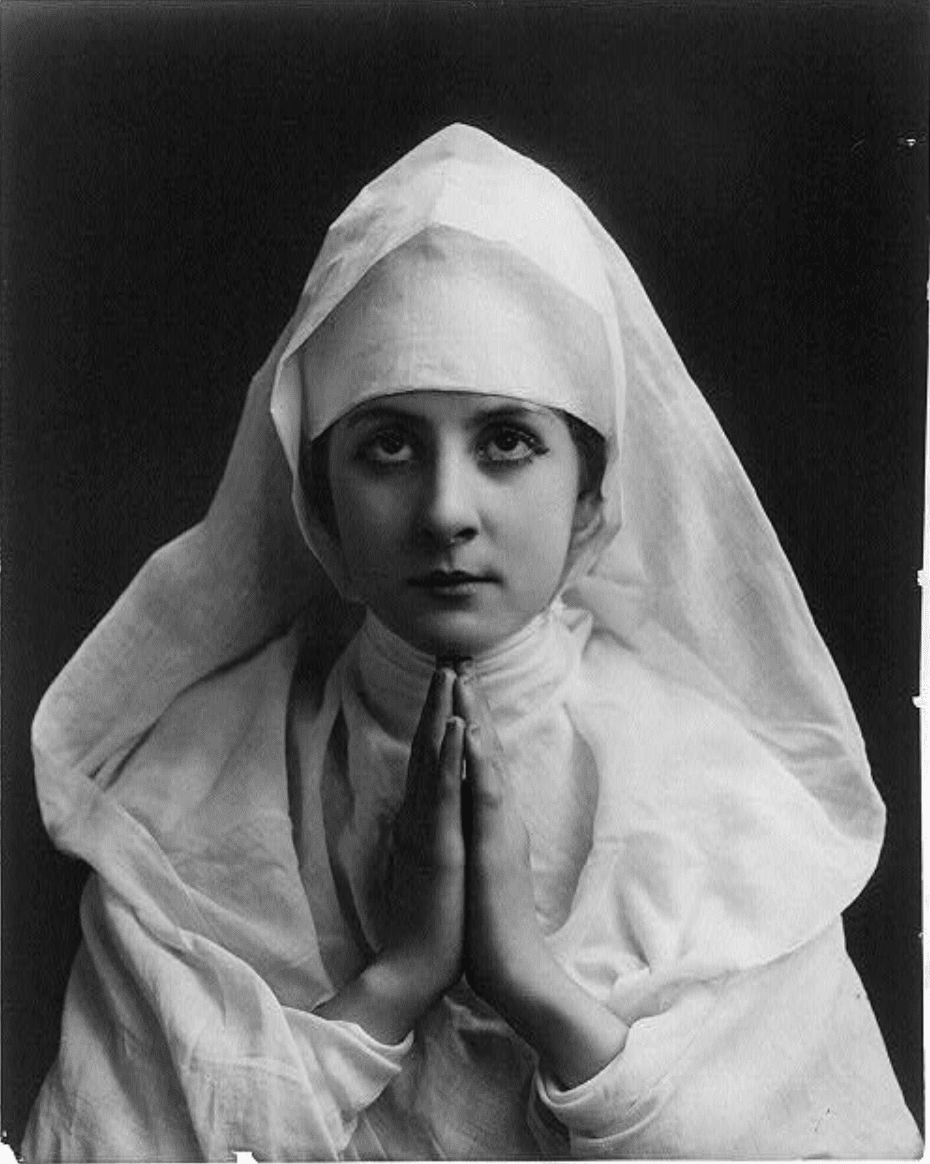
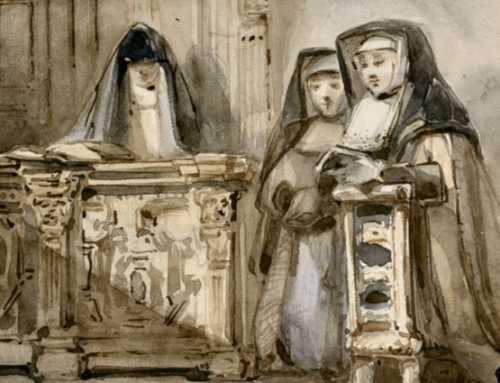
The featured image is “Young woman modeling: Half lgth., wearing nun’s white habit and praying,” and is in the public domain, courtesy of Wikimedia Commons.



Leave A Comment