
Whisky is not a product of savvy entrepreneurs. It is a product of Scottish culture that, like the drink, should be savored and appreciated. The primary consumers should be the local populations that imagined whisky. When operations go big to satisfy cosmopolitan demand, they lose something of that human touch and local flavor that give the product life.
 Scotch Whisky (without the “e”) justly merits acclaim from connoisseurs worldwide who appreciate its nuance and flavor. For this reason, Scotch is increasingly popular as more people are exposed to its charms. The whisky business is now booming in Scotland.
The growth should be a good thing. By modern business metrics, if a product is good, then more of it is better. Entrepreneurs should strive to do everything possible to expand production and maximize profits. Everyone should benefit from this arrangement. Indeed, distillers are ramping up production on the traditional islands where Scotch is made.
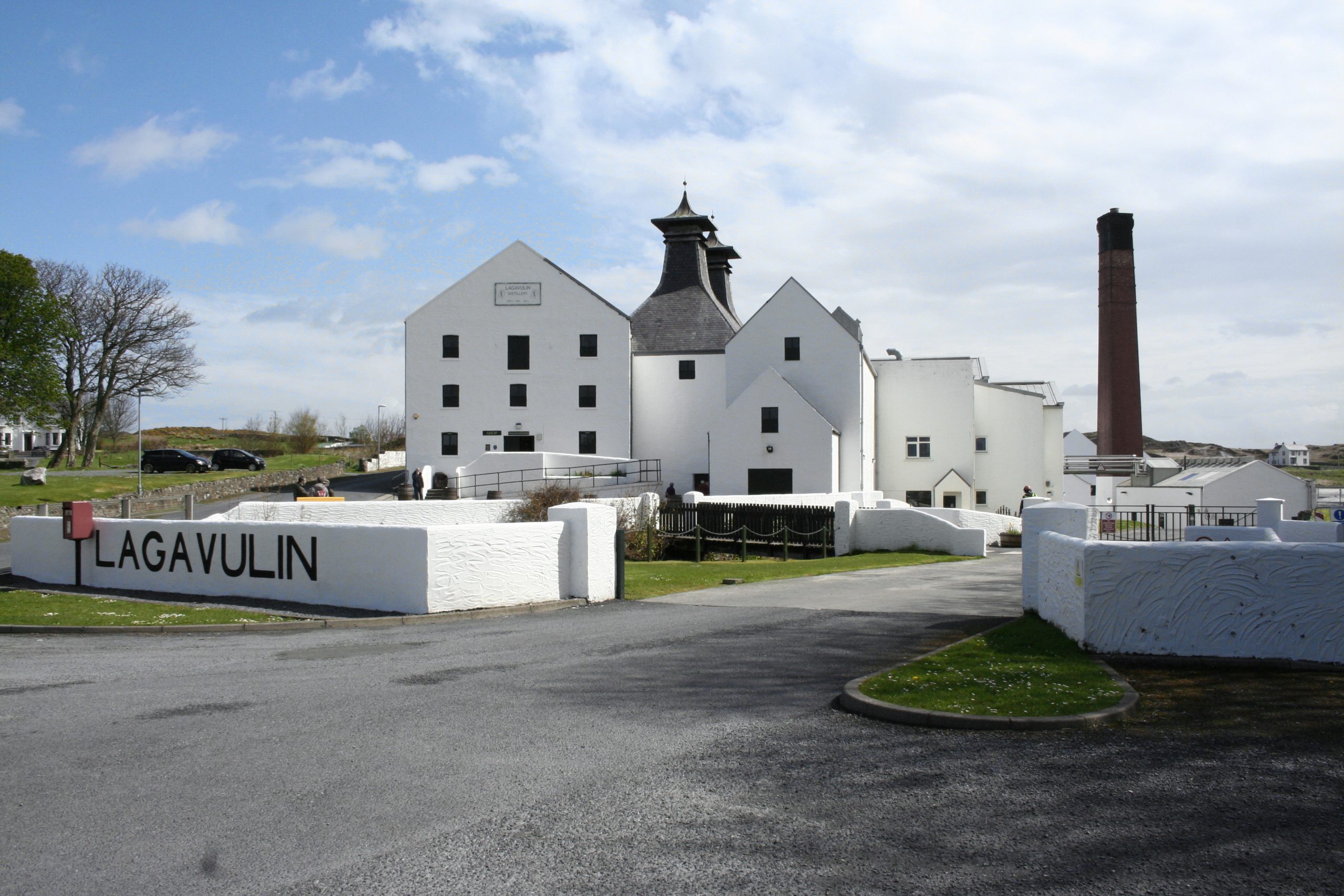
However, on the island of Islay, not everyone is happy with this development. The island is especially known for its peat-flavored Laphroaig (owned now by Beam Suntory) and its smoky Lagavulin (part of Diageo spirits). Many complain that this expansion is forgetting something essential. The island may be making good whisky, but it may also be selling its soul.
Losing Local Culture
There are nine distilleries on Islay, with three more being built and a fourth awaiting approval on the 239- square-mile island off Scotland’s west coast. Most of the distilleries are in the hands of giant liquor conglomerates with plenty of investment capital. Many locals complain the expansion on their picturesque island is turning the whole place into a corporate whisky factory.
Indeed, the island is losing its local flavor and culture. Its population of 3,228 cannot cope with the double invasion of whisky-makers and tourists. The boom is raising real estate prices so that young families can no longer afford to buy homes or acquire land for farming. Local businesses have trouble finding enough help. Tourists visiting the “Whisky Trail” are straining housing capacity since many houses are now repurposed for holiday rentals. Natives are leaving the island.
Some locals even presented a petition in 2019 asking the island council to freeze the building of new distilleries until the housing crisis can be resolved. The motion failed as distillers claimed they provide excellent career opportunities for everyone. They also pledged to invest in new housing to make it more affordable. However, the problems still linger.
Housing and jobs are not the real issues. Something much deeper is involved that extends beyond the financial bottom line. Inhabitants sense something is missing that must satisfy the soul. The invading corporate firms can construct state-of-the-art distilleries but cannot build a culture.
Good Whisky Just Another Excellent Product
Alas, modern economists treat all products indifferently, as mere things that must be made where comparative advantage exists. If cheap labor mixed with good water and grains come together in Islay, then whisky should be produced there. Should another place make something similar elsewhere, let it be done or moved there so that profits might be maximized.
When marketers find a fine product like Islay whisky that will attract consumers worldwide, they expand demand by advertising these high-end products as the best in their class. They create a mania around the product that gives rise to consumers who seek the best of everything and demand that it be available anytime, anywhere, and any place. Such consumers have no connection to the cultures that produce these distinctive items. They have no culture themselves save that of others. Creating fine products over generations is too much effort for these cosmopolitan connoisseurs.
If the Scots had followed the same logic and relied solely upon the best of other peoples’ cultures to develop their tastes, the rich Scotch whiskies would never have developed.
The Product of the Scottish Imagination
Whisky is not a product of savvy entrepreneurs. It is a product of Scottish culture that, like the drink, should be savored and appreciated. Even the word whisky (without the “e”) has cultural origins. It comes from the Scots Gaelic uisge beatha, an adaptation of the Latin phrase aqua vitae, meaning “water of life.”
Whisky-making was originally a cottage industry that developed over centuries of tradition. It was the wondrous product of the Scottish imagination. Scots experimented with the materials at hand to distill a fine drink corresponding to their rustic tastes. The distiller and local consumers co-created a product that became part of Scottish culture and identity, ideally suited to the region’s inhabitants.
The primary consumers should be the local populations that imagined whisky. As local cuisine is made for local inhabitants, whisky was made to reflect the native population and not vice versa.
Others may share the libation, but it is not theirs. They are mere connoisseurs invited to imbibe the best of this product, which has no rival. There is nothing wrong with others who want to taste and enjoy it. However, there is frenetic intemperance in wanting everything from everywhere. People should not live off the cultures of others. Such a system destroys the culture that gave excellent products their birth.
When operations go big to satisfy cosmopolitan demand, they lose something of that human touch and local flavor that give the product life. Mass production and marketing destroy the product’s tradition and turn it into another folkloric product in the company’s international catalog. Even these high-end markets became bland and the same everywhere worldwide, since there is no more culture to generate new excellent products.
Too Much Whisky
The world would be much richer culturally if each nation or region dared to imagine its own cultures and products, savoring and protecting them.
Such a daring feat would generate natural protectionism—respectful of free markets—that in the past was born of a zeal whereby populations simply preferred the local product out of the joy of consuming what was specific to them and showed natural wariness of what was not. Supported by healthy customs and authentic local elites, people had the temperance of staying within the limits of what expressed their souls, culture, and mentality.
Thus, Islay locals understandably resent the intrusion of the giant distilleries. Of what value are its whiskies if the island becomes a corporate whisky factory? This expansion destroys the lifestyle and culture that created this “water of life.” The cultureless devourers of high-end culture become its destroyers.
Something needs to change. There comes a time when there is too much whisky and too little cultural imagination.
The Imaginative Conservative applies the principle of appreciation to the discussion of culture and politics—we approach dialogue with magnanimity rather than with mere civility. Will you help us remain a refreshing oasis in the increasingly contentious arena of modern discourse? Please consider donating now.
The featured image, uploaded by MSeses, is a photograph of Gebäude der Lagavulin Distillery, Islay, Scotland. This file is licensed under the Creative Commons Attribution-Share Alike 4.0 International license, courtesy of Wikimedia Commons.





Always enjoy your articles, John
Fascinating and important article, John. Essentially, we all must figure out how to STOP such encroachments on the Real World by the Unreal world. I think your sentiments are the stuff of the writing of both Alastair McIntosh and Paul Kingsnorth — not to mention Wendell Berry in the USA. When I was just getting to know the life and work of Alasdair MacIntyre, I remember learning that the destruction of village and crofter life in his native Scotland was one thing that drove him to his early Marxism (thinking the problem would be solved by leftists) and to an interest in morals and moral philosophy. I must say — the “nationalism” we’re seeing everywhere is directly related to the development you describe in the article: When people of place and land feel they can do NOTHING to check the seemingly inexorable consumerist power ruining their towns and villages , and which ends up taking jobs away, they will turn to taking matters into their own hands. Guaranteed. Let’s be for Free Trade but also for Fair Trade, which means we must adjust globalization to benefit far more people than it does at this time.
As one whose pallet has advanced beyond overly peated whisky, your essay is subtle as the flavors of a well-crafted scotch without that overpowering smokiness that l the other nuances that emerge when the warmth of the floor of the mouth warms it. And yes, I occasionally enjoy my 18 year Oban and all it’s fine attributes!
What you bring to our attention is the meaning of true diversity – the kind that thrives only in enclaves of closely knit communities that celebrate their uniqueness, not the falsity of contrived by centralized enforcement of “approved” homogenous diversities.
Sad that big money trumps the citizens’ preferences in the minds and hearts of the political class. As power amasses so does corruption, and that maybe the downfall in producing a product that requires a full decade of processing to become what it truly should be. But what is destined to remain will be the craft that will resurrect when the mighty have fallen. Witness the craft distillers that have blossomed once local laws overtook what the Hamiltonians and their descendants reeked upon the bourbon industry for a hundred years or more.
Such are the permanent things, and you’ve brought to light how one of life’s simple pleasures fits into that picture.
Great essay!
There is a celebrated scene in “Moscow on the Hudson”, where the protagonist, a political refugee from the Soviet system, is faced by an entire aisle of breakfast cereal in a grocery store, and has a freak-out. So many choices, and so much on the shelves. It is totally different from “back home”.
Yet, if he had only known, there is very little to mark one from another, close your eyes, grab one, and go home to eat. No matter what your selection, it will still just be heavily sugared cardboard or styrofoam.
With most of the products in an age of mass production, mass consumption, and mass advertising to generate mass tastes, it doesn’t really matter, and the “generics” are often better than the Brand Names.
There are virtues to capitalist economic methods, and undeniable downsides when the economy becomes the society. (Not inevitable, as Marx was so wrong in stating.) Like any tool, it must be handled correctly, with knowledge and skill, else it can turn and savage you.
Excuse me, I have a sudden urge to taste something liquid and “smoky”.
Sad, but true.
Jack Daniel Distillery was bought out by Brown-Forman, a liberal beverage behemoth from Louisville, KY. They wrote a letter to a local Lynchburg business asking them to pull racist merchandise consisting of Confederate flags, Trump merchandise, pro- 1A & 2A, etc. (Actually we picked up a copy of “Song of the South” there and watched it with our kids. Not sure how it’s racist when the black characters are the only reliable sources of wisdom in the story.) The owner posted their letter in the store and online and is still in business as far as I know. For now he’s not willing to sell his soul, but big business will still salvate over it.
Well done. I am not a drinker of distilled spirits; however, the point of the article is well-taken: true culture cannot be bought and sold. It cannot be scaled up. It cannot be hurried. I will never understand every aspect of someone else’s culture because I was not brought up in it — not “cultured” in it. But I respect the Islay natives’ dismay at having their culture invaded.
An excellent piece. I am appreciative of an account that evades nostalgia but perseveres the past for the sake of proving the present. However, the recommendation to create an independent cultural force to balance out the destructive effects of the market remains vague. Is it the habits of consumers that need changing? Such critique seems to follow the logic of the capital that produced the issue in the first place. Is it the attitude towards local industry? this too seems to miss the point. Perhaps what can be recommended here is solely the revered approach to a slow death of drink, symbolizing local perfection. Perhaps we are to seek appropriate ways of mourning.
Came here by virtue of a German reportage on Islay and the underside of the whiskyboom. Being a commited lefitst (albeit in the vein of folks like Randolph Bourne, Dwight MacDonald, Marshall Berman or Michael Sandel) I’ve always found a point of convergence with classic conservatives (not the contemporary apologists for neo-liberalism and market anarchy, more John Adams, James Fenimore Cooper, Santayana, JRR Tolkien) in the common critique of liberal capitalist modernity and its corrosive effects. Conservatives seem to bemoan the loss of organic order that comes with the , leftists the commodification of all aspects of life, but in the end, thousands of Hippies could read the Catholic critique of modernity oin Lotd of the rings as an eco-critical manifesto, so there you are. “All that is solid melts into air, all that is holy is profaned” (Marx on the effect of capitalism on society). So yes, we’ve seen the invasion of golal corporations and mass tourism ravage once intact, stable, comparatively static societies, bringing progress and wealth (for some) as well as social dissolution, misery and trauma. On the other hand, whisky wasa barely potable community moonshine until it became a barrel aged quality product for export, no less than home consumption and it seems to me we owe far more important amenities of modern life to capitalism and markets. So the old question is, can you get the good without the bad? Can Islay get jobs and infrastructure through the whisky industry rather than the poverty and potato diet it was defined by until the 1950s? Without the dissolution of its communal structures, housing crises and ecological depletion? Well, if you ask me, it requires regulation, i.e. the autonomy of local political bodies from Bacardi, Diageo, LVMH and Suntory’s Big Bucks, the active participation and inclusion of local citizens in decisions that affect the island community. I’ll say Sláinte to that with a dram of Kilchoman Sanaig.