
The world of literature is awash with villains and villainy, but the presence of saints and sanctity is more subtle and understated.
 It is much easier to be a sinner than to become a saint. The former would seem to be the default setting of the human psyche, at least in its fallen broken state. We can sin without anyone’s help but we need help to be virtuous. To be more specific, we need that supernatural help which theologians call grace. This might explain why it is so much easier to depict viciousness in fiction than it is to portray sanctity.
The world of literature is awash with villains and villainy, but the presence of saints and sanctity is more subtle and understated. Some great writers, such as Graham Greene, seem to find it very difficult to portray sanctity in their characters. Take, for instance, the nameless and relatively shameless whisky priest in The Power and the Glory or the way in which Greene depicts children in the novel, including and especially the whisky priest’s illegitimate child. As a novelist, Greene seems almost obsessed with probing the darker side of his characters, to such an extent that even their goodness is warped. He has an apparent unwillingness or inability to allow even the children their innocence. Contrary to Christ’s exhortation that we must become like little children in order to enter the kingdom of heaven, Greene banishes everyone from paradise by refusing to admit the childlike into his fictional kingdom. Nobody is childlike in Greene’s novels, not even the children themselves.
We could go on forever with examples from the litany of villains in literature. They are innumerable. There are legions and legions of them. We will desist, however, because its much more edifying to look to the heavens. We will turn, therefore, to the litany of literary saints.
There is no better place to start than with Dante, whose Divine Comedy towers over the literary landscape as precipitously as Mount Purgatory towers over Dante and Virgil as they emerge from hell. Dante presents us with a plethora of impenitent sinners in hell but he also presents us with both kinds of saints, those which we know are in heaven because they have been canonized and those numberless saints who have attained the beatific vision without being formally recognized as saints. The latter are shown in purgatory, being cleansed of their sins, a reminder that even the saints were sinners.
Dante condemns one future saint to hell (Celestine V) and takes the literary liberty of canonizing his beloved Beatrice, placing her in the company of the saints in paradise. He introduces us to a heavenly host of famous saints, each of whom is simultaneously a literal “fact” and a literary “fiction”; they are real historical figures, presented as such, but are also characters in Dante’s fictional and allegorical narrative who are found in the spheres of heaven in which Dante places them and who speak their parts in accordance with the words that Dante places in their mouth.
As for Dante himself, he is both the author of the work and a character within it. Ironically, and delightfully, Dante canonizes his fictional self in the sense that the whole story is his spiritual progress and pilgrimage from the Dark Wood of sin in which he finds himself at the beginning of the story to the presence of God Himself in the gift of the beatific vision he is granted at the story’s spiritual climax.
Shakespeare presents us with a multitude of malevolent villains, many of whom are Machiavellian monsters, such as Richard III, Iago and Macbeth, but also a host of heavenly heroes and heroines, especially the latter, of whom Portia and Cordelia come instantly and insistently to mind. In the character of Hamlet, he presents us with the literary equivalent of the character of Dante in The Divine Comedy. Like Dante, he begins in a dark wood of despondency, tempted to despair and suicide, but grows in wisdom and virtue as the play progresses, musing on mortality, quoting from the Gospel in an act of faith in God’s providential presence, and lays down his life for his friends and countrymen to purge the “something rotten” from the body politic. At the end of the play, when Horatio prays that flights of angels might sing Hamlet to his rest, we have no doubt that they are doing so even as the prayer is being uttered.
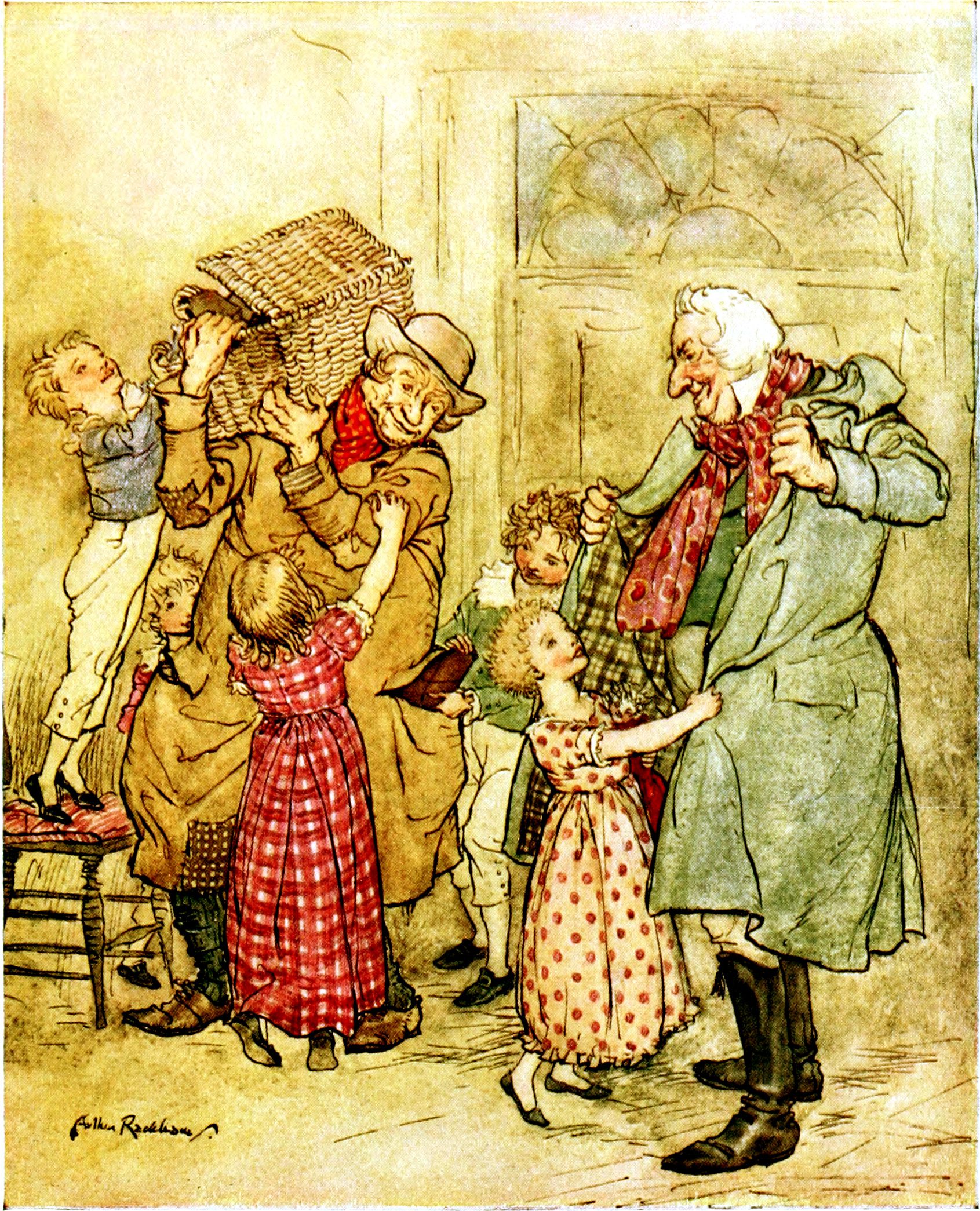
We’ll conclude, especially in the light of the Christmas season which approaches, with some of the saints who appear in Dickens’ Christmas Carol. We think of Scrooge’s nephew and of Fezziwig’s irrepressible and joyful charity. We think also of Bob Cratchit, the long-suffering and self-sacrificial pater familias par excellence, and also of his long-suffering and never-complaining youngest son, Tiny Tim, but we miss the point of the story if we do not think of Ebenezer Scrooge as a saint also. There is no doubt that he is a miserable sinner at the beginning of the story who would appear to be destined to hell if he refuses to heed the warnings of the ghosts who visit him. The point of the story is that he does heed their warnings. His conversion is one of the most powerful eucatastrophic moments in all of literature, the sudden joyous turn in Scrooge causing a sudden joyous turn in the story and a sudden joyous turn in the reader. As the prodigal son, returning to the Father through the worship of the Son, Scrooge becomes a “second father” to Tiny Tim, saving the boy from an early grave.
It is appropriate that we should end with the Prodigal Son, the most famous fictional saint of all. Christ shows us, in his fictional story of a converted sinner who returns to the Father, an image of whom we are all called to be. The Prodigal Son is not so much an Everyman figure because not all prodigals return to their Father; he is an “Everysaint” figure who shows us that we are all called to confess our sins and confess our faith in the One who has conquered the sins that He forgives. In this way, to echo the words of Tiny Tim, God blesses us every one.
The Imaginative Conservative applies the principle of appreciation to the discussion of culture and politics—we approach dialogue with magnanimity rather than with mere civility. Will you help us remain a refreshing oasis in the increasingly contentious arena of modern discourse? Please consider donating now.
The featured image is an image by Arthur Rackham from Charles Dickens’ A Christmas Carol (1915), and is in the public domain, courtesy of Wikimedia Commons.


Leave A Comment