
The gifts that the Wise Men gave to Christ are also gifts that Christ gives to us through the wisdom that the Wise Men bring with them to Bethlehem. All of us should give glory to God in the highest for this epiphanous blessing of faith and reason that he bestows on us.
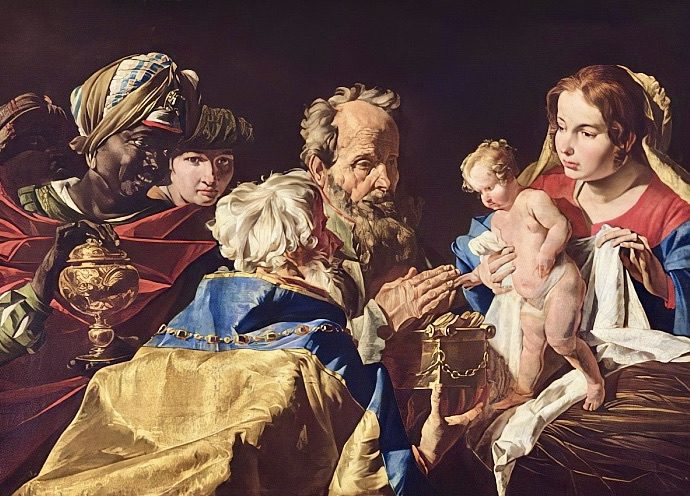 Who were the Wise Men and what was the meaning of the gifts that they brought to the infant Jesus? Those seeking an answer to the first question might want to read Mystery of the Magi: The Quest to Identify the Three Wise Men by Father Dwight Longenecker. Those seeking an answer to the latter question will find it in the theological tradition of the Church in which the gold, frankincense and myrrh are shown to represent, respectively, the kingship, divinity and humanity of Christ. There is, however, another way to contemplate the significance of the gifts that the Wise Men brought to Christ and this is to see them as gifts of wisdom given to each of us.
Laying our gold at the feet of Christ is the wisdom of detachment from the wealth that the world has to offer. If we will not be detached from such wealth, we will become too attached to it. We will become so attached to it, in fact, that we won’t be able to separate ourselves from it. We will no longer possess our possessions but will be possessed by them. We’ll be trapped. Like King Midas, we’ll be caught in the death-grasp of avarice, destroying the life of everything we touch. The wisdom that the Wise Men show in their gift of gold is the wisdom of Christ. Where your treasure is, Christ tells us, there your heart will be also. Those who invest in the world become worldly, having the world as their reward. Those who invest in heaven will be storing up treasure in heaven.
The gift of frankincense is the gift of ourselves in worship. If we are unable to make a gift of ourselves to others, we are condemning ourselves to the psychic imprisonment of egocentrism. If we will not escape from ourselves into the arms and heart of another, we will be imprisoned within ourselves, slaves of our own selfishness. It’s a simple and doom-laden choice which all of us must make. We either grow into the fullness of that which is beyond ourselves or else we are doomed to shrivel and shrink into our own gollumized selves with nothing but our own hardened hearts for company. The latter choice is a fate worse than death because it is hell itself! Such self-idolatry is the worst idolatry of all because it is the idolatry of pride. It is making ourselves pathetic and pitiful gods of our own pathetically pitiful cosmos, a cosmos which gets smaller in direct proportion to the extent that we are puffed up with the pomposity of pride.
In truth, the narcissistic prideful self is the most pitiful of all gods. Better to worship false gods than to worship the self, which is the falsest god of all.
The final gift is the most human of the three gifts because it stinks of death. Its presentation as a gift to the infant Christ Child was a prophecy of its being used by Nicodemus and Joseph of Arimathea to prepare the body of the crucified Christ for burial. The gift of myrrh can be seen therefore as a sign or symbol of our mortality. It is the gift of death. More specifically and more profoundly it is the giving of ourselves in death in the dying to ourselves which is necessary if we are to receive the gift of love. The essence of love is the emptying of the self for others. This was shown perfectly in the Birth of Christ, in the divine embrace and acceptance of mortal flesh, and was brought to fulfillment in the Death of Christ, in which the love of God is poured forth from Our Lord’s Sacred Heart.
We are told by Christ that we are to take up our own cross and follow Him, even to death itself. “For he that will save his life, shall lose it: and he that shall lose his life for my sake, shall find it. For what doth it profit a man, if he gain the whole world and suffer the loss of his own soul?” To love is to die to ourselves so that we might give our lives to another. If we give all that we have, it must mean giving our very lives. If we refuse the gift of our lives, we are refusing the gift of Life Himself. What indeed does it profit a man, if he gain the whole world and suffer the loss of his soul? Such a choice, such a refusal of the gift of death, is not merely a fool’s bargain but the devil’s bargain.
The gifts that the Wise Men gave to Christ are also gifts that Christ gives to us through the wisdom that the Wise Men bring with them to Bethlehem. All of us should give glory to God in the highest for this epiphanous blessing of faith and reason that he bestows on us.
The Imaginative Conservative applies the principle of appreciation to the discussion of culture and politics—we approach dialogue with magnanimity rather than with mere civility. Will you help us remain a refreshing oasis in the increasingly contentious arena of modern discourse? Please consider donating now.
The featured image is “The Adoration of the Magi” (17th century) by Matthias Stom, and is in the public domain, courtesy of Wikimedia Commons.





Leave A Comment