
 Those of us who love literature are puzzled by those who are indifferent to its goodness, truth and beauty. We are perplexed by those who won’t read fiction because they want the facts and nothing but the facts. We are bemused by those who won’t read poetry, preferring prose, because they want to remain grounded and do not want to have their heads in the clouds with the poets.
We are tempted to approach our puzzlement with the art of paradox, which might be defined as the use of an apparent contradiction to point to a deeper truth. The master of such paradox is G. K. Chesterton and we will use one of his most provocative paradoxes to provoke the literal-minded into a literary understanding of reality. “Not facts first,” Chesterton insisted, “truth first.”
At first sight, Chesterton appears to be enunciating nonsense. Surely facts are true. That’s why they are facts. But facts are, in fact, only facts. In the sense in which Chesterton is using the word, a “fact” is something physical. It is something that can be quantified and measured. But some of the truest things can’t be quantified in this way. Qualities such as goodness, truth and beauty cannot be quantified physically. They are metaphysical. They transcend physics. They transcend the mere facts.
If we insist on the facts and nothing but the facts, we are denying ourselves access to the truth. And this is why J. R. R. Tolkien could claim that fairy stories can show us the truth. He claimed in fact, or in truth, that they could hold up a mirror to man, that they could show us ourselves. This is more than a merely factual mirror can do.
Let’s begin with the factual mirror; the non-fictional mirror; the prosaic mirror; the non-metaphorical mirror. This is the ordinary physical mirror that we all have hanging in our ordinary physical homes. This factual mirror can only show us the facts. It can only show us the physical surface of things. It cannot show us anything deeper, anything truer. It cannot show us what we are feeling, or what we are desiring, or what we are dreading, or the people whom we know and love or hate. All these things, which are the very “stuff” of truth, are beyond the reach of the factual mirror.
Now let’s look at the mirror on the wall in fairyland. This is not a factual mirror but a fictional mirror; it is not a prosaic mirror but a poetic mirror; it doesn’t show us the mere physical facts but the deep spiritual truths. It is a magical mirror or a mystical mirror because it does show us what we are feeling and desiring and dreading. More important, it doesn’t show us our factual self, made of nothing but quantifiable molecules of flesh and blood. It shows us what we are in a much deeper sense by showing us who we are.
It shows us the fullness of ourselves in the fullness of our shared humanity and in the uniqueness of our human personhood. It shows us the three faces of humanity. It shows us anthropos, he who looks up in wonder; it shows us homo viator, the wayfarer on the pilgrimage of life and the quest for heaven; and it shows us homo superbus, the man of pride who refuses the pilgrimage of life and forsakes the quest for heaven. It shows us not merely who we are but who we should be and who we shouldn’t be. It shows us the path to heaven and the road to hell.
Perhaps we should end these musings on the truth to be found in fiction by asking the magical and mystical mirror a question that it has been asked before.
“Mirror, mirror on the wall, who is the fairest of them all?”
“The answer,” the mystical mirror of truth replies, “is the one with the heart of a little child. It is this little humble one who has the keys to fairyland. He who refuses the keys to fairyland will also refuse the keys to the kingdom of heaven.”
The Imaginative Conservative applies the principle of appreciation to the discussion of culture and politics—we approach dialogue with magnanimity rather than with mere civility. Will you help us remain a refreshing oasis in the increasingly contentious arena of modern discourse? Please consider donating now.
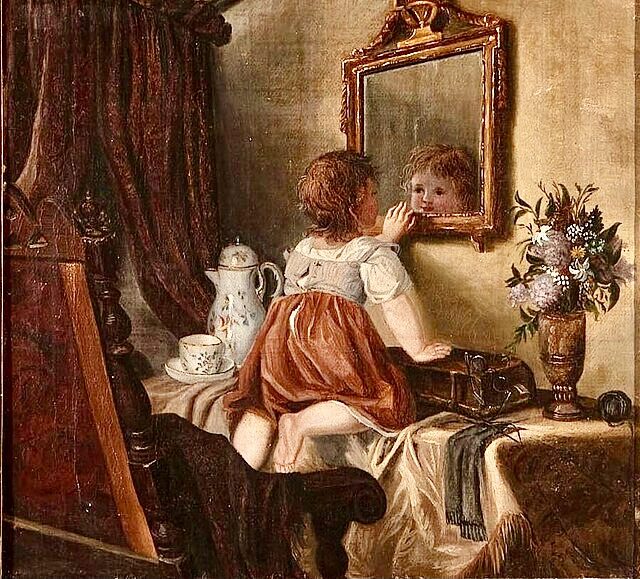
The featured image is “Child With Mirror” by Aleksandra Frosterus-Såltin (1875), and is in the pubic domain, courtesy of Wikimedia Commons.




I’ve known two people who never read fiction because they’re not interested in stories about people who never lived and events that never happened. Yet they’ll watch movies and television shows about people who never lived and events that never happened. Go figure!
“The little child” lives in a kind of heaven because he hasn’t yet risked losing the essence of innocent existence by naming things and thus building a series of interconnected facts in his mind, through which he can control his world. Perhaps Kipling’s lines are apposite here when he wrote, …”If you can think and not make thoughts your aim.” Such a need to control might be inevitable but we should be aware of the pitfalls of blinkered ideology through which we seek to control others.
During the process of reading Maisie Ward’s Chesterton biography, and now about to receive a copy of the Joseph Pearce Chesterton biography via a friend, I was interested to discover how GK’s reputed untidiness might, in his case at least, be psychologically related to his innocent good nature..?
A truly insightful piece. I wish there was a good deal more of it.
An interesting piece. I agree with Anthony: we could use “a good deal more of it”.
Such are good essays: leaving us wanting more, and forcing us to consider their meanings as they pertain to ourselves.
Thank you, Mr. Pearce, for this insightful essay. I had a friend say to me the other day “You don’t believe all that Jesus stuff, do you?” When I answered “Yes, I do”, he said “Well, I think it is all a fairy story!” Your essay has given me thoughts as to how I might have a further discussion about the truth within this “Fairy story” if the opportunity arises.
Thank you so much Mr.Pearce, very inspiring