
Both Pyotr Tchaikovsky (in 1840) and Johannes Brahms (in 1833) were born on May 7. That little coincidence didn’t help endear Brahms or his music to Tchaikovsky, however, as the Russian called the German “a conceited mediocrity” and “a giftless bastard.” But then one New Year’s Day, the two men met at a dinner and had drinks together.
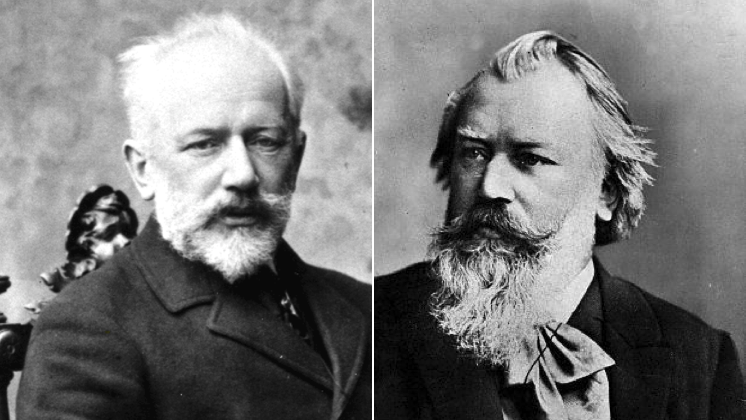
“I have played over the music of that scoundrel Brahms,” wrote Tchaikovsky in his diary in 1886. “What a giftless bastard!”
Russian composer Pyotr Tchaikovsky had a lot to say about Brahms’ music—all bad. Johannes Brahms, for his part, didn’t seem to much enjoy Tchaikovsky’s music, either. He attended a rehearsal for Tchaikovsky’s Fifth Symphony and fell asleep. Although the two composers share a birthday — May 7, with Brahms, born in 1833, being seven years older—they illustrate opposite poles of the composing spectrum. Brahms was the great classicist, building vast symphonies and concertos with intricate musical logic; Tchaikovsky was the heart-on-sleeve emotionalist, as colorful as Brahms was sober.
“It angers me that this conceited mediocrity is regarded as a genius,” Tchaikovsky continued in his diary. The quotes could fill a book. Some of his dislike seems to be envy of Brahms’ success. “Brahms is a celebrity; I’m a nobody. And yet, without false modesty, I tell you that I consider myself superior to Brahms. So what would I say to him: If I’m an honest and truthful person, then I would have to tell him this: ‘Herr Brahms! I consider you to be a very untalented person, full of pretensions but utterly devoid of creative inspiration. I rate you very poorly and indeed I simply look down upon you.’ “
But it was really the Germanic music style he hated. About Wagner, the Russian wrote, “After the last notes of Gotterdammerung I felt as though I had been let out of prison.” Tchaikovsky’s idea of music was simply different: color, melody, grace, direct, simple emotion. Brahms was interested in something else. “Brahms, as a musical personality, is simply antipathetic to me—I can’t stand him. No matter how much he tries, I always remain cold and hostile. This is purely instinctive reaction,” Tchaikovsky wrote in a letter.
Of course, Tchaikovsky wasn’t the only one who failed to appreciate the charms of the German. One writer said, “Art is long and life is short; here is evidently the explanation of a Brahms symphony.” And composer Benjamin Britten complained, “It’s not bad Brahms I mind, it’s good Brahms I can’t stand.” Needless to say, this is no longer the majority opinion, as Brahms and his music are almost universally loved by those who care about classical music. One critic explained: “Tchaikovsky’s music sounds better than it is; Brahms’ music is better than it sounds.”
But Brahms’ violin concerto was a particular target for Tchaikovsky, perhaps because he had written his own concerto, which had been very poorly received (it is also now accepted as a masterpiece). “Brahms’ concerto appealed to me as little as everything else he has written,” Tchaikovsky wrote in 1880 to his patron, Nadezhda von Meck. “Lots of preparations as it were for something, lots of hints that something is going to appear very soon and enchant you, but nothing does come out of it all, except for boredom.” Later in the letter comes the most famous quotation about Brahms: “It is like a splendid pedestal for a column, but the actual column is missing, and instead, what comes immediately after one pedestal is simply another pedestal.”
So, it comes as a surprise that when the two composers actually met each other, they got along very well. They met on New Year’s Day, 1888, when violinist Adolph Brodsky was rehearsing a Brahms trio. Brodsky had premiered Tchaikovsky’s Violin Concerto, and both composers were invited to dinner after the rehearsal. Tchaikovsky entered the room while the music was still playing, and after dinner, they drank together and got along famously. Brahms was doing his best to be friendly, Tchaikovsky noted, and the Russian composer found he actually liked the German, who was so different in character. Tchaikovsky was elegant and smoked fine cigarettes; Brahms was a German berger, smelled of old man and tweed, and smoked cigars, with the ash falling in his beard.
Brahms was known for his tart tongue. Once when he attended a rehearsal of one of his string quartets, he afterwards told the violist, “I liked the tempos, especially yours.” But Brahms was genial that night at Brodsky’s home, and they drank rather a lot. They met at least one more time and spent that night drinking as well. “Brahms is quite a tippler,” Tchaikovsky wrote back to Russia. Yet, the fact they could get on well together never changed his opinion of Brahms’ music. As he left the house that night after the dinner with the Brodskys, Anna Brodsky asked him if he liked what he had heard during the rehearsal.
“Don’t be angry with me, my dear friend,” he answered, “but I did not like it.”
Republished with gracious permission from Mr. Nilsen’s personal website.
This essay first appeared here in May 2017.
The Imaginative Conservative applies the principle of appreciation to the discussion of culture and politics—we approach dialogue with magnanimity rather than with mere civility. Will you help us remain a refreshing oasis in the increasingly contentious arena of modern discourse? Please consider donating now.
The featured image combines an image of Tchaikovsky and an image of Brahms, both of which are in the public domain, courtesy of Wikimedia Commons.





Hard to pick a favorite here, different styles, one more classical, the other more romantic. But then all I have to do is listen and enjoy both. Good to see they both eventually got along.
As Brahms was leaving a party at which he given many people a hard time, he remarked, “If there is anyone here I haven’t insulted, I apologize.,”
It would be absurd, of course, to say that the music of one is better than the other. They are both in the first rank. Nevertheless, their styles can be distinguished. It seems to me that, although Brahms welcomed wide variations in how his own works were interpreted, his style of composition did not lend itself to difference in interpretation as well as did Tchaikovsky’s. Could it be that Tchaikovsky’s negative opinion of Brahms’ music was rooted in this, that in his view Brahms — as well as Wagner — afforded less room for interpretation in performance?
I came here to read Tchaikovsky’s famous putdowns of Brahms’ music, and left heartwarmed to learn that the two of them spent more than one night drinking together! What fascinating evenings they must have been, even if the conversation carefully avoided music.
Two fabulous but very different composers. It just highlights the fact that great music can come in very different styles and forms of expression.
Despite the difference of personalities and Romantic Era composition styles, I can feel the passion in both’s music and am happy to listen to them all day long.
You know I totally agree with Pyotr, yes! and I agreed with him before I got to know his opinion, so he expressed myself
Petya was right. Brahms is just a hard-working German who desperately tries to imitate Beethoven with merely the talent of a music school teacher.
Have you ever listened to the First Movement of Brahms’ Fourth Symphony? It’s the most gorgeous symphonic music ever written. I could go on with this.
I have liked only two things of Tchaikovsky’s, “The Dance of the Sugar Plum Symphony,” which amounts to a fabulous song, and his last symphony, The Pathetique. I am amused by his foray into the life of a ballerina, though that could be myth.
I think the article makes Brahms look rather grand. He’s a fantastic figure. His insultingness seems to have been something the poor man was appalled by. I’m fascinated that neurologists believe this kink in Brahms’ brain was somehow intrinsic to his musical genius.
I think the Monty Python evaluation of Tchaikovsky holds up: an old poof who wrote some great tunes.
Just like Schubert!
Music will always be subjective to the listener’s ear ultimately, great compoers are not immune to that. Personally, I could easily replace Brahms with Beethoven and say the exact same thing that Tchaikovsky said about Brahms. I can count with one hand the pieces Beethoven wrote that move me or that I consider beautiful but yet here he is ever lauded as one of the greatest composers of all time. It is what it is…
I cannot be the first to notice the similarity of the third and fourth movements of Brahms 4th and Tchaikovsky 6th symphonies. That is, in each case the third movement appears to be an end to the symphony and the final movement is almost an epilogue to the composers’ symphonic output. The dates of these symphonies is interesting: the Brahms premiered in 1885 and the Tchaikovsky composed in 1893. Did Tchaikovsky hear the Brahms? Both are great composers and I’m sure that Tchaikovsky admired Brahms’s skill if not the resulting music. I wonder whether he was inspired to think ‘I understand what he is doing but I can do it better’?
I was laughing at Pyotr comments! Strong words of disdain and dislike from someone painfully shy and self effacing. Yes i love PIT works for their explosive, soaring melodies totally radical from the standards of his time and stuck to his guns, as in his Year 1812 Overture, even again, ironically, he hated that work
In the story that Anna Brodsky tells of the night the two met, the tension in the room was also relieved greatly when Edvard Grieg and his wife came in as the supper was winding down. Grieg and his wife had very sunny dispositions apparently. I have a copy of Anna Brodsky’s memoir. It is charming.
Generally, the person who sees both sides of an argument is a lot less interesting than the one who believes passionately in one side or the other, and far less likely to leave a mark on the world. That’s why we love both Tchaikovsky and Brahms, and why so few can match them.
A ‘phillip” in E minor on a dull winter’s day.
Such writings give hope when needed.
LOL to paraphrase Three Dog Night, I never understood a note he wrote, but I helped him drink his wine.
I have been collecting classical music recordings since the late 1950s, and I played second trombone in an undergrad and community symphony orchestra. For over forty years, I have lived in LA and attend frequent concerts by the LA Phil and other fine orchestras. The LA Phil, especially as seen in the Walt Disney Concert Hall, is the finest symphony orchestra in the galaxy.
This is so you’ll know where I am with music.
I have most of both Tchaikovsky and Brahms in my LP and CD collection. I find Brahms powerful and satisfying, but sometimes flat footed and clumsy.
Tchaikovsky can reach places inside me Brahms never knew existed. A pet device Tchaikovsky uses which still gives me chills is what my music mentor, a successful LA composer, conductor, and lecturer at LA Phil pre concert talks, refers to as his wedges. These are diverging runs, upward and downward in different choirs of the orchestra, which generate unbelievable energy and tension!
Brahms has no such stuff in his toolbox, and Brahms apparently never herd of cymbals or a bass drum. Tchaikovsky can use these to blow your branes out!
Here’s a possible parallel. I love the symphonies of Mahler, but Bruckner bores my nards off and I recall noting when I first experience one of his symphonies that he should get an award for making five minutes of music last for over and hour.
Parallel? Similarity? Discuss!
I listen to Brahms far more than Tchaikovsky…also an amateur musician, playing oboe and Sax. While I am fond of Brahms’ Symphonies, his chamber music is really what I find extraordinary and compelling, especially the string quintets